


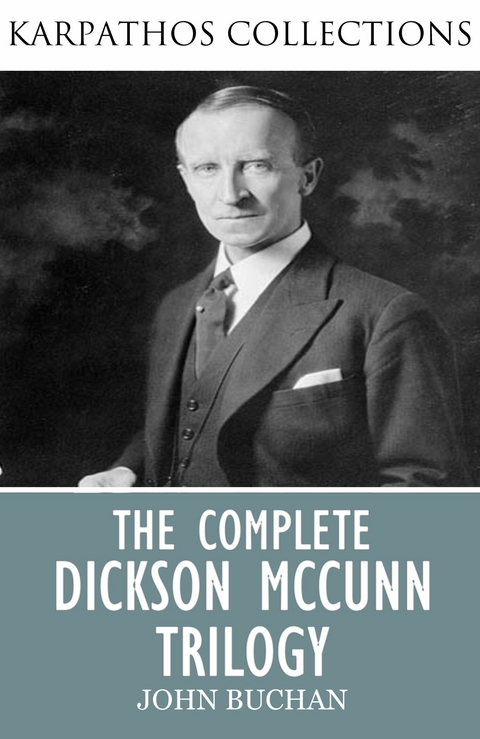
Complete Dickson McCunn Trilogy (eBook)
Charles River Editors (Verlag)
978-1-5080-2690-7 (ISBN)
Karpathos publishes the greatest works of history's greatest authors and collects them to make it easy and affordable for readers to have them all at the push of a button. All of our collections include a linked table of contents.John Buchan was a Scottish writer who also served as the Governor General of Canada. Some of Buchan's most famous works were the Dickson McCunn novels. This collection includes the following:HuntingtowerCastle GayThe House of the Four Winds
CHAPTER II: OF MR. JOHN HERITAGE AND THE DIFFERENCE IN POINTS OF VIEW
DICKSON MCCUNN WAS NEVER TO forget the first stage in that pilgrimage. A little after midday he descended from a grimy third-class carriage at a little station whose name I have forgotten. In the village near-by he purchased some new-baked buns and ginger biscuits, to which he was partial, and followed by the shouts of urchins, who admired his pack—"Look at the auld man gaun to the schule"—he emerged into open country. The late April noon gleamed like a frosty morning, but the air, though tonic, was kind. The road ran over sweeps of moorland where curlews wailed, and into lowland pastures dotted with very white, very vocal lambs. The young grass had the warm fragrance of new milk. As he went he munched his buns, for he had resolved to have no plethoric midday meal, and presently he found the burnside nook of his fancy, and halted to smoke. On a patch of turf close to a grey stone bridge he had out his Walton and read the chapter on “The Chavender or Chub.” The collocation of words delighted him and inspired him to verse. “Lavender or Lub"—"Pavender or Pub"—"Gravender or Grub"—but the monosyllables proved too vulgar for poetry. Regretfully he desisted.
The rest of the road was as idyllic as the start. He would tramp steadily for a mile or so and then saunter, leaning over bridges to watch the trout in the pools, admiring from a dry-stone dyke the unsteady gambols of new-born lambs, kicking up dust from strips of moor-burn on the heather. Once by a fir-wood he was privileged to surprise three lunatic hares waltzing. His cheeks glowed with the sun; he moved in an atmosphere of pastoral, serene and contented. When the shadows began to lengthen he arrived at the village of Cloncae, where he proposed to lie. The inn looked dirty, but he found a decent widow, above whose door ran the legend in home-made lettering, “Mrs. brockie tea and Coffee,” and who was willing to give him quarters. There he supped handsomely off ham and eggs, and dipped into a work called Covenanting Worthies, which garnished a table decorated with sea-shells. At half-past nine precisely he retired to bed and unhesitating sleep.
Next morning he awoke to a changed world. The sky was grey and so low that his outlook was bounded by a cabbage garden, while a surly wind prophesied rain. It was chilly, too, and he had his breakfast beside the kitchen fire. Mrs. Brockie could not spare a capital letter for her surname on the signboard, but she exalted it in her talk. He heard of a multitude of Brockies, ascendant, descendant and collateral, who seemed to be in a fair way to inherit the earth. Dickson listened sympathetically, and lingered by the fire. He felt stiff from yesterday’s exercise, and the edge was off his spirit.
The start was not quite what he had pictured. His pack seemed heavier, his boots tighter, and his pipe drew badly. The first miles were all uphill, with a wind tingling his ears, and no colours in the landscape but brown and grey. Suddenly he awoke to the fact that he was dismal, and thrust the notion behind him. He expanded his chest and drew in long draughts of air. He told himself that this sharp weather was better than sunshine. He remembered that all travellers in romances battled with mist and rain. Presently his body recovered comfort and vigour, and his mind worked itself into cheerfulness.
He overtook a party of tramps and fell into talk with them. He had always had a fancy for the class, though he had never known anything nearer it than city beggars. He pictured them as philosophic vagabonds, full of quaint turns of speech, unconscious Borrovians. With these samples his disillusionment was speedy. The party was made up of a ferret-faced man with a red nose, a draggle-tailed woman, and a child in a crazy perambulator. Their conversation was one-sided, for it immediately resolved itself into a whining chronicle of misfortunes and petitions for relief. It cost him half a crown to be rid of them.
The road was alive with tramps that day. The next one did the accosting. Hailing Mr. McCunn as “Guv’nor,” he asked to be told the way to Manchester. The objective seemed so enterprising that Dickson was impelled to ask questions, and heard, in what appeared to be in the accents of the Colonies, the tale of a career of unvarying calamity. There was nothing merry or philosophic about this adventurer. Nay, there was something menacing. He eyed his companion’s waterproof covetously, and declared that he had had one like it which had been stolen from him the day before. Had the place been lonely he might have contemplated highway robbery, but they were at the entrance to a village, and the sight of a public-house awoke his thirst. Dickson parted with him at the cost of sixpence for a drink.
He had no more company that morning except an aged stone-breaker whom he convoyed for half a mile. The stone-breaker also was soured with the world. He walked with a limp, which, he said, was due to an accident years before, when he had been run into by “ane o’ thae damned velocipeeds.” The word revived in Dickson memories of his youth, and he was prepared to be friendly. But the ancient would have none of it. He inquired morosely what he was after, and, on being told, remarked that he might have learned more sense. “It’s a daft-like thing for an auld man like you to be traivellin’ the roads. Ye maun be ill-off for a job.” Questioned as to himself he became, as the newspapers say, “reticent,” and having reached his bing of stones, turned rudely to his duties. “Awa’ hame wi’ ye,” were his parting words. “It’s idle scoondrels like you that maks wark for honest folk like me.”
The morning was not a success, but the strong air had given Dickson such an appetite that he resolved to break his rule, and, on reaching the little town of Kilchrist, he sought luncheon at the chief hotel. There he found that which revived his spirits. A solitary bagman shared the meal, who revealed the fact that he was in the grocery line. There followed a well-informed and most technical conversation. He was drawn to speak of the United Supply Stores, Limited, of their prospects and of their predecessor, Mr. McCunn, whom he knew well by repute but had never met. “Yon’s the clever one,” he observed. “I’ve always said there’s no longer head in the city of Glasgow than McCunn. An old-fashioned firm, but it has aye managed to keep up with the times. He’s just retired, they tell me, and in my opinion it’s a big loss to the provision trade....” Dickson’s heart glowed within him. Here was Romance; to be praised incognito; to enter a casual inn and find that fame had preceded him. He warmed to the bagman, insisted on giving him a liqueur and a cigar, and finally revealed himself. “I’m Dickson McCunn,” he said, “taking a bit holiday. If there’s anything I can do for you when I get back, just let me know.” With mutual esteem they parted.
He had need of all his good spirits, for he emerged into an unrelenting drizzle. The environs of Kilchrist are at the best unlovely, and in the wet they were as melancholy as a graveyard. But the encounter with the bagman had worked wonders with Dickson, and he strode lustily into the weather, his waterproof collar buttoned round his chin. The road climbed to a bare moor, where lagoons had formed in the ruts, and the mist showed on each side only a yard or two of soaking heather. Soon he was wet; presently every part of him, boots, body and pack, was one vast sponge. The waterproof was not water-proof, and the rain penetrated to his most intimate garments. Little he cared. He felt lighter, younger, than on the idyllic previous day. He enjoyed the buffets of the storm, and one wet mile succeeded another to the accompaniment of Dickson’s shouts and laughter. There was no one abroad that afternoon, so he could talk aloud to himself and repeat his favourite poems. About five in the evening there presented himself at the Black Bull Inn at Kirkmichael a soaked, disreputable, but most cheerful traveller.
Now the Black Bull at Kirkmichael is one of the few very good inns left in the world. It is an old place and an hospitable, for it has been for generations a haunt of anglers, who above all other men understand comfort. There are always bright fires there, and hot water, and old soft leather armchairs, and an aroma of good food and good tobacco, and giant trout in glass cases, and pictures of Captain Barclay of Urie walking to London, and Mr. Ramsay of Barnton winning a horse-race, and the three-volume edition of the Waverley Novels with many volumes missing, and indeed all those things which an inn should have. Also there used to be—there may still be—sound vintage claret in the cellars. The Black Bull expects its guests to arrive in every stage of dishevelment, and Dickson was received by a cordial landlord, who offered dry garments as a matter of course. The pack proved to have resisted the elements, and a suit of clothes and slippers were provided by the house. Dickson, after a glass of toddy, wallowed in a hot bath, which washed all the stiffness out of him. He had a fire in his bedroom, beside which he wrote the opening passages of that diary he had vowed to keep, descanting lyrically upon the joys of ill weather. At seven o’clock, warm and satisfied in soul, and with his body clad in raiment...
| Erscheint lt. Verlag | 22.3.2018 |
|---|---|
| Sprache | englisch |
| Themenwelt | Literatur ► Historische Romane |
| Literatur ► Klassiker / Moderne Klassiker | |
| Schlagworte | castle gay • Classic • Historical • Huntingtower • Literary • richard hannay • Scottish • the house of the four winds • thirty nine steps |
| ISBN-10 | 1-5080-2690-4 / 1508026904 |
| ISBN-13 | 978-1-5080-2690-7 / 9781508026907 |
| Informationen gemäß Produktsicherheitsverordnung (GPSR) | |
| Haben Sie eine Frage zum Produkt? |
 EPUB (Ohne DRM)
Digital Rights Management: ohne DRM
Dieses eBook enthält kein DRM oder Kopierschutz. Eine Weitergabe an Dritte ist jedoch rechtlich nicht zulässig, weil Sie beim Kauf nur die Rechte an der persönlichen Nutzung erwerben.
Dateiformat: EPUB (Electronic Publication)
EPUB ist ein offener Standard für eBooks und eignet sich besonders zur Darstellung von Belletristik und Sachbüchern. Der Fließtext wird dynamisch an die Display- und Schriftgröße angepasst. Auch für mobile Lesegeräte ist EPUB daher gut geeignet.
Systemvoraussetzungen:
PC/Mac: Mit einem PC oder Mac können Sie dieses eBook lesen. Sie benötigen dafür die kostenlose Software Adobe Digital Editions.
eReader: Dieses eBook kann mit (fast) allen eBook-Readern gelesen werden. Mit dem amazon-Kindle ist es aber nicht kompatibel.
Smartphone/Tablet: Egal ob Apple oder Android, dieses eBook können Sie lesen. Sie benötigen dafür eine kostenlose App.
Geräteliste und zusätzliche Hinweise
Buying eBooks from abroad
For tax law reasons we can sell eBooks just within Germany and Switzerland. Regrettably we cannot fulfill eBook-orders from other countries.
aus dem Bereich


