


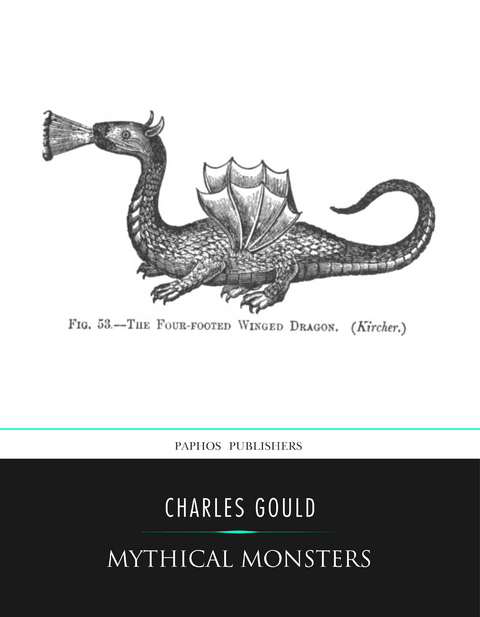
Mythical Monsters (eBook)
491 Seiten
Charles River Editors (Verlag)
978-1-5080-2642-6 (ISBN)
Paphos Publishers offers a wide catalog of rare classic titles, published for a new generation. Mythical Monsters is an overview of mythology across many cultures.
INTRODUCTION.
IT WOULD HAVE BEEN A bold step indeed for anyone, some thirty years ago, to have thought of treating the public to a collection of stories ordinarily reputed fabulous, and of claiming for them the consideration due to genuine realities, or to have advocated tales, time-honoured as fictions, as actual facts; and those of the nursery as being, in many instances, legends, more or less distorted, descriptive of real beings or events.
Now-a-days it is a less hazardous proceeding. The great era of advanced opinion, initiated by Darwin, which has seen, in the course of a few years, a larger progress in knowledge in all departments of science than decades of centuries preceding it, has, among other changes, worked a complete revolution in the estimation of the value of folk-lore; and speculations on it, which in the days of our boyhood would have been considered as puerile, are now admitted to be not merely interesting but necessary to those who endeavour to gather up the skeins of unwritten history, and to trace the antecedents and early migrations from parent sources of nations long since alienated from each other by customs, speech, and space.
I have, therefore, but little hesitation in gravely proposing to submit that many of the so-called mythical animals, which throughout long ages and in all nations have been the fertile subjects of fiction and fable, come legitimately within the scope of plain matter-of-fact Natural History, and that they may be considered, not as the outcome of exuberant fancy, but as creatures which really once existed, and of which, unfortunately, only imperfect and inaccurate descriptions have filtered down to us, probably very much refracted, through the mists of time.
I propose to follow, for a certain distance only, the path which has been pursued in the treatment of myths by mythologists, so far only, in fact, as may be necessary to trace out the homes and origin of those stories which in their later dress are incredible; deviating from it to dwell upon the possibility of their having preserved to us, through the medium of unwritten Natural History, traditions of creatures once co-existing with man, some of which are so weird and terrible as to appear at first sight to be impossible. I propose stripping them of those supernatural characters with which a mysteriously implanted love of the wonderful has invested them, and to examine them, as at the present day we are fortunately able to do, by the lights of the modern sciences of Geology, Evolution, and Philology.
For me the major part of these creatures are not chimeras but objects of rational study. The dragon, in place of being a creature evolved out of the imagination of Aryan man by the contemplation of lightning flashing through the caverns which he tenanted, as is held by some mythologists, is an animal which once lived and dragged its ponderous coils, and perhaps flew; which devastated herds, and on occasions swallowed their shepherd; which, establishing its lair in some cavern overlooking the fertile plain, spread terror and destruction around, and, protected from assault by dread or superstitious feeling, may even have been subsidised by the terror-stricken peasantry, who, failing the power to destroy it, may have preferred tethering offerings of cattle adjacent to its cavern to having it come down to seek supplies from amongst their midst. *
To me the specific existence of the unicorn seems not incredible, and, in fact, more probable than that theory which assigns its origin to a lunar myth. †
Again, believing as I do in the existence of some great undescribed inhabitant of the ocean depths, the much-derided sea-serpent, whose home seems especially to be adjacent to Norway, I recognise this monster as originating the myths of the midgard serpent which the Norse Elder Eddas have collected, this being the contrary view to that taken by mythologists, who invert the derivation, and suppose the stories current among the Norwegian fishermen to be modified versions of this important element of Norse mythology. ‡
I must admit that, for my part, I doubt the general derivation of myths from the contemplation of the visible workings of external nature.” * It seems to me easier to suppose that the palsy of time has enfeebled the utterance of these oft-told tales until their original appearance is almost unrecognisable, than that uncultured savages should possess powers of imagination and poetical invention far beyond those enjoyed by the most instructed nations of the present day; less hard to believe that these wonderful stories of gods and demigods, of giants and dwarfs, of dragons and monsters of all descriptions, are transformations than to believe them to be inventions. †
The author of Atlantis, ‡ indeed, claims that the gods and goddesses of the ancient Greeks, the Phœnicians, the Hindoos, and the Scandinavians were simply the kings, queens, and heroes of Atlantis, and the acts attributed to them in mythology a confused recollection of real historical events. Without conceding the locus of the originals, which requires much greater examination than I am able to make at the present time, I quite agree with him as to the principle. I believe that the mythological deities represent a confused chronology of far-distant times, and that the destruction of the Nemean lion, the Lernean hydra, and the Minotaur are simply the records of acts of unusual bravery in combating ferocious animals.
On the first landing of Pizarro the Mexicans entertained the opinion that man and horse were parts of one strange animal, * and we have thus a clue to the explanation of the origin of the belief in centaurs from a distant view of horsemen, a view possibly followed by the immediate flight of the observer, which rendered a solution of the extraordinary phenomenon impossible.
ON THE CREDIBILITY OF REMARKABLE STORIES.
Ferdinand Mendez Pinto quaintly observes, in one of his earlier chapters, “I will not speak of the Palace Royal, because I saw it but on the outside, howbeit the Chinese tell such wonders of it as would amaze a man; for it is my intent to relate nothing save what we beheld here with our own eyes, and that was so much as that I am afraid to write it; not that it would seem strange to those who have seen and read the marvels of the kingdom of China, but because I doubt that they which would compare those wondrous things that are in the countries they have not seen, with that little they have seen in their own, will make some question of it, or, it may be, give no credit at all to these truths, because they are not conformable to their understanding and small experience.” *
Now as some of the creatures whose existence I shall have to contend for in these volumes are objects of derision to a large proportion of mankind, and of reasonable doubt to another, I cannot help fortifying myself with some such outwork of reasoning as the pith of Pinto’s remarks affords, and supplementing it by adding that, while the balance between scepticism and credulity is undoubtedly always difficult to hold, yet, as Lord Bacon well remarks, “There is nothing makes a man suspect much more than to know little; and therefore men should remedy suspicion by procuring to know more.”
Whately extends Bacon’s proposition by adding, “This is equally true of the suspicions that have reference to things as persons”; in other words, ignorance and suspicion go hand-in-hand, and so travellers’ tales, even when supported by good evidence, are mostly denied credence or accepted with repugnance, when they offend the experience of those who, remaining at home, are thus only partially educated. Hence it is, not to go too far back for examples, that we have seen Bruce, Mungo Park, Du Chaillu, Gordon Cumming, Schliemann, * and Stanley treated with the most ungenerous criticism and contemptuous disbelief by persons who, however well informed in many subjects, lacked the extended and appreciative views which can only be acquired by travel.
Nor is this incredulity limited to travellers’ tales about savage life. It is just as often displayed in reference to the surroundings of uneventful life, provided they are different from those with which we are familiar.
Saladin rebuked the Knight of the Leopard for falsehood when the latter assured him that the waters of lakes in his own country became at times solidified, so that armed and mounted knights could cross them as if on dry land. And the wise Indian who was taken down to see the large American cities, with the expectation that, being convinced of the resources and irresistible power of civilization he would influence his tribe to submission on his return, to the surprise of the commissioners who had conveyed him, spoke in directly contrary terms to those expected of him, privately explaining in reply to their remonstrances, that had he told the truth to his tribe he would have been indelibly branded for the remainder of his life as an outrageous and contemptible liar. Chinese students, despatched for education in American or European capitals, are compelled on their return to make similar reservations, under pain of incurring a like penalty; and officials who, from contact with Europeans at the open ports, get their ideas expanded too...
| Erscheint lt. Verlag | 22.3.2018 |
|---|---|
| Sprache | englisch |
| Themenwelt | Literatur ► Historische Romane |
| Literatur ► Märchen / Sagen | |
| Literatur ► Romane / Erzählungen | |
| Schlagworte | Dragon • fairy • Free • Mythology |
| ISBN-10 | 1-5080-2642-4 / 1508026424 |
| ISBN-13 | 978-1-5080-2642-6 / 9781508026426 |
| Informationen gemäß Produktsicherheitsverordnung (GPSR) | |
| Haben Sie eine Frage zum Produkt? |
 EPUB (Adobe DRM)
Größe: 6,5 MB
Kopierschutz: Adobe-DRM
Adobe-DRM ist ein Kopierschutz, der das eBook vor Mißbrauch schützen soll. Dabei wird das eBook bereits beim Download auf Ihre persönliche Adobe-ID autorisiert. Lesen können Sie das eBook dann nur auf den Geräten, welche ebenfalls auf Ihre Adobe-ID registriert sind.
Details zum Adobe-DRM
Dateiformat: EPUB (Electronic Publication)
EPUB ist ein offener Standard für eBooks und eignet sich besonders zur Darstellung von Belletristik und Sachbüchern. Der Fließtext wird dynamisch an die Display- und Schriftgröße angepasst. Auch für mobile Lesegeräte ist EPUB daher gut geeignet.
Systemvoraussetzungen:
PC/Mac: Mit einem PC oder Mac können Sie dieses eBook lesen. Sie benötigen eine
eReader: Dieses eBook kann mit (fast) allen eBook-Readern gelesen werden. Mit dem amazon-Kindle ist es aber nicht kompatibel.
Smartphone/Tablet: Egal ob Apple oder Android, dieses eBook können Sie lesen. Sie benötigen eine
Geräteliste und zusätzliche Hinweise
Buying eBooks from abroad
For tax law reasons we can sell eBooks just within Germany and Switzerland. Regrettably we cannot fulfill eBook-orders from other countries.
EPUB (Ohne DRM)Digital Rights Management: ohne DRM
Dieses eBook enthält kein DRM oder Kopierschutz. Eine Weitergabe an Dritte ist jedoch rechtlich nicht zulässig, weil Sie beim Kauf nur die Rechte an der persönlichen Nutzung erwerben.
Dateiformat: EPUB (Electronic Publication)
EPUB ist ein offener Standard für eBooks und eignet sich besonders zur Darstellung von Belletristik und Sachbüchern. Der Fließtext wird dynamisch an die Display- und Schriftgröße angepasst. Auch für mobile Lesegeräte ist EPUB daher gut geeignet.
Systemvoraussetzungen:
PC/Mac: Mit einem PC oder Mac können Sie dieses eBook lesen. Sie benötigen dafür die kostenlose Software Adobe Digital Editions.
eReader: Dieses eBook kann mit (fast) allen eBook-Readern gelesen werden. Mit dem amazon-Kindle ist es aber nicht kompatibel.
Smartphone/Tablet: Egal ob Apple oder Android, dieses eBook können Sie lesen. Sie benötigen dafür eine kostenlose App.
Geräteliste und zusätzliche Hinweise
Buying eBooks from abroad
For tax law reasons we can sell eBooks just within Germany and Switzerland. Regrettably we cannot fulfill eBook-orders from other countries.
aus dem Bereich


