


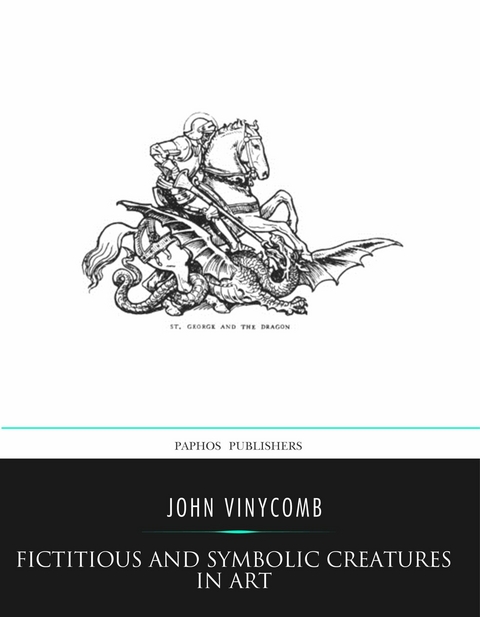
Fictitious and Symbolic Creatures in Art (eBook)
221 Seiten
Charles River Editors (Verlag)
978-1-5080-2640-2 (ISBN)
Paphos Publishers offers a wide catalog of rare classic titles, published for a new generation.Fictitious and Symbolic Creatures in Art is an overview of the mythology of creatures like angels, unicorns, dragons, and more.
INTRODUCTION
“ANGELS AND MINISTERS OF GRACE defend us."—"Hamlet.”
THE human mind has a passionate longing for knowledge even of things past comprehension. Where it cannot know, it will imagine; what the mind conceives it will attempt to define. Are facts wanting, poetry steps in, and myth and song supply the void; cave and forest, mountain and valley, lake and river, are theatres peopled by fancy, and
“as imagination bodies forth
The forms of things unknown, the poet’s pen
Turns them to shapes, and gives to airy nothing
A local habitation and a name.”
Traditions of unreal beings inhabit the air, and will not vanish be they ever so sternly commanded; from the misty records of antiquity and the relics of past greatness as seen sculptured in stupendous ruins on the banks of the Nile and the plains of Assyria, strange shapes look with their mute stony eyes upon a world that knows them but imperfectly, and vainly attempts to unriddle the unfathomable mystery of their being. Western nations, with their growing civilisations, conjured up monsters of benign or baneful influence, or engrafted and expanded the older ideas in a manner suited to their genius and national characteristics.
The creatures of the imagination, “Gorgons and Hydras and Chimeras dire,” shapes lovely and shapes terrible begot of unreason in the credulous minds of the imaginative, the timid and the superstitious,—or dreamy poetic fancies of fairies and elves of whom poets sing so sweetly:
“Shapes from the invisible world unearthly singing
From out the middle air, from flowery nests
And from the pillowy silkiness that rests
Full in the speculation of the stars,—”
Keats.
“or fairy elves,
Whose midnight revels, by the forest side
Or fountain, some belated peasant sees,
Or dreams he sees,—”
Milton, Paradise Lost, Book i.
the nameless dreads and horrors of the unknown powers of darkness, the pestiferous inhabitants of wastes and desert places where loneliness reigns supreme, and imaginary terrors assault the traveller on every hand, assuming forms more various and more to be dreaded than aught of mortal birth,—such vague and indefinable ideas, “legends fed by time and chance,” like rumours in the air, in the course of time assume tangible shape, receiving definite expression by the poet and artist until they become fixed in the popular mind as stern realities influencing the thoughts and habits of millions of people through successive generations. We see them in the rude fetish of the South Sea Islander, the myriad gods and monsters of heathen mythology, as well as in the superstitions of mediæval Europe, of which last the devil with horned brow, cloven hoofs and forked tail is the most “unreal mockery” of them all. The days of Diabolism and the old witch creed are, however, passed away; but under the dominance of these ideas during centuries, in Protestant and Catholic lands alike, hundreds of thousands of innocent victims of all ages and both sexes were accused of the most absurd and impossible crimes, and subjected to almost inconceivable torture and death.
The dying Christian about to pass through the valley of the shadow of death, in the words of the poet, expresses his faith in the nearness of the spirit world:
“I see a form ye cannot see
I hear a voice ye cannot hear.”
To the spiritually minded other forms, with more of the beautiful and less of the hideous and frightful, revealed themselves; the solitary recluse, his body and mind reduced to an unnatural condition by fasting and penance, in mental hallucination beheld his celestial visitants with awe and adoration, and saw in visions angels and archangels, cherubim and seraphim towering in a blaze of glory to illimitable height and extremest space. The rapt seraph and the whole angelic host of heaven to his ecstatic gaze was a revelation and a reality as tangible as were the powers of darkness seen and felt by more sordid natures, incapable of the higher conceptions, and whose minds were accessible chiefly through their terrors.
To classic fable we are indebted for very many of the fictitious animals which heralds have introduced into coats armorial. In all ages man has sought to explain by myths certain phenomena of nature which he has been unable to account for in a more rational manner. Earthquakes were the awakening of the earth tortoise which carried the earth on its back; the tides were the pulses of the ocean; lightning was the breath of demons, the thunderbolt of Jupiter, the hammer of Thor; volcanoes were the forges of the infernal deities. In the old Norse legends we read of waterspouts being looked upon as sea serpents, and wonderful stories are related of their power and influence. The Chinese imagine eclipses to be caused by great dragons which seek to devour the sun. Innumerable beliefs cluster round the sun, moon, and stars. We may trace from our own language the extent of power which these peculiar beliefs have had over the human mind. We still speak of mad people as lunatics, gloomy people as saturnine, sprightly people we term mercurial; we say, “Ill-star’d event,” &c. &c. The ships of the early navigators, with masts and sails and other requisites for directing their motion or influencing their speed, would be objects of astonishment to the inhabitants of the countries they visited, causing them to be received with the utmost respect and veneration. The ship was taken for a living animal, and hence originated, some say, the fables of winged dragons, griffons, flying citadels, and men transformed into birds and fishes. The winged Pegasus was nothing but a ship with sails and hence was said to be the offspring of Neptune.
“In reality,” says Southey, in his preface to the “Morte d’Arthur,” vol. ii. 1817, “mythological and romantic tales are current among all savages of whom we have any full account; for man has his intellectual as well as his bodily appetite, and these things are the food of his imagination and faith. They are found wherever there is language and discourse of reason; in other words, wherever there is man. And in similar states of society the fictions of different people will bear a corresponding resemblance, notwithstanding the differences of time and scene.” And Sir Walter Scott, in his “Essay on Romance and Chivalry,” following up the same idea, adds, “that the usual appearances and productions of nature offer to the fancy, in every part of the world, the same means of diversifying fictitious narrative by the introduction of prodigies. If in any romance we encounter the description of an elephant, we may reasonably conclude that a phenomenon unknown in Europe must have been borrowed from the East; but whoever has seen a serpent and a bird may easily aggravate the terrors of the former by conferring on a fictitious monster the wings of the latter; and whoever has seen or heard of a wolf, or lion and an eagle, may, by a similar exercise of invention, imagine a griffon or a hippogriff.”
Beyond the common experiences of every-day life the popular mind everywhere cares very little about simple commonplace practical truths. Human nature seems to crave mystery, to be fond of riddles and the marvellous, and doubtless it was ever so and provided for in all the old faiths of the world.
“The multitude of dragons, diverse as they are, reflecting the fears and fancies of the most different races, it is more than probable is a relic of the early serpent-worship which, according to Mr. Fergusson, is of such remote antiquity that the religion of the Jews was modern in comparison, the curse laid on the serpent being, in fact, levelled at the ancient superstition which it was intended to supersede. Notwithstanding the various forms under which we find the old dragon he ever retains something of the serpent about him, if no more than the scales. In the mediæval devil, too, the tail reveals his descent.” (Louis F. Day.)
The fictitious beings used as symbols in heraldry may be divided into two classes: (1) Celestial beings mentioned in Holy Writ, and those creatures of the imagination which, from the earliest ages, have held possession of men’s minds, profound symbols unlike anything in the heavens or in the earth beneath or in the waters under the earth. They may be abstract ideas embodied in tangible shape, such as the terrible creature, the type of some divine quality, that stands calm, immovable, and imperishable within the walls of our National Museum; such forms as the dragon, of the purely imaginative class, and those creatures compounded of parts of different real animals, yet unlike any one of them, each possessing special symbolic attributes, according to the traditional ideas held concerning them. (2) Animals purely heraldic, such as the heraldic tiger, panther incensed, heraldic antelope, &c., owe their origin and significance to other ideas, and must be accounted for on other grounds, namely, the mistaken ideas resulting from imperfect knowledge of these objects in natural history by early writers and herald painters, to...
| Erscheint lt. Verlag | 22.3.2018 |
|---|---|
| Sprache | englisch |
| Themenwelt | Literatur ► Historische Romane |
| Literatur ► Märchen / Sagen | |
| Literatur ► Romane / Erzählungen | |
| Schlagworte | Angel • Dragon • Free • Mythology • unicorn |
| ISBN-10 | 1-5080-2640-8 / 1508026408 |
| ISBN-13 | 978-1-5080-2640-2 / 9781508026402 |
| Informationen gemäß Produktsicherheitsverordnung (GPSR) | |
| Haben Sie eine Frage zum Produkt? |
 EPUB (Ohne DRM)
Digital Rights Management: ohne DRM
Dieses eBook enthält kein DRM oder Kopierschutz. Eine Weitergabe an Dritte ist jedoch rechtlich nicht zulässig, weil Sie beim Kauf nur die Rechte an der persönlichen Nutzung erwerben.
Dateiformat: EPUB (Electronic Publication)
EPUB ist ein offener Standard für eBooks und eignet sich besonders zur Darstellung von Belletristik und Sachbüchern. Der Fließtext wird dynamisch an die Display- und Schriftgröße angepasst. Auch für mobile Lesegeräte ist EPUB daher gut geeignet.
Systemvoraussetzungen:
PC/Mac: Mit einem PC oder Mac können Sie dieses eBook lesen. Sie benötigen dafür die kostenlose Software Adobe Digital Editions.
eReader: Dieses eBook kann mit (fast) allen eBook-Readern gelesen werden. Mit dem amazon-Kindle ist es aber nicht kompatibel.
Smartphone/Tablet: Egal ob Apple oder Android, dieses eBook können Sie lesen. Sie benötigen dafür eine kostenlose App.
Geräteliste und zusätzliche Hinweise
Buying eBooks from abroad
For tax law reasons we can sell eBooks just within Germany and Switzerland. Regrettably we cannot fulfill eBook-orders from other countries.
aus dem Bereich


