


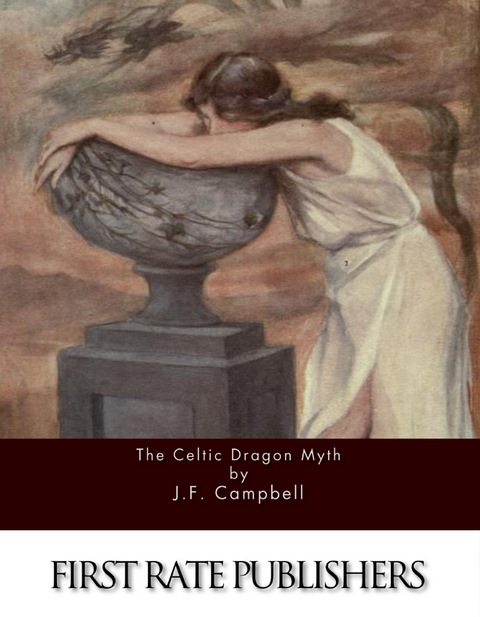
Celtic Dragon Myth (eBook)
229 Seiten
Charles River Editors (Verlag)
978-1-5080-2638-9 (ISBN)
Paphos Publishers offers a wide catalog of rare classic titles, published for a new generation. The Celtic Dragon Myth is an overview of Celtic mythology.
INTRODUCTION
BETWEEN THE YEARS 1870 AND 1884 the late Mr J. F. Campbell of Islay was repeatedly attracted by a series of legends current in the Highlands and Isles, which made special appeal to him as a storyologist. After reading a dozen versions of the stories, he found that no single title fitted so well as that of the Dragon Myth. “It treats of water, egg, mermaid, sea-dragon, tree, beasts, birds, fish, metals, weapons, and men mysteriously produced from sea-gifts. All versions agree in these respects; they are all water myths, and relate to the slaying of water monsters.”
As early indeed as 1862, while fresh from work, he had taken incidents from three versions and compared them with versions in other languages. Several journeys in the Highlands followed, as also in Japan, China, and Ceylon. While in the East, it was part of his pastimes to make sketches of the Dragons of the Orient, his mind being all the while full of the legends of the West. He regarded this as one of the most important of myths, and the most difficult to deal with. It is the State Myth of England, Russia, and Japan. He found it in the “Rig Veda,” and he concluded generally that it is Eur-Aryan in the widest sense.
Of his own work he expressly says that it is free translation. “I take the story from the Gaelic and tell it in my own words generally where the scribe’s language is prosy. But when passages occur which seem worth preservation—bits of recitation and quaint phrases—I have translated carefully. This is work honestly done while my head was full of the subject. I think that it might interest a large number of readers….” The manuscript is among the Campbell of Islay Collection in the Advocates’ Library, Edinburgh, to the Curators of which I am beholden for their courtesy, of which I now make public acknowledgment, in enabling me to complete at Glasgow University Library the transcription which I had begun many years ago.
For him the subject had two distinct aspects: first, the story is amusing for children; secondly, it has a scientific interest for a large and growing number of scholars. He had heard in London Mr Ralston give his lectures upon Russian stories, and found that the children in the audience were much amused. But amongst the audience were also Thomas Carlyle, Professor Owen, Sir R. Murchison, Reeve, Lady Ashburton, Miss Dempster of Skibo, and a number of learned people who wanted to know “the philosophy of the subject.” For Mr Campbell thought there was a great deal of philosophy in it, and he states: “I want readers, wise and foolish, to be equally well treated. The foolish may read the story, the wise may read both story and notes.”
He had read parallel stories in Swedish, German, French, Italian, English, and had heard outlines of Russian versions which seemed to him more mythical and nearer the original shape. He even found a part of the story in a book of Swahili tales told at Zanzibar.
“Theoretically,” he remarks in 1876, this looks like serpent worship, and the defeat of serpent worship by some mythical personage. Many of the incidents which are not in Gaelic, but are in Swedish, can be traced, and are explained in the Russian version, e.g., a well is a serpent, an apple tree is another serpent, a cushion in á meadow is a third serpent transformed. Three brothers are concerned in Russian. In Swedish the serpent-slaying heroes are born of maidens who in one instance drink of a well, and in the other eat an apple. Three brothers are concerned in the adventures in Gaelic in one case, and incidents enough for three are in the several versions; if they were combined, Gaelic Swedish and Russian together would make something like a fragment of mythology, but the Gaelic versions give the largest quantity of materials.”
The incidents, which number about 440, or deducting what are but variants, about 200, were put together from the following Gaelic versions or stories (of which some specimens are given in this book) collected between January 1856 and January 1861. They are:—
1. Sea-Maiden, No. IV., Popular Tales of the West Highlands, p. 72. Hector Urquhart and John Mackenzie, Inveraray.
2. The Three Roads. Hector Maclean and B. Macaskill, Berneray. MS.
3. The Fisher’s Son and The Daughter of the King of the Golden Castle. John Dewar; J. MacNair, Clachaig, Cowal. MS.
4. The Five-headed Giant. B. Macaskill, Berneray; and Hector Maclean. MS.
5. The Smith’s Son. Same sources. MS.
6. The Fisher. Hector Maclean and Alexander MacNeil, Ceanntangaval, Barra. MS.
7. The Gray Lad. Hector Maclean and John Smith, Polchar, S. Uist. MS.
8. The Second Son of the King of Ireland and The Daughter of the King of France. J. Dewar; J. MacNair, Clachaig, Cowal. MS.
9. The Sea Maiden. MS. notes by J. F. C., and John MacPhie, vol. i., Popular Tales. Interleaved copy, second recitation.
10. The Sea Maiden. Pp. 328, 346 of English Collection by J. F. C. Notes and MSS.
11. Notes from an Irish blind fiddler on the Loch Goil Head steamer. Interleaved copy. Popular Tales, vol i., p. 71.
Then came further Gaelic versions noted in 1870 and later:—
12. Notes in Journal, Aug. 17, 1870, pp. 1-10, from Lachlan MacNeill, 1 5 Maxwellton Street, Paisley.
13. Aug. 22, 1870. “John Mackenzie, fisherman, can repeat the story as printed from his telling in my book. Kenmore, Inveraray.”
14. Iain Beag Mac An Iasgair (Little John the Fisher’s Son); p. 42 of J. F. C.’s Journal for Sept. 1, 1870. From Malcolm MacDonald, fisherman, Benmore Cottage, Mull.
15. Fionn Mac A Bhradain agus Donnchadh mac a’ Bhradain. From — Maclean, fisherman, Bunessan, Ross of Mull.
It will be seen that the legends ranged over a wide Highland area; were thoroughly popular, and of the people. In Ireland there are references to the Dragon story also in Hyde’s Sgeulaidhe, and one may compare Synge’s The Aran Isles (pp. 40, 46, 24, 55). Parallel tales of contests with water-monsters are world-wide, and the story of St George and the Dragon, as told in Palestine, is very similar to that current in the Highlands. At Beyrût is shown the very well into which he cast the slain monster, and the place where the saint washed his hands thereafter. The story is:—
“There was once a great city that depended for its water-supply upon a fountain without the walls. A great dragon, possessed and moved by Satan himself, took possession of the fountain and refused to allow water to be taken unless, whenever people came to the spring, a youth or maiden was given to him to devour. The people tried again and again to destroy the monster, but though the flower of the city cheerfully went forth against it, its breath was so pestilential that they used to drop down dead before they came within bowshot.
The terrorised inhabitants were thus obliged to sacrifice their offspring, or die of thirst; till at last all the youths of the place had perished except the king’s daughter. So great was the distress of their subjects for want of water that the heart-broken parents could no longer withhold her, and amid the tears of the populace she went out towards the spring where the dragon lay awaiting her. But just as the noisome monster was going to leap on her, Mar Jiryis appeared, in golden panoply upon a fine white steed, and spear in hand. Riding full tilt at the dragon, he struck it fair between the eyes and laid it dead. The king, out of gratitude for this unlooked-for succour, gave Mar Jiryis his daughter and half of his kingdom.” 1
In the folk-lore of China there is a popular legend that the Chien Tang River was once infested by a great kiau or sea-serpent, and in 1129 A.D. a district graduate is said to have heroically thrown himself into the flood to encounter and destroy the monster. Formerly two dragons were supposed by the Chinese to have been in a narrow passage near Chinaye: they were very furious, and upset boats. According to the Rev. Mr Butler of the Presbyterian Mission in Ningpo, “they had to be appeased by the yearly offering of a girl of fair appearance and perfect body. At last one of the literati determined to stop this. He armed himself and jumped into the water; blood rose to the surface. He had killed one of the dragons. The other retired to the narrow place. A temple was erected to the hero at Peach Blossom ferry.” 1
In Japan 2 one of the dragon legends recounts how a very large serpent with eight heads and eight tails came annually and swallowed one person. A married couple who had eight children have at last only one girl left. They are in great grief. The hero, So-sa-no-o no mikoto, went to the sources of the river Hi-no-ka-mi at Idzumo and found an old man and woman clasping a young girl. “If you will give that girl to me I will save her.” The mikoto changed his form and assumed that of the girl: he divided the room into eight divisions, and in each placed one saki tub. The serpent approached, drank the saki, got...
| Erscheint lt. Verlag | 22.3.2018 |
|---|---|
| Sprache | englisch |
| Themenwelt | Literatur ► Historische Romane |
| Literatur ► Märchen / Sagen | |
| Literatur ► Romane / Erzählungen | |
| Schlagworte | Free • Ireland • Legend |
| ISBN-10 | 1-5080-2638-6 / 1508026386 |
| ISBN-13 | 978-1-5080-2638-9 / 9781508026389 |
| Informationen gemäß Produktsicherheitsverordnung (GPSR) | |
| Haben Sie eine Frage zum Produkt? |
 EPUB (Adobe DRM)
Größe: 650 KB
Kopierschutz: Adobe-DRM
Adobe-DRM ist ein Kopierschutz, der das eBook vor Mißbrauch schützen soll. Dabei wird das eBook bereits beim Download auf Ihre persönliche Adobe-ID autorisiert. Lesen können Sie das eBook dann nur auf den Geräten, welche ebenfalls auf Ihre Adobe-ID registriert sind.
Details zum Adobe-DRM
Dateiformat: EPUB (Electronic Publication)
EPUB ist ein offener Standard für eBooks und eignet sich besonders zur Darstellung von Belletristik und Sachbüchern. Der Fließtext wird dynamisch an die Display- und Schriftgröße angepasst. Auch für mobile Lesegeräte ist EPUB daher gut geeignet.
Systemvoraussetzungen:
PC/Mac: Mit einem PC oder Mac können Sie dieses eBook lesen. Sie benötigen eine
eReader: Dieses eBook kann mit (fast) allen eBook-Readern gelesen werden. Mit dem amazon-Kindle ist es aber nicht kompatibel.
Smartphone/Tablet: Egal ob Apple oder Android, dieses eBook können Sie lesen. Sie benötigen eine
Geräteliste und zusätzliche Hinweise
Buying eBooks from abroad
For tax law reasons we can sell eBooks just within Germany and Switzerland. Regrettably we cannot fulfill eBook-orders from other countries.
EPUB (Ohne DRM)Digital Rights Management: ohne DRM
Dieses eBook enthält kein DRM oder Kopierschutz. Eine Weitergabe an Dritte ist jedoch rechtlich nicht zulässig, weil Sie beim Kauf nur die Rechte an der persönlichen Nutzung erwerben.
Dateiformat: EPUB (Electronic Publication)
EPUB ist ein offener Standard für eBooks und eignet sich besonders zur Darstellung von Belletristik und Sachbüchern. Der Fließtext wird dynamisch an die Display- und Schriftgröße angepasst. Auch für mobile Lesegeräte ist EPUB daher gut geeignet.
Systemvoraussetzungen:
PC/Mac: Mit einem PC oder Mac können Sie dieses eBook lesen. Sie benötigen dafür die kostenlose Software Adobe Digital Editions.
eReader: Dieses eBook kann mit (fast) allen eBook-Readern gelesen werden. Mit dem amazon-Kindle ist es aber nicht kompatibel.
Smartphone/Tablet: Egal ob Apple oder Android, dieses eBook können Sie lesen. Sie benötigen dafür eine kostenlose App.
Geräteliste und zusätzliche Hinweise
Buying eBooks from abroad
For tax law reasons we can sell eBooks just within Germany and Switzerland. Regrettably we cannot fulfill eBook-orders from other countries.
aus dem Bereich


