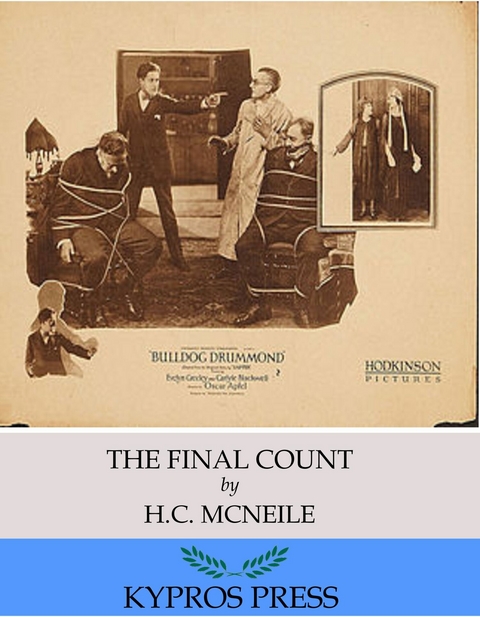
Final Count (eBook)
318 Seiten
Charles River Editors (Verlag)
978-1-5080-2297-8 (ISBN)

H.C. McNeile was a British soldier and writer best known for writing the Bulldog Drummond stories. This edition of The Final Count includes a table of contents.
I. — IN WHICH I HEAR A CRY IN THE NIGHT
IT WAS ON A WARM evening towards the end of April 1927 that the first act took place, though it is safe to say that there has never been any connection in the public mind up till this day between it and what came after. I was dining at Prince’s with Robin Gaunt, a young and extremely brilliant scientist, and a very dear friend of mine. We had been at school together and at Cambridge; and though we had lost sight of one another during the war, the threads of friendship had been picked up again quite easily at the conclusion of that foolish performance. I had joined the Gunners, whilst he, somewhat naturally, had gravitated towards the Royal Engineers. For a year or two, doubtless bearing in mind his really extraordinary gifts, the powers that be ordained that he should make roads, a form of entertainment of which he knew less than nothing. And Robin smiled thoughtfully and made roads. At least he did so officially: in reality he did other things, whilst a sergeant with a penchant for rum superintended the steam roller. And then one day came a peremptory order from G.H.Q. that Lieutenant Robin Gaunt, R. E., should cease making roads, and should report himself at the seats of the mighty at once. And Robin, still smiling thoughtfully, reported himself. As I have said, he had been doing other things during that eighteen months, and the fruits of his labours, sent direct and not through the usual official channels, lay on the table in front of the man to whom he reported.
From then on Robin became a mysterious and shadowy figure. I met him once on the leave boat going home, but he was singularly uncommunicative. He was always a silent sort of fellow, though on the rare occasions when he chose to talk he could be brilliant. But during that crossing he was positively taciturn.
He looked ill and I told him so.
‘Eighteen hours a day, old John, for eleven months on end. That’s what I’ve been doing, and I’m tired.’
He lit a cigarette and stared over the water.
‘Can you take it easy now?’ I asked him.
He gave a weary little smile.
‘If you mean by that, have I finished, then I can—more or less. But if you mean, can I take it easy from a mental point of view, God knows. I’ll not have to work eighteen hours a day any more, but there are worse things than physical exhaustion.’
And suddenly he laid his hand on my arm.
‘I know they’re Huns,’ he said tensely: ‘I know it’s just one’s bounden duty to use every gift one has been given to beat ‘em. But, damn it, John—they’re men too. They go back to their women-kind, just as all these fellows on this boat are going back to theirs.’
He paused, and I thought he was going to say something more. But he didn’t: he just gave a short laugh and led the way through the crowd to the bar.
‘A drink, John, and forget what I’ve been saying.’
That was in July ‘18, and I didn’t see him again till after the Armistice. We met in London, and at lunch I started pulling his leg over his eighteen hours’ work a day. He listened with a faint smile, and for a long while refused to be drawn. And it was only when the waiter went off to get change for the bill that he made a remark which for many months stuck in my mind.
‘There are a few things in my life that I’m thankful for, John,’ he said quietly. ‘And the one that I’m most thankful for is that the Boches broke when they did. For if they hadn’t...’
‘Well—if they hadn’t?’
‘There wouldn’t have been any Boches left to break.’
‘And a damned good thing too,’ I exclaimed.
He shrugged his shoulders.
‘They’re men too, as I said before. However, in Parliamentary parlance the situation does not arise. Wherefore, since it’s Tuesday today and Wednesday tomorrow, we might have another brandy.’
And with that the conversation closed. Periodically during the next few months that remark of his came back to my mind.
‘There wouldn’t have been any Boches left to break.’
An exaggeration, of course: a figure of speech, and yet Robin Gaunt was not given to the use of vain phrases. Years of scientific training had made him meticulously accurate in his use of words; and, certainly, if one-tenth of the wild rumours that circulated round the military Hush-Hush department was true, there might be some justification for his remark. But after a time I forgot all about it, and when Robin alluded to the matter at dinner on that evening in April I had to rack my brains to remember what he was talking about.
I’d suggested a play, but he had shaken his head.
‘I’ve an appointment, old man, tonight which I can’t break. Remember my eighteen hours’ work a day that you were so rude about?’
It took me a second or two to get the allusion.
‘Great Scott!’ I laughed, ‘that was the war to end war, my boy. To make the world safe for heroes to live in, with further slush ad nauseam. You don’t mean to say that you are still dabbling in horrors?’
‘Not exactly, John,’ he said gravely. ‘When the war was over I put the whole of that part of my life behind me. I hoped, as most of us did, that a new era had dawned: now I realise, as all of us realise, that we’ve merely gone back a few centuries. You know as well as I do that it is merely a question of time before the hatred of Germany for France boils up and cannot be restrained. Any thinking German will tell you so. Don’t let’s worry about whose fault it is: we’re concerned more with effects than causes. But when it does happen, there will be a war which for unparalleled ferocity has never before been thought of. Don’t let’s worry as to whether we go in, or on whose side we go in: those are problems that don’t concern us. Let us merely realise that primitive passions are boiling and seething in Europe, backed by inventions which are the last word in science. Force is the sole arbiter today: force and blazing hate, covered for diplomacy’s sake with a pitifully thin veneer of honeyed phrases. I tell you, John, I’ve just come back from Germany and I was staggered, simply staggered. The French desire for revanche in 1870 compared to German feeling today is as a tallow dip to the light of the sun.’
He lit a cigar thoughtfully.
‘However, all that is neither here nor there. Concentrate on that one idea, that force is the only thing that counts today: concentrate also on the idea that frightfulness in war is inevitable. I’ve come round to that way of thinking, you know. The more the thing drags on, the more suffering and sorrow to the larger number. Wherefore, pursuing the argument to a logical conclusion, it seems to me that it might be possible to arm a nation with a weapon so frightful, that by its very frightfulness war would be impossible because no other country would dare to fight.’
‘Frightfulness only breeds frightfulness,’ I remarked. ‘You’ll always get counter-measures.’
‘Not always,’ he said slowly. ‘Not always.’
‘But what’s your idea, Robin? What nation would you put in possession of such a weapon—granting for the moment that the weapon is there?’
He looked at me surprised. It was a silly remark, but I was thinking of France and Germany.
‘My dear old man—our own, of course. Who else? The policeman of the world. Perhaps America too: the English-speaking peoples. Put them in such a position, John, that they can say, should the necessity arise—"You shall not fight. You shall not again blacken the world with the hideous suffering of 1914. And since we can’t prevent you fighting by words, we’ll do it by force."‘
His eyes were gleaming, and I stared at him curiously. That he was in dead earnest was obvious, but the whole thing seemed to me to be preposterous.
‘You can’t demonstrate the frightfulness of any weapon, my dear fellow,’ I objected, ‘unless you go to war yourself. So what the devil is the good of it anyway?’
‘Then, if necessary, go to war. Go to war for one day—against both of them. And at the end of that day say to them—"Now will you stop? If you don’t, the same thing will happen to you tomorrow, and the next day, and the next, until you do!"‘
‘But what will happen to them?’ I cried.
‘Universal, instantaneous death over as large or as small an area as is desired.’
I think it was at that moment that I first began to entertain doubts as to Robin’s sanity. Not that people dining near would have noticed anything amiss with him: his voice was low-pitched and quiet. But the whole idea was so utterly far-fetched and fantastic that I couldn’t help wondering if his brilliant brain hadn’t crossed that tiny bridge which...
| Erscheint lt. Verlag | 22.3.2018 |
|---|---|
| Sprache | englisch |
| Themenwelt | Literatur ► Anthologien |
| Literatur ► Klassiker / Moderne Klassiker | |
| Literatur ► Romane / Erzählungen | |
| Schlagworte | British • bulldog drummond • Historical • No Man's Land • ratcatcher • the black gang • the third round |
| ISBN-10 | 1-5080-2297-6 / 1508022976 |
| ISBN-13 | 978-1-5080-2297-8 / 9781508022978 |
| Informationen gemäß Produktsicherheitsverordnung (GPSR) | |
| Haben Sie eine Frage zum Produkt? |
 EPUB (Ohne DRM)
Digital Rights Management: ohne DRM
Dieses eBook enthält kein DRM oder Kopierschutz. Eine Weitergabe an Dritte ist jedoch rechtlich nicht zulässig, weil Sie beim Kauf nur die Rechte an der persönlichen Nutzung erwerben.
Dateiformat: EPUB (Electronic Publication)
EPUB ist ein offener Standard für eBooks und eignet sich besonders zur Darstellung von Belletristik und Sachbüchern. Der Fließtext wird dynamisch an die Display- und Schriftgröße angepasst. Auch für mobile Lesegeräte ist EPUB daher gut geeignet.
Systemvoraussetzungen:
PC/Mac: Mit einem PC oder Mac können Sie dieses eBook lesen. Sie benötigen dafür die kostenlose Software Adobe Digital Editions.
eReader: Dieses eBook kann mit (fast) allen eBook-Readern gelesen werden. Mit dem amazon-Kindle ist es aber nicht kompatibel.
Smartphone/Tablet: Egal ob Apple oder Android, dieses eBook können Sie lesen. Sie benötigen dafür eine kostenlose App.
Geräteliste und zusätzliche Hinweise
Buying eBooks from abroad
For tax law reasons we can sell eBooks just within Germany and Switzerland. Regrettably we cannot fulfill eBook-orders from other countries.
aus dem Bereich