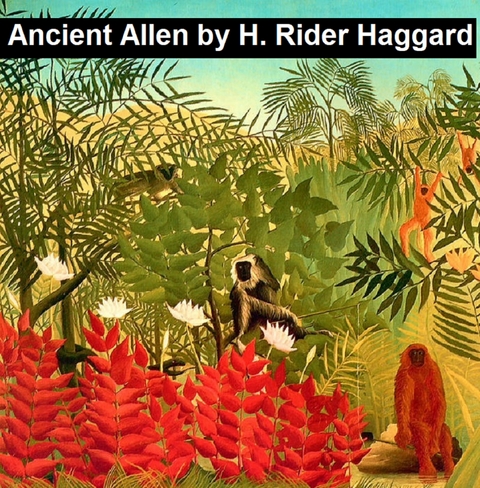
Ancient Allen (eBook)
218 Seiten
Seltzer Books (Verlag)
978-1-4553-4693-6 (ISBN)
Adventure novel, first published in 1920. According to Wikipedia: "e;Sir Henry Rider Haggard (1856 - 1925), was a prolific writer of adventure novels set in exotic locations, predominantly Africa. He was also involved in agricultural reform around the British Empire. His stories, situated at the lighter end of Victorian literature, continue to be popular and influential to this day."e;
"When we were boy and girl, Bes. We used to play together, being cousins, and I used to hold her hand. Then suddenly she refused to let me hold her hand any more, and I being quite grown up then, though she was younger, understood that I had better go away."
"I should have stopped where I was, Master."
"No, Bes. She was studying to be a priestess and my great uncle, the holy Tanofir, told me that I had better go away. So I went down south hunting and fighting in command of the troops, and met you, Bes."
"Which perhaps was better for you, Master, than to stop to watch the lady Amada acquire learning. Still, I wonder whether the holy Tanofir is /always/ right. You see, Master, he thinks a great deal of priests and priestesses, and is so very old that he has forgotten all about love and that without it there never would have been a holy Tanofir."
"The holy Tanofir thinks of souls, not of bodies, Bes."
"Yes, Master. Still, oil is of no use without a lamp, or a soul without a body, at least here underneath the sun, or so we were taught who worship the Grasshopper. But, Master, when you came back from all your hunting, what happened then?"
"Then I found, Bes, that the lady Amada, having acquired all the learning possible, had taken her first vows to Isis, which she said she would not break for any man on earth although she might have done so without crime. Therefore, although I was dear to her, as a brother would have been had she had one, and she swore that she had never even thought of another man, she refused so much as to think of marrying who dreamed only of the heavenly perfections of the lady Isis."
"Ump!" said Bes. "We Ethiopians have Priestesses of the Grasshopper, or the Grasshopper's wife, but they do not think of her like that. I hope that one day something stronger than herself will not cause the lady Amada to break her vows to the heavenly Isis. Only then, perhaps, it may be for the sake of another man who did not go off to the East on account of such fool's talk. But here is a village and the horses are spent. Let us stop and eat, as I suppose even the lady Amada does sometimes."
On the following afternoon we crossed the Nile, and towards sunset entered the vast and ancient city of Memphis. On its white walls floated the banners of the Great King which Bes pointed out to me, saying that wherever we went in the whole world, it seemed that we could never be free from those accursed symbols.
"May I live to spit upon them and cast them into the moat," I answered savagely, for as I drew near to Amada they grew ten times more hateful to me than they had been before.
In truth I was nearer to Amada than I thought, for after we had passed the enclosure of the temple of Ptah, the most wonderful and the mightiest in the whole world, we came to the temple of Isis. There near to the pylon gate we met a procession of her priests and priestesses advancing to offer the evening sacrifice of song and flowers, clad, all of them, in robes of purest white. It was a day of festival, so singers went with them. After the singers came a band of priestesses bearing flowers, in front of whom walked another priestess shaking a /sistrum/ that made a little tinkling music.
Even at a distance there was something about the tall and slender shape of this priestess that stirred me. When we came nearer I saw why, for it was Amada herself. Through the thin veil she wore I could see her dark and tender eyes set beneath the broad brow that was so full of thought, and the sweet, curved mouth that was like no other woman's. Moreover there could be no doubt since the veil parting above her breast showed the birth-mark for which she was famous, the mark of the young moon, the sign of Isis.
I sprang from my horse and ran towards her. She looked up and saw me. At first she frowned, then her face grew wondering, then tender, and I thought that her red lips shaped my name. Moreover in her confusion she let the /sistrum/ fall.
I muttered "Amada!" and stepped forward, but priests ran between us and thrust me away. Next moment she had recovered the /sistrum/ and passed on with her head bowed. Nor did she lift her eyes to look back.
"Begone, man!" cried a priest, "Begone, whoever you may be. Because you wear Eastern armour do you think that you can dare the curse of Isis?"
Then I fell back, the holy image of the goddess passed and the procession vanished through the pylon gate. I, Shabaka the Egyptian, stood by my horse and watched it depart. I was happy because the lady Amada was alive, well, and more beautiful than ever; also because she had shown signs of joy and confusion at seeing me again. Yet I was unhappy because I met her still filling a holy office which built a wall between us, also because it seemed to me an evil omen that I should have been repelled from her by a priest of Isis who talked of the curse of the goddess. Moreover the sacred statue, I suppose by accident, turned towards me as it passed and perhaps by the chance of light, seemed to frown upon me.
Thus I thought as Shabaka hundreds of years before the Christian era, but as Allan Quatermain the modern man, to whom it was given so marvellously to behold all these things and who in beholding them, yet never quite lost the sense of his own identity of to-day, I was amazed. For I knew that this lady Amada was the same being though clad in different flesh, as that other lady with whom I had breathed the magical /Taduki/ fumes which had power to rend the curtain of the past, or, perhaps, only to breed dreams of what it might have been.
To the outward eye, indeed she was different, as I was different, taller, more slender, larger-eyed, with longer and slimmer hands than those of any Western woman, and on the whole even more beautiful and alluring. Moreover that mysterious look which from time to time I had seen on Lady Ragnall's face, was more constant on that of the lady Amada. It brooded in the deep eyes and settled in a curious smile about the curves of the lips, a smile that was not altogether human, such a smile as one might wear who had looked on hidden things and heard voices that spoke beyond the limits of the world.
Somehow neither then nor at any other time during all my dream, could I imagine this Amada, this daughter of a hundred kings, whose blood might be traced back through dynasty on dynasty, as nothing but a woman who nurses children upon her breast. It was as though something of our common nature had been bred out of her and something of another nature whereof we have no ken, had entered to fill its place. And yet these two women were the same, that I /knew/, or at any rate, much of them was the same, for who can say what part of us we leave behind as we flit from life to life, to find it again elsewhere in the abysms of Time and Change? One thing too was quite identical--the birthmark of the new moon above the breast which the priests of the Kendah had declared was always the seal that marked their prophetess, the guardian of the Holy Child.
When the procession had quite departed and I could no longer hear the sound of singing, I remounted and rode on to my house, or rather to that of my mother, the great lady Tiu, which was situated beneath the wall of the old palace facing towards the Nile. Indeed my heart was full of this mother of mine whom I loved and who loved me, for I was her only child, and my father had been long dead; so long that I could not remember him. Eight months had gone by since I saw her face and in eight months who knew what might have happened? The thought made me cold for she, who was aged and not too strong, perhaps had been gathered to Osiris. Oh! if that were so!
I shook my tired horse to a canter, Bes riding ahead of me to clear a road through the crowded street in which, at this hour of sundown, all the idlers of Memphis seemed to have gathered. They stared at me because it was not common to see men riding in Memphis, and with little love, since from my dress and escort they took me to be some envoy from their hated master, the Great King of the East. Some even threatened to bar the way; but we thrust through and presently turned into a thoroughfare of private houses standing in their own gardens. Ours was the third of these. At its gate I leapt from my horse, pushed open the closed door and hastened in to seek and learn.
I had not far to go for, there in the courtyard, standing at the head of our modest household and dressed in her festal robes, was my mother, the stately and white-haired lady Tiu, as one stands who awaits the coming of an honoured guest. I ran to her and kneeling, kissed her hand, saying,
"My mother! My mother, I have come safe home and greet you."
"I greet you also, my son," she answered, bending down and kissing me on the brow, "who have been in far lands and passed so many dangers. I greet you and thank the guardian gods who have brought you safe home again. Rise, my son."
I rose and kissed her on the face, then looked at the servants who were bowing their welcome to me, and said,
"How comes it, Lady of the House, that all are gathered here? Did you await some guest?"
"We awaited you, my son. For an hour have we stood here listening for the...
| Erscheint lt. Verlag | 1.3.2018 |
|---|---|
| Sprache | englisch |
| Themenwelt | Literatur ► Anthologien |
| Literatur ► Klassiker / Moderne Klassiker | |
| Literatur ► Romane / Erzählungen | |
| ISBN-10 | 1-4553-4693-4 / 1455346934 |
| ISBN-13 | 978-1-4553-4693-6 / 9781455346936 |
| Informationen gemäß Produktsicherheitsverordnung (GPSR) | |
| Haben Sie eine Frage zum Produkt? |
 EPUB (Adobe DRM)
Größe: 536 KB
Kopierschutz: Adobe-DRM
Adobe-DRM ist ein Kopierschutz, der das eBook vor Mißbrauch schützen soll. Dabei wird das eBook bereits beim Download auf Ihre persönliche Adobe-ID autorisiert. Lesen können Sie das eBook dann nur auf den Geräten, welche ebenfalls auf Ihre Adobe-ID registriert sind.
Details zum Adobe-DRM
Dateiformat: EPUB (Electronic Publication)
EPUB ist ein offener Standard für eBooks und eignet sich besonders zur Darstellung von Belletristik und Sachbüchern. Der Fließtext wird dynamisch an die Display- und Schriftgröße angepasst. Auch für mobile Lesegeräte ist EPUB daher gut geeignet.
Systemvoraussetzungen:
PC/Mac: Mit einem PC oder Mac können Sie dieses eBook lesen. Sie benötigen eine
eReader: Dieses eBook kann mit (fast) allen eBook-Readern gelesen werden. Mit dem amazon-Kindle ist es aber nicht kompatibel.
Smartphone/Tablet: Egal ob Apple oder Android, dieses eBook können Sie lesen. Sie benötigen eine
Geräteliste und zusätzliche Hinweise
Buying eBooks from abroad
For tax law reasons we can sell eBooks just within Germany and Switzerland. Regrettably we cannot fulfill eBook-orders from other countries.
aus dem Bereich