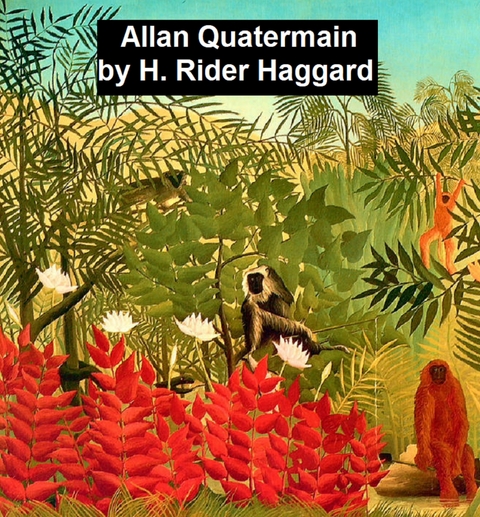
Allan Quatermain (eBook)
298 Seiten
Seltzer Books (Verlag)
978-1-4553-4685-1 (ISBN)

Adventure novel, first published in 1887. Sequel to King Solomon's Mines. According to Wikipedia: "e;Sir Henry Rider Haggard (1856 - 1925), was a prolific writer of adventure novels set in exotic locations, predominantly Africa. He was also involved in agricultural reform around the British Empire. His stories, situated at the lighter end of Victorian literature, continue to be popular and influential to this day."e;
'Well, well,' thought I, 'you have come in search of adventures, Allan my boy, and you have certainly got them. At your time of life, too! You ought to be ashamed of yourself; but somehow you are not, and, awful as it all is, perhaps you will pull through after all; and if you don't, why, you cannot help it, you see! And when all's said and done an underground river will make a very appropriate burying-place.'
At first, however, I am bound to say that the strain upon the nerves was very great. It is trying to the coolest and most experienced person not to know from one hour to another if he has five minutes more to live, but there is nothing in this world that one cannot get accustomed to, and in time we began to get accustomed even to that. And, after all, our anxiety, though no doubt natural, was, strictly speaking, illogical, seeing that we never know what is going to happen to us the next minute, even when we sit in a well-drained house with two policemen patrolling under the window--nor how long we have to live. It is all arranged for us, my sons, so what is the use of bothering?
It was nearly midday when we made our dive into darkness, and we had set our watch (Good and Umslopogaas) at two, having agreed that it should be of a duration of five hours. At seven o'clock, accordingly, Sir Henry and I went on, Sir Henry at the bow and I at the stern, and the other two lay down and went to sleep. For three hours all went well, Sir Henry only finding it necessary once to push us off from the side; and I that but little steering was required to keep us straight, as the violent current did all that was needed, though occasionally the canoe showed a tendency which had to be guarded against to veer and travel broadside on. What struck me as the most curious thing about this wonderful river was: how did the air keep fresh? It was muggy and thick, no doubt, but still not sufficiently so to render it bad or even remarkably unpleasant. The only explanation that I can suggest is that the water of the lake had sufficient air in it to keep the atmosphere of the tunnel from absolute stagnation, this air being given out as it proceeded on its headlong way. Of course I only give the solution of the mystery for what it is worth, which perhaps is not much.
When I had been for three hours or so at the helm, I began to notice a decided change in the temperature, which was getting warmer. At first I took no notice of it, but when, at the expiration of another half-hour, I found that it was getting hotter and hotter, I called to Sir Henry and asked him if he noticed it, or if it was only my imagination. 'Noticed it!' he answered; 'I should think so. I am in a sort of Turkish bath.' Just about then the others woke up gasping, and were obliged to begin to discard their clothes. Here Umslopogaas had the advantage, for he did not wear any to speak of, except a moocha.
Hotter it grew, and hotter yet, till at last we could scarcely breathe, and the perspiration poured out of us. Half an hour more, and though we were all now stark naked, we could hardly bear it. The place was like an antechamber of the infernal regions proper. I dipped my hand into the water and drew it out almost with a cry; it was nearly boiling. We consulted a little thermometer we had--the mercury stood at 123 degrees. From the surface of the water rose a dense cloud of steam. Alphonse groaned out that we were already in purgatory, which indeed we were, though not in the sense that he meant it. Sir Henry suggested that we must be passing near the seat of some underground volcanic fire, and I am inclined to think, especially in the light of what subsequently occurred, that he was right. Our sufferings for some time after this really pass my powers of description. We no longer perspired, for all the perspiration had been sweated out of us. We simply lay in the bottom of the boat, which we were now physically incapable of directing, feeling like hot embers, and I fancy undergoing very much the same sensations that the poor fish do when they are dying on land--namely, that of slow suffocation. Our skins began to crack, and the blood to throb in our heads like the beating of a steam-engine.
This had been going on for some time, when suddenly the river turned a little, and I heard Sir Henry call out from the bows in a hoarse, startled voice, and, looking up, saw a most wonderful and awful thing. About half a mile ahead of us, and a little to the left of the centre of the stream--which we could now see was about ninety feet broad--a huge pillar-like jet of almost white flame rose from the surface of the water and sprang fifty feet into the air, when it struck the roof and spread out some forty feet in diameter, falling back in curved sheets of fire shaped like the petals of a full-blown rose. Indeed this awful gas jet resembled nothing so much as a great flaming flower rising out of the black water. Below was the straight stalk, a foot or more thick, and above the dreadful bloom. And as for the fearfulness of it and its fierce and awesome beauty, who can describe it? Certainly I cannot. Although we were now some five hundred yards away, it, notwithstanding the steam, lit up the whole cavern as clear as day, and we could see that the roof was here about forty feet above us, and washed perfectly smooth with water. The rock was black, and here and there I could make out long shining lines of ore running through it like great veins, but of what metal they were I know not.
On we rushed towards this pillar of fire, which gleamed fiercer than any furnace ever lit by man.
'Keep the boat to the right, Quatermain--to the right,' shouted Sir Henry, and a minute afterwards I saw him fall forward senseless. Alphonse had already gone. Good was the next to go. There they lay as though dead; only Umslopogaas and I kept our senses. We were within fifty yards of it now, and I saw the Zulu's head fall forward on his hands. He had gone too, and I was alone. I could not breathe; the fierce heat dried me up. For yards and yards round the great rose of fire the rock-roof was red-hot. The wood of the boat was almost burning. I saw the feathers on one of the dead swans begin to twist and shrivel up; but I would not give in. I knew that if I did we should pass within three or four yards of the gas jet and perish miserably. I set the paddle so as to turn the canoe as far from it as possible, and held on grimly.
My eyes seemed to be bursting from my head, and through my closed lids I could see the fierce light. We were nearly opposite now; it roared like all the fires of hell, and the water boiled furiously around it. Five seconds more. We were past; I heard the roar behind me.
Then I too fell senseless. The next thing that I recollect is feeling a breath of air upon my face. My eyes opened with great difficulty. I looked up. Far, far above me there was light, though around me was great gloom. Then I remembered and looked. The canoe still floated down the river, and in the bottom of it lay the naked forms of my companions. 'Were they dead?' I wondered. 'Was I left alone in this awful place?' I knew not. Next I became conscious of a burning thirst. I put my hand over the edge of the boat into the water and drew it up again with a cry. No wonder: nearly all the skin was burnt off the back of it. The water, however, was cold, or nearly so, and I drank pints and splashed myself all over. My body seemed to suck up the fluid as one may see a brick wall suck up rain after a drought; but where I was burnt the touch of it caused intense pain. Then I bethought myself of the others, and, dragging myself towards them with difficulty, I sprinkled them with water, and to my joy they began to recover--Umslopogaas first, then the others. Next they drank, absorbing water like so many sponges. Then, feeling chilly--a queer contrast to our recent sensations--we began as best we could to get into our clothes. As we did so Good pointed to the port side of the canoe: it was all blistered with heat, and in places actually charred. Had it been built like our civilized boats, Good said that the planks would certainly have warped and let in enough water to sink us; but fortunately it was dug out of the soft, willowy wood of a single great tree, and had sides nearly three inches and a bottom four inches thick. What that awful flame was we never discovered, but I suppose that there was at this spot a crack or hole in the bed of the river through which a vast volume of gas forced its way from its volcanic home in the bowels of the earth towards the upper air. How it first became ignited is, of course, impossible to say--probably, I should think, from some spontaneous explosion of mephitic gases.
As soon as we had got some things together and shaken ourselves together a little, we set to work to make out where we were now. I have said that there was light above, and on examination we found that it came from the sky. Our river that was, Sir Henry said, a literal realization of the wild vision of the poet, *{Where Alph the sacred river ran / Through caverns measureless to man / Down to a sunless sea} was no longer underground, but was running on its darksome way, not now through 'caverns measureless to man', but between two frightful cliffs which cannot have been less than...
| Erscheint lt. Verlag | 1.3.2018 |
|---|---|
| Sprache | englisch |
| Themenwelt | Literatur ► Anthologien |
| Literatur ► Klassiker / Moderne Klassiker | |
| Literatur ► Romane / Erzählungen | |
| ISBN-10 | 1-4553-4685-3 / 1455346853 |
| ISBN-13 | 978-1-4553-4685-1 / 9781455346851 |
| Informationen gemäß Produktsicherheitsverordnung (GPSR) | |
| Haben Sie eine Frage zum Produkt? |
 EPUB (Adobe DRM)
Größe: 597 KB
Kopierschutz: Adobe-DRM
Adobe-DRM ist ein Kopierschutz, der das eBook vor Mißbrauch schützen soll. Dabei wird das eBook bereits beim Download auf Ihre persönliche Adobe-ID autorisiert. Lesen können Sie das eBook dann nur auf den Geräten, welche ebenfalls auf Ihre Adobe-ID registriert sind.
Details zum Adobe-DRM
Dateiformat: EPUB (Electronic Publication)
EPUB ist ein offener Standard für eBooks und eignet sich besonders zur Darstellung von Belletristik und Sachbüchern. Der Fließtext wird dynamisch an die Display- und Schriftgröße angepasst. Auch für mobile Lesegeräte ist EPUB daher gut geeignet.
Systemvoraussetzungen:
PC/Mac: Mit einem PC oder Mac können Sie dieses eBook lesen. Sie benötigen eine
eReader: Dieses eBook kann mit (fast) allen eBook-Readern gelesen werden. Mit dem amazon-Kindle ist es aber nicht kompatibel.
Smartphone/Tablet: Egal ob Apple oder Android, dieses eBook können Sie lesen. Sie benötigen eine
Geräteliste und zusätzliche Hinweise
Buying eBooks from abroad
For tax law reasons we can sell eBooks just within Germany and Switzerland. Regrettably we cannot fulfill eBook-orders from other countries.
aus dem Bereich