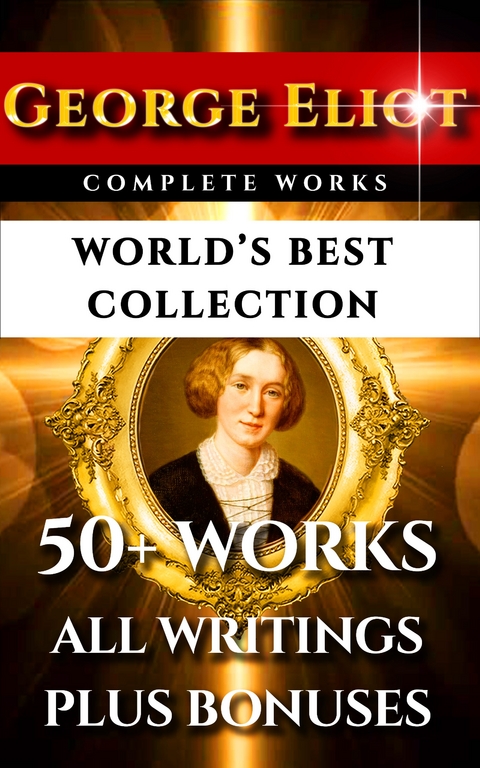
George Eliot Complete Works - World's Best Collection (eBook)
4300 Seiten
Imagination Books (Verlag)
978-1-928457-67-1 (ISBN)
George Eliot Complete Works World's Best Collection
This is the world's best George Eliot collection, including the most complete set of Eliot's works available plus many free bonus materials.
George Eliot
Mary Anne (alternatively Mary Ann or Marian) Evans (22 November 1819 - 22 December 1880), known by her pen name George Eliot (as was the convention of the time) was an English novelist, journalist, and translator and one of the leading writers of the Victorian era
The 'Must-Have' Complete Collection
In this irresistible collection you get all of George Eliot's work, with All her books, All her novels, and All her rare poems. This collection also in includes a biography so you can experience the life of the woman behind the words. Plus this collection also includes bonus materials.
Works Included:
Novels
Silas Marner The Weaver Of Raveloe
Middlemarch
The Mill On The Floss
Impressions Of Theophrastus Such
The Lifted Veil
Romola
Scenes Of Clerical Life
Felix Holt, The Radical
Daniel Deronda
Brother Jacob
Adam Bede
The Poetry Of George Eliot Inlcuding:
How Anna Loved The King
O May I Join The Choir Invisibile
All The Essays Of George Eliot
Your Free Special Bonuses
Ethics Of George Eliot's Work By John Crombie Brown
George Eliot: A Critical Study Of Her Life, Writings And Philosophy by George Willis Cooke
Historical Context and Literary Context Notes - Detailed explanations of the Victorian Era and Victorian Literature written specially for this collection.
Get This Collection Right Now
This is the best George Eliot collection you can get, so get it now and start enjoying and being inspired by her world like never before!
George Eliot Complete Works World's Best CollectionThis is the world's best George Eliot collection, including the most complete set of Eliot's works available plus many free bonus materials.George EliotMary Anne (alternatively Mary Ann or Marian) Evans (22 November 1819 - 22 December 1880), known by her pen name George Eliot (as was the convention of the time) was an English novelist, journalist, and translator and one of the leading writers of the Victorian eraThe 'Must-Have' Complete CollectionIn this irresistible collection you get all of George Eliot's work, with All her books, All her novels, and All her rare poems. This collection also in includes a biography so you can experience the life of the woman behind the words. Plus this collection also includes bonus materials.Works Included:NovelsSilas Marner The Weaver Of RaveloeMiddlemarchThe Mill On The FlossImpressions Of Theophrastus SuchThe Lifted VeilRomolaScenes Of Clerical LifeFelix Holt, The RadicalDaniel DerondaBrother JacobAdam BedeThe Poetry Of George EliotInlcuding:How Anna Loved The KingO May I Join The Choir InvisibileAll The Essays Of George EliotYour Free Special BonusesEthics Of George Eliot's Work By John Crombie BrownGeorge Eliot: A Critical Study Of Her Life, Writings And Philosophy by George Willis CookeHistorical Context and Literary Context Notes- Detailed explanations of the Victorian Era and Victorian Literature written specially for this collection.Get This Collection Right NowThis is the best George Eliot collection you can get, so get it now and start enjoying and being inspired by her world like never before!
Historical Context – The Victorian Era
The Victorian Era
The Victorian era was the period of Queen Victoria's reign, from 20 June 1837 until her death on 22 January 1901.
The era followed the Georgian period (and Regency Period ) and preceded the Edwardian period
From a historical point of view, in terms of moral sensibilities and political reforms, the period can arguably be said to have begun with the passing of the Reform Act of 1832.
Ideologically, the Victorian era witnessed resistance to the rationalism that defined the Georgian period and an increasing turn towards romanticism and even mysticism with regard to religion, social values, and arts.
Religiously, there was a strong drive for higher moral standards. Indeed, moral standards improved very dramatically, especially for the middle class. As will be explained, this resulted in the idea of the typical Victorian – upstanding, moral, working to better him/herself and working towards the greater good for all society, in and outside of the empire.
From this stand point, term ‘Victorian Morality’ is often used to describe the people and the belief system of the era - this encompassed sexual proprietary, hard work, honesty, thriftiness, a sense of duty and responsibility towards the less well-off who deserved help.
The negative aspects of this typical ‘Victorian personality’ has also led to Victorians be characterized as stodgy, stuck up, preachy and stoic.
In England itself, there was an increasing shift towards social and political reform, in real terms. Indeed, when Victorians spoke about justice, ending poverty or child-labor and about improving the quality of life, they meant it and they meant it not just for their own country.
Other notable elements of typical Victorian Era people included:
Moral values such as Sabbath observance, responsibility, charitably charity, discipline in the home, and self-examination for the smallest faults and needs of improvement.
Historians continue to debate the various causes of this dramatic change and the ‘creation’ of the Victorian morality. Some emphasize the strong reaction against the French Revolution (1789 onwards). There was also the powerful role of the evangelical movement among religious organizations of the time and factions inside the established Church of England. These religious and political reformers set up organizations (with growing number of followers) that monitored behavior and pushed for government action.
Class Structure
In terms of this shift, between 1780 and 1850 the English ceased to be one of the most aggressive, brutal, rowdy, outspoken, riotous, cruel and bloodthirsty nations in the world and became one of the most inhibited, polite, orderly, tender-minded, prudish and hypocritical.
Among the higher social classes, there was less gambling, horse races, obscene theatres and prostitution. The debauchery of aristocratic England in the early 19th century simply disappeared.
In England itself, politics became increasingly liberal with shifts in the direction of gradual political reform and industrial reform.
The two main political parties during the era were the Whigs/Liberals and the Conservatives, and by the end of the Victorian Era, the Labour Party had formed as a distinct political entity.
Literature
The problem with the classification of "Victorian literature" is the difference between early works and later works of periods, the later works said to have more in common with the writers of the Edwardian period. Many writers straddle this divide.
Victorian literature is preceded by Romanticism and Realism and Modernism, and in some way can be said to be a mixture of both schools of literature and arts. It could be called a fusion of romantic and realist style of writing.
There were, however significant differences.
Firstly, in the Romantic period, poetry had been the dominant genre, but in the Victorian Eras, the novel became the dominant form of entertainment. The novel itself, as a concept of entertainment vehicle, had not been popular for many years, in neglect since the 1830s, but grew in popularity during this period.
Victorian novels showed idealized portraits of difficult lives in which hard work, perseverance, love and luck win out in the end.
This encapsulated the Victorian morality of improvement and betterment in life, with a central moral lesson at heart. This changed in tone and style as the century progressed and life began to change.
Some of the most famous novelists from this Victorian Era include:
Charles Dickens (1812–1870) – He dominated the first part of Victoria's reign, starting with his first novel, The Pickwick Papers, (written when he was 25 and published in 1836). His works often had a satirical edge and through his popular writing, he also highlighted social problems and the plight of the poor and oppressed.
William Makepeace Thackeray's (1811–1863) – His most famous work Vanity Fair appeared in 1848.
The Brontë sisters, Charlotte (1816–55), Emily (1818–48) and Anne (1820–49) – they published significant works in the 1840s, including the Gothic-influenced Wuthering Heights and Jane Eyre. Anne's second novel The Tenant of Wildfell Hall (1848) was written in realistic rather than romantic style and is mainly considered to be the first sustained feminist novels.
George Eliot (Mary Anne Evans) (1819–80) - Middlemarch (1872) was a later work in the last part of the Victorian era, and is regarded by many as the greatest British novel ever written.
Thomas Hardy (1840–1928) - Under the Greenwood Tree (1872) Jude the Obscure (1895) are also later Victorian era novels that are extremely, highly regarded.
Lewis Carroll, R. M. Ballantyne and Anna Sewell wrote mainly for children, although they had an adult following – Lewis Carroll’s works produced a new genre of writing, known as Nonsense Verse or Nonsense Poetry.
Another major movement in Victorian literature was a tendency towards darker themes and Gothic imagery. These tales often revolved around larger-than-life characters such as Sherlock Holmes, and other flamboyant and individual fictional characters such as Dracula, Edward Hyde and The Invisible Man who often had exotic enemies to foil.
This Gothic literature combined romance and horror, to thrill and terrify the reader with foreign monsters, ghosts, curses, hidden rooms and witchcraft.
This resurgence in Gothic themes is even evident in Oscar Wilde’s ‘A Picture of Dorian Gray’.
Poetry
Much of the poetical work of the time is seen as a bridge between the romantic era and the modernist poetry of the next century.
Elizabeth Barrett Browning, Robert Browning (1812–89) and Alfred Tennyson (1809–92) were Victorian England's most famous poets. Alfred Lord Tennyson held the poet laureateship of England for over forty years, and the works of the Browning’s produced many beautiful, tender and passionate poems, during the period when they conducted their love affair through letters and verse.
One of the aspects of much of Victorian Literature was a renewed interest in both classical literature and medieval literature.
The stories of heroism and chivalry, of knights and nobility, of honor and kinship, became important again. In a way, this renewed interest echoed the Victorian morality of the day, and the heroism and noble, courtly behavior of the characters was in some way imparted onto Victorian society and the empire itself.
The best example of this is Alfred Tennyson's ‘Idylls of the King’, where he blended legends of King Arthur with contemporary ideas.
Theatre
It was not until the last decades of the nineteenth century that any significant works were produced. This began with Gilbert and Sullivan's comic operas, from the 1870s, various plays of George Bernard Shaw (1856–1950) in the 1890s, and Oscar Wilde's (1854–1900) The Importance of Being Earnest, which held an ironic mirror to the aristocracy while displaying virtuosic mastery of wit and paradoxical wisdom.
Scientific Books
The Victorian era was an important time for the development of science and one book in particular remains famous as both a work of ‘literature’, a dividing line in society, and an example of this Victorian era scientific development - Charles Darwin's On the Origin of Species, with his theory of evolution, challenged many of the ideas the Victorians had.
Common themes in Victorian Literature
There are several characteristics of Victorian Literature:
Firstly, as said, literature in the Victorian age tended to come face to face with realism. They focused more on real people, real problems and practical interests. In this way, the literature also became a powerful instrument for human progress.
Victorian literature also seems to deviate from the idea of “art for art’s sake” and asserts its moral purpose – it had a message to state besides just entertainment.
Lastly, there was more pessimism and confusion within the age and this was reflected in the works.
Famous Victorian novelists and poets include: Matthew Arnold, the Bronte sisters, Christina Rossetti, Joseph Conrad, Robert Browning, Sir Arthur Conan Doyle, Elizabeth Barrett Browning, Edward Bulwer-Lytton, Wilkie Collins, Charles Dickens, Benjamin Disraeli, George Eliot, George Meredith, Elizabeth Gaskell, George Gissing, Richard Jefferies, Thomas Hardy, A. E....
| Erscheint lt. Verlag | 2.8.2018 |
|---|---|
| Sprache | englisch |
| Themenwelt | Literatur ► Anthologien |
| Literatur ► Klassiker / Moderne Klassiker | |
| Literatur ► Romane / Erzählungen | |
| Schlagworte | Middlemarch • Mill on the Floss • Silas Marner • The Lifted Veil • victorian era literature • Victorian writers • Wuthering Heights |
| ISBN-10 | 1-928457-67-3 / 1928457673 |
| ISBN-13 | 978-1-928457-67-1 / 9781928457671 |
| Informationen gemäß Produktsicherheitsverordnung (GPSR) | |
| Haben Sie eine Frage zum Produkt? |
 EPUB (Adobe DRM)
Kopierschutz: Adobe-DRM
Adobe-DRM ist ein Kopierschutz, der das eBook vor Mißbrauch schützen soll. Dabei wird das eBook bereits beim Download auf Ihre persönliche Adobe-ID autorisiert. Lesen können Sie das eBook dann nur auf den Geräten, welche ebenfalls auf Ihre Adobe-ID registriert sind.
Details zum Adobe-DRM
Dateiformat: EPUB (Electronic Publication)
EPUB ist ein offener Standard für eBooks und eignet sich besonders zur Darstellung von Belletristik und Sachbüchern. Der Fließtext wird dynamisch an die Display- und Schriftgröße angepasst. Auch für mobile Lesegeräte ist EPUB daher gut geeignet.
Systemvoraussetzungen:
PC/Mac: Mit einem PC oder Mac können Sie dieses eBook lesen. Sie benötigen eine
eReader: Dieses eBook kann mit (fast) allen eBook-Readern gelesen werden. Mit dem amazon-Kindle ist es aber nicht kompatibel.
Smartphone/Tablet: Egal ob Apple oder Android, dieses eBook können Sie lesen. Sie benötigen eine
Geräteliste und zusätzliche Hinweise
Buying eBooks from abroad
For tax law reasons we can sell eBooks just within Germany and Switzerland. Regrettably we cannot fulfill eBook-orders from other countries.
aus dem Bereich