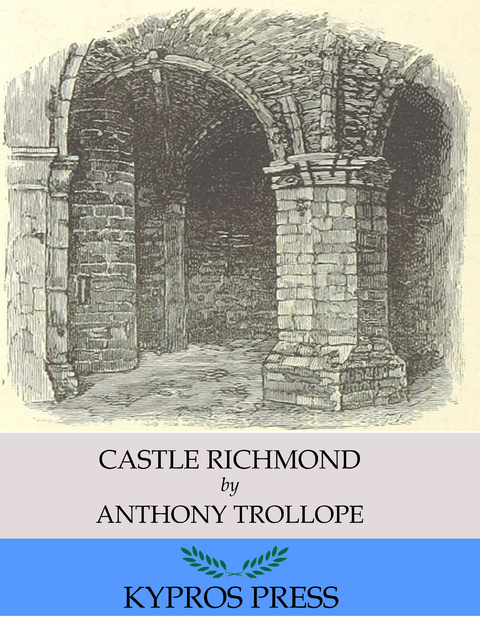
Castle Richmond (eBook)
Charles River Editors (Verlag)
978-1-5080-1627-4 (ISBN)
Anthony Trollope was a British writer who is considered to be one of the most prominent authors of the Victorian era. Trollope created the fictional county of Barsetshire which many of his novels are set in. Trollope also wrote on the political and social issues on England during his time. This edition of Castle Richmond includes a table of contents.
CHAPTER I. THE BARONY OF DESMOND.
I WONDER WHETHER THE NOVEL-READING world—that part of it, at least, which may honour my pages—will be offended if I lay the plot of this story in Ireland! That there is a strong feeling against things Irish it is impossible to deny. Irish servants need not apply; Irish acquaintances are treated with limited confidence; Irish cousins are regarded as being decidedly dangerous; and Irish stories are not popular with the booksellers.
For myself, I may say that if I ought to know anything about any place, I ought to know something about Ireland; and I do strongly protest against the injustice of the above conclusions. Irish cousins I have none. Irish acquaintances I have by dozens; and Irish friends, also, by twos and threes, whom I can love and cherish—almost as well, perhaps, as though they had been born in Middlesex. Irish servants I have had some in my house for years, and never had one that was faithless, dishonest, or intemperate. I have travelled all over Ireland, closely as few other men can have done, and have never had my portmanteau robbed or my pocket picked. At hotels I have seldom locked up my belongings, and my carelessness has never been punished. I doubt whether as much can be said for English inns.
Irish novels were once popular enough. But there is a fashion in novels, as there is in colours and petticoats; and now I fear they are drugs in the market. It is hard to say why a good story should not have a fair chance of success whatever may be its bent; why it should not be reckoned to be good by its own intrinsic merits alone; but such is by no means the case. I was waiting once, when I was young at the work, in the back parlour of an eminent publisher, hoping to see his eminence on a small matter of business touching a three-volumed manuscript which I held in my hand. The eminent publisher, having probably larger fish to fry, could not see me, but sent his clerk or foreman to arrange the business.
“A novel, is it, sir?” said the foreman.
“Yes,” I answered; “a novel.”
“It depends very much on the subject,” said the foreman, with a thoughtful and judicious frown—"upon the name, sir, and the subject;—daily life, sir; that’s what suits us; daily English life. Now your historical novel, sir, is not worth the paper it’s written on.”
I fear that Irish character is in these days considered almost as unattractive as historical incident; but, nevertheless, I will make the attempt. I am now leaving the Green Isle and my old friends, and would fain say a word of them as I do so. If I do not say that word now it will never be said.
The readability of a story should depend, one would say, on its intrinsic merit rather than on the site of its adventures. No one will think that Hampshire is better for such a purpose than Cumberland, or Essex than Leicestershire. What abstract objection can there then be to the county Cork?
Perhaps the most interesting, and certainly the most beautiful part of Ireland is that which lies down in the extreme south-west, with fingers stretching far out into the Atlantic Ocean. This consists of the counties Cork and Kerry, or a portion, rather, of those counties. It contains Killarney, Glengarriffe, Bantry, and Inchigeela; and is watered by the Lee, the Blackwater, and the Flesk. I know not where is to be found a land more rich in all that constitutes the loveliness of scenery.
Within this district, but hardly within that portion of it which is most attractive to tourists, is situated the house and domain of Castle Richmond. The river Blackwater rises in the county Kerry, and running from west to east through the northern part of the county Cork, enters the county Waterford beyond Fermoy. In its course it passes near the little town of Kanturk, and through the town of Mallow: Castle Richmond stands close upon its banks, within the barony of Desmond, and in that Kanturk region through which the Mallow and Killarney railway now passes, but which some thirteen years since knew nothing of the navvy’s spade, or even of the engineer’s theodolite.
Castle Richmond was at this period the abode of Sir Thomas Fitzgerald, who resided there, ever and always, with his wife, Lady Fitzgerald, his two daughters, Mary and Emmeline Fitzgerald, and, as often as purposes of education and pleasure suited, with his son Herbert Fitzgerald. Neither Sir Thomas nor Sir Thomas’s house had about them any of those interesting picturesque faults which are so generally attributed to Irish landlords and Irish castles. He was not out of elbows, nor was he an absentee. Castle Richmond had no appearance of having been thrown out of its own windows. It was a good, substantial, modern family residence, built not more than thirty years since by the late baronet, with a lawn sloping down to the river, with kitchen gardens and walls for fruit, with ample stables, and a clock over the entrance to the stable yard. It stood in a well-timbered park duly stocked with deer,—and with foxes also, which are agricultural animals much more valuable in an Irish county than deer. So that as regards its appearance Castle Richmond might have been in Hampshire or Essex; and as regards his property, Sir Thomas Fitzgerald might have been a Leicestershire baronet.
Here, at Castle Richmond, lived Sir Thomas with his wife and daughters; and here, taking the period of our story as being exactly thirteen years since, his son Herbert was staying also in those hard winter months; his Oxford degree having been taken, and his English pursuits admitting of a temporary sojourn in Ireland.
But Sir Thomas Fitzgerald was not the great man of that part of the country—at least, not the greatest man; nor was Lady Fitzgerald by any means the greatest lady. As this greatest lady, and the greatest man also, will, with their belongings, be among the most prominent of our dramatis personæ, it may be well that I should not even say a word of them.
All the world must have heard of Desmond Court. It is the largest inhabited residence known in that part of the world, where rumours are afloat of how it covers ten acres of ground; how in hewing the stones for it a whole mountain was cut away; how it should have cost hundreds of thousands of pounds, only that the money was never paid by the rapacious, wicked, bloodthirsty old earl who caused it to be erected;—and how the cement was thickened with human blood. So goes rumour with the more romantic of the Celtic tale-bearers.
It is a huge place—huge, ungainly, and uselessly extensive; built at a time when, at any rate in Ireland, men considered neither beauty, aptitude, nor economy. It is three stories high, and stands round a quadrangle, in which there are two entrances opposite to each other. Nothing can be well uglier than that great paved court, in which there is not a spot of anything green, except where the damp has produced an unwholesome growth upon the stones; nothing can well be more desolate. And on the outside of the building matters are not much better. There are no gardens close up to the house, no flower-beds in the nooks and corners, no sweet shrubs peeping in at the square windows. Gardens there are, but they are away, half a mile off; and the great hall door opens out upon a flat, bleak park, with hardly a scrap around it which courtesy can call a lawn.
Here, at this period of ours, lived Clara, Countess of Desmond, widow of Patrick, once Earl of Desmond, and father of Patrick, now Earl of Desmond. These Desmonds had once been mighty men in their country, ruling the people around them as serfs, and ruling them with hot iron rods. But those days were now long gone, and tradition told little of them that was true. How it had truly fared either with the earl, or with their serfs, men did not well know; but stories were ever being told of walls built with human blood, and of the devil bearing off upon his shoulder a certain earl who was in any other way quite unbearable, and depositing some small unburnt portion of his remains fathoms deep below the soil in an old burying-ground near Kanturk. And there had been a good earl, as is always the case with such families; but even his virtues, according to tradition, had been of a useless namby-pamby sort. He had walked to the shrine of St. Finbar, up in the little island of the Gougane Barra, with unboiled peas in his shoes; had forgiven his tenants five years’ rent all round, and never drank wine or washed himself after the death of his lady wife.
At the present moment the Desmonds were not so potent either for good or ill. The late earl had chosen to live in London all his life, and had sunk down to be the toadying friend, or perhaps I should more properly say the bullied flunky, of a sensual, wine-bibbing, gluttonous—king. Late in life, when he was broken in means and character, he had married. The lady of his choice had been chosen as an heiress; but there had been some slip between that cup of fortune and his lip; and she, proud and beautiful, for such she had been—had neither relieved nor softened the poverty of her profligate old lord.
She was left at his death with two children, of whom the eldest, Lady Clara Desmond, will be the heroine of this story. The youngest, Patrick, now Earl of Desmond, was two years younger than his sister, and will make our acquaintance as a lad fresh from Eton.
In these days money was not plentiful with the Desmonds. Not but that their estates were as wide almost as their renown, and that the Desmonds were still great people in the...
| Erscheint lt. Verlag | 22.3.2018 |
|---|---|
| Sprache | englisch |
| Themenwelt | Literatur ► Anthologien |
| Literatur ► Klassiker / Moderne Klassiker | |
| Literatur ► Romane / Erzählungen | |
| Schlagworte | British • can you forgive her • Castle • eustace diamonds • Historical • Medieval • The Three Clerks |
| ISBN-10 | 1-5080-1627-5 / 1508016275 |
| ISBN-13 | 978-1-5080-1627-4 / 9781508016274 |
| Informationen gemäß Produktsicherheitsverordnung (GPSR) | |
| Haben Sie eine Frage zum Produkt? |
 EPUB (Adobe DRM)
Größe: 2,9 MB
Kopierschutz: Adobe-DRM
Adobe-DRM ist ein Kopierschutz, der das eBook vor Mißbrauch schützen soll. Dabei wird das eBook bereits beim Download auf Ihre persönliche Adobe-ID autorisiert. Lesen können Sie das eBook dann nur auf den Geräten, welche ebenfalls auf Ihre Adobe-ID registriert sind.
Details zum Adobe-DRM
Dateiformat: EPUB (Electronic Publication)
EPUB ist ein offener Standard für eBooks und eignet sich besonders zur Darstellung von Belletristik und Sachbüchern. Der Fließtext wird dynamisch an die Display- und Schriftgröße angepasst. Auch für mobile Lesegeräte ist EPUB daher gut geeignet.
Systemvoraussetzungen:
PC/Mac: Mit einem PC oder Mac können Sie dieses eBook lesen. Sie benötigen eine
eReader: Dieses eBook kann mit (fast) allen eBook-Readern gelesen werden. Mit dem amazon-Kindle ist es aber nicht kompatibel.
Smartphone/Tablet: Egal ob Apple oder Android, dieses eBook können Sie lesen. Sie benötigen eine
Geräteliste und zusätzliche Hinweise
Buying eBooks from abroad
For tax law reasons we can sell eBooks just within Germany and Switzerland. Regrettably we cannot fulfill eBook-orders from other countries.
EPUB (Ohne DRM)Digital Rights Management: ohne DRM
Dieses eBook enthält kein DRM oder Kopierschutz. Eine Weitergabe an Dritte ist jedoch rechtlich nicht zulässig, weil Sie beim Kauf nur die Rechte an der persönlichen Nutzung erwerben.
Dateiformat: EPUB (Electronic Publication)
EPUB ist ein offener Standard für eBooks und eignet sich besonders zur Darstellung von Belletristik und Sachbüchern. Der Fließtext wird dynamisch an die Display- und Schriftgröße angepasst. Auch für mobile Lesegeräte ist EPUB daher gut geeignet.
Systemvoraussetzungen:
PC/Mac: Mit einem PC oder Mac können Sie dieses eBook lesen. Sie benötigen dafür die kostenlose Software Adobe Digital Editions.
eReader: Dieses eBook kann mit (fast) allen eBook-Readern gelesen werden. Mit dem amazon-Kindle ist es aber nicht kompatibel.
Smartphone/Tablet: Egal ob Apple oder Android, dieses eBook können Sie lesen. Sie benötigen dafür eine kostenlose App.
Geräteliste und zusätzliche Hinweise
Buying eBooks from abroad
For tax law reasons we can sell eBooks just within Germany and Switzerland. Regrettably we cannot fulfill eBook-orders from other countries.
aus dem Bereich