


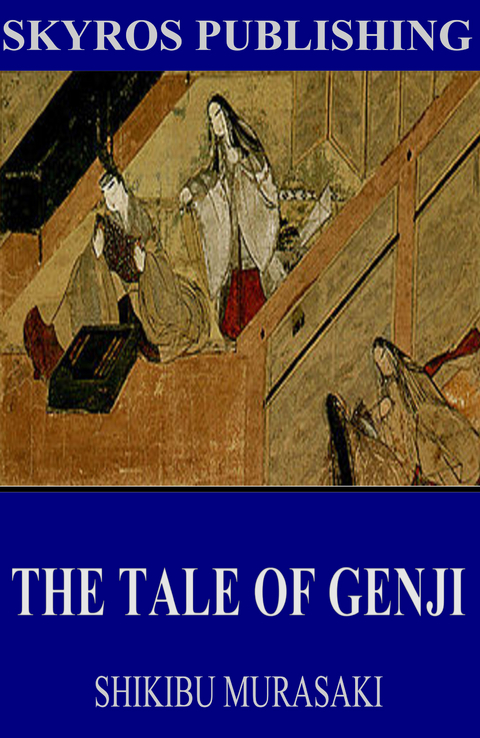
Tale of Genji (eBook)
322 Seiten
Charles River Editors (Verlag)
978-1-5183-3124-4 (ISBN)
Skyros Publishing is dedicated to reproducing the finest books ever written and letting readers of all ages experience a classic for the first time or revisit a past favorite.The Tale of Genji is a classic work of Japanese literature written by the noblewoman Shikibu Murasaki. The book, which is thought to be one of the world's first novels, was written in the 11th century.
CHAPTER I
THE CHAMBER OF KIRI 1
IN THE REIGN OF A certain Emperor, whose name is unknown to us, there was, among the Niogo 2 and Kôyi 2 of the Imperial Court, one who, though she was not of high birth, enjoyed the full tide of Royal favor. Hence her superiors, each one of whom had always been thinking—"I shall be the one,” gazed upon her disdainfully with malignant eyes, and her equals and inferiors were more indignant still.
Such being the state of affairs, the anxiety which she had to endure was great and constant, and this was probably the reason why her health was at last so much affected, that she was often compelled to absent herself from Court, and to retire to the residence of her mother.
Her father, who was a Dainagon, 3 was dead; but her mother, being a woman of good sense, gave her every possible guidance in the due performance of Court ceremony, so that in this respect she seemed but little different from those whose fathers and mothers were still alive to bring them before public notice, yet, nevertheless, her friendliness made her oftentimes feel very diffident from the want of any patron of influence.
These circumstances, however, only tended to make the favor shown to her by the Emperor wax warmer and warmer, and it was even shown to such an extent as to become a warning to after-generations. There had been instances in China in which favoritism such as this had caused national disturbance and disaster; and thus the matter became a subject of public
animadversion, and it seemed not improbable that people would begin to allude even to the example of Yô-ki-hi. 4
In due course, and in consequence, we may suppose, of the Divine blessing on the sincerity of their affection, a jewel of a little prince was born to her. The first prince who had been born to the Emperor was the child of Koki-den-Niogo, 5 the daughter of the Udaijin (a great officer of State). Not only was he first in point of age, but his influence on his mother’s side was so great that public opinion had almost unanimously fixed upon him as heir-apparent. Of this the Emperor was fully conscious, and he only regarded the new-born child with that affection which one lavishes on a domestic favorite. Nevertheless, the mother of the first prince had, not unnaturally, a foreboding that unless matters were managed adroitly her child might be superseded by the younger one. She, we may observe, had been established at Court before any other lady, and had more children than one. The Emperor, therefore, was obliged to treat her with due respect, and reproaches from her always affected him more keenly than those of any others.
To return to her rival. Her constitution was extremely delicate, as we have seen already, and she was surrounded by those who would fain lay bare, so to say, her hidden scars. Her apartments in the palace were Kiri-Tsubo (the chamber of Kiri); so called from the trees that were planted around. In visiting her there the Emperor had to pass before several other chambers, whose occupants universally chafed when they saw it. And again, when it was her turn to attend upon the Emperor, it often happened that they played off mischievous pranks upon her, at different points in the corridor, which leads to the Imperial quarters. Sometimes they would soil the skirts of her attendants, sometimes they would shut against her the door of the covered portico, where no other passage existed; and thus, in every possible way, they one and all combined to annoy her.
The Emperor at length became aware of this, and gave her, for her special chamber, another apartment, which was in the Kôrô-Den, and which was quite close to those in which he himself
resided. It had been originally occupied by another lady who was now removed, and thus fresh resentment was aroused.
When the young Prince was three years old the Hakamagi 6 took place. It was celebrated with a pomp scarcely inferior to that which adorned the investiture of the first Prince. In fact, all available treasures were exhausted on the occasion. And again the public manifested its disapprobation. In the summer of the same year the Kiri-Tsubo-Kôyi became ill, and wished to retire from the palace. The Emperor, however, who was accustomed to see her indisposed, strove to induce her to remain. But her illness increased day by day; and she had drooped and pined away until she was now but a shadow of her former self. She made scarcely any response to the affectionate words and expressions of tenderness which her Royal lover caressingly bestowed upon her. Her eyes were half-closed: she lay like a fading flower in the last stage of exhaustion, and she became so much enfeebled that her mother appeared before the Emperor and entreated with tears that she might be allowed to leave. Distracted by his vain endeavors to devise means to aid her, the Emperor at length ordered a Te-gruma 7 to be in readiness to convey her to her own home, but even then he went to her apartment and cried despairingly: “Did not we vow that we would neither of us be either before or after the other even in travelling the last long journey of life? And can you find it in your heart to leave me now?” Sadly and tenderly looking up, she thus replied, with almost failing breath:–
“Since my departure for this dark journey,
Makes you so sad and lonely,
Fain would I stay though weak and weary,
And live for your sake only!”
“Had I but known this before—”
She appeared to have much more to say, but was too weak to continue. Overpowered with grief, the Emperor at one moment would fain accompany her himself, and at another moment would have her remain to the end where she then was.
At the last, her departure was hurried, because the exorcism for the sick had been appointed to take place on that evening at her home, and she went. The child Prince, however, had been left in the Palace, as his mother wished, even at that time, to make her withdrawal as privately as possible, so as to avoid any invidious observations on the part of her rivals. To the Emperor the night now became black with gloom. He sent messenger after messenger to make inquiries, and could not await their return with patience. Midnight came, and with it the sound of lamentation. The messenger, who could do nothing else, hurried back with the sad tidings of the truth. From that moment the mind of the Emperor was darkened, and he confined himself to his private apartments.
He would still have kept with himself the young Prince now motherless, but there was no precedent for this, and it was arranged that he should be sent to his grandmother for the mourning. The child, who understood nothing, looked with amazement at the sad countenances of the Emperor, and of those around him. All separations have their sting, but sharp indeed was the sting in a case like this.
Now the funeral took place. The weeping and wailing mother, who might have longed to mingle in the same flames, 8 entered a carriage, accompanied by female mourners. The procession arrived at the cemetery of Otagi, and the solemn rites commenced. What were then the thoughts of the desolate mother? The image of her dead daughter was still vividly present to her—still seemed animated with life. She must see her remains become ashes to convince herself that she was really dead. During the ceremony, an Imperial messenger came from the Palace, and invested the dead with the title of Sammi. The letters patent were read, and listened to in solemn silence. The Emperor conferred this title now in regret that during her lifetime he had not even promoted her position from a Kôyi to a Niogo, and wishing at this last moment to raise her title at least one step higher. Once more several tokens of disapprobation were manifested against the proceeding. But, in other respects, the beauty of the departed, and her gracious bearing, which had ever commanded admiration, made people begin to think of her with sympathy. It was the excess of the Emperor’s favor which had created so many detractors
during her lifetime; but now even rivals felt pity for her; and if any did not, it was in the Koki-den. “When one is no more, the memory becomes so dear,” may be an illustration of a case such as this.
Some days passed, and due requiem services were carefully performed. The Emperor was still plunged in thought, and no society had attractions for him. His constant consolation was to send messengers to the grandmother of the child, and to make inquiries after them. It was now autumn, and the evening winds blew chill and cold. The Emperor—who, when he saw the first Prince, could not refrain from thinking of the younger one—became more thoughtful than ever; and, on this evening, he sent Yugei-no Miôbu 9 to repeat his inquiries. She went as the new moon just rose, and the Emperor stood and contemplated from his veranda the prospect spread before him. At such moments he had usually been surrounded by a few chosen friends, one of whom was almost invariably his lost love. Now she was no more. The thrilling notes of her music, the touching strains of her melodies, stole over him in his dark and dreary...
| Erscheint lt. Verlag | 22.3.2018 |
|---|---|
| Übersetzer | Shikibu Murasaki |
| Sprache | englisch |
| Themenwelt | Literatur ► Historische Romane |
| Literatur ► Klassiker / Moderne Klassiker | |
| Schlagworte | Asia • Classic • Fiction • History • Japanese • Literary • Samurai |
| ISBN-10 | 1-5183-3124-6 / 1518331246 |
| ISBN-13 | 978-1-5183-3124-4 / 9781518331244 |
| Informationen gemäß Produktsicherheitsverordnung (GPSR) | |
| Haben Sie eine Frage zum Produkt? |
 EPUB (Adobe DRM)
Größe: 841 KB
Kopierschutz: Adobe-DRM
Adobe-DRM ist ein Kopierschutz, der das eBook vor Mißbrauch schützen soll. Dabei wird das eBook bereits beim Download auf Ihre persönliche Adobe-ID autorisiert. Lesen können Sie das eBook dann nur auf den Geräten, welche ebenfalls auf Ihre Adobe-ID registriert sind.
Details zum Adobe-DRM
Dateiformat: EPUB (Electronic Publication)
EPUB ist ein offener Standard für eBooks und eignet sich besonders zur Darstellung von Belletristik und Sachbüchern. Der Fließtext wird dynamisch an die Display- und Schriftgröße angepasst. Auch für mobile Lesegeräte ist EPUB daher gut geeignet.
Systemvoraussetzungen:
PC/Mac: Mit einem PC oder Mac können Sie dieses eBook lesen. Sie benötigen eine
eReader: Dieses eBook kann mit (fast) allen eBook-Readern gelesen werden. Mit dem amazon-Kindle ist es aber nicht kompatibel.
Smartphone/Tablet: Egal ob Apple oder Android, dieses eBook können Sie lesen. Sie benötigen eine
Geräteliste und zusätzliche Hinweise
Buying eBooks from abroad
For tax law reasons we can sell eBooks just within Germany and Switzerland. Regrettably we cannot fulfill eBook-orders from other countries.
EPUB (Ohne DRM)Digital Rights Management: ohne DRM
Dieses eBook enthält kein DRM oder Kopierschutz. Eine Weitergabe an Dritte ist jedoch rechtlich nicht zulässig, weil Sie beim Kauf nur die Rechte an der persönlichen Nutzung erwerben.
Dateiformat: EPUB (Electronic Publication)
EPUB ist ein offener Standard für eBooks und eignet sich besonders zur Darstellung von Belletristik und Sachbüchern. Der Fließtext wird dynamisch an die Display- und Schriftgröße angepasst. Auch für mobile Lesegeräte ist EPUB daher gut geeignet.
Systemvoraussetzungen:
PC/Mac: Mit einem PC oder Mac können Sie dieses eBook lesen. Sie benötigen dafür die kostenlose Software Adobe Digital Editions.
eReader: Dieses eBook kann mit (fast) allen eBook-Readern gelesen werden. Mit dem amazon-Kindle ist es aber nicht kompatibel.
Smartphone/Tablet: Egal ob Apple oder Android, dieses eBook können Sie lesen. Sie benötigen dafür eine kostenlose App.
Geräteliste und zusätzliche Hinweise
Buying eBooks from abroad
For tax law reasons we can sell eBooks just within Germany and Switzerland. Regrettably we cannot fulfill eBook-orders from other countries.
aus dem Bereich


