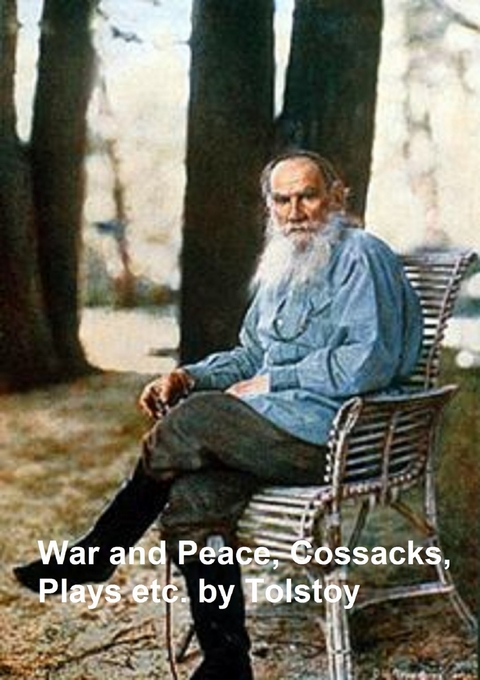
War and Peace, Cossacks, Plays, etc. (eBook)
1123 Seiten
Seltzer Books (Verlag)
978-1-4553-9338-1 (ISBN)
This file includes: Father Sergius, Master and Man, What Men Live by and Other Tales, The Cause of It All, The First Distiller, Fruits of Culture, The Light Shines in Darkness, The Live Corpse, The Power of Darkness, and War and Peace. According to Wikipedia: 'Leo Tolstoy, or Count Lev Nikolayevich Tolstoy (September 9 [O.S. August 28] 1828 - November 20 [O.S. November 7] 1910), was a Russian writer widely regarded as among the greatest of novelists. His masterpieces War and Peace and Anna Karenina represent in their scope, breadth and vivid depiction of 19th-century Russian life and attitudes, the peak of realist fiction. Tolstoy's further talents as essayist, dramatist, and educational reformer made him the most influential member of the aristocratic Tolstoy family. His literal interpretation of the ethical teachings of Jesus, centering on the Sermon on the Mount, caused him in later life to become a fervent Christian anarchist and pacifist. His ideas on nonviolent resistance, expressed in such works as The Kingdom of God Is Within You, were to have a profound impact on such pivotal twentieth-century figures as Gandhi and Martin Luther King, Jr.' Also according to Wikipedia: 'Aylmer Maude (28 March 1858 - 25 August 1938) and Louise Maude (1855-1939) were English translators of Tolstoy's works, and Aylmer Maude also wrote his friend Tolstoy's biography. After living many years in Russia the Maudes spent the rest of their life in England translating Tolstoy's writing and promoting public interest in his work. Aylmer Maude was also involved in a number of early 20th century progressive and idealistic causes.'
This file includes: Father Sergius, Master and Man, What Men Live by and Other Tales, The Cause of It All, The First Distiller, Fruits of Culture, The Light Shines in Darkness, The Live Corpse, The Power of Darkness, and War and Peace. According to Wikipedia: "e;Leo Tolstoy, or Count Lev Nikolayevich Tolstoy (September 9 [O.S. August 28] 1828 - November 20 [O.S. November 7] 1910), was a Russian writer widely regarded as among the greatest of novelists. His masterpieces War and Peace and Anna Karenina represent in their scope, breadth and vivid depiction of 19th-century Russian life and attitudes, the peak of realist fiction. Tolstoy's further talents as essayist, dramatist, and educational reformer made him the most influential member of the aristocratic Tolstoy family. His literal interpretation of the ethical teachings of Jesus, centering on the Sermon on the Mount, caused him in later life to become a fervent Christian anarchist and pacifist. His ideas on nonviolent resistance, expressed in such works as The Kingdom of God Is Within You, were to have a profound impact on such pivotal twentieth-century figures as Gandhi and Martin Luther King, Jr."e; Also according to Wikipedia: "e;Aylmer Maude (28 March 1858 - 25 August 1938) and Louise Maude (1855-1939) were English translators of Tolstoy's works, and Aylmer Maude also wrote his friend Tolstoy's biography. After living many years in Russia the Maudes spent the rest of their life in England translating Tolstoy's writing and promoting public interest in his work. Aylmer Maude was also involved in a number of early 20th century progressive and idealistic causes."e;
WAR AND PEACE, THE COSSACKS, 6 PLAYS, PLUS STORIES AND NOVELLAS BY TOLSTOY
translated by Aylmer and Louise Maude
________________
Published by Seltzer Books. seltzerbooks.com
established in 1974, as B&R Samizdat Express
offering over 14,000 books
feedback welcome: seltzer@seltzerbooks.com
________________
Novellas and Stories
What Men Live by and Other Tales
Plays
Novels
____________
FATHER SERGIUS
By Leo Tolstoy
I
In Petersburg in the eighteen-forties a surprising event occurred. An officer of the Cuirassier Life Guards, a handsome prince who everyone predicted would become aide-de-camp to the Emperor Nicholas I and have a brilliant career, left the service, broke off his engagement to a beautiful maid of honour, a favourite of the Empress's, gave his small estate to his sister, and retired to a monastery to become a monk.
This event appeared extraordinary and inexplicable to those who did not know his inner motives, but for Prince Stepan Kasatsky himself it all occurred so naturally that he could not imagine how he could have acted otherwise.
His father, a retired colonel of the Guards, had died when Stepan was twelve, and sorry as his mother was to part from her son, she entered him at the Military College as her deceased husband had intended.
The widow herself, with her daughter, Varvara, moved to Petersburg to be near her son and have him with her for the holidays.
The boy was distinguished both by his brilliant ability and by his immense self-esteem. He was first both in his studies--especially in mathematics, of which he was particularly fond--and also in drill and in riding. Though of more than average height, he was handsome and agile, and he would have been an altogether exemplary cadet had it not been for his quick temper. He was remarkably truthful, and was neither dissipated nor addicted to drink. The only faults that marred his conduct were fits of fury to which he was subject and during which he lost control of himself and became like a wild animal. He once nearly threw out of the window another cadet who had begun to tease him about his collection of minerals. On another occasion he came almost completely to grief by flinging a whole dish of cutlets at an officer who was acting as steward, attacking him and, it was said, striking him for having broken his word and told a barefaced lie. He would certainly have been reduced to the ranks had not the Director of the College hushed up the whole matter and dismissed the steward.
By the time he was eighteen he had finished his College course and received a commission as lieutenant in an aristocratic regiment of the Guards.
The Emperor Nicholas Pavlovich (Nicholas I) had noticed him while he was still at the College, and continued to take notice of him in the regiment, and it was on this account that people predicted for him an appointment as aide-de-camp to the Emperor. Kasatsky himself strongly desired it, not from ambition only but chiefly because since his cadet days he had been passionately devoted to Nicholas Pavlovich. The Emperor had often visited the Military College and every time Kasatsky saw that tall erect figure, with breast expanded in its military overcoat, entering with brisk step, saw the cropped side-whiskers, the moustache, the aquiline nose, and heard the sonorous voice exchanging greetings with the cadets, he was seized by the same rapture that he experienced later on when he met the woman he loved. Indeed, his passionate adoration of the Emperor was even stronger: he wished to sacrifice something--everything, even himself--to prove his complete devotion. And the Emperor Nicholas was conscious of evoking this rapture and deliberately aroused it. He played with the cadets, surrounded himself with them, treating them sometimes with childish simplicity, sometimes as a friend, and then again with majestic solemnity. After that affair with the officer, Nicholas Pavlovich said nothing to Kasatsky, but when the latter approached he waved him away theatrically, frowned, shook his finger at him, and afterwards when leaving, said: 'Remember that I know everything. There are some things I would rather not know, but they remain here,' and he pointed to his heart.
When on leaving College the cadets were received by the Emperor, he did not again refer to Kasatsky's offence, but told them all, as was his custom, that they should serve him and the fatherland loyally, that he would always be their best friend, and that when necessary they might approach him direct. All the cadets were as usual greatly moved, and Kasatsky even shed tears, remembering the past, and vowed that he would serve his beloved Tsar with all his soul.
When Kasatsky took up his commission his mother moved with her daughter first to Moscow and then to their country estate. Kasatsky gave half his property to his sister and kept only enough to maintain himself in the expensive regiment he had joined.
To all appearance he was just an ordinary, brilliant young officer of the Guards making a career for himself; but intense and complex strivings went on within him. From early childhood his efforts had seemed to be very varied, but essentially they were all one and the same. He tried in everything he took up to attain such success and perfection as would evoke praise and surprise. Whether it was his studies or his military exercises, he took them up and worked at them till he was praised and held up as an example to others. Mastering one subject he took up another, and obtained first place in his studies. For example, while still at College he noticed in himself an awkwardness in French conversation, and contrived to master French till he spoke it as well as Russian, and then he took up chess and became an excellent player.
Apart from his main vocation, which was the service of his Tsar and the fatherland, he always set himself some particular aim, and however unimportant it was, devoted himself completely to it and lived for it until it was accomplished. And as soon as it was attained another aim would immediately present itself, replacing its predecessor. This passion for distinguishing himself, or for accomplishing something in order to distinguish himself, filled his life. On taking up his commission he set himself to acquire the utmost perfection in knowledge of the service, and very soon became a model officer, though still with the same fault of ungovernable irascibility, which here in the service again led him to commit actions inimical to his success. Then he took to reading, having once in conversation in society felt himself deficient in general education--and again achieved his purpose. Then, wishing to secure a brilliant position in high society, he learnt to dance excellently and very soon was invited to all the balls in the best circles, and to some of their evening gatherings. But this did not satisfy him: he was accustomed to being first, and in this society was far from being so.
The highest society then consisted, and I think always consist, of four sorts of people: rich people who are received at Court, people not wealthy but born and brought up in Court circles, rich people who ingratiate themselves into the Court set, and people neither rich nor belonging to the Court but who ingratiate themselves into the first and second sets.
Kasatsky did not belong to the first two sets, but was readily welcomed in the others. On entering society he determined to have relations with some society lady, and to his own surprise quickly accomplished this purpose. He soon realized, however, that the circles in which he moved were not the highest, and that though he was received in the highest spheres he did not belong to them. They were polite to him, but showed by their whole manner that they had their own set and that he was not of it. And Kasatsky wished to belong to that inner circle. To attain that end it would be necessary to be an aide-de-camp to the Emperor--which he expected to become--or to marry into that exclusive set, which he resolved to do. And his choice fell on a beauty belonging to the Court, who not merely belonged to the circle into which he wished to be accepted, but whose friendship was coveted by the very highest people and those most firmly established in that highest circle. This was Countess Korotkova. Kasatsky began to pay court to her, and not merely for the sake of his career. She was extremely attractive and he soon fell in love with her. At first she was noticeably cool towards him, but then suddenly changed and became gracious, and her mother gave him pressing invitations to visit them. Kasatsky proposed and was...
| Erscheint lt. Verlag | 1.3.2018 |
|---|---|
| Sprache | englisch |
| Themenwelt | Literatur ► Anthologien |
| Literatur ► Klassiker / Moderne Klassiker | |
| Literatur ► Romane / Erzählungen | |
| ISBN-10 | 1-4553-9338-X / 145539338X |
| ISBN-13 | 978-1-4553-9338-1 / 9781455393381 |
| Informationen gemäß Produktsicherheitsverordnung (GPSR) | |
| Haben Sie eine Frage zum Produkt? |
 EPUB (Adobe DRM)
Größe: 2,1 MB
Kopierschutz: Adobe-DRM
Adobe-DRM ist ein Kopierschutz, der das eBook vor Mißbrauch schützen soll. Dabei wird das eBook bereits beim Download auf Ihre persönliche Adobe-ID autorisiert. Lesen können Sie das eBook dann nur auf den Geräten, welche ebenfalls auf Ihre Adobe-ID registriert sind.
Details zum Adobe-DRM
Dateiformat: EPUB (Electronic Publication)
EPUB ist ein offener Standard für eBooks und eignet sich besonders zur Darstellung von Belletristik und Sachbüchern. Der Fließtext wird dynamisch an die Display- und Schriftgröße angepasst. Auch für mobile Lesegeräte ist EPUB daher gut geeignet.
Systemvoraussetzungen:
PC/Mac: Mit einem PC oder Mac können Sie dieses eBook lesen. Sie benötigen eine
eReader: Dieses eBook kann mit (fast) allen eBook-Readern gelesen werden. Mit dem amazon-Kindle ist es aber nicht kompatibel.
Smartphone/Tablet: Egal ob Apple oder Android, dieses eBook können Sie lesen. Sie benötigen eine
Geräteliste und zusätzliche Hinweise
Buying eBooks from abroad
For tax law reasons we can sell eBooks just within Germany and Switzerland. Regrettably we cannot fulfill eBook-orders from other countries.
EPUB (Ohne DRM)Digital Rights Management: ohne DRM
Dieses eBook enthält kein DRM oder Kopierschutz. Eine Weitergabe an Dritte ist jedoch rechtlich nicht zulässig, weil Sie beim Kauf nur die Rechte an der persönlichen Nutzung erwerben.
Dateiformat: EPUB (Electronic Publication)
EPUB ist ein offener Standard für eBooks und eignet sich besonders zur Darstellung von Belletristik und Sachbüchern. Der Fließtext wird dynamisch an die Display- und Schriftgröße angepasst. Auch für mobile Lesegeräte ist EPUB daher gut geeignet.
Systemvoraussetzungen:
PC/Mac: Mit einem PC oder Mac können Sie dieses eBook lesen. Sie benötigen dafür die kostenlose Software Adobe Digital Editions.
eReader: Dieses eBook kann mit (fast) allen eBook-Readern gelesen werden. Mit dem amazon-Kindle ist es aber nicht kompatibel.
Smartphone/Tablet: Egal ob Apple oder Android, dieses eBook können Sie lesen. Sie benötigen dafür eine kostenlose App.
Geräteliste und zusätzliche Hinweise
Buying eBooks from abroad
For tax law reasons we can sell eBooks just within Germany and Switzerland. Regrettably we cannot fulfill eBook-orders from other countries.
aus dem Bereich