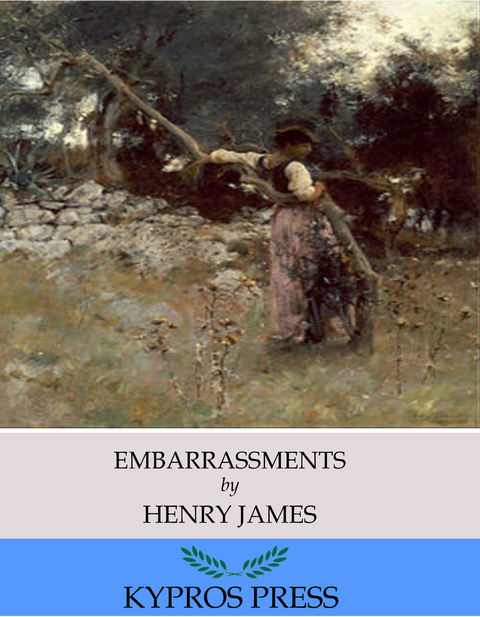
Embarrassments (eBook)
248 Seiten
Charles River Editors (Verlag)
978-1-5183-0534-4 (ISBN)

Henry James was an American born writer who spent most of his life in Britain. Because of that James often wrote novels about Americans traveling to Europe and their encounters with Europeans. This edition of Embarrassments includes a table of contents.
II
THE EFFECT OF MY VISIT to Bridges was to turn me out for more profundity. Hugh Vereker, as I saw him there, was of a contact so void of angles that I blushed for the poverty of imagination involved in my small precautions. If he was in spirits it was not because he had read my review; in fact on the Sunday morning I felt sure he hadn’t read it, though The Middle had been out three days and bloomed, I assured myself, in the stiff garden of periodicals which gave one of the ormolu tables the air of a stand at a station. The impression he made on me personally was such that I wished him to read it, and I corrected to this end with a surreptitious hand what might be wanting in the careless conspicuity of the sheet. I am afraid I even watched the result of my manouvre, but up to luncheon I watched in vain.
When afterwards, in the course of our gregarious walk, I found myself for half an hour, not perhaps without another manoeuvre, at the great man’s side, the result of his affability was a still livelier desire that he should not remain in ignorance of the peculiar justice I had done him. It was not that he seemed to thirst for justice; on the contrary I had not yet caught in his talk the faintest grunt of a grudge—a note for which my young experience had already given me an ear. Of late he had had more recognition, and it was pleasant, as we used to say in The Middle, to see that it drew him out. He wasn’t of course popular, but I judged one of the sources of his good humour to be precisely that his success was independent of that. He had none the less become in a manner the fashion; the critics at least had put on a spurt and caught up with him. We had found out at last how clever he was, and he had had to make the best of the loss of his mystery. I was strongly tempted, as I walked beside him, to let him know how much of that unveiling was my act; and there was a moment when I probably should have done so had not one of the ladies of our party, snatching a place at his other elbow, just then appealed to him in a spirit comparatively selfish. It was very discouraging: I almost felt the liberty had been taken with myself.
I had had on my tongue’s end, for my own part, a phrase or two about the right word at the right time; but later on I was glad not to have spoken, for when on our return we clustered at tea I perceived Lady Jane, who had not been out with us, brandishing The Middle with her longest arm. She had taken it up at her leisure; she was delighted with what she had found, and I saw that, as a mistake in a man may often be a felicity in a woman, she would practically do for me what I hadn’t been able to do for myself. “Some sweet little truths that needed to be spoken,” I heard her declare, thrusting the paper at rather a bewildered couple by the fireplace. She grabbed it away from them again on the reappearance of Hugh Vereker, who after our walk had been upstairs to change something. “I know you don’t in general look at this kind of thing, but it’s an occasion really for doing so. You haven’t seen it? Then you must. The man has actually got at you, at what I always feel, you know.” Lady Jane threw into her eyes a look evidently intended to give an idea of what she always felt; but she added that she couldn’t have expressed it. The man in the paper expressed it in a striking manner. “Just see there, and there, where I’ve dashed it, how he brings it out.” She had literally marked for him the brightest patches of my prose, and if I was a little amused Vereker himself may well have been. He showed how much he was when before us all Lady Jane wanted to read something aloud. I liked at any rate the way he defeated her purpose by jerking the paper affectionately out of her clutch. He would take it upstairs with him, would look at it on going to dress. He did this half an hour later—I saw it in his hand when he repaired to his room. That was the moment at which, thinking to give her pleasure, I mentioned to Lady Jane that I was the author of the review. I did give her pleasure, I judged, but perhaps not quite so much as I had expected. If the author was “only me” the thing didn’t seem quite so remarkable. Hadn’t I had the effect rather of diminishing the lustre of the article than of adding to my own? Her ladyship was subject to the most extraordinary drops. It didn’t matter; the only effect I cared about was the one it would have on Vereker up there by his bedroom fire.
At dinner I watched for the signs of this impression, tried to fancy there was some happier light in his eyes; but to my disappointment Lady Jane gave me no chance to make sure. I had hoped she would call triumphantly down the table, publicly demand if she hadn’t been right. The party was large—there were people from outside as well, but I had never seen a table long enough to deprive Lady Jane of a triumph. I was just reflecting in truth that this interminable board would deprive me of one, when the guest next me, dear woman—she was Miss Poyle, the vicar’s sister, a robust, unmodulated person—had the happy inspiration and the unusual courage to address herself across it to Vereker, who was opposite, but not directly, so that when he replied they were both leaning forward. She inquired, artless body, what he thought of Lady Jane’s “panegyric,” which she had read—not connecting it however with her right-hand neighbour; and while I strained my ear for his reply I heard him, to my stupefaction, call back gaily, with his mouth full of bread: “Oh, it’s all right—it’s the usual twaddle!”
I had caught Vereker’s glance as he spoke, but Miss Poyle’s surprise was a fortunate cover for my own. “You mean he doesn’t do you justice?” said the excellent woman.
Vereker laughed out, and I was happy to be able to do the same. “It’s a charming article,” he tossed us.
Miss Poyle thrust her chin half across the cloth.
“Oh you’re so deep!” she drove home.
“As deep as the ocean! All I pretend is, the author doesn’t see—”
A dish was at this point passed over his shoulder, and we had to wait while he helped himself.
“Doesn’t see what?” my neighbour continued.
“Doesn’t see anything.”
“Dear me—how very stupid!”
“Not a bit,” Vereker laughed again. “Nobody does.”
The lady on his further side appealed to him, and Miss Poyle sank back to me. “Nobody sees anything!” she cheerfully announced; to which I replied that I had often thought so too, but had somehow taken the thought for a proof on my own part of a tremendous eye. I didn’t tell her the article was mine; and I observed that Lady Jane, occupied at the end of the table, had not caught Vereker’s words.
I rather avoided him after dinner, for I confess he struck me as cruelly conceited, and the revelation was a pain. “The usual twaddle"—my acute little study! That one’s admiration should have had a reserve or two could gall him to that point? I had thought him placid, and he was placid enough; such a surface was the hard, polished glass that encased the bauble of his vanity. I was really ruffled, the only comfort was that if nobody saw anything George Corvick was quite as much out of it as I. This comfort however was not sufficient, after the ladies had dispersed, to carry me in the proper manner—I mean in a spotted jacket and humming an air—into the smoking-room. I took my way in some dejection to bed; but in the passage I encountered Mr. Vereker, who had been up once more to change, coming out of his room. He was humming an air and had on a spotted jacket, and as soon as he saw me his gaiety gave a start.
“My dear young man,” he exclaimed, “I’m so glad to lay hands on you! I’m afraid I most unwittingly wounded you by those words of mine at dinner to Miss Poyle. I learned but half an hour ago from Lady Jane that you wrote the little notice in The Middle.”
I protested that no bones were broken; but he moved with me to my own door, his hand on my shoulder, kindly feeling for a fracture; and on hearing that I had come up to bed he asked leave to cross my threshold and just tell me in three words what his qualification of my remarks had represented. It was plain he really feared I was hurt, and the sense of his solicitude suddenly made all the difference to me. My cheap review fluttered off into space, and the best things I had said in it became flat enough beside the brilliancy of his being there. I can see him there still, on my rug, in the firelight and his spotted jacket, his fine, clear face all bright with the desire to be tender to my youth. I don’t know what he had at first meant to say, but I think the sight of my relief touched him, excited him, brought up words to his lips from far within. It was so these words presently conveyed to me something that, as I afterwards knew, he had never uttered to any one. I have always done justice to the generous impulse that made him speak; it was simply compunction for a snub unconsciously administered to a man of letters in a position inferior to his own, a man of letters moreover in the very act of praising him. To make the thing right he talked to me exactly as an equal and on the ground of what we both loved best. The hour, the place, the unexpectedness...
| Erscheint lt. Verlag | 22.3.2018 |
|---|---|
| Sprache | englisch |
| Themenwelt | Literatur ► Anthologien |
| Literatur ► Klassiker / Moderne Klassiker | |
| Literatur ► Romane / Erzählungen | |
| Schlagworte | British • Classic • Cultural • Daisy Miller • Historical • Portrait of a Lady • The Americans • Turn of the Screw • Washington Square |
| ISBN-10 | 1-5183-0534-2 / 1518305342 |
| ISBN-13 | 978-1-5183-0534-4 / 9781518305344 |
| Informationen gemäß Produktsicherheitsverordnung (GPSR) | |
| Haben Sie eine Frage zum Produkt? |
 EPUB (Adobe DRM)
Größe: 749 KB
Kopierschutz: Adobe-DRM
Adobe-DRM ist ein Kopierschutz, der das eBook vor Mißbrauch schützen soll. Dabei wird das eBook bereits beim Download auf Ihre persönliche Adobe-ID autorisiert. Lesen können Sie das eBook dann nur auf den Geräten, welche ebenfalls auf Ihre Adobe-ID registriert sind.
Details zum Adobe-DRM
Dateiformat: EPUB (Electronic Publication)
EPUB ist ein offener Standard für eBooks und eignet sich besonders zur Darstellung von Belletristik und Sachbüchern. Der Fließtext wird dynamisch an die Display- und Schriftgröße angepasst. Auch für mobile Lesegeräte ist EPUB daher gut geeignet.
Systemvoraussetzungen:
PC/Mac: Mit einem PC oder Mac können Sie dieses eBook lesen. Sie benötigen eine
eReader: Dieses eBook kann mit (fast) allen eBook-Readern gelesen werden. Mit dem amazon-Kindle ist es aber nicht kompatibel.
Smartphone/Tablet: Egal ob Apple oder Android, dieses eBook können Sie lesen. Sie benötigen eine
Geräteliste und zusätzliche Hinweise
Buying eBooks from abroad
For tax law reasons we can sell eBooks just within Germany and Switzerland. Regrettably we cannot fulfill eBook-orders from other countries.
EPUB (Ohne DRM)Digital Rights Management: ohne DRM
Dieses eBook enthält kein DRM oder Kopierschutz. Eine Weitergabe an Dritte ist jedoch rechtlich nicht zulässig, weil Sie beim Kauf nur die Rechte an der persönlichen Nutzung erwerben.
Dateiformat: EPUB (Electronic Publication)
EPUB ist ein offener Standard für eBooks und eignet sich besonders zur Darstellung von Belletristik und Sachbüchern. Der Fließtext wird dynamisch an die Display- und Schriftgröße angepasst. Auch für mobile Lesegeräte ist EPUB daher gut geeignet.
Systemvoraussetzungen:
PC/Mac: Mit einem PC oder Mac können Sie dieses eBook lesen. Sie benötigen dafür die kostenlose Software Adobe Digital Editions.
eReader: Dieses eBook kann mit (fast) allen eBook-Readern gelesen werden. Mit dem amazon-Kindle ist es aber nicht kompatibel.
Smartphone/Tablet: Egal ob Apple oder Android, dieses eBook können Sie lesen. Sie benötigen dafür eine kostenlose App.
Geräteliste und zusätzliche Hinweise
Buying eBooks from abroad
For tax law reasons we can sell eBooks just within Germany and Switzerland. Regrettably we cannot fulfill eBook-orders from other countries.
aus dem Bereich