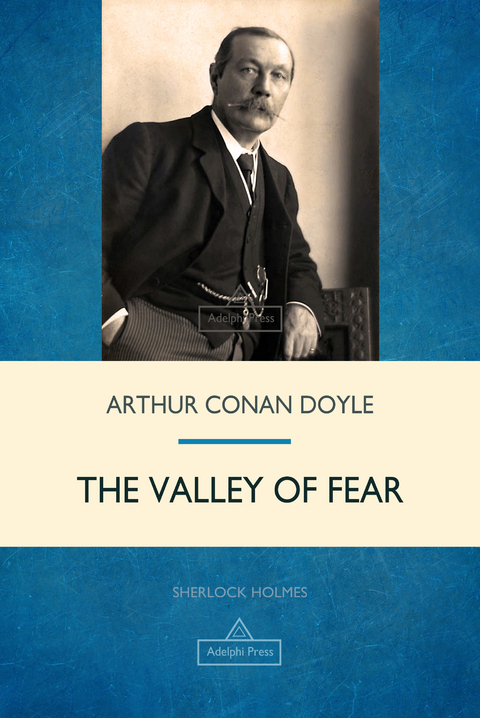
Valley of Fear (eBook)
162 Seiten
Adelphi Press (Verlag)
978-1-78724-623-2 (ISBN)
A cipher message arrives from Fred Porlock, a pseudonymous agent of Professor Moriarty. After Porlock sends the message, however, he changes his mind for fear of Moriarty's discovering that he is a traitor. He decides not to send the key to the cipher, but he sends Holmes a note telling of this decision.
CHAPTER 2 — SHERLOCK HOLMES DISCOURSES
It was one of those dramatic moments for which my friend existed. It would be an overstatement to say that he was shocked or even excited by the amazing announcement. Without having a tinge of cruelty in his singular composition, he was undoubtedly callous from long overstimulation. Yet, if his emotions were dulled, his intellectual perceptions were exceedingly active. There was no trace then of the horror which I had myself felt at this curt declaration; but his face showed rather the quiet and interested composure of the chemist who sees the crystals falling into position from his oversaturated solution.
“Remarkable!” said he. “Remarkable!”
“You don’t seem surprised.”
“Interested, Mr. Mac, but hardly surprised. Why should I be surprised? I receive an anonymous communication from a quarter which I know to be important, warning me that danger threatens a certain person. Within an hour I learn that this danger has actually materialized and that the person is dead. I am interested; but, as you observe, I am not surprised.”
In a few short sentences he explained to the inspector the facts about the letter and the cipher. MacDonald sat with his chin on his hands and his great sandy eyebrows bunched into a yellow tangle.
“I was going down to Birlstone this morning,” said he. “I had come to ask you if you cared to come with me—you and your friend here. But from what you say we might perhaps be doing better work in London.”
“I rather think not,” said Holmes.
“Hang it all, Mr. Holmes!” cried the inspector. “The papers will be full of the Birlstone mystery in a day or two; but where’s the mystery if there is a man in London who prophesied the crime before ever it occurred? We have only to lay our hands on that man, and the rest will follow.”
“No doubt, Mr. Mac. But how do you propose to lay your hands on the so-called Porlock?”
MacDonald turned over the letter which Holmes had handed him. “Posted in Camberwell—that doesn’t help us much. Name, you say, is assumed. Not much to go on, certainly. Didn’t you say that you have sent him money?”
“Twice.”
“And how?”
“In notes to Camberwell post office.”
“Did you ever trouble to see who called for them?”
“No.”
The inspector looked surprised and a little shocked. “Why not?”
“Because I always keep faith. I had promised when he first wrote that I would not try to trace him.”
“You think there is someone behind him?”
“I know there is.”
“This professor that I’ve heard you mention?”
“Exactly!”
Inspector MacDonald smiled, and his eyelid quivered as he glanced towards me. “I won’t conceal from you, Mr. Holmes, that we think in the C.I.D. that you have a wee bit of a bee in your bonnet over this professor. I made some inquiries myself about the matter. He seems to be a very respectable, learned, and talented sort of man.”
“I’m glad you’ve got so far as to recognize the talent.”
“Man, you can’t but recognize it! After I heard your view I made it my business to see him. I had a chat with him on eclipses. How the talk got that way I canna think; but he had out a reflector lantern and a globe, and made it all clear in a minute. He lent me a book; but I don’t mind saying that it was a bit above my head, though I had a good Aberdeen upbringing. He’d have made a grand meenister with his thin face and gray hair and solemn-like way of talking. When he put his hand on my shoulder as we were parting, it was like a father’s blessing before you go out into the cold, cruel world.”
Holmes chuckled and rubbed his hands. “Great!” he said. “Great! Tell me, Friend MacDonald, this pleasing and touching interview was, I suppose, in the professor’s study?”
“That’s so.”
“A fine room, is it not?”
“Very fine—very handsome indeed, Mr. Holmes.”
“You sat in front of his writing desk?”
“Just so.”
“Sun in your eyes and his face in the shadow?”
“Well, it was evening; but I mind that the lamp was turned on my face.”
“It would be. Did you happen to observe a picture over the professor’s head?”
“I don’t miss much, Mr. Holmes. Maybe I learned that from you. Yes, I saw the picture—a young woman with her head on her hands, peeping at you sideways.”
“That painting was by Jean Baptiste Greuze.”
The inspector endeavoured to look interested.
“Jean Baptiste Greuze,” Holmes continued, joining his finger tips and leaning well back in his chair, “was a French artist who flourished between the years 1750 and 1800. I allude, of course to his working career. Modern criticism has more than indorsed the high opinion formed of him by his contemporaries.”
The inspector’s eyes grew abstracted. “Hadn’t we better—” he said.
“We are doing so,” Holmes interrupted. “All that I am saying has a very direct and vital bearing upon what you have called the Birlstone Mystery. In fact, it may in a sense be called the very centre of it.”
MacDonald smiled feebly, and looked appealingly to me. “Your thoughts move a bit too quick for me, Mr. Holmes. You leave out a link or two, and I can’t get over the gap. What in the whole wide world can be the connection between this dead painting man and the affair at Birlstone?”
“All knowledge comes useful to the detective,” remarked Holmes. “Even the trivial fact that in the year 1865 a picture by Greuze entitled La Jeune Fille a l’Agneau fetched one million two hundred thousand francs—more than forty thousand pounds—at the Portalis sale may start a train of reflection in your mind.”
It was clear that it did. The inspector looked honestly interested.
“I may remind you,” Holmes continued, “that the professor’s salary can be ascertained in several trustworthy books of reference. It is seven hundred a year.”
“Then how could he buy—”
“Quite so! How could he?”
“Ay, that’s remarkable,” said the inspector thoughtfully. “Talk away, Mr. Holmes. I’m just loving it. It’s fine!”
Holmes smiled. He was always warmed by genuine admiration—the characteristic of the real artist. “What about Birlstone?” he asked.
“We’ve time yet,” said the inspector, glancing at his watch. “I’ve a cab at the door, and it won’t take us twenty minutes to Victoria. But about this picture: I thought you told me once, Mr. Holmes, that you had never met Professor Moriarty.”
“No, I never have.”
“Then how do you know about his rooms?”
“Ah, that’s another matter. I have been three times in his rooms, twice waiting for him under different pretexts and leaving before he came. Once—well, I can hardly tell about the once to an official detective. It was on the last occasion that I took the liberty of running over his papers—with the most unexpected results.”
“You found something compromising?”
“Absolutely nothing. That was what amazed me. However, you have now seen the point of the picture. It shows him to be a very wealthy man. How did he acquire wealth? He is unmarried. His younger brother is a station master in the west of England. His chair is worth seven hundred a year. And he owns a Greuze.”
“Well?”
“Surely the inference is plain.”
“You mean that he has a great income and that he must earn it in an illegal fashion?”
“Exactly. Of course I have other reasons for thinking so—dozens of exiguous threads which lead vaguely up towards the centre of the web where the poisonous, motionless creature is lurking. I only mention the Greuze because it brings the matter within the range of your own observation.”
“Well, Mr. Holmes, I admit that what you say is interesting: it’s more than interesting—it’s just wonderful. But let us have it a little clearer if you can. Is it forgery, coining, burglary—where does the money come from?”
“Have you ever read of Jonathan Wild?”
“Well, the name has a familiar sound. Someone in a novel, was he not? I don’t take much stock of detectives in novels—chaps that do things and never let you see how they do them. That’s just inspiration: not business.”
“Jonathan Wild wasn’t a detective, and he wasn’t in a novel. He was a master criminal, and he lived last century—1750 or thereabouts.”
“Then he’s no use to me. I’m a practical man.”
“Mr. Mac, the most practical thing that you ever did in your life would be to shut yourself up for three months and read twelve hours a day at the annals of crime. Everything comes in circles—even Professor Moriarty. Jonathan Wild was the hidden force of the London criminals, to whom he sold his brains and his organization on a fifteen per cent. commission. The old wheel turns, and the same spoke comes up. It’s all been done before, and will be again. I’ll tell you one or two things about Moriarty which may interest you.”
“You’ll interest me, right enough.”
“I happen to know who is the first link in his chain—a chain with this Napoleon-gone-wrong at one end, and a hundred broken fighting men, pickpockets, blackmailers, and card sharpers at the other, with every sort of crime in between. His chief of staff is Colonel Sebastian Moran, as aloof and guarded and inaccessible to the law as himself. What do you think he pays him?”
“I’d like to hear.”
“Six thousand a year. That’s paying for brains, you...
| Erscheint lt. Verlag | 5.7.2018 |
|---|---|
| Reihe/Serie | Sherlock Holmes | Sherlock Holmes |
| Sprache | englisch |
| Themenwelt | Literatur ► Anthologien |
| Literatur ► Klassiker / Moderne Klassiker | |
| Literatur ► Romane / Erzählungen | |
| Schlagworte | adventure stories • Conan Doyle • Crime • detective • Doyle • Dr. Watson • Murder • Mystery • Sherlock • Sherlock Holmes |
| ISBN-10 | 1-78724-623-X / 178724623X |
| ISBN-13 | 978-1-78724-623-2 / 9781787246232 |
| Informationen gemäß Produktsicherheitsverordnung (GPSR) | |
| Haben Sie eine Frage zum Produkt? |
 EPUB (Adobe DRM)
Größe: 886 KB
Kopierschutz: Adobe-DRM
Adobe-DRM ist ein Kopierschutz, der das eBook vor Mißbrauch schützen soll. Dabei wird das eBook bereits beim Download auf Ihre persönliche Adobe-ID autorisiert. Lesen können Sie das eBook dann nur auf den Geräten, welche ebenfalls auf Ihre Adobe-ID registriert sind.
Details zum Adobe-DRM
Dateiformat: EPUB (Electronic Publication)
EPUB ist ein offener Standard für eBooks und eignet sich besonders zur Darstellung von Belletristik und Sachbüchern. Der Fließtext wird dynamisch an die Display- und Schriftgröße angepasst. Auch für mobile Lesegeräte ist EPUB daher gut geeignet.
Systemvoraussetzungen:
PC/Mac: Mit einem PC oder Mac können Sie dieses eBook lesen. Sie benötigen eine
eReader: Dieses eBook kann mit (fast) allen eBook-Readern gelesen werden. Mit dem amazon-Kindle ist es aber nicht kompatibel.
Smartphone/Tablet: Egal ob Apple oder Android, dieses eBook können Sie lesen. Sie benötigen eine
Geräteliste und zusätzliche Hinweise
Buying eBooks from abroad
For tax law reasons we can sell eBooks just within Germany and Switzerland. Regrettably we cannot fulfill eBook-orders from other countries.
EPUB (Ohne DRM)Digital Rights Management: ohne DRM
Dieses eBook enthält kein DRM oder Kopierschutz. Eine Weitergabe an Dritte ist jedoch rechtlich nicht zulässig, weil Sie beim Kauf nur die Rechte an der persönlichen Nutzung erwerben.
Dateiformat: EPUB (Electronic Publication)
EPUB ist ein offener Standard für eBooks und eignet sich besonders zur Darstellung von Belletristik und Sachbüchern. Der Fließtext wird dynamisch an die Display- und Schriftgröße angepasst. Auch für mobile Lesegeräte ist EPUB daher gut geeignet.
Systemvoraussetzungen:
PC/Mac: Mit einem PC oder Mac können Sie dieses eBook lesen. Sie benötigen dafür die kostenlose Software Adobe Digital Editions.
eReader: Dieses eBook kann mit (fast) allen eBook-Readern gelesen werden. Mit dem amazon-Kindle ist es aber nicht kompatibel.
Smartphone/Tablet: Egal ob Apple oder Android, dieses eBook können Sie lesen. Sie benötigen dafür eine kostenlose App.
Geräteliste und zusätzliche Hinweise
Buying eBooks from abroad
For tax law reasons we can sell eBooks just within Germany and Switzerland. Regrettably we cannot fulfill eBook-orders from other countries.
aus dem Bereich