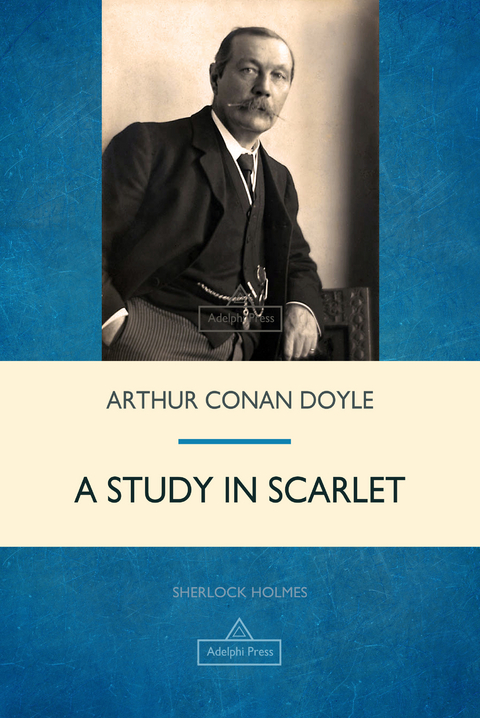
Study in Scarlet (eBook)
126 Seiten
Adelphi Press (Verlag)
978-1-78724-616-4 (ISBN)
Dr. Watson, having returned to London after serving in the Second Anglo-Afghan War, visits the Criterion Restaurant and runs into an old friend named Stamford. Watson confides in Stamford that, due to a shoulder injury that he sustained at the Battle of Maiwand, he has been forced to leave the armed services and is now looking for a place to live. Stamford mentions that an acquaintance of his, Sherlock Holmes, is looking for someone to split the rent at a flat at 221B Baker Street, but he cautions Watson about Holmes's eccentricities.
CHAPTER 2 THE SCIENCE OF DEDUCTION
We met next day as he had arranged, and inspected the rooms at No. 221B, Baker Street, of which he had spoken at our meeting. They consisted of a couple of comfortable bedrooms and a single large airy sitting-room, cheerfully furnished, and illuminated by two broad windows. So desirable in every way were the apartments, and so moderate did the terms seem when divided between us, that the bargain was concluded upon the spot, and we at once entered into possession. That very evening I moved my things round from the hotel, and on the following morning Sherlock Holmes followed me with several boxes and portmanteaus. For a day or two we were busily employed in unpacking and laying out our property to the best advantage. That done, we gradually began to settle down and to accommodate ourselves to our new surroundings.
Holmes was certainly not a difficult man to live with. He was quiet in his ways, and his habits were regular. It was rare for him to be up after ten at night, and he had invariably breakfasted and gone out before I rose in the morning. Sometimes he spent his day at the chemical laboratory, sometimes in the dissecting-rooms, and occasionally in long walks, which appeared to take him into the lowest portions of the city. Nothing could exceed his energy when the working fit was upon him; but now and again a reaction would seize him, and for days on end he would lie upon the sofa in the sitting-room, hardly uttering a word or moving a muscle from morning to night. On these occasions I have noticed such a dreamy, vacant expression in his eyes, that I might have suspected him of being addicted to the use of some narcotic, had not the temperance and cleanliness of his whole life forbidden such a notion.
As the weeks went by, my interest in him and my curiosity as to his aims in life gradually deepened and increased. His very person and appearance were such as to strike the attention of the most casual observer. In height he was rather over six feet, and so excessively lean that he seemed to be considerably taller. His eyes were sharp and piercing, save during those intervals of torpor to which I have alluded; and his thin, hawk-like nose gave his whole expression an air of alertness and decision. His chin, too, had the prominence and squareness which mark the man of determination. His hands were invariably blotted with ink and stained with chemicals, yet he was possessed of extraordinary delicacy of touch, as I frequently had occasion to observe when I watched him manipulating his fragile philosophical instruments.
The reader may set me down as a hopeless busybody, when I confess how much this man stimulated my curiosity, and how often I endeavoured to break through the reticence which he showed on all that concerned himself. Before pronouncing judgment, however, be it remembered how objectless was my life, and how little there was to engage my attention. My health forbade me from venturing out unless the weather was exceptionally genial, and I had no friends who would call upon me and break the monotony of my daily existence. Under these circumstances, I eagerly hailed the little mystery which hung around my companion, and spent much of my time in endeavouring to unravel it.
He was not studying medicine. He had himself, in reply to a question, confirmed Stamford’s opinion upon that point. Neither did he appear to have pursued any course of reading which might fit him for a degree, in science or any other recognized portal which would give him an entrance into the learned world. Yet his zeal for certain studies was remarkable, and within eccentric limits his knowledge was so extraordinarily ample and minute that his observations have fairly astounded me. Surely no man would work so hard or attain such precise information unless he had some definite end in view. Desultory readers are seldom remarkable for the exactness of their learning. No man burdens his mind with small matters unless he has some very good reason for doing so.
His ignorance was as remarkable as his knowledge. Of contemporary literature, philosophy and politics he appeared to know next to nothing. Upon my quoting Thomas Carlyle, he inquired in the naivest way who he might be and what he had done. My surprise reached a climax, however, when I found incidentally that he was ignorant of the Copernican Theory and of the composition of the Solar System. That any civilized human being in this nineteenth century should not be aware that the earth travelled round the sun appeared to me to be such an extraordinary fact that I could hardly realize it.
“You appear to be astonished,” he said, smiling at my expression of surprise. “Now that I do know it I shall do my best to forget it.”
“To forget it!”
“You see,” he explained, “I consider that a man’s brain originally is like a little empty attic, and you have to stock it with such furniture as you choose. A fool takes in all the lumber of every sort that he comes across, so that the knowledge which might be useful to him gets crowded out, or at best is jumbled up with a lot of other things, so that he has a difficulty in laying his hands upon it. Now the skilful workman is very careful indeed as to what he takes into his brain-attic. He will have nothing but the tools which may help him in doing his work, but of these he has a large assortment, and all in the most perfect order. It is a mistake to think that that little room has elastic walls and can distend to any extent. Depend upon it there comes a time when for every addition of knowledge you forget something that you knew before. It is of the highest importance, therefore, not to have useless facts elbowing out the useful ones.”
“But the Solar System!” I protested.
“What the deuce is it to me?” he interrupted impatiently: “you say that we go round the sun. If we went round the moon it would not make a pennyworth of difference to me or to my work.”
I was on the point of asking him what that work might be, but something in his manner showed me that the question would be an unwelcome one. I pondered over our short conversation however, and endeavoured to draw my deductions from it. He said that he would acquire no knowledge which did not bear upon his object. Therefore all the knowledge which he possessed was such as would be useful to him. I enumerated in my own mind all the various points upon which he had shown me that he was exceptionally well informed. I even took a pencil and jotted them down. I could not help smiling at the document when I had completed it. It ran in this way:
Sherlock Holmes — his limits
1. Knowledge of Literature. — Nil.
2. Philosophy. — Nil.
3. Astronomy. — Nil.
4. Politics. — Feeble.
5. Botany. — Variable.
Well up in belladonna, opium, and poisons generally.
Knows nothing of practical gardening.
6. Knowledge of Geology. — Practical, but limited.
Tells at a glance different soils from each other.
After walks has shown me splashes upon his trousers, and told me by their colour and consistence in
what part of London he had received them.
7. Knowledge of Chemistry. — Profound.
8. Anatomy. — Accurate, but unsystematic
9. Sensational Literature. — Immense.
He appears to know every detail of every horror
perpetrated in the century.
10. Plays the violin well.
11. Is an expert singlestick player, boxer, and swordsman.
12. Has a good practical knowledge of British law.
When I had got so far in my list I threw it into the fire in despair. “If I can only find what the fellow is driving at by reconciling all these accomplishments, and discovering a calling which needs them all,” I said to myself, “I may as well give up the attempt at once.”
I see that I have alluded above to his powers upon the violin. These were very remarkable, but as eccentric as all his other accomplishments. That he could play pieces, and difficult pieces, I knew well, because at my request he has played me some of Mendelssohn’s Lieder, and other favourites. When left to himself, however, he would seldom produce any music or attempt any recognized air. Leaning back in his armchair of an evening, he would close his eyes and scrape carelessly at the fiddle which was thrown across his knee. Sometimes the chords were sonorous and melancholy. Occasionally they were fantastic and cheerful. Clearly they reflected the thoughts which possessed him, but whether the music aided those thoughts, or whether the playing was simply the result of a whim or fancy, was more than I could determine. I might have rebelled against these exasperating solos had it not been that he usually terminated them by playing in quick succession a whole series of my favourite airs as a slight compensation for the trial upon my patience.
During the first week or so we had no callers, and I had begun to think that my companion was as friendless a man as I was myself. Presently, however, I found that he had many acquaintances, and those in the most different classes of society. There was one little sallow, rat-faced, dark-eyed fellow, who was introduced to me as Mr. Lestrade, and who came three or four times in a single week. One morning a young girl called, fashionably dressed, and stayed for half an hour or more. The same afternoon brought a gray-headed, seedy visitor, looking like a Jew peddler, who appeared to me to be much excited, and who was closely followed by a slipshod elderly woman. On another occasion an old white-haired gentleman had an interview with my companion; and on another, a railway porter in his velveteen uniform. When any of these nondescript individuals put in an...
| Erscheint lt. Verlag | 5.7.2018 |
|---|---|
| Reihe/Serie | Sherlock Holmes | Sherlock Holmes |
| Sprache | englisch |
| Themenwelt | Literatur ► Anthologien |
| Literatur ► Klassiker / Moderne Klassiker | |
| Literatur ► Romane / Erzählungen | |
| Schlagworte | adventure stories • Conan Doyle • Crime • detective • Doyle • Dr. Watson • Murder • Mystery • Sherlock • Sherlock Holmes |
| ISBN-10 | 1-78724-616-7 / 1787246167 |
| ISBN-13 | 978-1-78724-616-4 / 9781787246164 |
| Informationen gemäß Produktsicherheitsverordnung (GPSR) | |
| Haben Sie eine Frage zum Produkt? |
 EPUB (Adobe DRM)
Größe: 861 KB
Kopierschutz: Adobe-DRM
Adobe-DRM ist ein Kopierschutz, der das eBook vor Mißbrauch schützen soll. Dabei wird das eBook bereits beim Download auf Ihre persönliche Adobe-ID autorisiert. Lesen können Sie das eBook dann nur auf den Geräten, welche ebenfalls auf Ihre Adobe-ID registriert sind.
Details zum Adobe-DRM
Dateiformat: EPUB (Electronic Publication)
EPUB ist ein offener Standard für eBooks und eignet sich besonders zur Darstellung von Belletristik und Sachbüchern. Der Fließtext wird dynamisch an die Display- und Schriftgröße angepasst. Auch für mobile Lesegeräte ist EPUB daher gut geeignet.
Systemvoraussetzungen:
PC/Mac: Mit einem PC oder Mac können Sie dieses eBook lesen. Sie benötigen eine
eReader: Dieses eBook kann mit (fast) allen eBook-Readern gelesen werden. Mit dem amazon-Kindle ist es aber nicht kompatibel.
Smartphone/Tablet: Egal ob Apple oder Android, dieses eBook können Sie lesen. Sie benötigen eine
Geräteliste und zusätzliche Hinweise
Buying eBooks from abroad
For tax law reasons we can sell eBooks just within Germany and Switzerland. Regrettably we cannot fulfill eBook-orders from other countries.
EPUB (Ohne DRM)Digital Rights Management: ohne DRM
Dieses eBook enthält kein DRM oder Kopierschutz. Eine Weitergabe an Dritte ist jedoch rechtlich nicht zulässig, weil Sie beim Kauf nur die Rechte an der persönlichen Nutzung erwerben.
Dateiformat: EPUB (Electronic Publication)
EPUB ist ein offener Standard für eBooks und eignet sich besonders zur Darstellung von Belletristik und Sachbüchern. Der Fließtext wird dynamisch an die Display- und Schriftgröße angepasst. Auch für mobile Lesegeräte ist EPUB daher gut geeignet.
Systemvoraussetzungen:
PC/Mac: Mit einem PC oder Mac können Sie dieses eBook lesen. Sie benötigen dafür die kostenlose Software Adobe Digital Editions.
eReader: Dieses eBook kann mit (fast) allen eBook-Readern gelesen werden. Mit dem amazon-Kindle ist es aber nicht kompatibel.
Smartphone/Tablet: Egal ob Apple oder Android, dieses eBook können Sie lesen. Sie benötigen dafür eine kostenlose App.
Geräteliste und zusätzliche Hinweise
Buying eBooks from abroad
For tax law reasons we can sell eBooks just within Germany and Switzerland. Regrettably we cannot fulfill eBook-orders from other countries.
aus dem Bereich