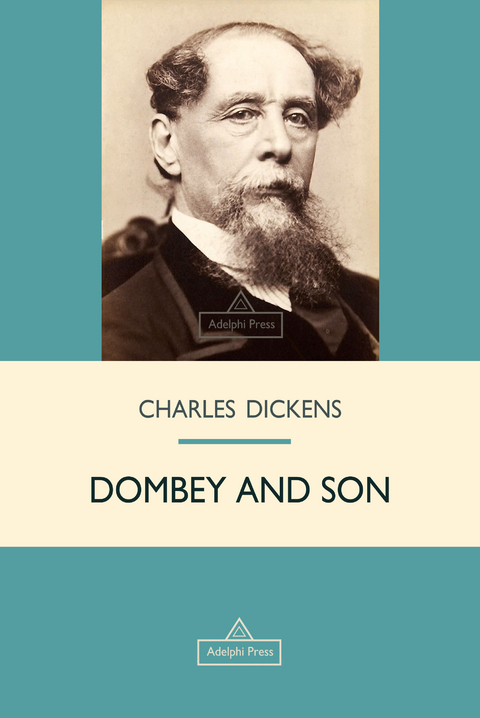
Dombey and Son (eBook)
866 Seiten
Adelphi Press (Verlag)
978-1-78724-612-6 (ISBN)

Dombey and Son follows life of Paul Dombey, a wealthy owner of a shipping company. Paul's dream is to have a son to continue his business. His wife dies in childbirth and Paul ends up with a daughter instead of the desired son. The book elaborates on a number of socially significant themes. In particular the book deals with the then-prevalent common practice of arranged marriages for financial gain. Other themes to be detected within this work include social inequality, familial relationships, and as ever in Dickens, betrayal and deceit and the consequences thereof.
CHAPTER 2. IN WHICH TIMELY PROVISION IS MADE FOR AN EMERGENCY THAT WILL SOMETIMES ARISE IN THE BEST-REGULATED FAMILIES.
‘I shall never cease to congratulate myself,’ said Mrs Chick,’ on having said, when I little thought what was in store for us,—really as if I was inspired by something,—that I forgave poor dear Fanny everything. Whatever happens, that must always be a comfort to me!’
Mrs Chick made this impressive observation in the drawing-room, after having descended thither from the inspection of the mantua-makers upstairs, who were busy on the family mourning. She delivered it for the behoof of Mr Chick, who was a stout bald gentleman, with a very large face, and his hands continually in his pockets, and who had a tendency in his nature to whistle and hum tunes, which, sensible of the indecorum of such sounds in a house of grief, he was at some pains to repress at present.
‘Don’t you over-exert yourself, Loo,’ said Mr Chick, ‘or you’ll be laid up with spasms, I see. Right tol loor rul! Bless my soul, I forgot! We’re here one day and gone the next!’
Mrs Chick contented herself with a glance of reproof, and then proceeded with the thread of her discourse.
‘I am sure,’ she said, ‘I hope this heart-rending occurrence will be a warning to all of us, to accustom ourselves to rouse ourselves, and to make efforts in time where they’re required of us. There’s a moral in everything, if we would only avail ourselves of it. It will be our own faults if we lose sight of this one.’
Mr Chick invaded the grave silence which ensued on this remark with the singularly inappropriate air of ‘A cobbler there was;’ and checking himself, in some confusion, observed, that it was undoubtedly our own faults if we didn’t improve such melancholy occasions as the present.
‘Which might be better improved, I should think, Mr C.,’ retorted his helpmate, after a short pause, ‘than by the introduction, either of the college hornpipe, or the equally unmeaning and unfeeling remark of rump-te-iddity, bow-wow-wow!’—which Mr Chick had indeed indulged in, under his breath, and which Mrs Chick repeated in a tone of withering scorn.
‘Merely habit, my dear,’ pleaded Mr Chick.
‘Nonsense! Habit!’ returned his wife. ‘If you’re a rational being, don’t make such ridiculous excuses. Habit! If I was to get a habit (as you call it) of walking on the ceiling, like the flies, I should hear enough of it, I daresay.’
It appeared so probable that such a habit might be attended with some degree of notoriety, that Mr Chick didn’t venture to dispute the position.
‘Bow-wow-wow!’ repeated Mrs Chick with an emphasis of blighting contempt on the last syllable. ‘More like a professional singer with the hydrophobia, than a man in your station of life!’
‘How’s the Baby, Loo?’ asked Mr Chick: to change the subject.
‘What Baby do you mean?’ answered Mrs Chick.
‘The poor bereaved little baby,’ said Mr Chick. ‘I don’t know of any other, my dear.’
‘You don’t know of any other,’ retorted Mrs Chick. ‘More shame for you, I was going to say.’
Mr Chick looked astonished.
‘I am sure the morning I have had, with that dining-room downstairs, one mass of babies, no one in their senses would believe.’
‘One mass of babies!’ repeated Mr Chick, staring with an alarmed expression about him.
‘It would have occurred to most men,’ said Mrs Chick, ‘that poor dear Fanny being no more,—those words of mine will always be a balm and comfort to me,’ here she dried her eyes; ‘it becomes necessary to provide a Nurse.’
‘Oh! Ah!’ said Mr Chick. ‘Toor-ru!—such is life, I mean. I hope you are suited, my dear.’
‘Indeed I am not,’ said Mrs Chick; ‘nor likely to be, so far as I can see, and in the meantime the poor child seems likely to be starved to death. Paul is so very particular—naturally so, of course, having set his whole heart on this one boy—and there are so many objections to everybody that offers, that I don’t see, myself, the least chance of an arrangement. Meanwhile, of course, the child is—’
‘Going to the Devil,’ said Mr Chick, thoughtfully, ‘to be sure.’
Admonished, however, that he had committed himself, by the indignation expressed in Mrs Chick’s countenance at the idea of a Dombey going there; and thinking to atone for his misconduct by a bright suggestion, he added:
‘Couldn’t something temporary be done with a teapot?’
If he had meant to bring the subject prematurely to a close, he could not have done it more effectually. After looking at him for some moments in silent resignation, Mrs Chick said she trusted he hadn’t said it in aggravation, because that would do very little honour to his heart. She trusted he hadn’t said it seriously, because that would do very little honour to his head. As in any case, he couldn’t, however sanguine his disposition, hope to offer a remark that would be a greater outrage on human nature in general, we would beg to leave the discussion at that point.
Mrs Chick then walked majestically to the window and peeped through the blind, attracted by the sound of wheels. Mr Chick, finding that his destiny was, for the time, against him, said no more, and walked off. But it was not always thus with Mr Chick. He was often in the ascendant himself, and at those times punished Louisa roundly. In their matrimonial bickerings they were, upon the whole, a well-matched, fairly-balanced, give-and-take couple. It would have been, generally speaking, very difficult to have betted on the winner. Often when Mr Chick seemed beaten, he would suddenly make a start, turn the tables, clatter them about the ears of Mrs Chick, and carry all before him. Being liable himself to similar unlooked for checks from Mrs Chick, their little contests usually possessed a character of uncertainty that was very animating.
Miss Tox had arrived on the wheels just now alluded to, and came running into the room in a breathless condition.
‘My dear Louisa,’ said Miss Tox, ‘is the vacancy still unsupplied?’
‘You good soul, yes,’ said Mrs Chick.
‘Then, my dear Louisa,’ returned Miss Tox, ‘I hope and believe—but in one moment, my dear, I’ll introduce the party.’
Running downstairs again as fast as she had run up, Miss Tox got the party out of the hackney-coach, and soon returned with it under convoy.
It then appeared that she had used the word, not in its legal or business acceptation, when it merely expresses an individual, but as a noun of multitude, or signifying many: for Miss Tox escorted a plump rosy-cheeked wholesome apple-faced young woman, with an infant in her arms; a younger woman not so plump, but apple-faced also, who led a plump and apple-faced child in each hand; another plump and also apple-faced boy who walked by himself; and finally, a plump and apple-faced man, who carried in his arms another plump and apple-faced boy, whom he stood down on the floor, and admonished, in a husky whisper, to ‘kitch hold of his brother Johnny.’
‘My dear Louisa,’ said Miss Tox, ‘knowing your great anxiety, and wishing to relieve it, I posted off myself to the Queen Charlotte’s Royal Married Females,’ which you had forgot, and put the question, Was there anybody there that they thought would suit? No, they said there was not. When they gave me that answer, I do assure you, my dear, I was almost driven to despair on your account. But it did so happen, that one of the Royal Married Females, hearing the inquiry, reminded the matron of another who had gone to her own home, and who, she said, would in all likelihood be most satisfactory. The moment I heard this, and had it corroborated by the matron—excellent references and unimpeachable character—I got the address, my dear, and posted off again.’
‘Like the dear good Tox, you are!’ said Louisa.
‘Not at all,’ returned Miss Tox. ‘Don’t say so. Arriving at the house (the cleanest place, my dear! You might eat your dinner off the floor), I found the whole family sitting at table; and feeling that no account of them could be half so comfortable to you and Mr Dombey as the sight of them all together, I brought them all away. This gentleman,’ said Miss Tox, pointing out the apple-faced man, ‘is the father. Will you have the goodness to come a little forward, Sir?’
The apple-faced man having sheepishly complied with this request, stood chuckling and grinning in a front row.
‘This is his wife, of course,’ said Miss Tox, singling out the young woman with the baby. ‘How do you do, Polly?’
‘I’m pretty well, I thank you, Ma’am,’ said Polly.
By way of bringing her out dexterously, Miss Tox had made the inquiry as in condescension to an old acquaintance whom she hadn’t seen for a fortnight or so.
‘I’m glad to hear it,’ said Miss Tox. ‘The other young woman is her unmarried sister who lives with them, and would take care of her children. Her name’s Jemima. How do you do, Jemima?’
‘I’m pretty well, I thank you, Ma’am,’ returned Jemima.
‘I’m very glad indeed to hear it,’ said Miss Tox. ‘I hope you’ll keep so. Five children. Youngest six weeks. The fine little boy with the blister on his nose is the eldest. The blister, I believe,’ said Miss Tox, looking round upon the family, ‘is not constitutional, but accidental?’
The apple-faced man was understood to growl, ‘Flat iron.’
‘I beg your pardon, Sir,’ said Miss Tox, ‘did you—’
‘Flat iron,’ he repeated.
‘Oh yes,’ said Miss...
| Erscheint lt. Verlag | 4.7.2018 |
|---|---|
| Reihe/Serie | Victorian Epic | Victorian Epic |
| Sprache | englisch |
| Themenwelt | Literatur ► Anthologien |
| Literatur ► Klassiker / Moderne Klassiker | |
| Literatur ► Romane / Erzählungen | |
| Schlagworte | Charles Dickens • David Copperfield • Dickens • English classic • Family • Human nature • Inequality • marriage • Social Class • Social Justice • Social novel • Social Order • Victorian • Women |
| ISBN-10 | 1-78724-612-4 / 1787246124 |
| ISBN-13 | 978-1-78724-612-6 / 9781787246126 |
| Informationen gemäß Produktsicherheitsverordnung (GPSR) | |
| Haben Sie eine Frage zum Produkt? |
 EPUB (Adobe DRM)
Größe: 1,2 MB
Kopierschutz: Adobe-DRM
Adobe-DRM ist ein Kopierschutz, der das eBook vor Mißbrauch schützen soll. Dabei wird das eBook bereits beim Download auf Ihre persönliche Adobe-ID autorisiert. Lesen können Sie das eBook dann nur auf den Geräten, welche ebenfalls auf Ihre Adobe-ID registriert sind.
Details zum Adobe-DRM
Dateiformat: EPUB (Electronic Publication)
EPUB ist ein offener Standard für eBooks und eignet sich besonders zur Darstellung von Belletristik und Sachbüchern. Der Fließtext wird dynamisch an die Display- und Schriftgröße angepasst. Auch für mobile Lesegeräte ist EPUB daher gut geeignet.
Systemvoraussetzungen:
PC/Mac: Mit einem PC oder Mac können Sie dieses eBook lesen. Sie benötigen eine
eReader: Dieses eBook kann mit (fast) allen eBook-Readern gelesen werden. Mit dem amazon-Kindle ist es aber nicht kompatibel.
Smartphone/Tablet: Egal ob Apple oder Android, dieses eBook können Sie lesen. Sie benötigen eine
Geräteliste und zusätzliche Hinweise
Buying eBooks from abroad
For tax law reasons we can sell eBooks just within Germany and Switzerland. Regrettably we cannot fulfill eBook-orders from other countries.
EPUB (Ohne DRM)Digital Rights Management: ohne DRM
Dieses eBook enthält kein DRM oder Kopierschutz. Eine Weitergabe an Dritte ist jedoch rechtlich nicht zulässig, weil Sie beim Kauf nur die Rechte an der persönlichen Nutzung erwerben.
Dateiformat: EPUB (Electronic Publication)
EPUB ist ein offener Standard für eBooks und eignet sich besonders zur Darstellung von Belletristik und Sachbüchern. Der Fließtext wird dynamisch an die Display- und Schriftgröße angepasst. Auch für mobile Lesegeräte ist EPUB daher gut geeignet.
Systemvoraussetzungen:
PC/Mac: Mit einem PC oder Mac können Sie dieses eBook lesen. Sie benötigen dafür die kostenlose Software Adobe Digital Editions.
eReader: Dieses eBook kann mit (fast) allen eBook-Readern gelesen werden. Mit dem amazon-Kindle ist es aber nicht kompatibel.
Smartphone/Tablet: Egal ob Apple oder Android, dieses eBook können Sie lesen. Sie benötigen dafür eine kostenlose App.
Geräteliste und zusätzliche Hinweise
Buying eBooks from abroad
For tax law reasons we can sell eBooks just within Germany and Switzerland. Regrettably we cannot fulfill eBook-orders from other countries.
aus dem Bereich