


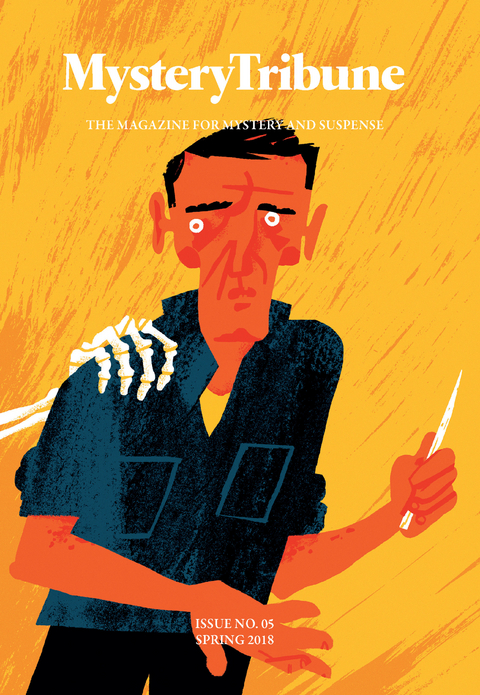
Mystery Tribune / Issue Nº5 (eBook)
240 Seiten
Mystery Tribune (Verlag)
9780000084767 (ISBN)
Our 240 page Spring 2018 anniversary issue of Mystery Tribune is a must-have! This volume features previously unpublished short fiction from enduring voices such as Mickey Spillane and Max Allan Collins as well stories from Rob Hart and Todd Robinson.
A curated collection of photography from European and American artists, interview with Megan Abbott and Alison Gaylin on comics thriller 'Normandy Gold', and some of the best voices in mystery and suspense are among the other highlights.
The issue features:
Stories by Mickey Spillane, Max Allan Collins, Frank Diamond, Nels Hanson, Rob Hart, Todd Robinson, Lynn Kostoff, and Charles Roland. Revisit of a classic essay in defense of crime fiction by Arthur Benjamin Reeve. Interviews and Reviews by Megan Abbott, Alison Gaylin, and Tom Andes. Photography by Guda Koster (Netherlands), Chrissie White (U.S.) and more...
An elegantly crafted quarterly issue, with a beautiful layout designed for optimal reading experience, our Spring 2018 issue will make a perfect companion or gift for avid mystery readers and fans of literary crime fiction.
Fiction
Mercy
by Charles Roland
“Sometimes,” said Carter, then paused and shook his head. “Sometimes I just can’t see the good in people.”
Ronnie nodded like, I got it, I hear you. This was one of the things he was good at. Ronnie always got it, always heard you.
“Tell you something,” Ronnie said. “Something my dad used to tell me.”
He paused for a second, looked up and to the side, like his dad was talking to him right at the moment.
“He said: ‘Seeing the good in people is just seeing the good in yourself.’”
Carter nodded, though he wasn’t sure what Ronnie was getting at. Carter saw the good in himself. It didn’t mean that everyone else was good, too.
Ronnie looked back into Carter’s face.
“Something else he used to tell me. Used to say that mercy was the best thing in a man. A righteous man is good, but a merciful man is great.”
Ronnie paused again. Carter said nothing.
“He did this job for a lot of years,” said Ronnie.
Carter nodded. He didn’t need reminding. Ronnie’s dad was a hero, a civil rights pioneer, first black prosecutor in this part of the state. Nobody — black, white, nobody — had a bad word to say about him. When Ronnie’s dad took a judgeship and Ronnie ran for the old man’s job, there wasn’t even anybody who wanted to run against him.
And Ronnie could go on about the old man sometimes, too.
“I hear you,” said Carter. “I hear you. But this kid, he’s bad. He’s bad, boss. And we’re not in the mercy business.”
“No,” said Ronnie. “No, we’re not. We’re in the justice business. But sometimes the two go together.” He paused. “Give it a try. He doesn’t take the plea, we push for fifteen.”
Carter hesitated, said nothing.
“I’m not gonna tell you what to do,” Ronnie said. “Your case, your call. But nobody’s dead.”
“Could’ve been,” said Carter.
“But they’re not,” said Ronnie. “Not even hurt bad. They’re lucky. He’s lucky.”
“He’s a bad shot,” said Carter.
Ronnie laughed.
“No joke,” he said. “But look: take it as it is, and not how it could’ve been. Nobody’s dead. Everybody got lucky. Maybe a little mercy is due.”
Carter wasn’t fully convinced, but he nodded anyway.
“I’ll call Curtis,” he said.
◆
Curtis Johnson sat across the table from his client in the meeting room at the Monroe-Keowah Regional Detention Center.
“Heard from the prosecutor,” he said. “You plead, they’ll do eight. Out in five, you keep your shit together.”
His client smiled. The kid was nineteen, skinny, tattoos all over. Didn’t look like jail had been much for him. His face was unmarked, his hair looked right. His eyes were calm, hard. His smile was cold.
“Nah,” he said.
“Okay,” said Curtis. “We can talk about it later.”
“What else?”
“Investigator’s going to talk to Keisha, see if she’s sure about what she’s saying. It was a couple months ago now. Police scared her pretty good. Maybe now she’s not scared, she doesn’t feel like she has to say what they want her to say.” He paused. “Anyway, he’ll go talk to her, find out how we sit.”
“Alright,” said the kid. He smiled again, or maybe it was more like a smirk. Still cold. “Make sure you tell my cousin Luther what’s going on. Make sure he knows what you doing.”
“Alright,” said Curtis. He started to pack up. “Anything else?”
“Nah.”
◆
Bobby Lessingame parked his car in the visitors lot and walked toward the front steps of Monroe High School.
Strictly speaking — hell, speaking any way at all — he wasn’t supposed to be here. For sure he wasn’t supposed to pull a kid out of class, pin her in the hallway, push her on her statement. But he knew that nobody would fuck with a white guy who looked like he had a job to do.
Besides, Bobby still walked like a cop. He’d worked ten years as a field agent for the South Carolina Law Enforcement Division, and then another handful for the Keowah County Sherriff. Then there was nowhere left to go — law enforcement wouldn’t touch him after what happened in Keowah — so he got his private investigator’s license and set up shop in Monroe.
Bobby knew what he was selling. He wore a sport coat, shaved, held himself like a guy in charge. Never told anyone he was a cop, but people thought what they thought; if they talked to him, went along with him because he seemed like police, that wasn’t his doing. He wasn’t impersonating anyone.
Anyway, he had to use the value he had. It wasn’t like he ever really investigated anything — police did that, and the prosecutors passed everything they had to the defense anyway. What Bobby could do was talk to people, push up on them, maybe make them see things differently. Remember things they forgot. Forget things they remembered.
Bobby walked right past the front desk and down the hall into the cafeteria, hard and tall like he owned the fucking place.
Monroe High was one of the bad schools in the county, and it showed. The facilities were battered; the paint was chipped, the tables and benches scarred. The students — mostly poor, mostly black — eyed him as he walked past the common areas and open classrooms. They knew what was up.
He reached the room he was looking for and came inside without knocking.
“He took out his wallet, flipped it open to the badge. It was a flat piece of metal in the right general shape, INVESTIGATOR across the top. He’d bought it on the Internet.”
“I need Keisha Daniels,” he told the teacher.
This was one of his things: You don’t ask. You tell.
The teacher was an older black woman. She looked startled for a minute, then unsure. Turned to her students, back to Bobby, to the students again. Then she pointed at one of them.
“Keisha,” she said. “This man needs to speak with you.”
Keisha came up to the front of the room and followed Bobby outside. She was fourteen, Bobby knew, but she looked to him like a grown woman, full and ripe. He pulled the classroom door shut and led her halfway down the hall. He eyed her up and down. Goddamn, he thought.
Then she opened her mouth to speak, and he was ashamed. Her voice was childlike, high-pitched and small, almost strangled.
“You the police?” she asked.
He took out his wallet, flipped it open to the badge. It was a flat piece of metal in the right general shape, INVESTIGATOR across the top. He’d bought it on the Internet. Most of the time nobody looked closely.
“Investigator,” he said, which was the truth. He never said he was anything he wasn’t. People thought what they thought.
“You know why I’m here to talk to you?” he asked.
Keisha shook her head, looked at the floor.
“We’re following up on that thing from a couple months ago, you said you seen your boyfriend Andre shoot some people.”
Keisha kept her eyes on the floor.
“He didn’t kill nobody,” she said, in that tiny voice.
“Alright,” said Bobby. “Shoot at some people. Okay?”
He waited. Keisha didn’t speak.
“We need to talk about what you said right after it happened. What you told the police right then.”
“They told my mom they’d call when I had to go to court,” Keisha said. She was very still. Bobby could tell she was afraid.
It was good that she was scared. Bobby hated himself a little, felt wrong, but it was what it was. He had a job.
“That’s right,” he said. “But, see, looking at what you told the officers, it seems kind of hard to believe that you saw what you said. I mean, it was dark, the club was crowded, everything happened quick.”
He gave her a second to think about it.
“He’d been raising his voice steadily as he spoke, getting closer to the girl, pushing up on her...”
“You said you saw Andre had a gun in his hand, saw him shoot the gun. You said you saw that.”
He paused again.
“But weren’t you scared? Right? I mean, these guys are yelling, fighting, the music’s still on, it’s loud, lights flashing, then there’s gunshots. You gonna tell me you saw Andre shoot them people? You weren’t down on the floor, or looking for the door, or every which way? You knew to look at Andre, right then, so you could see him shoot his gun?”
He’d been raising his voice steadily as he spoke, getting closer to the girl, pushing up on her, trying to make her see he thought her story was bullshit. Now he got quiet again.
“Now, seems like to me, maybe the police told you Andre had a gun, told you he shot some people, and you said you seen it ‘cause you were scared. But maybe the truth is everything happened all at once, and you don’t really know what you saw. You didn’t see anything, except the police told you what happened and you said, ‘that’s right.’”
He waited.
“Is that how it went, Keisha?”
She was still looking at the floor. No sounds came. She shook her head.
Bobby thought: Fuck.
“I didn’t catch that,” he said.
“I saw Andre with the gun,” she said. “I saw him shoot.”
Fuck.
“The police said I had to tell the truth. They told my mom that Andre couldn’t do nothing to me.”
She looked up at Bobby. Her eyes were scared.
“That’s true, right? Andre can’t do nothing to me?”
Bobby felt...
| Erscheint lt. Verlag | 6.7.2018 |
|---|---|
| Sprache | englisch |
| Themenwelt | Literatur ► Krimi / Thriller / Horror |
| ISBN-13 | 9780000084767 / 9780000084767 |
| Informationen gemäß Produktsicherheitsverordnung (GPSR) | |
| Haben Sie eine Frage zum Produkt? |
 EPUB (Adobe DRM)
Größe: 42,8 MB
Kopierschutz: Adobe-DRM
Adobe-DRM ist ein Kopierschutz, der das eBook vor Mißbrauch schützen soll. Dabei wird das eBook bereits beim Download auf Ihre persönliche Adobe-ID autorisiert. Lesen können Sie das eBook dann nur auf den Geräten, welche ebenfalls auf Ihre Adobe-ID registriert sind.
Details zum Adobe-DRM
Dateiformat: EPUB (Electronic Publication)
EPUB ist ein offener Standard für eBooks und eignet sich besonders zur Darstellung von Belletristik und Sachbüchern. Der Fließtext wird dynamisch an die Display- und Schriftgröße angepasst. Auch für mobile Lesegeräte ist EPUB daher gut geeignet.
Systemvoraussetzungen:
PC/Mac: Mit einem PC oder Mac können Sie dieses eBook lesen. Sie benötigen eine
eReader: Dieses eBook kann mit (fast) allen eBook-Readern gelesen werden. Mit dem amazon-Kindle ist es aber nicht kompatibel.
Smartphone/Tablet: Egal ob Apple oder Android, dieses eBook können Sie lesen. Sie benötigen eine
Geräteliste und zusätzliche Hinweise
Buying eBooks from abroad
For tax law reasons we can sell eBooks just within Germany and Switzerland. Regrettably we cannot fulfill eBook-orders from other countries.
aus dem Bereich


