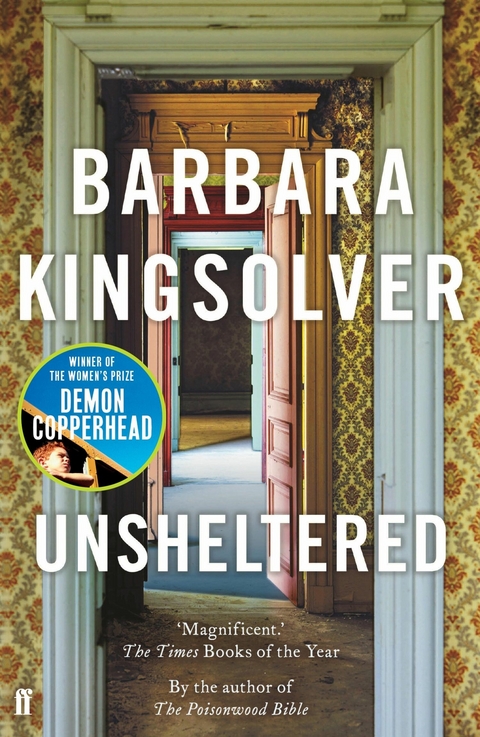
Unsheltered (eBook)
464 Seiten
Faber & Faber (Verlag)
978-0-571-34706-3 (ISBN)

Barbara Kingsolver is the global prize-winning and bestselling author of novels including Unsheltered, Flight Behaviour, The Lacuna, The Poisonwood Bible and Demon Copperhead, as well as books of poetry, essays and creative non-fiction. Her work of narrative non-fiction is the influential bestseller Animal, Vegetable, Miracle: A Year of Food Life. Kingsolver's work has been translated into more than thirty languages and has earned literary awards and a devoted readership at home and abroad. She has won the Pulitzer Prize for Fiction, the James Tait Black Prize for Fiction and is the first author to win the Women's Prize twice. Barbara lives with her family on a farm in southern Appalachia.
**NOW INCLUDING THE FIRST CHAPTER OF DEMON COPPERHEAD**WINNER OF THE PULITZER PRIZE FOR FICTIONTWICE WINNER OF THE WOMEN'S PRIZE FOR FICTIONTHE MULTI-MILLION COPY BESTSELLING AUTHOR'Magnificent.' The Times, 'Books of the Year''Gripping.' Grazia'Peerless.' Daily Mail'Wise.' Sunday TimesMeet Willa Knox, a woman who stands braced against a world which seems to hold little mercy for her and her family - or their old, crumbling house, falling down around them. Willa's two grown-up children, a new-born grandchild, and her ailing father-in-law have all moved in at a time when life seems at its most precarious. But when Willa discovers that a pioneering female scientist lived on the same street in the 1800s, could this historical connection be enough to save their home from ruin? And can Willa, despite the odds, keep her family together?
As always, Kingsolver gives readers plenty to think about. Her warm humanism coupled with an unabashed point of view make her a fine 21st-century exponent of the honorable tradition of politically engaged fiction.
Exceptionally involving and rewarding.There is much to delight in and think about while reveling in Kingsolver's vital characters, quicksilver dialogue, intimate moments, dramatic showdowns, and lushly realized milieus.An enveloping, tender, witty, and awakening novel of love and trauma, family and survival, moral dilemmas and intellectual challenges.
Kingsolver's meticulously observed, elegantly structured novel unites social commentary with gripping storytelling.Containing both a rich story and a provocative depiction of times that shake the shelter of familiar beliefs, this novel shows Kingsolver at the top of her game.
The simplest thing would be to tear it down,” the man said. “The house is a shambles.”
She took this news as a blood-rush to the ears: a roar of peasant ancestors with rocks in their fists, facing the evictor. But this man was a contractor. Willa had called him here and she could send him away. She waited out her panic while he stood looking at her shambles, appearing to nurse some satisfaction from his diagnosis. She picked out words.
“It’s not a living thing. You don’t just pronounce it dead. Anything that goes wrong with a structure can be replaced with another structure. Am I right?”
“Correct. What I am saying is that the structure needing to be replaced is all of it. I’m sorry. Your foundation is nonexistent.”
Again the roar on her eardrums. She stared at the man’s black coveralls, netted with cobwebs he’d collected in the crawl space. Petrofaccio was his name. Pete. “How could a house this old have a nonexistent foundation?”
“Not the entire house. You see where they put on this addition? Those walls have nothing substantial to rest on. And the addition entails your kitchen, your bathrooms, everything you basically need in a functional house.”
Includes, she thought. Entails is the wrong word.
One of the neighbor kids slid out his back door. His glance hit Willa and bounced off quickly as he cut through the maze of cars in his yard and headed out to the alley. He and his brother worked on the vehicles mostly at night, sliding tools back and forth under portable utility lights. Their quiet banter and intermittent Spanish expletives of frustration or success drifted through Willa’s bedroom windows as the night music of a new town. She had no hard feelings toward the vehicle boneyard, or these handsome boys and their friends, who all wore athletic shorts and plastic bath shoes as if life began in a locker room. The wrong here was a death sentence falling on her house while that one stood by, nonchalant, with its swaybacked roofline and vinyl siding peeling off in leprous shreds. Willa’s house was brick. Not straw or sticks, not a thing to get blown away in a puff.
The silence had extended beyond her turn to speak. Mr. Petrofaccio courteously examined the two mammoth trees that shaded this yard and half the block. Willa had admired the pair of giants out her kitchen window and assumed they were as old as the house, but hadn’t credited them with a better life expectancy.
“I have no idea why someone would do that,” he finally offered. “Put up an addition with no foundation. No reputable contractor would do that.”
It did seem to be sitting directly on the ground, now that she looked, with the bottom courses of bricks relaxing out of rank into wobbly rows. A carapace of rusted tin roofing stretched over the gabled third floor and the two-story addition cobbled on the back, apparently in haste. Two tall chimneys leaned in opposite directions. Cracks zigzagged lightningwise down the brick walls. How had she not seen all this? Willa was the one who raised her anxiety shield against every family medical checkup or late-night ring of the phone, expecting the worst so life couldn’t blindside them. But she’d looked up contractors that morning with no real foreboding. Probably assuming her family had already used up its quota of misfortune.
“I can’t hire you to tear down my house and start over.” Willa ran her hands through her hair at the temples, and felt idiotic. Both-hands-on-the-temples was a nervous habit she’d been trying to break for about twenty years, since her kids told her it made her look like The Scream. She shoved her fists into the pockets of her khaki shorts. “We were thinking we’d fix it up, sell it, and get something closer to Philadelphia. We don’t need this much room. Nobody needs this much room.”
On the moral side of things, Mr. Petrofaccio gave no opinion.
“But you’re saying we would have to repair it first to put it on the market. And I’ve noticed about every fourth house in this town has a For Sale sign. They’re all in better shape than this one, is that what you’re telling me?”
“Twenty five percent, that would be a high estimate. Ten percent is about right.”
“And are they selling?”
“They are not.”
“So that’s also a reason not to tear down the house.” She realized her logic in this moment was not watertight. “Okay, you know what? The main thing is we live here. We’ve got my husband’s disabled father with us right now. And our daughter.”
“Also a baby in the picture, am I right? I saw baby items, a crib and all. When I was inspecting the ruptures in the ductwork on the third floor.”
Her jaw dropped, a little.
“Sorry,” he said. “I had to get behind the crib to look at the ductwork. You said you are looking to downsize, so I just wondered. Seems like a lot of family.”
She didn’t respond. Pete extracted a handkerchief from his pocket, mopped his face, blew his nose, and put it away. He must have been braising inside those coveralls.
“That is a blessed event, ma’am,” he suggested. “A baby.”
“Thank you. It’s my son’s child, just born. We’re driving up to Boston this weekend to meet the baby and bring them the crib.”
Pete nodded thoughtfully. “Due respect, ma’am, people usually ask for an inspection before they purchase a house.”
“We didn’t buy it!” She wrestled her tone into neutral. “We inherited. We were in Virginia wondering what to do with some old mansion in New Jersey after my aunt died, and then out of the blue my husband got a job offer from Chancel. A half-hour commute, that’s too good to be true, right?”
“Your husband is a professor up there?” Pete’s nostrils flared, sniffing for money maybe, engaging the common misconception that academics have it.
“On a one-year contract that may not be renewed,” she said, taking care of that. “My aunt had this place rented for quite a while. She was in a facility out in Ocean City.”
“Sorry for your loss.”
“It’s been a year, all right. She and my mother died a week apart, same kind of rare cancer, and they were twins. Seventy-nine.”
“Now that is something. Sad, I mean, but that is like a magazine story. Some of that crazy crap they make up and nobody believes.”
She let out an unhappy laugh. “I’m a magazine editor.”
“Oh yeah? Newsweek, National Geographic, like that?”
“Yeah, like that. Glossy, award winning. Mine went broke.”
Pete clucked his tongue. “You hate to hear it.”
“Sorry to keep you standing out here. Can I offer you some iced tea?”
“Thanks, no. Gotta go check a termite damage on Elmer.”
“Right.” Despite her wish to forget everything he’d told her, Willa found his accent intriguing. Before this move she’d dreaded having to listen to New Jerseyans walking out the doo-ah, driving to the shoo-ah, but South Jersey was full of linguistic surprises. This Pete was the homegrown deal, part long-voweled Philly lowball, part Pennsylvania Amish or something. She watched him scrutinize the garage on the property line: two stories, antique glass windows, thick pelt of English ivy. “You think that building goes with this house?” she asked. “The deed isn’t very clear.”
“That is not yours. That would be the stip house to the property next door.”
“The stip house.”
“Yes ma’am. When they sold these lots back in the day, they had stipulations. Improve the property in one year’s time, show intent to reside, plant trees, and all like that. Folks put up these structures while they got it together to build their real house.”
“Really.”
“You look around this town you’ll see a few, all built on the same plan. Trusses like a barn, fast and cheap. Some guy was doing well in the stip house business I figure.”
“What era are we talking about?”
“Landis,” he replied. “You don’t know about Landis?”
“He’s what, some real estate developer?”
“A king more like, back in the day. This is just a bunch of wild wilderness when he buys it, right? Thirty thousand acres and nobody but Indians and runaway slaves. So he makes this big plan to get people to come. Heaven-on-earth kind of thing.”
“One of those utopian communities? You’re kidding me.”
“I am not. Farms like a picture book. You notice...
| Erscheint lt. Verlag | 16.10.2018 |
|---|---|
| Verlagsort | London |
| Sprache | englisch |
| Themenwelt | Literatur ► Romane / Erzählungen |
| Schlagworte | A. S. Byatt • barack obama • best books of 2018 • Lacuna • Margaret Atwood • political novel • The Poisonwood Bible |
| ISBN-10 | 0-571-34706-1 / 0571347061 |
| ISBN-13 | 978-0-571-34706-3 / 9780571347063 |
| Informationen gemäß Produktsicherheitsverordnung (GPSR) | |
| Haben Sie eine Frage zum Produkt? |
 EPUB (Adobe DRM)
Kopierschutz: Adobe-DRM
Adobe-DRM ist ein Kopierschutz, der das eBook vor Mißbrauch schützen soll. Dabei wird das eBook bereits beim Download auf Ihre persönliche Adobe-ID autorisiert. Lesen können Sie das eBook dann nur auf den Geräten, welche ebenfalls auf Ihre Adobe-ID registriert sind.
Details zum Adobe-DRM
Dateiformat: EPUB (Electronic Publication)
EPUB ist ein offener Standard für eBooks und eignet sich besonders zur Darstellung von Belletristik und Sachbüchern. Der Fließtext wird dynamisch an die Display- und Schriftgröße angepasst. Auch für mobile Lesegeräte ist EPUB daher gut geeignet.
Systemvoraussetzungen:
PC/Mac: Mit einem PC oder Mac können Sie dieses eBook lesen. Sie benötigen eine
eReader: Dieses eBook kann mit (fast) allen eBook-Readern gelesen werden. Mit dem amazon-Kindle ist es aber nicht kompatibel.
Smartphone/Tablet: Egal ob Apple oder Android, dieses eBook können Sie lesen. Sie benötigen eine
Geräteliste und zusätzliche Hinweise
Buying eBooks from abroad
For tax law reasons we can sell eBooks just within Germany and Switzerland. Regrettably we cannot fulfill eBook-orders from other countries.
aus dem Bereich