


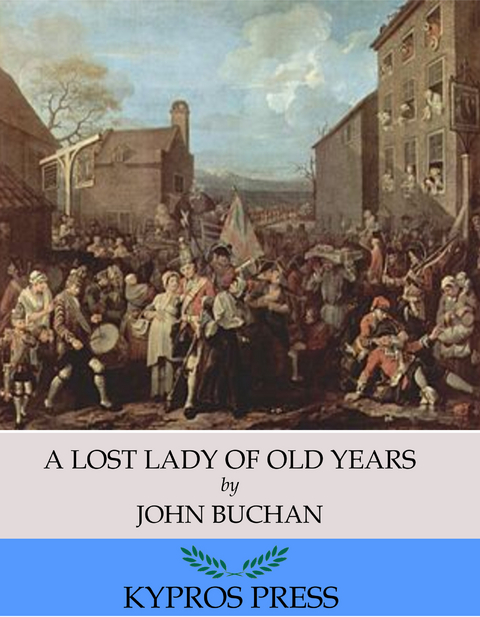
Lost Lady of Old Years (eBook)
310 Seiten
Charles River Editors (Verlag)
978-1-5183-0342-5 (ISBN)

John Buchan was a Scottish writer and Unionist politician who served as Governor General of Canada. Buchan wrote a vast amount of books including the Richard Hannay novels that have recently been turned into a popular British television show. This edition of A Lost Lady of Old Years includes a table of contents.
CHAPTER II. HOW MR. FRANCIS BIRKENSHAW DEPARTED HIS NATIVE CITY.
THE CHILD FRANCIS GREW UP to manhood with something of precipitancy, for in that house life was not suited for a lengthy play-day. At five he had been as ugly as sin in face, though well-grown and straight in body. His father’s hard features and ruddy skin were joined to Marion’s sloe-black eyes and hair, and such a conjunction is not fair in childhood. So peculiarly sinister an appearance would have made him the butt of his coevals, had he not possessed a hot temper and an uncommonly hard fist. From his sixth year battles were of daily occurrence, and it was rarely that the week-end found him with his face unmarked. But inch by inch, wound by wound, he fought his way to fame, till the mere sight of his black countenance was more than enough to hush the wrangling of the others and incline their ears to his words.
But with those days we have little to do, and it is at the maturity of eighteen that we would take up the tale of his life. His sisters, Jean and Lisbeth, were now grown to high-coloured, loud-spoken girls, who shared their mother’s likings and their mother’s comeliness. The Birkenshaw payments made comfort possible, and the house was conducted in a pleasant stir, with gossips sitting at all hours and the sharp tones of the housewife guarding its cleanliness and order. The two lasses were the blacksmith’s true grandchildren, and in no way different from a thousand such maids in the city. They loved to dress in their best of a Sabbath and walk in decent procession to the Cross Kirk, where the ministrations of Mr. Linklater were sugared with the attentions of the young apprentices. They were notable cooks and wrought all day to their mother’s bidding with a cheery bustle. In a word, they were of their mother’s pattern,—honest, fresh-coloured, hearty, and friendly to all.
Had it not been for their brother’s presence, the household in the Monk’s Vennel might have been an abode of prosperous peace. But Francis was a puzzle to most folk and a grief to his mother such as her foolish loose-lived husband had never been. The years brought him height and strength and a handsome face. It would have been hard to find in all the town a nobler figure of a man, when anger did not distort the features. From some unknown forebear he derived an air of uncommon masterfulness, and a carriage which might have vied with that of the greatest buck of the day, my Lord Craigforth himself. His temper was like his body, fierce, and strong, and hot as a red fire, so that no man could anger him with safety. In happier conditions he might have followed the paths of virtue, for there seemed nothing ignoble in that brow and eye. But in the kitchen of his home, among the clatter of neighbour tongues and women’s gossip, in the presence of his mother and sisters and the rotund housewives who called them friends, he was wofully out of place.
In his childhood he had cared little for the thing, for the street was his home at most hours; but as he grew to age the whole life oppressed him with deep disgust. To him alone had fallen a share of the Birkenshaw temper, and he revolted from this unctuous existence. For his kin he had fits of tenderness, but at his age no feeling is so weak as domestic love. The result was not hard to foresee. With such share as he had of the family income he took to his own pleasures, and the house saw him not save at meal-time and the late night.
Who shall tell of the glorious Edinburgh of that age in all its colour and splendour and dirt? The years of last century were still young, the second George was but new on the throne, and in the northern city life flowed freely and hotly in a muddy, turbulent stream. The drums of war were still in men’s memories, and soldiers from the Castle still thronged the street. In the narrow alleys which wound like snakes among the high, dark houses there lurked filth and disease which have long since gone from the land. Ragged Highland lairds and broken gillies, fine periwigged gentlemen, ministers many with their sombre black, fair ladies and country wives, honest shepherds in homespun from the South, half the gentry of the land, as well as the staid merchant or the wandering southerner, were jostled on the narrow causeway by French agents and priests in hiding, or fell a prey at dark corners to the lurking cut-purse. Roaring east winds disturbed the trials in the Parliament House, where half a dozen learned judges administered the law, ere hurrying back to dinner and their unfinished treatises on Taste and the Sublime. And the same wind caught at the throats of half-starved loyalists shivering in entries, and praying and plotting for that day when the King should come back to his own. Every now and again the streets were in an uproar over some straggling news of a fresh landing, and the good citizens listened to the bugle on the Castle rock with a feeling of confirmed security. It was the day of riot and bright colour, of fine dresses and rags, of honest poverty and the blackguard shuffling in the same kennel,—a day when no man knew his own mind or his neighbours’, and the King’s peace was more brittle than the King desired.
But above all it was the hey-day of taverns, great houses of festivity where beside leaping fires a motley crew dined and grew drunk in all good fellowship. The age must be thick with alarums and perils of war to produce the fine flower of tavern-life. It is when a man’s mind is hot with wild news or the expectation of its reception that he leaves his ingle and seeks the steaming hearth and the talk of neighbours. And who can tell of the possibilities which lie in such an evening, of a door flung open and a stranger coming full of unheard-of tales? The inn-lounger is as surely a glutton for the romantic as the adventurer upon the sea.
To such homes of the soul went Francis with more zeal than discretion. There, and not in the female atmosphere of the Monk’s Vennel, he found the things in which his heart delighted. The talk of men in its freedom and brutality was his delight, and in the motley concourse of folk he had matter for a living interest. A strain of inherited vice made the darker side of it soon cease to appall him, and in time he passed from the place of a spectator to that of a partaker in many carousals, a sworn friend to half the riff-raff in the city, the ally of loose women and causeway sots.
Yet in this spring-tide of wild oats there was none of the sower’s zest. After all, he was very much of an amateur in vice, restrained from excess by many bonds of memory, convention, and human kindliness. His course was the recoil from the paths of fireside virtue, the outcome of something uncommon and heroical in a nature run to seed. At moments a sense of the folly of it all oppressed him, but the fatal rhetoric of a boy’s thoughts put the graver reflection to flight. He would regain his self-respect by fancying himself a man of the world, living with a hand close on the springs of life, one who in all folly was something beyond his allies. And in consequence he sank but rarely into brutish drunkenness,—a sin (for the confusion of all doctrines of heredity) which had little hold upon him,—and even from such lapses recovered himself with a certain alertness of spirit. Yet this was but the immaturity of his character, a thing to pass away with years, and in a little Francis might have looked to grow to a blackguard of some quality.
To his mother his life was a source of uncomprehending grief. Her efforts of kindness were now repelled and now met half-way with an inconsistency which confounded all her notions. When her son staggered home in the small hours, or when Mistress Leithen of the Candle Row retailed strange stories of his evil-doing, the unhappy woman was, if anything, less pained than mystified. Maternal affection, which for the glorifying of poor humanity, is strongest in the coarsely sentimental, bade her sorrow, when all the rest of her nature bade her only wonder. So with a patience and a denseness too deep for words, she persisted in her tenderness, bore his lordly humours, and revolted his soul with a thousand nauseous vulgarities, since to the rake the only intolerable coarseness is the respectably plebeian.
Now it chanced that Fate took it upon her to order events for the saving of Francis’ soul. About his eighteenth year he had entered a writer’s office in the city, for no other cause than to give himself some name whereby to describe his life. An odd strain of worldly prudence kept him from neglecting his duties to dismissal point, and in a sort of careful idleness he copied deeds, visited ground for seisin, and collected rents in and out of the town. He had no ill-will to the work, provided it did not bear too hardly upon his time. But meanwhile in the burgh of Dysart, which sits perched on the steep shore of Fife, there lived a Mr. Gregor Shillinglaw, who as the one lawyer in the place had a good livelihood and a busy life. He was growing old, and in the natural course bethought him of a successor. His head clerk, John Henryson, was able and willing for the place, but Mr. Shillinglaw belonged to a school of men who have less respect for long services than for family ties. Once on a time a Birkenshaw had married a distant cousin of his, and the two names had a kinship in his memory. So it fell out that, being in Edinburgh at the office of Trumbull and Gleed, who were Francis’s masters, he saw the lad, heard his name, and was affected with a sudden kindness.
He asked after his...
| Erscheint lt. Verlag | 22.3.2018 |
|---|---|
| Sprache | englisch |
| Themenwelt | Literatur ► Historische Romane |
| Literatur ► Klassiker / Moderne Klassiker | |
| Schlagworte | dickson mccunn • Historical • richard hannay • Scottish • sir edward theiley • thrity nine steps • witch wood |
| ISBN-10 | 1-5183-0342-0 / 1518303420 |
| ISBN-13 | 978-1-5183-0342-5 / 9781518303425 |
| Informationen gemäß Produktsicherheitsverordnung (GPSR) | |
| Haben Sie eine Frage zum Produkt? |
 EPUB (Adobe DRM)
Größe: 765 KB
Kopierschutz: Adobe-DRM
Adobe-DRM ist ein Kopierschutz, der das eBook vor Mißbrauch schützen soll. Dabei wird das eBook bereits beim Download auf Ihre persönliche Adobe-ID autorisiert. Lesen können Sie das eBook dann nur auf den Geräten, welche ebenfalls auf Ihre Adobe-ID registriert sind.
Details zum Adobe-DRM
Dateiformat: EPUB (Electronic Publication)
EPUB ist ein offener Standard für eBooks und eignet sich besonders zur Darstellung von Belletristik und Sachbüchern. Der Fließtext wird dynamisch an die Display- und Schriftgröße angepasst. Auch für mobile Lesegeräte ist EPUB daher gut geeignet.
Systemvoraussetzungen:
PC/Mac: Mit einem PC oder Mac können Sie dieses eBook lesen. Sie benötigen eine
eReader: Dieses eBook kann mit (fast) allen eBook-Readern gelesen werden. Mit dem amazon-Kindle ist es aber nicht kompatibel.
Smartphone/Tablet: Egal ob Apple oder Android, dieses eBook können Sie lesen. Sie benötigen eine
Geräteliste und zusätzliche Hinweise
Buying eBooks from abroad
For tax law reasons we can sell eBooks just within Germany and Switzerland. Regrettably we cannot fulfill eBook-orders from other countries.
EPUB (Ohne DRM)Digital Rights Management: ohne DRM
Dieses eBook enthält kein DRM oder Kopierschutz. Eine Weitergabe an Dritte ist jedoch rechtlich nicht zulässig, weil Sie beim Kauf nur die Rechte an der persönlichen Nutzung erwerben.
Dateiformat: EPUB (Electronic Publication)
EPUB ist ein offener Standard für eBooks und eignet sich besonders zur Darstellung von Belletristik und Sachbüchern. Der Fließtext wird dynamisch an die Display- und Schriftgröße angepasst. Auch für mobile Lesegeräte ist EPUB daher gut geeignet.
Systemvoraussetzungen:
PC/Mac: Mit einem PC oder Mac können Sie dieses eBook lesen. Sie benötigen dafür die kostenlose Software Adobe Digital Editions.
eReader: Dieses eBook kann mit (fast) allen eBook-Readern gelesen werden. Mit dem amazon-Kindle ist es aber nicht kompatibel.
Smartphone/Tablet: Egal ob Apple oder Android, dieses eBook können Sie lesen. Sie benötigen dafür eine kostenlose App.
Geräteliste und zusätzliche Hinweise
Buying eBooks from abroad
For tax law reasons we can sell eBooks just within Germany and Switzerland. Regrettably we cannot fulfill eBook-orders from other countries.
aus dem Bereich


