


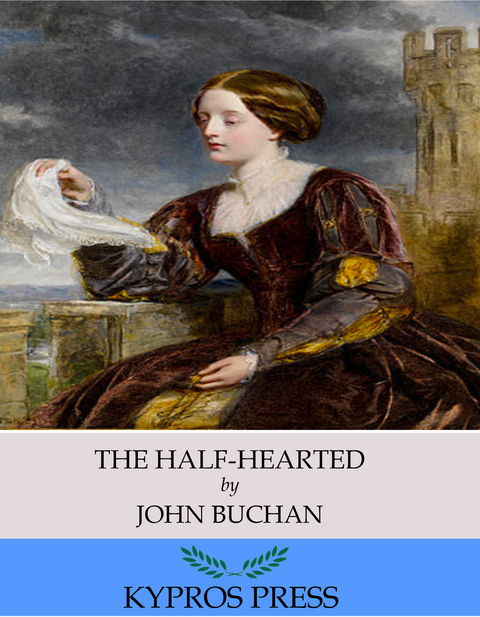
Half-Hearted (eBook)
380 Seiten
Charles River Editors (Verlag)
978-1-5183-0340-1 (ISBN)
John Buchan was a Scottish writer and Unionist politician who served as Governor General of Canada. Buchan wrote a vast amount of books including the Richard Hannay novels that have recently been turned into a popular British television show. This edition of The Half-Hearted includes a table of contents.
CHAPTER 2: LADY MANORWATER’S GUESTS
WHEN THE AFTERNOON TRAIN FROM the south drew into Gledsmuir station, a girl who had been devouring the landscape for the last hour with eager eyes, rose nervously to prepare for exit. To Alice Wishart the country was a novel one, and the prospect before her an unexplored realm of guesses. The daughter of a great merchant, she had lived most of her days in the ugly environs of a city, save for such time as she had spent at the conventional schools. She had never travelled; the world of men and things was merely a name to her, and a girlhood, lonely and brightened chiefly by the companionship of books, had not given her self-confidence. She had casually met Lady Manorwater at some political meeting in her father’s house, and the elder woman had taken a strong liking to the quiet, abstracted child. Then came an invitation to Glenavelin, accepted gladly yet with much fear and searching of heart. Now, as she looked out on the shining mountain land, she was full of delight that she was about to dwell in the heart of it. Something of pride, too, was present, that she was to be the guest of a great lady, and see something of a life which seemed infinitely remote to her provincial thoughts. But when her journey drew near its end she was foolishly nervous, and scanned the platform with anxious eye.
The sight of her hostess reassured her. Lady Manorwater was a small middle-aged woman, with a thin classical face, large colourless eyes, and untidy fair hair. She was very plainly dressed, and as she darted forward to greet the girl with entire frankness and kindness, Alice forgot her fears and kissed her heartily. A languid young woman was introduced as Miss Afflint, and in a few minutes the three were in the Glenavelin carriage with the wide glen opening in front.
“Oh, my dear, I hope you will enjoy your visit. We are quite a small party, for Jack says Glenavelin is far too small to entertain in. You are fond of the country, aren’t you? And of course the place is very pretty. There is tennis and golf and fishing; but perhaps you don’t like these things? We are not very well off for neighbours, but we are large enough in number to be sufficient to ourselves. Don’t you think so, Bertha?” And Lady Manorwater smiled at the third member of the group.
Miss Afflint, a silent girl, smiled back and said nothing. She had been engaged in a secret study of Alice’s face, and whenever the object of the study raised her eyes she found a pair of steady blue ones beaming on her. It was a little disconcerting, and Alice gazed out at the landscape with a fictitious curiosity.
They passed out of the Gled valley into the narrower strath of Avelin, and soon, leaving the meadows behind, went deep into the recesses of woods. At a narrow glen bridged by the road and bright with the spray of cascades and the fresh green of ferns, Alice cried out in delight, “Oh, I must come back here some day and sketch it. What a Paradise of a place!”
“Then you had better ask Lewie’s permission.” And Lady Manorwater laughed.
“Who is Lewie?” asked the girl, anticipating some gamekeeper or shepherd.
“Lewie is my nephew. He lives at Etterick, up at the head of the glen.”
Miss Afflint spoke for the first time. “A very good man. You should know Lewie, Miss Wishart. I’m sure you would like him. He is a great traveller, you know, and has written a famous book. Lewis Haystoun is his full name.”
“Why, I have read it,” cried Alice. “You mean the book about Kashmir. But I thought the author was an old man.”
“Lewie is not very old,” said his aunt; “but I haven’t seen him for years, so he may be decrepit by this time. He is coming home soon, he says, but he never writes. I know two of his friends who pay a Private Inquiry Office to send them news of him.”
Alice laughed and became silent. What merry haphazard people were these she had fallen among! At home everything was docketed and ordered. Meals were immovable feasts, the hour for bed and the hour for rising were more regular than the sun’s. Her father was full of proverbs on the virtue of regularity, and was wont to attribute every vice and misfortune to its absence. And yet here were men and women who got on very well without it. She did not wholly like it. The little doctrinaire in her revolted and she was pleased to be censorious.
“You are a very learned young woman, aren’t you?” said Lady Manorwater, after a short silence. “I have heard wonderful stories about your learning. Then I hope you will talk to Mr. Stocks, for I am afraid he is shocked at Bertha’s frivolity. He asked her if she was in favour of the Prisons Regulation Bill, and she was very rude.”
“I only said,” broke in Miss Afflint, “that owing to my lack of definite local knowledge I was not in a position to give an answer commensurate with the gravity of the subject.” She spoke in a perfect imitation of the tone of a pompous man.
“Bertha, I do not approve of you,” said Lady Manorwater. “I forbid you to mimic Mr. Stocks. He is very clever, and very much in earnest over everything. I don’t wonder that a butterfly like you should laugh, but I hope Miss Wishart will be kind to him.”
“I am afraid I am very ignorant,” said Alice hastily, “and I am very useless. I never did any work of any sort in my life, and when I think of you I am ashamed.”
“Oh, my dear child, please don’t think me a paragon,” cried her hostess in horror. “I am a creature of vague enthusiasms and I have the sense to know it. Sometimes I fancy I am a woman of business, and then I take up half a dozen things till Jack has to interfere to prevent financial ruin. I dabble in politics and I dabble in philanthropy; I write review articles which nobody reads, and I make speeches which are a horror to myself and a misery to my hearers. Only by the possession of a sense of humour am I saved from insignificance.”
To Alice the speech was the breaking of idols. Competence, responsibility were words she had been taught to revere, and to hear them light-heartedly disavowed seemed an upturning of the foundation of things. You will perceive that her education had not included that valuable art, the appreciation of the flippant.
By this time the carriage was entering the gates of the park, and the thick wood cleared and revealed long vistas of short hill grass, rising and falling like moorland, and studded with solitary clumps of firs. Then a turn in the drive brought them once more into shadow, this time beneath a heath-clad knoll where beeches and hazels made a pleasant tangle. All this was new, not three years old; but soon they were in the ancient part of the policy which had surrounded the old house of Glenavelin. Here the grass was lusher, the trees antique oaks and beeches, and grey walls showed the boundary of an old pleasure-ground. Here in the soft sunlit afternoon sleep hung like a cloud, and the peace of centuries dwelt in the long avenues and golden pastures. Another turning and the house came in sight, at first glance a jumble of grey towers and ivied walls. Wings had been built to the original square keep, and even now it was not large, a mere moorland dwelling. But the whitewashed walls, the crow-step gables, and the quaint Scots baronial turrets gave it a perfection to the eye like a house in a dream. To Alice, accustomed to the vulgarity of suburban villas with Italian campaniles, a florid lodge a stone’s throw from the house, darkened too with smoke and tawdry with paint, this old-world dwelling was a patch of wonderland. Her eyes drank in the beauty of the place—the great blue backs of hill beyond, the acres of sweet pasture, the primeval woods.
“Is this Glenavelin?” she cried. “Oh, what a place to live in!”
“Yes, it’s very pretty, dear.” And Lady Manorwater, who possessed half a dozen houses up and down the land, patted her guest’s arm and looked with pleasure on the flushed girlish face.
Two hours later, Alice, having completed dressing, leaned out of her bedroom window to drink in the soft air of evening. She had not brought a maid, and had refused her hostess’s offer to lend her her own on the ground that maids were a superfluity. It was her desire to be a very practical young person, a scorner of modes and trivialities, and yet she had taken unusual care with her toilet this evening, and had spent many minutes before the glass. Looking at herself carefully, a growing conviction began to be confirmed—that she was really rather pretty. She had reddish-brown hair and—a rare conjunction— dark eyes and eyebrows and a delicate colour. As a small girl she had lamented bitterly the fate that bad not given her the orthodox beauty of the dark or fair maiden, and in her school days she had passed for plain. Now it began to dawn on her that she had beauty of a kind—the charm of strangeness; and her slim strong figure had the grace which a wholesome life alone can give. She was in high spirits, curious, interested, and generous. The people amused her, the place was a fairyland and outside the golden weather lay still and fragrant among the hills.
When she came down to the...
| Erscheint lt. Verlag | 22.3.2018 |
|---|---|
| Sprache | englisch |
| Themenwelt | Literatur ► Historische Romane |
| Literatur ► Klassiker / Moderne Klassiker | |
| Schlagworte | dickson mccunn • Historical • richard hannay • Scottish • sir edward theiley • thrity nine steps • witch wood |
| ISBN-10 | 1-5183-0340-4 / 1518303404 |
| ISBN-13 | 978-1-5183-0340-1 / 9781518303401 |
| Informationen gemäß Produktsicherheitsverordnung (GPSR) | |
| Haben Sie eine Frage zum Produkt? |
 EPUB (Adobe DRM)
Größe: 846 KB
Kopierschutz: Adobe-DRM
Adobe-DRM ist ein Kopierschutz, der das eBook vor Mißbrauch schützen soll. Dabei wird das eBook bereits beim Download auf Ihre persönliche Adobe-ID autorisiert. Lesen können Sie das eBook dann nur auf den Geräten, welche ebenfalls auf Ihre Adobe-ID registriert sind.
Details zum Adobe-DRM
Dateiformat: EPUB (Electronic Publication)
EPUB ist ein offener Standard für eBooks und eignet sich besonders zur Darstellung von Belletristik und Sachbüchern. Der Fließtext wird dynamisch an die Display- und Schriftgröße angepasst. Auch für mobile Lesegeräte ist EPUB daher gut geeignet.
Systemvoraussetzungen:
PC/Mac: Mit einem PC oder Mac können Sie dieses eBook lesen. Sie benötigen eine
eReader: Dieses eBook kann mit (fast) allen eBook-Readern gelesen werden. Mit dem amazon-Kindle ist es aber nicht kompatibel.
Smartphone/Tablet: Egal ob Apple oder Android, dieses eBook können Sie lesen. Sie benötigen eine
Geräteliste und zusätzliche Hinweise
Buying eBooks from abroad
For tax law reasons we can sell eBooks just within Germany and Switzerland. Regrettably we cannot fulfill eBook-orders from other countries.
EPUB (Ohne DRM)Digital Rights Management: ohne DRM
Dieses eBook enthält kein DRM oder Kopierschutz. Eine Weitergabe an Dritte ist jedoch rechtlich nicht zulässig, weil Sie beim Kauf nur die Rechte an der persönlichen Nutzung erwerben.
Dateiformat: EPUB (Electronic Publication)
EPUB ist ein offener Standard für eBooks und eignet sich besonders zur Darstellung von Belletristik und Sachbüchern. Der Fließtext wird dynamisch an die Display- und Schriftgröße angepasst. Auch für mobile Lesegeräte ist EPUB daher gut geeignet.
Systemvoraussetzungen:
PC/Mac: Mit einem PC oder Mac können Sie dieses eBook lesen. Sie benötigen dafür die kostenlose Software Adobe Digital Editions.
eReader: Dieses eBook kann mit (fast) allen eBook-Readern gelesen werden. Mit dem amazon-Kindle ist es aber nicht kompatibel.
Smartphone/Tablet: Egal ob Apple oder Android, dieses eBook können Sie lesen. Sie benötigen dafür eine kostenlose App.
Geräteliste und zusätzliche Hinweise
Buying eBooks from abroad
For tax law reasons we can sell eBooks just within Germany and Switzerland. Regrettably we cannot fulfill eBook-orders from other countries.
aus dem Bereich


