


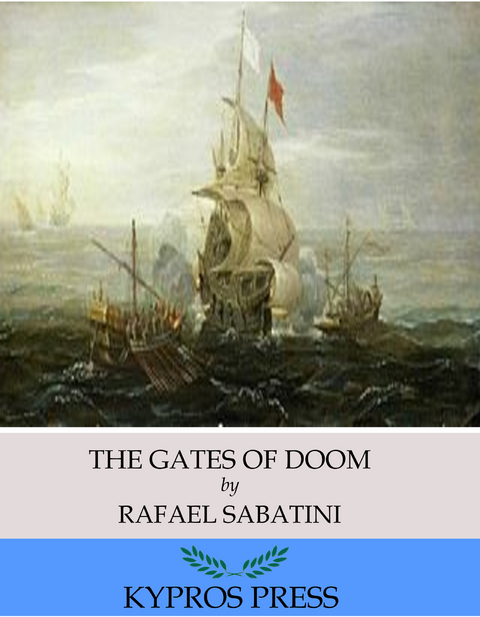
Gates of Doom (eBook)
359 Seiten
Charles River Editors (Verlag)
978-1-5183-0268-8 (ISBN)
Rafael Sabatini an Italian writer best known for his historical romance novels in the early 20th century. Sabatini had many best-sellers including The Sea-Hawk, Scaramouche, and Captain Blood. This edition of The Gates of Doom includes a table of contents.
CHAPTER 1. THE PLAYERS
THE ROOM—SOMEWHAT DISORDERED NOW, AT the end of that long night’s play—was spacious, lofty and handsomely equipped. On a boldly carved, walnut side table of Dutch origin there was a disarray of glasses, bottles, plates and broken meats. From a mahogany wine cooler beneath this table’s arched legs sprouted the corkless necks of a half-score empty bottles. About the card-table in the room’s middle stood irregularly some eight or ten chairs, lately occupied by the now departed players. One overturned chair lay neglected where it had fallen. Cards were still strewn upon the table’s cover of green baize and some few lay scattered on the scarlet Turkey rug that covered a square of the blocked and polished floor.
Overhead in the heavy chandelier of ormolu and crystal the candles were guttering, caught by the draught from one of the long French windows which his lordship had just opened. In the gap he stood, gazing out into the chill grey dawn and the wraiths of mist that hung above the park.
By the carved overmantel, his shoulders to the shelf and the ormolu timepiece, which marked now the hour of three, stood Lord Pauncefort’s only lingering and most important guest. He was a man of rather more than middle height, slender as a rapier is slender, of a steely, supple strength. He was simply yet very elegantly dressed in black, relieved only by the silver embroidery on his stockings, the paste buckles that flashed from his lacquered, red-heeled shoes, and the lace at his throat, among which a great sapphire glowed with sombre fire. Enough remained, however, in his erect carriage, his Steinkirk, the clubbing of his hair and the bronze of his face to advertise the soldier.
His keen blue eyes were upon the figure of his host, and in them was reflected the faint smile that softened the somewhat hard lines of his mouth. Yet the smile was scornful—of his host and of the night that was sped; scornful and something sad.
Was it, he mused, upon such as these that his king and master relied in his dire need? Was it to gain such support as my lord Pauncefort and his precious friends could offer to that desperate cause that he, himself, had ventured once more into England where a thousand guineas was offered for his head?
The play, he reflected contemptuously, they had urged as a wise measure of precaution: let them do their plotting about a faro-table, had been their plea; thus they should pass for a parcel of idle gamesters, and none could dream that the game was a pretence, a mere mask upon their real business. Thus had they deluded themselves, but not him. He had seen, and soon, that the plotting was the pretence, and play the business. And what play! A gamester all his life, a man who had beggared himself a score of times in twenty different lands, never had he known such stakes as those which had been laid that night, never had he seen such sums change hands across the green baize of a card table.
He checked the contemptuous current of his thoughts to reflect that he himself had plunged as headlong as the most reckless of them into the game that was afoot. Had he not won a fortune ‘twixt the commencement and the abandoning of that monstrous play? His winnings amounted to something over ten thousand guineas, and at no one time in his vagrant, adventurous life had he been master of half that sum. Yet it did not follow that he was quite as they. If he had risked that night certain moneys that he scarce dared call his own, so did he hesitate to call his own the vast sum which he had won.
Ten thousand guineas! Ten times the value set by the Government upon his own poor head, he reflected whimsically.
And then Lord Pauncefort turned from the window and the sight of his lordship’s livid, distorted countenance drove all other considerations from his guest’s mind, brought a sudden cry of concern from his lips.
“My lord, are you ill?”
His lordship made a gesture of denial. “It—it is not that,” he said, and his voice was husky with emotion. He was a man of some thirty years of age, of a swarthy male beauty that was almost arresting. His large eyes were dark and liquid, his mouth delicately limned, his nose intrepidly arched, with fine sensitive nostrils. But the brow was alarmingly shallow and there was a cleft in the square—the too square—chin. He stood now, dabbing his moist brow with a flimsy kerchief that was not whiter than the hand that held it.
“Captain Gaynor,” he explained abruptly, almost fiercely, “I am a broken man. I have ruined myself this night.”
There was scarce one of the departed guests, Captain Gaynor bethought him, who had not left that house a winner, and in all his lordship’s losses must amount to almost twice the sum of the Captain’s winnings.
None the less, his lordship’s outcry jarred upon the Captain’s nice sensibilities. Such an admission made to one who was a heavy winner—and that one none so intimately admitted to his lordship’s private confidences, when all was said—seemed to Captain Gaynor an outrage on decorum. He held that the man who cannot lose with calm and grace, no matter what the game or what the stakes—even though it should be life itself—has not the right to enter into play. And this was no abstract creed. It was the one by which the Captain lived.
The sight of the stricken man before him moved him to no pity.
Rather it inspired in him a contempt that amounted almost to physical ill being, to disgust. His immediate impulse was to take his leave. If, indeed, he had lingered at all after the departure of his fellow-guests, it had been in the hope that my Lord Pauncefort might yet have something for his private ear concerning the real business that had brought him to England and to that house. And perceiving now how idle had been this hope, observing his host’s suddenly altered condition, Captain Gaynor’s inclination was to depart.
But he reflected that to depart abruptly after that confession might be to offend. On his own account this would have troubled the Captain not at all. But for the Cause’s sake, and for the sake of the service it might be Pauncefort’s to render to that Cause, he did not wish to give offence to his host if it might be avoided. He was in a quandary, and vexed thereby; for quandaries were not usual in the life of this man who lived by swift decisions and swift action.
He shifted uneasily where he stood, and his face assumed a mask of polite concern. His lordship had sunk into the nearest chair, like a man wearied to exhaustion. There was a wildness in his eyes, and he continued nervously to dab his brow—that brow whose shallowness belied the general nobility of his countenance.
“You think, maybe, that I exaggerate,” he resumed presently. “But I tell you, sir, that I have played the knave this night. I have lost four thousand guineas to Martindale, another two to Bagshot, and I have lost my honour too, for I have forfeited all chance of ever being able to pay those losses.”
The concern in the Captain’s face appeared to deepen.
“They are your friends,” he said slowly. “Surely they will be glad to wait upon your convenience.” In his own breast pocket rested his lordship’s draft upon his bankers for the eight thousand and odd guineas he had lost to the Captain.
“My convenience?” cried Pauncefort, and his white face writhed in a spasm of mocking laughter. “I tell you, man, that in all the world I cannot claim ten guineas for my own. You are a gamester, Captain Gaynor?” he ended between question and assertion.
“So rumour says of me—I confess with justice,” the Captain admitted, and the faintest of ironic smiles quivered on his firm lips.
“I am engaged at present in a game wherein I have staked my head. Has your lordship ever played as deep as that?”
“Ay, have I. Do I not tell you, man, that I have staked my honour; and honour, surely, is more than life.”
“So I have heard say,” answered Captain Gaynor, like a sceptic.
He had little comfort for his host, little encouragement for the confidences that Pauncefort insisted upon thrusting on him. Indeed, it was his deliberate aim to stifle them. He desired them not. Although his acquaintance with Lord Pauncefort was considerable, it was not an acquaintance that had ever ripened, or promised to ripen, into friendship. The link that bound them was their common devotion to the Stuart Cause, whose agent Captain Gaynor was. Beyond that they had no common interest, although, when all is said, that might be accounted interest enough to bind two men at such a time.
But, despite the Captain’s chill aloofness, his lordship was not to be repressed. In the nature of this man of so strong and noble-seeming a countenance there was a strain of weakness almost feminine. He was of those who must forever be proclaiming griefs and grievances, finding it impossible to bear in silence and in dignity the burden of their woes. He was of those who in their trouble must forever be confiding in the hope of lessening their oppression. Moreover he had at present another motive for his confidence: a faint hope that it might bear him...
| Erscheint lt. Verlag | 22.3.2018 |
|---|---|
| Sprache | englisch |
| Themenwelt | Literatur ► Historische Romane |
| Literatur ► Klassiker / Moderne Klassiker | |
| Schlagworte | Adventure • Captain Blood • Classic • Historical • Italian • Medieval • Romance • Scaramouche • swordfighting • the sea-hawk |
| ISBN-10 | 1-5183-0268-8 / 1518302688 |
| ISBN-13 | 978-1-5183-0268-8 / 9781518302688 |
| Informationen gemäß Produktsicherheitsverordnung (GPSR) | |
| Haben Sie eine Frage zum Produkt? |
 EPUB (Adobe DRM)
Größe: 716 KB
Kopierschutz: Adobe-DRM
Adobe-DRM ist ein Kopierschutz, der das eBook vor Mißbrauch schützen soll. Dabei wird das eBook bereits beim Download auf Ihre persönliche Adobe-ID autorisiert. Lesen können Sie das eBook dann nur auf den Geräten, welche ebenfalls auf Ihre Adobe-ID registriert sind.
Details zum Adobe-DRM
Dateiformat: EPUB (Electronic Publication)
EPUB ist ein offener Standard für eBooks und eignet sich besonders zur Darstellung von Belletristik und Sachbüchern. Der Fließtext wird dynamisch an die Display- und Schriftgröße angepasst. Auch für mobile Lesegeräte ist EPUB daher gut geeignet.
Systemvoraussetzungen:
PC/Mac: Mit einem PC oder Mac können Sie dieses eBook lesen. Sie benötigen eine
eReader: Dieses eBook kann mit (fast) allen eBook-Readern gelesen werden. Mit dem amazon-Kindle ist es aber nicht kompatibel.
Smartphone/Tablet: Egal ob Apple oder Android, dieses eBook können Sie lesen. Sie benötigen eine
Geräteliste und zusätzliche Hinweise
Buying eBooks from abroad
For tax law reasons we can sell eBooks just within Germany and Switzerland. Regrettably we cannot fulfill eBook-orders from other countries.
EPUB (Ohne DRM)Digital Rights Management: ohne DRM
Dieses eBook enthält kein DRM oder Kopierschutz. Eine Weitergabe an Dritte ist jedoch rechtlich nicht zulässig, weil Sie beim Kauf nur die Rechte an der persönlichen Nutzung erwerben.
Dateiformat: EPUB (Electronic Publication)
EPUB ist ein offener Standard für eBooks und eignet sich besonders zur Darstellung von Belletristik und Sachbüchern. Der Fließtext wird dynamisch an die Display- und Schriftgröße angepasst. Auch für mobile Lesegeräte ist EPUB daher gut geeignet.
Systemvoraussetzungen:
PC/Mac: Mit einem PC oder Mac können Sie dieses eBook lesen. Sie benötigen dafür die kostenlose Software Adobe Digital Editions.
eReader: Dieses eBook kann mit (fast) allen eBook-Readern gelesen werden. Mit dem amazon-Kindle ist es aber nicht kompatibel.
Smartphone/Tablet: Egal ob Apple oder Android, dieses eBook können Sie lesen. Sie benötigen dafür eine kostenlose App.
Geräteliste und zusätzliche Hinweise
Buying eBooks from abroad
For tax law reasons we can sell eBooks just within Germany and Switzerland. Regrettably we cannot fulfill eBook-orders from other countries.
aus dem Bereich


