


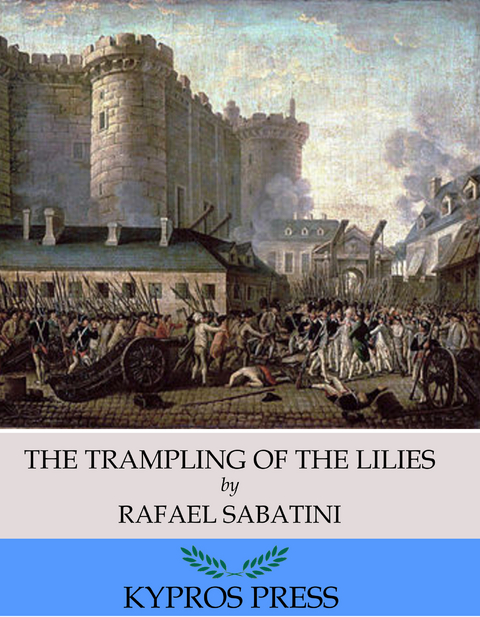
Trampling of the Lilies (eBook)
283 Seiten
Charles River Editors (Verlag)
978-1-5183-0261-9 (ISBN)

Rafael Sabatini an Italian writer best known for his historical romance novels in the early 20th century. Sabatini had many best-sellers including The Sea-Hawk, Scaramouche, and Captain Blood. This edition of The Trampling of the Lilies includes a table of contents.
CHAPTER I. MONSIEUR THE SECRETARY
IT WAS SPRING AT BELLECOUR—THE spring of 1789, a short three months before the fall of the Bastille came to give the nobles pause, and make them realise that these new philosophies, which so long they have derided, were by no means the idle vapours they had deemed them.
By the brook, plashing its glittering course through the park of Bellecour, wandered La Boulaye, his long, lean, figure clad with a sombreness that was out of harmony in that sunlit, vernal landscape. But the sad-hued coat belied that morning a heart that sang within his breast as joyously as any linnet of the woods through which he strayed. That he was garbed in black was but the outward indication of his clerkly office, for he was secretary to the most noble the Marquis de Fresnoy de Bellecour, and so clothed in the livery of the ink by which he lived. His face was pale and lean and thoughtful, but within his great, intelligent eyes there shone a light of new-born happiness. Under his arm he carried a volume of the new philosophies which Rousseau had lately given to the world, and which was contributing so vastly to the mighty change that was impending. But within his soul there dwelt in that hour no such musty subject as the metaphysical dreams of old Rousseau. His mood inclined little to the “Discourses upon the Origin of Inequality” which his elbow hugged to his side. Rather was it a mood of song and joy and things of light, and his mind was running on a string of rhymes which mentally he offered up to his divinity. A high-born lady was she, daughter to his lordly employer, the most noble Marquis of Bellecour. And he a secretary, a clerk! Aye, but a clerk with a great soul, a secretary with a great belief in the things to come, which in that musty tome beneath his arm were dimly prophesied.
And as he roamed beside the brook, his feet treading the elastic, velvety turf, and crushing heedlessly late primrose and stray violet, his blood quickened by the soft spring breeze, fragrant with hawthorn and the smell of the moist brown earth, La Boulaye’s happiness gathered strength from the joy that on that day of spring seemed to invest all Nature. An old-world song stole from his firm lips-at first timidly, like a thing abashed in new surroundings, then in bolder tones that echoed faintly through the trees
“Si le roi m’avait donne
Paris, sa grande ville,
Et qui’il me fallut quitter
L’amour de ma mie,
Je dirais au roi Louis
Reprenez votre Paris.
J’aime mieux ma mie, O gai!
J’aime mieux ma mie!”
How mercurial a thing is a lover’s heart! Here was one whose habits were of solemnity and gloomy thought turned, so joyous that he could sing aloud, alone in the midst of sunny Nature, for no better reason than that Suzanne de Bellecour had yesternight smiled as—for some two minutes by the clock—she had stood speaking with him.
“Presumptuous that I am,” said he to the rivulet, to contradict himself the next moment. “But no; the times are changing. Soon we shall be equals all, as the good God made us, and—”
He paused, and smiled pensively. And as again the memory of her yesternight’s kindness rose before him, his smile broadened; it became a laugh that went ringing down the glade, scaring a noisy thrush into silence and sending it flying in affright across the scintillant waters of the brook. Then that hearty laugh broke sharply off, as, behind him, the sweetest voice in all the world demanded the reason of this mad-sounding mirth.
La Boulaye’s breath seemed in that instant to forsake him and he grew paler than Nature and the writer’s desk had fashioned him. Awkwardly he turned and made her a deep bow.
“Mademoiselle! You—you see that you surprised me!” he faltered, like a fool. For how should he, whose only comrades had been books, have learnt to bear himself in the company of a woman, particularly when she belonged to the ranks of those whom—despite Rousseau and his other dear philosophers—he had been for years in the habit of accounting his betters?
“Why, then, I am glad, Monsieur, that I surprised you in so gay a humour—for, my faith, it is a rare enough thing.”
“True, lady,” said he foolishly, yet politely agreeing with her, “it is a rare thing.” And he sighed—"Helas!”
At that the laughter leapt from her young lips, and turned him hot and cold as he stood awkwardly before her.
“I see that we shall have you sad at the thought of how rare is happiness, you that but a moment back were—or so it seemed—so joyous. Or is it that my coming has overcast the sky of your good humour?” she demanded archly.
He blushed like a school-girl, and strenuously protested that it was not so. In his haste he fell headlong into the sin of hastiness—as was but natural—and said perhaps too much.
“Your coming, Mademoiselle?” he echoed. “Nay but even had I been sad, your coming must have dispelled my melancholy as the coming of the sun dispels the mist upon the mountains.”
“A poet?” She mocked him playfully, with a toss of black curls and a distracting glance of eyes blue as the heavens above them. “A poet, Monsieur, and I never suspected it, for all that I held you a great scholar. My father says you are.”
“Are we not all poets at some season of our lives?” quoth he, for growing accustomed to her presence—ravished by it, indeed—his courage was returning fast and urging him beyond the limits of discretion.
“And in what season may this rhyming fancy touch us?” she asked. “Enlighten me, Monsieur.”
He smiled, responsive to her merry mood, and his courage ever swelling under the suasion of it, he answered her in a fearless, daring fashion that was oddly unlike his wont. But then, he was that day a man transformed.
“It comes, Mademoiselle, upon some spring morning such as this—for is not spring the mating season, and have not poets sung of it, inspired and conquered by it? It comes in the April of life, when in our hearts we bear the first fragrant bud of what shall anon blossom into a glorious summer bloom red as is Love’s livery and perfumed beyond all else that God has set on earth for man’s delight and thankfulness.”
The intensity with which he spoke, and the essence of the speech itself, left her a moment dumb with wonder and with an incomprehensible consternation, born of some intuition not yet understood.
“And so, Monsieur, the Secretary,” said she at last, a nervous laugh quivering in her first words, “from all this wondrous verbiage I am to take it that you love?”
“Aye, that I love, dear lady,” he cried, his eyes so intent upon her that her glance grew timid and fell before them. And then, a second later, she could have screamed aloud in apprehension, for the book of Jean Jacques Rousseau lay tumbled in the grass where he had flung it, even as he flung himself upon his knees before her. “You may take it indeed that I love—that I love you, Mademoiselle.”
The audacious words being spoken, his courage oozed away and anti-climax, followed. He paled and trembled, yet he knelt on until she should bid him rise, and furtively he watched her face. He saw it darken; he saw the brows knit; he noted the quickening breath, and in all these signs he read his doom before she uttered it.
“Monsieur, monsieur,” she answered him, and sad was her tone, “to what lengths do you urge this springtime folly? Have you forgotten so your station—yes, and mine—that because I talk with you and laugh with you, and am kind to you, you must presume to speak to me in this fashion? What answer shall I make you, Monsieur—for I am not so cruel that I can answer you as you deserve.”
An odd thing indeed was La Boulaye’s courage. An instant ago he had felt a very coward, and had quivered, appalled by the audacity of his own words. Now that she assailed him thus, and taxed him with that same audacity, the blood of anger rushed to his face—anger of the quality that has its source in shame. In a second he was on his feet before her, towering to the full of his lean height. The words came from him in a hot stream, which for reckless passion by far outvied his erstwhile amatory address.
“My station?” he cried, throwing wide his arms. “What fault lies in my station? I am a secretary, a scholar, and so, by academic right, a gentleman. Nay, Mademoiselle, never laugh; do not mock me yet. In what do you find me less a man than any of the vapid caperers that fill your father’s salon? Is not my shape as good? Are not my arms as strong, my hands as deft, my wits as keen, and my soul as true? Aye,” he pursued with another wild wave of his long arms, “my attributes have all these virtues, and yet you scorn me—you scorn me because of my station, so you say!”
How she had angered him! All the pent-up gall of years against the supercilia of the class from which she sprang surged in that moment to his lips. He bethought him...
| Erscheint lt. Verlag | 22.3.2018 |
|---|---|
| Sprache | englisch |
| Themenwelt | Literatur ► Historische Romane |
| Literatur ► Klassiker / Moderne Klassiker | |
| Schlagworte | Adventure • Captain Blood • Classic • Historical • Italian • Medieval • Romance • Scaramouche • swordfighting • the sea-hawk |
| ISBN-10 | 1-5183-0261-0 / 1518302610 |
| ISBN-13 | 978-1-5183-0261-9 / 9781518302619 |
| Informationen gemäß Produktsicherheitsverordnung (GPSR) | |
| Haben Sie eine Frage zum Produkt? |
 EPUB (Adobe DRM)
Größe: 834 KB
Kopierschutz: Adobe-DRM
Adobe-DRM ist ein Kopierschutz, der das eBook vor Mißbrauch schützen soll. Dabei wird das eBook bereits beim Download auf Ihre persönliche Adobe-ID autorisiert. Lesen können Sie das eBook dann nur auf den Geräten, welche ebenfalls auf Ihre Adobe-ID registriert sind.
Details zum Adobe-DRM
Dateiformat: EPUB (Electronic Publication)
EPUB ist ein offener Standard für eBooks und eignet sich besonders zur Darstellung von Belletristik und Sachbüchern. Der Fließtext wird dynamisch an die Display- und Schriftgröße angepasst. Auch für mobile Lesegeräte ist EPUB daher gut geeignet.
Systemvoraussetzungen:
PC/Mac: Mit einem PC oder Mac können Sie dieses eBook lesen. Sie benötigen eine
eReader: Dieses eBook kann mit (fast) allen eBook-Readern gelesen werden. Mit dem amazon-Kindle ist es aber nicht kompatibel.
Smartphone/Tablet: Egal ob Apple oder Android, dieses eBook können Sie lesen. Sie benötigen eine
Geräteliste und zusätzliche Hinweise
Buying eBooks from abroad
For tax law reasons we can sell eBooks just within Germany and Switzerland. Regrettably we cannot fulfill eBook-orders from other countries.
EPUB (Ohne DRM)Digital Rights Management: ohne DRM
Dieses eBook enthält kein DRM oder Kopierschutz. Eine Weitergabe an Dritte ist jedoch rechtlich nicht zulässig, weil Sie beim Kauf nur die Rechte an der persönlichen Nutzung erwerben.
Dateiformat: EPUB (Electronic Publication)
EPUB ist ein offener Standard für eBooks und eignet sich besonders zur Darstellung von Belletristik und Sachbüchern. Der Fließtext wird dynamisch an die Display- und Schriftgröße angepasst. Auch für mobile Lesegeräte ist EPUB daher gut geeignet.
Systemvoraussetzungen:
PC/Mac: Mit einem PC oder Mac können Sie dieses eBook lesen. Sie benötigen dafür die kostenlose Software Adobe Digital Editions.
eReader: Dieses eBook kann mit (fast) allen eBook-Readern gelesen werden. Mit dem amazon-Kindle ist es aber nicht kompatibel.
Smartphone/Tablet: Egal ob Apple oder Android, dieses eBook können Sie lesen. Sie benötigen dafür eine kostenlose App.
Geräteliste und zusätzliche Hinweise
Buying eBooks from abroad
For tax law reasons we can sell eBooks just within Germany and Switzerland. Regrettably we cannot fulfill eBook-orders from other countries.
aus dem Bereich


