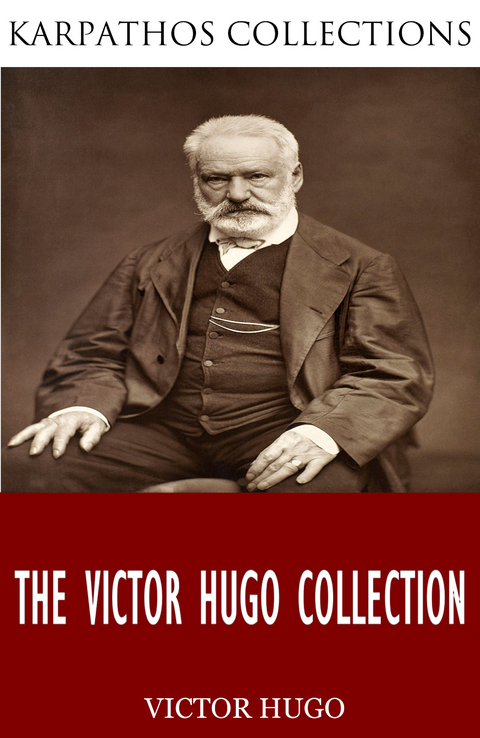
Victor Hugo Collection (eBook)
Charles River Editors (Verlag)
978-1-5312-7330-9 (ISBN)
Karpathos publishes the greatest works of history's greatest authors and collects them to make it easy and affordable for readers to have them all at the push of a button. All of our collections include a linked table of contents.Victor Hugo was one of the greatest French authors in history. Hugo was a prolific writer and his classic novels Les Miserables and the Hunchback of Notre Dame have been adapted into film many times. This collection includes the following:NOVELS:Les MiserablesThe Hunchback of Notre DameNapoleon the LittleThe Man Who LaughsToilers of the SeaNinety-ThreeThe History of a CrimeThe Last Day of a Condemned ManBug-Jargal SHORT STORIES:Claude Gueux POETRY COLLECTIONS:Early PoemsOdesBalladesLes OrientalesLes Feuilles D AutomneLes Chants Du CrepusculeLes Voix InterieuresLes Rayons et Les OmbresLes ChatimentsLes ContemplationsLa Legende Des SieclesLa Voix De GuernseyLes Chansons Des Rues et Des BoisL annee TerribleL art Detre GrandpereVarious PiecesDramatic Pieces NON-FICTION:The Memoirs of Victor HugoBIOGRAPHIES:Victor Hugo s Romances by Robert Louis StevensonVictor Hugo: His Life and Work by George Barnett Smith
CHAPTER II—M. MYRIEL BECOMES M. WELCOME
The episcopal palace of D—— adjoins the hospital.
The episcopal palace was a huge and beautiful house, built of stone at the beginning of the last century by M. Henri Puget, Doctor of Theology of the Faculty of Paris, Abbé of Simore, who had been Bishop of D—— in 1712. This palace was a genuine seignorial residence. Everything about it had a grand air,—the apartments of the Bishop, the drawing-rooms, the chambers, the principal courtyard, which was very large, with walks encircling it under arcades in the old Florentine fashion, and gardens planted with magnificent trees. In the dining-room, a long and superb gallery which was situated on the ground-floor and opened on the gardens, M. Henri Puget had entertained in state, on July 29, 1714, My Lords Charles Brulart de Genlis, archbishop; Prince d’Embrun; Antoine de Mesgrigny, the capuchin, Bishop of Grasse; Philippe de Vendome, Grand Prior of France, Abbé of Saint Honore de Lerins; Francois de Berton de Crillon, bishop, Baron de Vence; Cesar de Sabran de Forcalquier, bishop, Seignor of Glandeve; and Jean Soanen, Priest of the Oratory, preacher in ordinary to the king, bishop, Seignor of Senez. The portraits of these seven reverend personages decorated this apartment; and this memorable date, the 29th of July, 1714, was there engraved in letters of gold on a table of white marble.
The hospital was a low and narrow building of a single story, with a small garden.
Three days after his arrival, the Bishop visited the hospital. The visit ended, he had the director requested to be so good as to come to his house.
“Monsieur the director of the hospital,” said he to him, “how many sick people have you at the present moment?”
“Twenty-six, Monseigneur.”
“That was the number which I counted,” said the Bishop.
“The beds,” pursued the director, “are very much crowded against each other.”
“That is what I observed.”
“The halls are nothing but rooms, and it is with difficulty that the air can be changed in them.”
“So it seems to me.”
“And then, when there is a ray of sun, the garden is very small for the convalescents.”
“That was what I said to myself.”
“In case of epidemics,—we have had the typhus fever this year; we had the sweating sickness two years ago, and a hundred patients at times,—we know not what to do.”
“That is the thought which occurred to me.”
“What would you have, Monseigneur?” said the director. “One must resign one’s self.”
This conversation took place in the gallery dining-room on the ground-floor.
The Bishop remained silent for a moment; then he turned abruptly to the director of the hospital.
“Monsieur,” said he, “how many beds do you think this hall alone would hold?”
“Monseigneur’s dining-room?” exclaimed the stupefied director.
The Bishop cast a glance round the apartment, and seemed to be taking measures and calculations with his eyes.
“It would hold full twenty beds,” said he, as though speaking to himself. Then, raising his voice:—
“Hold, Monsieur the director of the hospital, I will tell you something. There is evidently a mistake here. There are thirty-six of you, in five or six small rooms. There are three of us here, and we have room for sixty. There is some mistake, I tell you; you have my house, and I have yours. Give me back my house; you are at home here.”
On the following day the thirty-six patients were installed in the Bishop’s palace, and the Bishop was settled in the hospital.
M. Myriel had no property, his family having been ruined by the Revolution. His sister was in receipt of a yearly income of five hundred francs, which sufficed for her personal wants at the vicarage. M. Myriel received from the State, in his quality of bishop, a salary of fifteen thousand francs. On the very day when he took up his abode in the hospital, M. Myriel settled on the disposition of this sum once for all, in the following manner. We transcribe here a note made by his own hand:—
NOTE ON THE REGULATION OF MY HOUSEHOLD EXPENSES.
For the little seminary . . . . . . . . . . . . . . 1,500 livres
Society of the mission . . . . . . . . . . . . . . 100 “
For the Lazarists of Montdidier . . . . . . . . . . 100 “
Seminary for foreign missions in Paris . . . . . . 200 “
Congregation of the Holy Spirit . . . . . . . . . . 150 “
Religious establishments of the Holy Land . . . . . 100 “
Charitable maternity societies . . . . . . . . . . 300 “
Extra, for that of Arles . . . . . . . . . . . . . 50 “
Work for the amelioration of prisons . . . . . . . 400 “
Work for the relief and delivery of prisoners . . . 500 “
To liberate fathers of families incarcerated for debt 1,000 “
Addition to the salary of the poor teachers of the
diocese . . . . . . . . . . . . . . . . . . . 2,000 “
Public granary of the Hautes-Alpes . . . . . . . . 100 “
Congregation of the ladies of D——, of Manosque, and of
Sisteron, for the gratuitous instruction of poor
girls . . . . . . . . . . . . . . . . . . . . 1,500 “
For the poor . . . . . . . . . . . . . . . . . . . 6,000 “
My personal expenses . . . . . . . . . . . . . . . 1,000 “
———
Total . . . . . . . . . . . . . . . . . . . . 15,000 “
M. Myriel made no change in this arrangement during the entire period that he occupied the see of D—— As has been seen, he called it regulating his household expenses.
This arrangement was accepted with absolute submission by Mademoiselle Baptistine. This holy woman regarded Monseigneur of D—— as at one and the same time her brother and her bishop, her friend according to the flesh and her superior according to the Church. She simply loved and venerated him. When he spoke, she bowed; when he acted, she yielded her adherence. Their only servant, Madame Magloire, grumbled a little. It will be observed that Monsieur the Bishop had reserved for himself only one thousand livres, which, added to the pension of Mademoiselle Baptistine, made fifteen hundred francs a year. On these fifteen hundred francs these two old women and the old man subsisted.
And when a village curate came to D——, the Bishop still found means to entertain him, thanks to the severe economy of Madame Magloire, and to the intelligent administration of Mademoiselle Baptistine.
One day, after he had been in D—— about three months, the Bishop said:—
“And still I am quite cramped with it all!”
“I should think so!” exclaimed Madame Magloire. “Monseigneur has not even claimed the allowance which the department owes him for the expense of his carriage in town, and for his journeys about the diocese. It was customary for bishops in former days.”
“Hold!” cried the Bishop, “you are quite right, Madame Magloire.”
And he made his demand.
Some time afterwards the General Council took this demand under consideration, and voted him an annual sum of three thousand francs, under this heading: Allowance to M. the Bishop for expenses of carriage, expenses of posting, and expenses of pastoral visits.
This provoked a great outcry among the local burgesses; and a senator of the Empire, a former member of the Council of the Five Hundred which favored the 18 Brumaire, and who was provided with a magnificent senatorial office in the vicinity of the town of D——, wrote to M. Bigot de Preameneu, the minister of public worship, a very angry and confidential note on the subject, from which we extract these authentic lines:—
“Expenses of carriage? What can be done with it in a town of less than four thousand inhabitants? Expenses of journeys? What is the use of these trips, in the first place? Next, how can the posting be accomplished in these mountainous parts? There are no roads. No one travels otherwise than on horseback. Even the bridge between Durance and Chateau-Arnoux can barely support ox-teams. These priests are all thus, greedy and avaricious. This man played the good priest when he first came. Now he does like the rest; he must have a carriage and a posting-chaise, he must have luxuries, like the bishops of the olden days. Oh, all this priesthood! Things will not go well, M. le Comte, until the Emperor has freed us from these black-capped rascals. Down with the Pope! [Matters were...
| Erscheint lt. Verlag | 22.3.2018 |
|---|---|
| Sprache | englisch |
| Themenwelt | Literatur ► Anthologien |
| Literatur ► Klassiker / Moderne Klassiker | |
| Literatur ► Romane / Erzählungen | |
| Schlagworte | Classic • French • Gothic • Historical • Hunchback • Les Miserables • Romance |
| ISBN-10 | 1-5312-7330-0 / 1531273300 |
| ISBN-13 | 978-1-5312-7330-9 / 9781531273309 |
| Informationen gemäß Produktsicherheitsverordnung (GPSR) | |
| Haben Sie eine Frage zum Produkt? |
 EPUB (Adobe DRM)
Größe: 5,5 MB
Kopierschutz: Adobe-DRM
Adobe-DRM ist ein Kopierschutz, der das eBook vor Mißbrauch schützen soll. Dabei wird das eBook bereits beim Download auf Ihre persönliche Adobe-ID autorisiert. Lesen können Sie das eBook dann nur auf den Geräten, welche ebenfalls auf Ihre Adobe-ID registriert sind.
Details zum Adobe-DRM
Dateiformat: EPUB (Electronic Publication)
EPUB ist ein offener Standard für eBooks und eignet sich besonders zur Darstellung von Belletristik und Sachbüchern. Der Fließtext wird dynamisch an die Display- und Schriftgröße angepasst. Auch für mobile Lesegeräte ist EPUB daher gut geeignet.
Systemvoraussetzungen:
PC/Mac: Mit einem PC oder Mac können Sie dieses eBook lesen. Sie benötigen eine
eReader: Dieses eBook kann mit (fast) allen eBook-Readern gelesen werden. Mit dem amazon-Kindle ist es aber nicht kompatibel.
Smartphone/Tablet: Egal ob Apple oder Android, dieses eBook können Sie lesen. Sie benötigen eine
Geräteliste und zusätzliche Hinweise
Buying eBooks from abroad
For tax law reasons we can sell eBooks just within Germany and Switzerland. Regrettably we cannot fulfill eBook-orders from other countries.
EPUB (Ohne DRM)Digital Rights Management: ohne DRM
Dieses eBook enthält kein DRM oder Kopierschutz. Eine Weitergabe an Dritte ist jedoch rechtlich nicht zulässig, weil Sie beim Kauf nur die Rechte an der persönlichen Nutzung erwerben.
Dateiformat: EPUB (Electronic Publication)
EPUB ist ein offener Standard für eBooks und eignet sich besonders zur Darstellung von Belletristik und Sachbüchern. Der Fließtext wird dynamisch an die Display- und Schriftgröße angepasst. Auch für mobile Lesegeräte ist EPUB daher gut geeignet.
Systemvoraussetzungen:
PC/Mac: Mit einem PC oder Mac können Sie dieses eBook lesen. Sie benötigen dafür die kostenlose Software Adobe Digital Editions.
eReader: Dieses eBook kann mit (fast) allen eBook-Readern gelesen werden. Mit dem amazon-Kindle ist es aber nicht kompatibel.
Smartphone/Tablet: Egal ob Apple oder Android, dieses eBook können Sie lesen. Sie benötigen dafür eine kostenlose App.
Geräteliste und zusätzliche Hinweise
Buying eBooks from abroad
For tax law reasons we can sell eBooks just within Germany and Switzerland. Regrettably we cannot fulfill eBook-orders from other countries.
aus dem Bereich