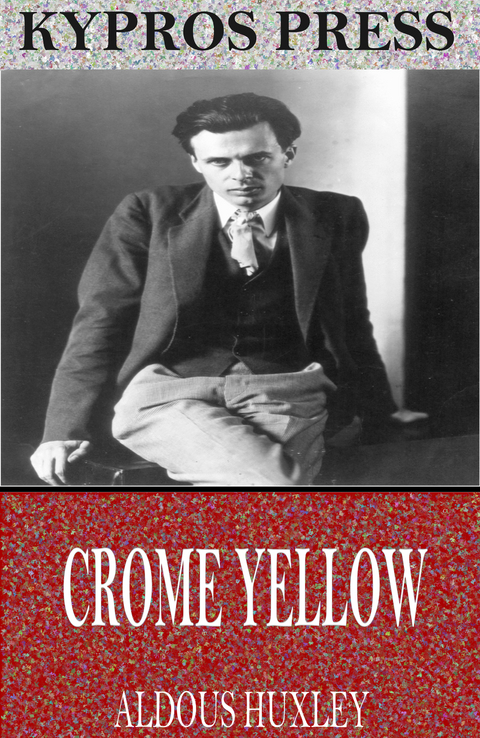
Crome Yellow (eBook)
230 Seiten
Charles River Editors (Verlag)
978-1-5312-6838-1 (ISBN)
Aldous Huxley was a prominent English writer and philosopher in the twentieth century. Huxley was nominated an astounding seven times for the Nobel Prize in Literature and is considered to be one of the greatest intellectuals of his time. This edition of Crome Yellow includes a table of contents.
CHAPTER III.
The terrace in front of the house was a long narrow strip of turf, bounded along its outer edge by a graceful stone balustrade. Two little summer-houses of brick stood at either end. Below the house the ground sloped very steeply away, and the terrace was a remarkably high one; from the balusters to the sloping lawn beneath was a drop of thirty feet. Seen from below, the high unbroken terrace wall, built like the house itself of brick, had the almost menacing aspect of a fortification—a castle bastion, from whose parapet one looked out across airy depths to distances level with the eye. Below, in the foreground, hedged in by solid masses of sculptured yew trees, lay the stone-brimmed swimming-pool. Beyond it stretched the park, with its massive elms, its green expanses of grass, and, at the bottom of the valley, the gleam of the narrow river. On the farther side of the stream the land rose again in a long slope, chequered with cultivation. Looking up the valley, to the right, one saw a line of blue, far-off hills.
The tea-table had been planted in the shade of one of the little summer-houses, and the rest of the party was already assembled about it when Denis and Priscilla made their appearance. Henry Wimbush had begun to pour out the tea. He was one of those ageless, unchanging men on the farther side of fifty, who might be thirty, who might be anything. Denis had known him almost as long as he could remember. In all those years his pale, rather handsome face had never grown any older; it was like the pale grey bowler hat which he always wore, winter and summer—unageing, calm, serenely without expression.
Next him, but separated from him and from the rest of the world by the almost impenetrable barriers of her deafness, sat Jenny Mullion. She was perhaps thirty, had a tilted nose and a pink-and-white complexion, and wore her brown hair plaited and coiled in two lateral buns over her ears. In the secret tower of her deafness she sat apart, looking down at the world through sharply piercing eyes. What did she think of men and women and things? That was something that Denis had never been able to discover. In her enigmatic remoteness Jenny was a little disquieting. Even now some interior joke seemed to be amusing her, for she was smiling to herself, and her brown eyes were like very bright round marbles.
On his other side the serious, moonlike innocence of Mary Bracegirdle’s face shone pink and childish. She was nearly twenty-three, but one wouldn’t have guessed it. Her short hair, clipped like a page’s, hung in a bell of elastic gold about her cheeks. She had large blue china eyes, whose expression was one of ingenuous and often puzzled earnestness.
Next to Mary a small gaunt man was sitting, rigid and erect in his chair. In appearance Mr. Scogan was like one of those extinct bird-lizards of the Tertiary. His nose was beaked, his dark eye had the shining quickness of a robin’s. But there was nothing soft or gracious or feathery about him. The skin of his wrinkled brown face had a dry and scaly look; his hands were the hands of a crocodile. His movements were marked by the lizard’s disconcertingly abrupt clockwork speed; his speech was thin, fluty, and dry. Henry Wimbush’s school-fellow and exact contemporary, Mr. Scogan looked far older and, at the same time, far more youthfully alive than did that gentle aristocrat with the face like a grey bowler.
Mr. Scogan might look like an extinct saurian, but Gombauld was altogether and essentially human. In the old-fashioned natural histories of the ‘thirties he might have figured in a steel engraving as a type of Homo Sapiens—an honour which at that time commonly fell to Lord Byron. Indeed, with more hair and less collar, Gombauld would have been completely Byronic—more than Byronic, even, for Gombauld was of Provencal descent, a black-haired young corsair of thirty, with flashing teeth and luminous large dark eyes. Denis looked at him enviously. He was jealous of his talent: if only he wrote verse as well as Gombauld painted pictures! Still more, at the moment, he envied Gombauld his looks, his vitality, his easy confidence of manner. Was it surprising that Anne should like him? Like him?—it might even be something worse, Denis reflected bitterly, as he walked at Priscilla’s side down the long grass terrace.
Between Gombauld and Mr. Scogan a very much lowered deck-chair presented its back to the new arrivals as they advanced towards the tea-table. Gombauld was leaning over it; his face moved vivaciously; he smiled, he laughed, he made quick gestures with his hands. From the depths of the chair came up a sound of soft, lazy laughter. Denis started as he heard it. That laughter—how well he knew it! What emotions it evoked in him! He quickened his pace.
In her low deck-chair Anne was nearer to lying than to sitting. Her long, slender body reposed in an attitude of listless and indolent grace. Within its setting of light brown hair her face had a pretty regularity that was almost doll-like. And indeed there were moments when she seemed nothing more than a doll; when the oval face, with its long-lashed, pale blue eyes, expressed nothing; when it was no more than a lazy mask of wax. She was Henry Wimbush’s own niece; that bowler-like countenance was one of the Wimbush heirlooms; it ran in the family, appearing in its female members as a blank doll-face. But across this dollish mask, like a gay melody dancing over an unchanging fundamental bass, passed Anne’s other inheritance—quick laughter, light ironic amusement, and the changing expressions of many moods. She was smiling now as Denis looked down at her: her cat’s smile, he called it, for no very good reason. The mouth was compressed, and on either side of it two tiny wrinkles had formed themselves in her cheeks. An infinity of slightly malicious amusement lurked in those little folds, in the puckers about the half-closed eyes, in the eyes themselves, bright and laughing between the narrowed lids.
The preliminary greetings spoken, Denis found an empty chair between Gombauld and Jenny and sat down.
“How are you, Jenny?” he shouted to her.
Jenny nodded and smiled in mysterious silence, as though the subject of her health were a secret that could not be publicly divulged.
“How’s London been since I went away?” Anne inquired from the depth of her chair.
The moment had come; the tremendously amusing narrative was waiting for utterance. “Well,” said Denis, smiling happily, “to begin with...”
“Has Priscilla told you of our great antiquarian find?” Henry Wimbush leaned forward; the most promising of buds was nipped.
“To begin with,” said Denis desperately, “there was the Ballet...”
“Last week,” Mr. Wimbush went on softly and implacably, “we dug up fifty yards of oaken drain-pipes; just tree trunks with a hole bored through the middle. Very interesting indeed. Whether they were laid down by the monks in the fifteenth century, or whether...”
Denis listened gloomily. “Extraordinary!” he said, when Mr. Wimbush had finished; “quite extraordinary!” He helped himself to another slice of cake. He didn’t even want to tell his tale about London now; he was damped.
For some time past Mary’s grave blue eyes had been fixed upon him. “What have you been writing lately?” she asked. It would be nice to have a little literary conversation.
“Oh, verse and prose,” said Denis—"just verse and prose.”
“Prose?” Mr. Scogan pounced alarmingly on the word. “You’ve been writing prose?”
“Yes.”
“Not a novel?”
“Yes.”
“My poor Denis!” exclaimed Mr. Scogan. “What about?”
Denis felt rather uncomfortable. “Oh, about the usual things, you know.”
“Of course,” Mr. Scogan groaned. “I’ll describe the plot for you. Little Percy, the hero, was never good at games, but he was always clever. He passes through the usual public school and the usual university and comes to London, where he lives among the artists. He is bowed down with melancholy thought; he carries the whole weight of the universe upon his shoulders. He writes a novel of dazzling brilliance; he dabbles delicately in Amour and disappears, at the end of the book, into the luminous Future.”
Denis blushed scarlet. Mr. Scogan had described the plan of his novel with an accuracy that was appalling. He made an effort to laugh. “You’re entirely wrong,” he said. “My novel is not in the least like that.” It was a heroic lie. Luckily, he reflected, only two chapters were written. He would tear them up that very evening when he unpacked.
Mr. Scogan paid no attention to his denial, but went on: “Why will you young men continue to write about things that are so entirely uninteresting as the mentality of adolescents and artists? Professional anthropologists might find it interesting to turn sometimes from the beliefs of the Blackfellow to the philosophical preoccupations of the undergraduate. But you can’t expect an ordinary adult man, like myself, to be much moved by the story of his spiritual troubles. And after all, even in England, even in Germany and Russia, there are more adults than adolescents. As for the artist, he is preoccupied with...
| Erscheint lt. Verlag | 22.3.2018 |
|---|---|
| Sprache | englisch |
| Themenwelt | Literatur ► Anthologien |
| Literatur ► Klassiker / Moderne Klassiker | |
| Literatur ► Romane / Erzählungen | |
| Schlagworte | Brave New World • British • Classic • Fiction • Literary • Philosophy • Poetry |
| ISBN-10 | 1-5312-6838-2 / 1531268382 |
| ISBN-13 | 978-1-5312-6838-1 / 9781531268381 |
| Informationen gemäß Produktsicherheitsverordnung (GPSR) | |
| Haben Sie eine Frage zum Produkt? |
 EPUB (Adobe DRM)
Größe: 1,1 MB
Kopierschutz: Adobe-DRM
Adobe-DRM ist ein Kopierschutz, der das eBook vor Mißbrauch schützen soll. Dabei wird das eBook bereits beim Download auf Ihre persönliche Adobe-ID autorisiert. Lesen können Sie das eBook dann nur auf den Geräten, welche ebenfalls auf Ihre Adobe-ID registriert sind.
Details zum Adobe-DRM
Dateiformat: EPUB (Electronic Publication)
EPUB ist ein offener Standard für eBooks und eignet sich besonders zur Darstellung von Belletristik und Sachbüchern. Der Fließtext wird dynamisch an die Display- und Schriftgröße angepasst. Auch für mobile Lesegeräte ist EPUB daher gut geeignet.
Systemvoraussetzungen:
PC/Mac: Mit einem PC oder Mac können Sie dieses eBook lesen. Sie benötigen eine
eReader: Dieses eBook kann mit (fast) allen eBook-Readern gelesen werden. Mit dem amazon-Kindle ist es aber nicht kompatibel.
Smartphone/Tablet: Egal ob Apple oder Android, dieses eBook können Sie lesen. Sie benötigen eine
Geräteliste und zusätzliche Hinweise
Buying eBooks from abroad
For tax law reasons we can sell eBooks just within Germany and Switzerland. Regrettably we cannot fulfill eBook-orders from other countries.
EPUB (Ohne DRM)Digital Rights Management: ohne DRM
Dieses eBook enthält kein DRM oder Kopierschutz. Eine Weitergabe an Dritte ist jedoch rechtlich nicht zulässig, weil Sie beim Kauf nur die Rechte an der persönlichen Nutzung erwerben.
Dateiformat: EPUB (Electronic Publication)
EPUB ist ein offener Standard für eBooks und eignet sich besonders zur Darstellung von Belletristik und Sachbüchern. Der Fließtext wird dynamisch an die Display- und Schriftgröße angepasst. Auch für mobile Lesegeräte ist EPUB daher gut geeignet.
Systemvoraussetzungen:
PC/Mac: Mit einem PC oder Mac können Sie dieses eBook lesen. Sie benötigen dafür die kostenlose Software Adobe Digital Editions.
eReader: Dieses eBook kann mit (fast) allen eBook-Readern gelesen werden. Mit dem amazon-Kindle ist es aber nicht kompatibel.
Smartphone/Tablet: Egal ob Apple oder Android, dieses eBook können Sie lesen. Sie benötigen dafür eine kostenlose App.
Geräteliste und zusätzliche Hinweise
Buying eBooks from abroad
For tax law reasons we can sell eBooks just within Germany and Switzerland. Regrettably we cannot fulfill eBook-orders from other countries.
aus dem Bereich