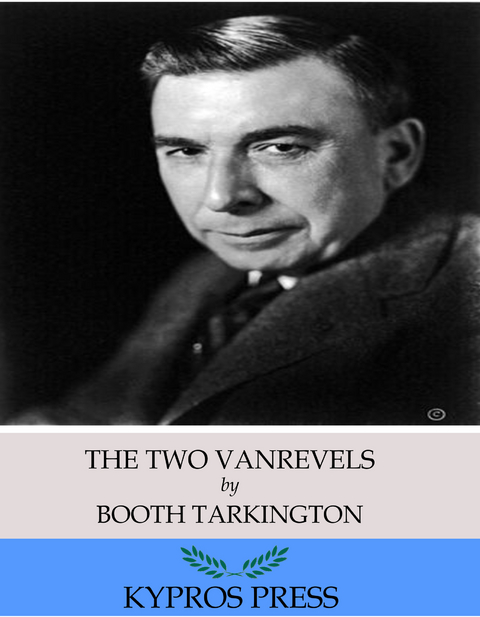
Two Vanrevels (eBook)
251 Seiten
Charles River Editors (Verlag)
978-1-5080-8531-7 (ISBN)
Booth Tarkington was a Pulitzer Prize winning American author best known for writing historical novels such as The Magnificent Ambersons and Alice Adams. Many of Tarkington's books are set in fictional towns in the Midwest near the turn of the 20th century. This edition of The Two Vanrevels includes a table of contents.
CHAPTER I. A CAT CAN DO MORE THAN LOOK AT A KING
IT WAS LONG AGO IN the days when men sighed when they fell in love; when people danced by candle and lamp, and did dance, too, instead of solemnly gliding about; in that mellow time so long ago, when the young were romantic and summer was roses and wine, old Carewe brought his lovely daughter home from the convent to wreck the hearts of the youth of Rouen.
That was not a far journey; only an afternoon’s drive through the woods and by the river, in an April, long ago; Miss Betty’s harp carefully strapped behind the great lumbering carriage, her guitar on the front seat, half-buried under a mound of bouquets and oddly shaped little bundles, farewell gifts of her comrades and the good Sisters. In her left hand she clutched a small lace handkerchief, with which she now and then touched her eyes, brimmed with the parting from Sister Cecilia, Sister Mary Bazilede, the old stone steps and all the girls: but for every time that she lifted the dainty kerchief to brush away the edge of a tear, she took a deep breath of the Western woodland air and smiled at least twice; for the years of strict inclosure within St. Mary’s walls and still gardens were finished and done with, and at last the many-colored world flashed and danced in a mystery before her. This mystery was brilliant to the convent-girl because it contained men; she was eager to behold it.
They rumbled into town after sunset, in the fair twilight, the dogs barking before them, and everyone would have been surprised to know that Tom Vanrevel, instead of Mr. Crailey Gray, was the first to see her. By the merest accident, Tom was strolling near the Carewe place at the time; and when the carriage swung into the gates, with rattle and clink and clouds of dust at the finish, it was not too soon lost behind the shrubbery and trees for Tom to catch something more than a glimpse of a gray skirt behind a mound of flowers, and of a charming face with parted lips and dark eyes beneath the scuttle of an enormous bonnet. It happened—perhaps it is more accurate to say that Tom thought it happened—that she was just clearing away her veil when he turned to look. She blushed suddenly, so much was not to be mistaken; and the eyes that met his were remarkable for other reasons than the sheer loveliness of them, in that, even in the one flash of them he caught, they meant so many things at one time. They were sparkling, yet mournful; and they were wistful, although undeniably lively with the gayest comprehension of the recipient of their glance, seeming to say, “Oh, it’s you, young man, is it!” And they were shy and mysterious with youth, full of that wonder at the world which has the appearance, sometimes, of wisdom gathered in the unknown out of which we came. But, above all, these eyes were fully conscious of Tom Vanrevel.
Without realizing what he did, Mr. Vanrevel stopped short. He had been swinging a walkingstick, which, describing a brief arc, remained poised half-way in its descent. There was only that one glance between them; and the carriage disappeared, leaving a scent of spring flowers in the air.
The young man was left standing on the wooden pavement in the midst of a great loneliness, yet enveloped in the afterglow, his soul roseate, his being quavering, his expression, like his cane, instantaneously arrested. With such promptitude and finish was he disposed of, that, had Miss Carewe been aware of his name and the condition wrought in him by the single stroke, she could have sought only the terse Richard of England for a like executive ability, “Off with his head! So much for Vanrevel!”
She had lifted a slender hand to the fluttering veil, a hand in a white glove with a small lace gauntlet at the wrist. This gesture was the final divinity of the radiant vision which remained with the dazed young man as he went down the street; and it may have been three-quarters of an hour later when the background of the picture became vivid to him: a carefully dressed gentleman with heavy brows and a handsome high nose, who sat stiffly upright beside the girl, his very bright eyes quite as conscious of the stricken pedestrian as were hers, vastly different, however, in this: that they glittered, nay, almost bristled, with hostility; while every polished button of his blue coat seemed to reflect their malignancy, and to dart little echoing shafts of venom at Mr. Vanrevel.
Tom was dismayed by the acuteness of his perception that a man who does not speak to you has no right to have a daughter like the lady in the carriage; and, the moment of this realization occurring as he sat making a poor pretence to eat his evening meal at the “Rouen House,” he dropped his fork rattling upon his plate and leaned back, staring at nothing, a proceeding of which his table-mate, Mr. William Cummings, the editor of the Rouen Journal, was too busy over his river bass to take note.
“Have you heard what’s new in town?” asked Cummings presently, looking up.
“No,” said Tom truthfully, for he had seen what was new, but not heard it.
“Old Carewe’s brought his daughter home. Fanchon Bareaud was with her at St. Mary’s until last year and Fanchon says she’s not only a great beauty but a great dear.”
“Ah!” rejoined the other with masterly indifference. “Dare say—dare say.”
“No wonder you’re not interested,” said Cummings cheerfully, returning to the discussion of his bass. “The old villain will take precious good care you don’t come near her.”
Mr. Vanrevel already possessed a profound conviction to the same effect. Robert Meilhac Carewe was known not only as the wealthiest citizen of Rouen, but also as its heartiest and most steadfast hater: and, although there were only five or six thousand inhabitants, neither was a small distinction. For Rouen was ranked, in those easy days, as a wealthy town; even as it was called an old town; proud of its age and its riches, and bitter in its politics, of course. The French had built a fort there, soon after LaSalle’s last voyage, and, as Crailey Gray said, had settled the place, and had then been settled themselves by the pioneer militia. After the Revolution, Carolinians and Virginians had come, by way of Tennessee and Kentucky; while the adventurous countrymen from Connecticut, travelling thither to sell, remained to buy—and then sell—when the country was in its teens. In course of time the little trading-post of the Northwest Territory had grown to be the leading centre of elegance and culture in the Ohio Valley—at least they said so in Rouen; only a few people in the country, such as Mr. Irving of Tarrytown, for instance, questioning whether a centre could lead.
The pivotal figure, though perhaps not the heart, of this centre, was unquestionably Mr. Carewe, and about him the neat and tight aristocracy of the place revolved; the old French remnant, having liberally intermarried, forming the nucleus, together with descendants of the Cavaliers (and those who said they were) and the industrious Yankees, by virtue (if not by the virtues) of all whom, the town grew and prospered. Robert Carewe was Rouen’s magnate, commercially and socially, and, until an upstart young lawyer named Vanrevel struck into his power with a broad-axe, politically. The wharves were Carewe’s; the warehouses that stood by the river, and the line of packets which plied upon it, were his; half the town was his, and in Rouen this meant that he was possessed of the Middle Justice, the High and the Low. His mother was a Frenchwoman, and, in those days, when to go abroad was a ponderous and venturesome undertaking, the fact that he had spent most of his youth in the French capital wrought a certain glamour about him; for to the American, Paris was Europe, and it lay shimmering on the far horizon of every imagination, a golden city. Scarce a drawing-room in Rouen lacked its fearsome engraving entitled “Grand Ball at the Tuileries,” nor was Godey’s Magazine ever more popular than when it contained articles elaborate of similar scenes of festal light, where brilliant uniforms mingled with shining jewels, fair locks, and the white shoulders of magnificently dressed duchesses, countesses, and ladies. Credit for this description should be given entirely to the above-mentioned periodical. Furthermore, a sojourn in Paris was held to confer a “certain nameless and indescribable polish” upon the manners of the visitor; also, there was something called “an air of foreign travel.”
They talked a great deal about polish in those days; and some examples still extant do not deny their justification; but in the case of Mr. Carewe, there existed a citizen of Rouen, one already quoted, who had the temerity to declare the polish to be in truth quite nameless and indescribable for the reason that one cannot paint a vacuum. However, subscription to this opinion should not be over-hasty, since Mr. Crailey Gray had been notoriously a rival of Carewe’s with every pretty woman in town, both having the same eye in such matters, and also because the slandered gentleman could assume a manner when he chose to, whether or not he possessed it. At his own table he exhaled a hospitable graciousness which, from a man of known evil temper, carried the winsomeness of surprise. When he wooed, it was with an air of stately devotion, combined with that knowingness which sometimes offsets for a widower the tendency a girl has to giggle at him; and the...
| Erscheint lt. Verlag | 22.3.2018 |
|---|---|
| Sprache | englisch |
| Themenwelt | Literatur ► Anthologien |
| Literatur ► Klassiker / Moderne Klassiker | |
| Literatur ► Romane / Erzählungen | |
| Schlagworte | alice adams • American • Culture • Historical • Industrial Revolution • magnificent ambersons • penrod |
| ISBN-10 | 1-5080-8531-5 / 1508085315 |
| ISBN-13 | 978-1-5080-8531-7 / 9781508085317 |
| Informationen gemäß Produktsicherheitsverordnung (GPSR) | |
| Haben Sie eine Frage zum Produkt? |
 EPUB (Adobe DRM)
Größe: 644 KB
Kopierschutz: Adobe-DRM
Adobe-DRM ist ein Kopierschutz, der das eBook vor Mißbrauch schützen soll. Dabei wird das eBook bereits beim Download auf Ihre persönliche Adobe-ID autorisiert. Lesen können Sie das eBook dann nur auf den Geräten, welche ebenfalls auf Ihre Adobe-ID registriert sind.
Details zum Adobe-DRM
Dateiformat: EPUB (Electronic Publication)
EPUB ist ein offener Standard für eBooks und eignet sich besonders zur Darstellung von Belletristik und Sachbüchern. Der Fließtext wird dynamisch an die Display- und Schriftgröße angepasst. Auch für mobile Lesegeräte ist EPUB daher gut geeignet.
Systemvoraussetzungen:
PC/Mac: Mit einem PC oder Mac können Sie dieses eBook lesen. Sie benötigen eine
eReader: Dieses eBook kann mit (fast) allen eBook-Readern gelesen werden. Mit dem amazon-Kindle ist es aber nicht kompatibel.
Smartphone/Tablet: Egal ob Apple oder Android, dieses eBook können Sie lesen. Sie benötigen eine
Geräteliste und zusätzliche Hinweise
Buying eBooks from abroad
For tax law reasons we can sell eBooks just within Germany and Switzerland. Regrettably we cannot fulfill eBook-orders from other countries.
EPUB (Ohne DRM)Digital Rights Management: ohne DRM
Dieses eBook enthält kein DRM oder Kopierschutz. Eine Weitergabe an Dritte ist jedoch rechtlich nicht zulässig, weil Sie beim Kauf nur die Rechte an der persönlichen Nutzung erwerben.
Dateiformat: EPUB (Electronic Publication)
EPUB ist ein offener Standard für eBooks und eignet sich besonders zur Darstellung von Belletristik und Sachbüchern. Der Fließtext wird dynamisch an die Display- und Schriftgröße angepasst. Auch für mobile Lesegeräte ist EPUB daher gut geeignet.
Systemvoraussetzungen:
PC/Mac: Mit einem PC oder Mac können Sie dieses eBook lesen. Sie benötigen dafür die kostenlose Software Adobe Digital Editions.
eReader: Dieses eBook kann mit (fast) allen eBook-Readern gelesen werden. Mit dem amazon-Kindle ist es aber nicht kompatibel.
Smartphone/Tablet: Egal ob Apple oder Android, dieses eBook können Sie lesen. Sie benötigen dafür eine kostenlose App.
Geräteliste und zusätzliche Hinweise
Buying eBooks from abroad
For tax law reasons we can sell eBooks just within Germany and Switzerland. Regrettably we cannot fulfill eBook-orders from other countries.
aus dem Bereich