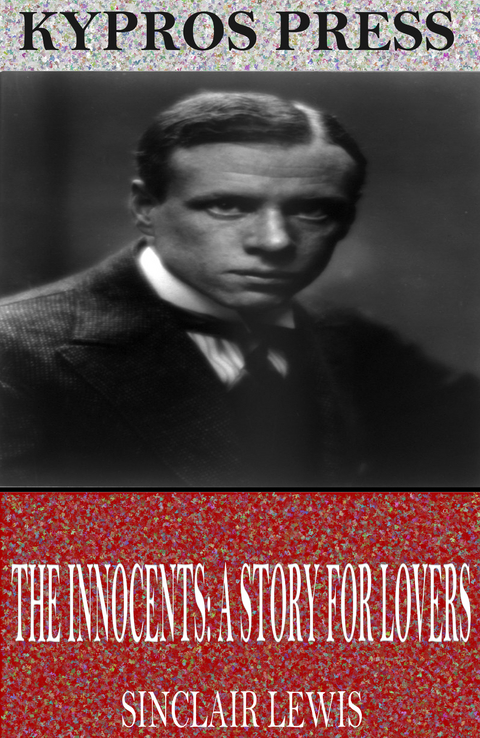
Innocents: A Story for Lovers (eBook)
172 Seiten
Charles River Editors (Verlag)
978-1-5312-6570-0 (ISBN)
Sinclair Lewis was a prominent American author in the 20th century. Lewis was the first writer from the United States to receive the Nobel Prize in Literature. Lewis' books are noted for their insightful commentaries on capitalism and materialism between World War I and World War II. This edition of The Innocents: A Story for Lovers includes a table of contents.
CHAPTER III
THEY changed from steamer to railroad; about eleven in the morning they stepped out at West Skipsit, Cape Cod. Uncle Joe Tubbs and Mrs. Tubbs were driving up, in a country buggy. Father and Mother filled their nostrils with the smell of the salt marshes, their ears with the long murmur of the mile-distant surf, their eyes with the shine of the great dunes and the demure peace of a New England white cottage standing among firs and apple-trees—scent and sound and sight of their freedom.
“Father, we’re here!” Mother whispered, her eyes wet. Then, “Oh, do be careful of that box. There’s a hat there that’s going to make Matilda Tubbs catch her death from envy!”
To the Tubbses, though they were cynical with a hoary wisdom in regard to New-Yorkers and summerites and boarders in general, the annual coming of the Applebys was welcome as cider and buttered toast—yes, they even gave Father and Mother the best chamber, with the four-poster bed and the mirror bordered with Florida shells, at a much reduced rate. They burrowed into their grim old hearts as Uncle Joe Tubbs grubbed into the mud for clams, and brought out treasures of shy affection.
As soon as they reached the Tubbs farm-house the two women went off together to the kitchen, while the men sneaked toward the inlet. Mother didn’t show her new hat as yet; that was in reserve to tantalize Mrs. Tubbs with the waiting. Besides, for a day or two the women couldn’t take down the bars and say what they thought. But the men immediately pounded each other on the back and called each other “Seth” and “Joe,” and, keeping behind banks lest they be seen by young uns, they shamefacedly paddled barefoot—two old men with bare feet and silvery shanks, chuckling and catching crabs, in a salt inlet among rolling hillocks covered with sedge-grass that lisped in the breeze. The grass hollows were filled with quiet and the sound of hovering flies. Beyond was a hill shiny with laurel.
They dug for Little-Neck clams in the mud by the Pond, they discussed the cranberry bog and the war and the daily catch of the traps; they interrupted their sage discourse to whoop at a mackerel gull that flapped above them; they prowled along the inlet to the Outside, and like officials they viewed a passing pogie-boat. Uncle Joe Tubbs ought to have been washing dishes, and he knew it, but the coming of the Applebys annually gave him the excuse for a complete loaf. Besides, he was sure that by now Mother Appleby would be in apron and gingham, helping the protesting yet willing Mrs. Tubbs.
The greatest philosophical theory in the world is that “people are people.” The Applebys, who had mellowed among streets and shops, were very much like the Tubbses of Cape Cod. Father was, in his unquenchable fondness for Mother, like Romeo, like golden Aucassin. But also in his sly fondness for loafing on a sunny grass-bank, smoking a vile pipe and arguing that the war couldn’t last more than six months, he was very much like Uncle Joe Tubbs. As for Mother, she gossiped about the ancient feud between the West Skipsit Universalists and Methodists, and she said “wa’n’t” exactly like Mrs. Tubbs.
There were other boarders at the Tubbses’, and before them at supper both of the old couples maintained the gravity with which, vainly, Age always endeavors to impress Youth. Uncle Joe was crotchety, and Mrs. Tubbs was brisk about the butter, and the Applebys were tremendously dignified and washed and brushed, and not averse to being known as superior star boarders from that superior city, New York, personages to whom the opera and the horse-show were perfectly familiar. Father dismissed a small, amateurish war debate by letting it be known that in his business—nature of business not stated—he was accustomed to meet the diplomatic representatives of the very choicest nations, and to give them advice. Which, indeed, he did—regarding shoes. For Pilkings & Son had a rather élite clientele for Sixth Avenue, and Father had with his own hands made glad the feet of the Swedish consul and the Bolivian trade agent.
A man from South Bromfield started to cap the pose, as low persons always do in these boarding-houses, but Father changed the subject, in a slightly peppery manner. Father could be playful with Mother, but, like all men who are worth anything, he could be as Olympian as a king or a woman author or a box-office manager when he was afflicted by young men who chewed gum and were chatty. He put his gold-bowed eye-glasses on the end of his nose and looked over them so wealthily that the summerites were awed and shyly ate their apple-sauce to the last dreg.
Twelve o’clock dinner at the Tubbses’ was a very respectable meal, with roasts and vegetables to which you could devote some skill and energy. But supper was more like an after-thought, a sort of afternoon tea without the wrist-watch conversation. It was soon over, the dishes soon washed, and by seven o’clock the Applebys and Tubbses gathered in the sacred parlor, where ordinary summerites were not welcome, where the family crayon-enlargements hung above the green plush settee from Boston, which was flanked by the teak table which Uncle Joe’s Uncle Ira had brought from China, and the whale’s vertebræ without which no high-caste Cape Cod household is virtuous. With joy and verbal fireworks, with highly insulting comments on one another’s play, began the annual series of cribbage games—a world’s series, a Davis cup tournament. Doffing his usual tobacco-chewing, collarless, jocose manner, Uncle Joe reverently took from the what-not the ancestral cribbage-board, carved from a solid walrus-tooth. They stood about exclaiming over it, then fell to. “Fifteen-two, fifteen-four, and a pair is six!” rang out, triumphantly. Finally (as happened every year on the occasion of their first game), when the men had magnificently won, Mrs. Tubbs surprised them with refreshments—they would have been jolly well surprised if she hadn’t surprised them—and Father played recent New York musical comedy songs on his new mouth-organ, stopping to explain the point of each, whereupon Mother shook her head and said, warningly, “Now, Father, you be careful what you say. Honestly, I don’t know what the world is coming to, Mrs. Tubbs, the way men carry on nowadays.” But she wasn’t very earnest about it because she was gigglingly aware that Uncle Joe was stealing Mrs. Tubbs’s share of the doughnuts.
They were all as hysterical as a girls’ school during this annual celebration. But Father peeped out of the parlor window and saw the lush moonlight on marsh and field. To Mother, with an awed quiet, “Sarah, it’s moonlight, like it used to be—” The Tubbses seemed to understand that the sweethearts wanted to be alone, and they made excuses to be off to bed. On the porch, wrapped in comforters and coats against the seaside chill, Father and Mother cuddled together. They said little—everything was said for them by the moonlight, silvery on the marshes, wistful silver among the dunes, while the surf was lulled and the whole spacious night seemed reverent with love. His hand cradled hers as the hand of a child would close round a lily leaf.
Halcyon days of sitting in rocking-chairs under the beech-trees on locust-zizzing afternoons, of hunting for shells on the back-side shore of the Cape, of fishing for whiting from the landing on the bay side, of musing among the many-colored grasses of the uplands. They would have gone ambling along such dreamland roads to the end of their vacation had it not been for the motor-car of Uncle Joe’s son-in-law.
That car changed their entire life. Among the hills of peace there was waiting for them an adventure.
Uncle Joe’s son-in-law lived in a portable bungalow a mile away. He rotated crops. He peddled fish with a motor-car. In five minutes he could detach from the back of his car the box in which he carried the fish, clap on a rather rickety tonneau, and be ready to compete in stylish pleasures with the largest limousine from Newport or Brookline. Father and Mother went wheezing about the country with him. Father had always felt that he had the makings of a motorist, because of the distinct pleasure he had felt in motor-bus rides on New York Sundays, and he tactfully encouraged the son-in-law in the touring mania. So it was really Father’s fault that they found the tea-room.
The six of them, the Applebys, the Tubbses, and son-in-law and daughter, somewhat cramped as to space and dusty as to garments, had motored to Cotagansuit. Before them, out across the road, hung the sign: Ye Tea Shoppe.
“Say, by Jiminy! let’s go into that Tea Shoppy and have some eats,” said Father. “My treat.”
“Nope, it’s mine,” said the Tubbses’ son-in-law, hypocritically.
“Not a word out of you!” sang out Father, gallantly. “Hey there, chauffeur, stop this new car of mine at the Shoppy.”
As the rusty car drew up Mrs. Tubbs and Mother looked rather agitatedly at a group of young people, girls in smocks and men in white flannels, who were making society noises before the brown barn which had been turned into a tea-room. The two old women felt that they weren’t quite dressed for a party; they were shy of silken youth. Mrs....
| Erscheint lt. Verlag | 22.3.2018 |
|---|---|
| Sprache | englisch |
| Themenwelt | Literatur ► Anthologien |
| Literatur ► Klassiker / Moderne Klassiker | |
| Literatur ► Romane / Erzählungen | |
| Schlagworte | American • babbitt • Classic • Cultural • Historical • Literary • Main Street • Social |
| ISBN-10 | 1-5312-6570-7 / 1531265707 |
| ISBN-13 | 978-1-5312-6570-0 / 9781531265700 |
| Informationen gemäß Produktsicherheitsverordnung (GPSR) | |
| Haben Sie eine Frage zum Produkt? |
 EPUB (Adobe DRM)
Größe: 1 MB
Kopierschutz: Adobe-DRM
Adobe-DRM ist ein Kopierschutz, der das eBook vor Mißbrauch schützen soll. Dabei wird das eBook bereits beim Download auf Ihre persönliche Adobe-ID autorisiert. Lesen können Sie das eBook dann nur auf den Geräten, welche ebenfalls auf Ihre Adobe-ID registriert sind.
Details zum Adobe-DRM
Dateiformat: EPUB (Electronic Publication)
EPUB ist ein offener Standard für eBooks und eignet sich besonders zur Darstellung von Belletristik und Sachbüchern. Der Fließtext wird dynamisch an die Display- und Schriftgröße angepasst. Auch für mobile Lesegeräte ist EPUB daher gut geeignet.
Systemvoraussetzungen:
PC/Mac: Mit einem PC oder Mac können Sie dieses eBook lesen. Sie benötigen eine
eReader: Dieses eBook kann mit (fast) allen eBook-Readern gelesen werden. Mit dem amazon-Kindle ist es aber nicht kompatibel.
Smartphone/Tablet: Egal ob Apple oder Android, dieses eBook können Sie lesen. Sie benötigen eine
Geräteliste und zusätzliche Hinweise
Buying eBooks from abroad
For tax law reasons we can sell eBooks just within Germany and Switzerland. Regrettably we cannot fulfill eBook-orders from other countries.
EPUB (Ohne DRM)Digital Rights Management: ohne DRM
Dieses eBook enthält kein DRM oder Kopierschutz. Eine Weitergabe an Dritte ist jedoch rechtlich nicht zulässig, weil Sie beim Kauf nur die Rechte an der persönlichen Nutzung erwerben.
Dateiformat: EPUB (Electronic Publication)
EPUB ist ein offener Standard für eBooks und eignet sich besonders zur Darstellung von Belletristik und Sachbüchern. Der Fließtext wird dynamisch an die Display- und Schriftgröße angepasst. Auch für mobile Lesegeräte ist EPUB daher gut geeignet.
Systemvoraussetzungen:
PC/Mac: Mit einem PC oder Mac können Sie dieses eBook lesen. Sie benötigen dafür die kostenlose Software Adobe Digital Editions.
eReader: Dieses eBook kann mit (fast) allen eBook-Readern gelesen werden. Mit dem amazon-Kindle ist es aber nicht kompatibel.
Smartphone/Tablet: Egal ob Apple oder Android, dieses eBook können Sie lesen. Sie benötigen dafür eine kostenlose App.
Geräteliste und zusätzliche Hinweise
Buying eBooks from abroad
For tax law reasons we can sell eBooks just within Germany and Switzerland. Regrettably we cannot fulfill eBook-orders from other countries.
aus dem Bereich