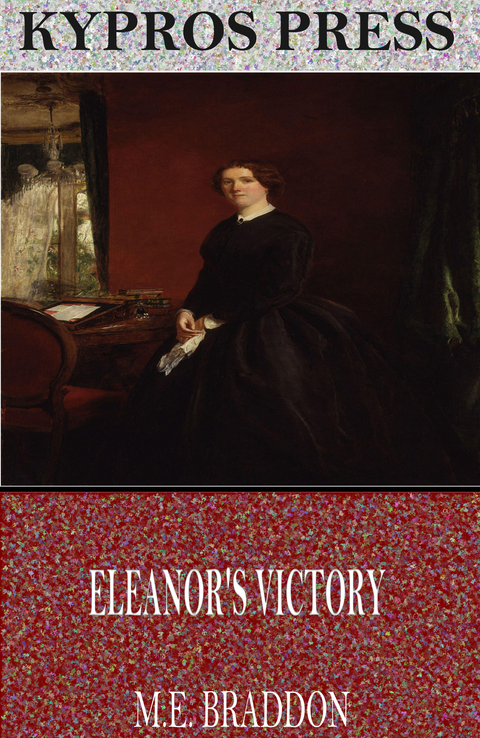
Eleanor's Victory (eBook)
724 Seiten
Charles River Editors (Verlag)
978-1-5312-6443-7 (ISBN)

M.E. Braddon was a popular British writer during the Victorian Era. Among Braddon's best known novels are Lady Audley's Secret and Aurora Floyd. This edition of Eleanor's Victory includes a table of contents.
CHAPTER 2. THE ENTRESOL IN THE RUE DE L’ARCHEVÊQUE.
MR. VANE took his daughter away from the station in one of those secondary and cheaper vehicles which are distinguished by the discriminating Parisian by some mysterious difference of badge. The close, stifling carriage rattled over the uneven stones of long streets which were unfamiliar to Eleanor Vane, until it emerged into the full glory of the lighted Boulevard. The light-hearted school-girl could not suppress a cry of rapture as she looked once more at the broad thoroughfare, the dazzling lamps, the crowd, the theatres, the cafés, the beauty and splendour, although she had spent her summer holiday in Paris only a year before.
“It seems so beautiful again, papa,” she said, “just as if I’d never seen it before; and I’m to stop here now, and never, never to leave you again, to go away for such a cruel distance. You don’t know how unhappy I’ve been, sometimes, papa dear. I wouldn’t tell you then, for fear of making you uneasy; but I can tell you now, now that it’s all over.”
“Unhappy!” gasped the old man, clenching his fist; “they’ve not been unkind to you—they’ve not dared—”
“Oh, no, dearest father. They’ve been very, very good. I was quite a favourite, papa. Yes, though there were so many rich girls in the school, and I was only a half-boarder, I was quite a favourite with Miss Bennett and Miss Sophia; though I know I was careless and lazy sometimes, not on purpose, you know, papa, for I tried hard to get on with my education, for your sake, darling. No, everybody was very kind to me, papa; but I used to think sometimes how far I was from you; what miles and miles and miles of sea and land there were between us, and that if you should be ill—I—”
Eleanor Vane broke down, and her father clasped her in his arms, and cried over her silently. The tears came with very little provocation to the old man’s handsome blue eyes. He was of that sanguine temperament which to the last preserves the fondest delusions of youth. At seventy-five years of age he hoped and dreamed and deluded himself as foolishly as he had done at seventeen. His sanguine temperament had been for ever leading him astray for more than sixty years. Severe judges called George Vane a liar; but perhaps his shallow romances, his pitiful boasts, were more often highly-coloured and poetical versions of the truth, than actual falsehood.
It was past twelve o’clock when the carriage drove away from the lights and splendour into the darkness of a labyrinth of quiet streets behind the Madeleine. The Rue de l’Archevêque was one of these dingy and quiet streets, very narrow, very close and stifling in the hot August midnight. The vehicle stopped abruptly at a corner, before a little shop, the shutters of which were closed, of course, at this hour.
“It is a butcher’s shop, I am sorry to say, my love,” Mr. Vane said, apologetically, as he handed his daughter on to the pavement; “but I find myself very comfortable here, and it is conveniently adjacent to the Boulevards.”
The old man paid the driver, who had deposited mademoiselle’s box upon the threshold of the little door beside the butcher’s shop. The pour-boire was not a very large one, but Mr. Vane bestowed it with the air of a prince. He pushed open the low door, and took his daughter into a narrow passage. There was no porter or portress, for the butcher’s shop and the apartments belonging to it were abnormal altogether; but there was a candle and box of matches on a shelf in a corner of the steep corkscrew staircase. The driver carried Eleanor’s box as far as the entresol in consideration of his pour-boire, but departed while Mr. Vane was opening the door of an apartment facing the staircase.
The entresol consisted of three little rooms, opening one out of another, and so small and low that Miss Vane almost fancied herself in a doll’s house. Every article of furniture in the stifling little apartment bore the impress of its nationality. Tawdry curtains of figured damask, resplendent with dirty tulips and monster roses, tarnished ormolu mouldings, a gilded clock with a cracked dial and a broken shade, a pair of rickety bronze candlesticks, a couple of uncompromising chairs covered with dusty green velvet and relieved by brass-headed nails, and a square table with a long trailing cover of the same material as the curtains, completed the adornments of the sitting-room. The bed-chambers were smaller, closer, and hotter. Voluminous worsted curtains falling before the narrow windows, and smothering the little beds, made the stifling atmosphere yet more stifling. The low ceilings seemed to rest on the top of poor Eleanor’s head. She had been accustomed to large airy rooms, and broad uncurtained open windows.
“How hot it is here, papa,” she said, drawing a long breath.
“It always is hot in Paris at this time of year, my dear,” Mr. Vane answered; “the rooms are small, you see, but convenient. That is to be your bed-room, my love,” he added, indicating one of the little chambers.
He was evidently habituated to Parisian lodging-houses, and saw no discomfort in the tawdry grandeur, the shabby splendour, the pitiful attempt to substitute scraps of gilding and patches of velvet for the common necessaries and decencies of life.
“And now let me look at you, my dear; let me look at you, Eleanor.”
George Mowbray Vane set the candlestick upon the rusty velvet cover of the low mantelpiece, and drew his daughter towards him. She had thrown off her bonnet and loose grey cloak, and stood before her father in her scanty muslin frock, with all her auburn hair hanging about her face and shoulders, and glittering in the dim light of that one scrap of wax candle.
“My pet, how beautiful you have grown, how beautiful!” the old man said, with an accent of fond tenderness. “We’ll teach Mrs. Bannister a lesson some of these days, Eleanor. Yes, our turn will come, my love; I know that I shall die a rich man.”
Miss Vane was accustomed to hear this remark from her father. She inherited something of his sanguine nature, and she loved him very dearly, so she may be forgiven if she believed in his vague visions of future grandeur. She had never seen anything in her life but chaotic wrecks of departed splendour, confusion, debt, and difficulty. She had not been called upon to face poverty in the fair hand-to-hand struggle which ennobles and elevates the sturdy wrestler in the battle of life. No, she had rather been compelled to play at hide-and-seek with the grim enemy. She had never gone out into the open, and looked her foe full in the eyes, hardy, resolute, patient, and steadfast. She was familiar with all those debasing tricks and pitiful subterfuges whereby the weak and faint-hearted seek to circumvent the enemy; but she had never been taught the use of those measures by which he may be honestly beaten.
The Mrs. Bannister of whom George Vane had spoken, was one of his elder daughters, who had been very, very ungrateful to him, he declared; and who now in his old age doled him out the meagre allowance which enabled him to occupy an entresol over a butcher’s shop, and dine daily at one of the cheap restaurants in the Palais Royal.
Mr. Vane was wont to lament his daughter’s cruel lack of affection in very bitter language, freely interspersed with quotations from “King Lear;” indeed I believe he considered his case entirely parallel with that of the injured British monarch and father; ignoring the one rather important fact that, whereas Lear’s folly had been the too generous division of his own fortune between his recreant daughters, his weakness had been the reckless waste and expenditure of the portions which his children had inherited from their mother.
Mrs. Bannister, instigated thereto by her husband, had protested some years before against the several acts of folly and extravagance by which the fortune which ought to have been hers had been fooled away. She declined to allow her father more than the pittance alluded to above; although, as she was now a rich widow, and of course entirely her own mistress, she might have done much more.
“Yes, my darling,” Mr. Vane said, as he proudly contemplated his youngest child’s beauty, “we will turn the tables upon Mrs. Bannister and the rest of them, yet, please God. My Benjamin; my youngest, brightest darling; we’ll teach them a lesson. They may poke their old father away in a foreign lodging, and stint him of money for any little innocent pleasure; but the day will come, my love, the day will come!”
The old man nodded his head two or three times with solemn significance. The sanguine, impulsive nature, dwarfed and fettered by the cruel bonds of poverty, was too elastic to be entirely repressed even by those galling chains; and having hoped all his life, and having enjoyed such successes and good fortune as fall to the lot of very few men, he went on hoping in his old age, blindly confident that some sudden revolution in the wheel of life would lift him out of his obscurity and set him again on the pinnacle he had once occupied so proudly.
He had had a host of friends and many children, and he had squandered more than one fortune, not being any more careful of other people’s money than of his own; and now, in his poverty and desolation, the...
| Erscheint lt. Verlag | 22.3.2018 |
|---|---|
| Sprache | englisch |
| Themenwelt | Literatur ► Anthologien |
| Literatur ► Klassiker / Moderne Klassiker | |
| Literatur ► Romane / Erzählungen | |
| Schlagworte | Aurora Floyd • British • Historical • lady audley • Maria Edgeworth • mrs. henry wood • Victorian |
| ISBN-10 | 1-5312-6443-3 / 1531264433 |
| ISBN-13 | 978-1-5312-6443-7 / 9781531264437 |
| Informationen gemäß Produktsicherheitsverordnung (GPSR) | |
| Haben Sie eine Frage zum Produkt? |
 EPUB (Adobe DRM)
Größe: 1,4 MB
Kopierschutz: Adobe-DRM
Adobe-DRM ist ein Kopierschutz, der das eBook vor Mißbrauch schützen soll. Dabei wird das eBook bereits beim Download auf Ihre persönliche Adobe-ID autorisiert. Lesen können Sie das eBook dann nur auf den Geräten, welche ebenfalls auf Ihre Adobe-ID registriert sind.
Details zum Adobe-DRM
Dateiformat: EPUB (Electronic Publication)
EPUB ist ein offener Standard für eBooks und eignet sich besonders zur Darstellung von Belletristik und Sachbüchern. Der Fließtext wird dynamisch an die Display- und Schriftgröße angepasst. Auch für mobile Lesegeräte ist EPUB daher gut geeignet.
Systemvoraussetzungen:
PC/Mac: Mit einem PC oder Mac können Sie dieses eBook lesen. Sie benötigen eine
eReader: Dieses eBook kann mit (fast) allen eBook-Readern gelesen werden. Mit dem amazon-Kindle ist es aber nicht kompatibel.
Smartphone/Tablet: Egal ob Apple oder Android, dieses eBook können Sie lesen. Sie benötigen eine
Geräteliste und zusätzliche Hinweise
Buying eBooks from abroad
For tax law reasons we can sell eBooks just within Germany and Switzerland. Regrettably we cannot fulfill eBook-orders from other countries.
EPUB (Ohne DRM)Digital Rights Management: ohne DRM
Dieses eBook enthält kein DRM oder Kopierschutz. Eine Weitergabe an Dritte ist jedoch rechtlich nicht zulässig, weil Sie beim Kauf nur die Rechte an der persönlichen Nutzung erwerben.
Dateiformat: EPUB (Electronic Publication)
EPUB ist ein offener Standard für eBooks und eignet sich besonders zur Darstellung von Belletristik und Sachbüchern. Der Fließtext wird dynamisch an die Display- und Schriftgröße angepasst. Auch für mobile Lesegeräte ist EPUB daher gut geeignet.
Systemvoraussetzungen:
PC/Mac: Mit einem PC oder Mac können Sie dieses eBook lesen. Sie benötigen dafür die kostenlose Software Adobe Digital Editions.
eReader: Dieses eBook kann mit (fast) allen eBook-Readern gelesen werden. Mit dem amazon-Kindle ist es aber nicht kompatibel.
Smartphone/Tablet: Egal ob Apple oder Android, dieses eBook können Sie lesen. Sie benötigen dafür eine kostenlose App.
Geräteliste und zusätzliche Hinweise
Buying eBooks from abroad
For tax law reasons we can sell eBooks just within Germany and Switzerland. Regrettably we cannot fulfill eBook-orders from other countries.
aus dem Bereich