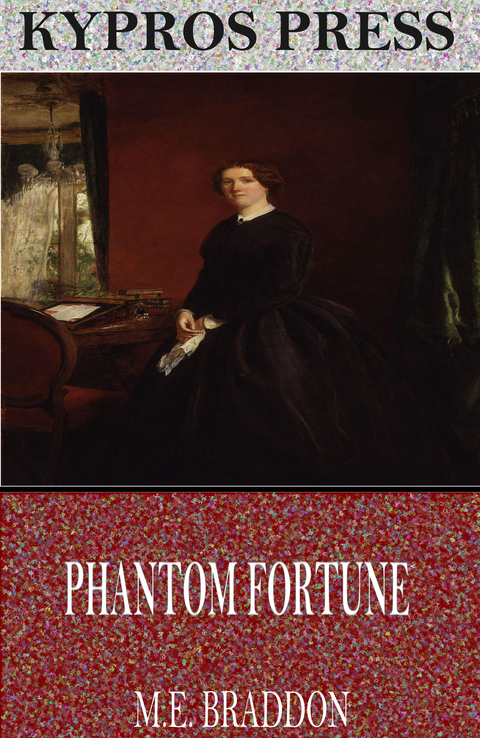
Phantom Fortune (eBook)
744 Seiten
Charles River Editors (Verlag)
978-1-5312-6426-0 (ISBN)

M.E. Braddon was a popular British writer during the Victorian Era. Among Braddon's best known novels are Lady Audley's Secret and Aurora Floyd. This edition of Phantom Fortune includes a table of contents.
CHAPTER I. PENELOPE.
People dined earlier forty years ago than they do now. Even that salt of the earth, the elect of society, represented by that little great world which lies between the narrow circle bounded by Bryanstone Square on the north and by Birdcage Walk on the south, did not consider seven o’clock too early an hour for a dinner party which was to be followed by routs, drums, concerts, conversazione, as the case might be. It was seven o’clock on a lovely June evening, and the Park was already deserted, and carriages were rolling swiftly along all the Westend squares, carrying rank, fashion, wealth, and beauty, political influence, and intellectual power, to the particular circle in which each was destined to illumine upon that particular evening.
Stateliest among London squares, Grosvenor—in some wise a wonder to the universe as newly lighted with gas—grave Grosvenor, with its heavy old Georgian houses and pompous porticoes, sparkled and shone, not alone with the novel splendour of gas, but with the light of many wax candles, clustering flower-like in silver branches and girandoles, multiplying their flame in numerous mirrors; and of all the houses in that stately square none had a more imposing aspect than Lord Denyer’s dark red brick mansion, with stone dressings, and the massive grandeur of an Egyptian mausoleum.
Lord Denyer was an important personage in the political and diplomatic world. He had been ambassador at Constantinople and at Paris, and had now retired on his laurels, an influence still, but no longer an active power in the machine of government. At his house gathered all that was most brilliant in London society. To be seen at Lady Denyer’s evening parties was the guinea stamp of social distinction; to dine with Lord Denyer was an opening in life, almost as valuable as University honours, and more difficult of attainment.
It was during the quarter of an hour before dinner that a group of persons, mostly personages, congregated round Lord Denyer’s chimney-piece, naturally trending towards the social hearth, albeit it was the season for roses and lilies rather than of fires, and the hum of the city was floating in upon the breath of the warm June evening through the five tall windows which opened upon Lord Denyer’s balcony.
The ten or twelve persons assembled seemed only a sprinkling in the large lofty room, furnished sparsely with amber satin sofas, a pair of Florentine marble tables, and half an acre or so of looking glass. Voluminous amber draperies shrouded the windows, and deadened the sound of rolling wheels, and the voices and footfalls of western London. The drawing rooms of those days were neither artistic nor picturesque—neither Early English nor Low Dutch, nor Renaissance, nor Anglo-Japanese. A stately commonplace distinguished the reception rooms of the great world. Upholstery stagnated at a dead level of fluted legs, gilding, plate glass, and amber satin.
Lady Denyer stood a little way in advance of the group on the hearthrug, fanning herself, with her eye on the door, while she listened languidly to the remarks of a youthful diplomatist, a sprig of a lordly tree, upon the last début at Her Majesty’s Theatre.
‘My own idea was that she screamed,’ said her ladyship. ‘But the new Rosinas generally do scream. Why do we have a new Rosina every year, whom nobody ever hears of afterwards? What becomes of them? Do they die, or do they set up as singing mistresses in second-rate watering-places?’ hazarded her ladyship, with her eye always on the door.
She was a large woman in amethyst satin, and a gauze turban with a diamond aigrette, a splendid jewel, which would not have misbeseemed the head-gear of an Indian prince. Lady Denyer was one of the last women who wore a turban, and that Oriental head-dress became her bold and massive features.
Infinitely bored by the whiskerless attaché, who had entered upon a disquisition on the genius of Rossini as compared with this new man Meyerbeer, her ladyship made believe to hear, while she listened intently to the confidential murmurs of the group on the hearthrug, the little knot of personages clustered round Lord Denyer. ‘Indian mail in this morning,’ said one—’nothing else talked of at the club. Very flagrant case! A good deal worse than Warren Hastings. Quite clear there must be a public inquiry—House of Lords—criminal prosecution.’
‘I was told on very good authority, that he has been recalled, and is now on his passage home,’ said another man.
Lord Denyer shrugged his shoulders, pursed up his lips, and looked ineffably wise, a way he had when he knew very little about the subject under discussion.
‘How will she take it, do you think?’ inquired Colonel Madison, of the Life Guards, a man about town, and an inveterate gossip, who knew everybody, and everybody’s family history, down to the peccadilloes of people’s great grandmothers.
‘You will have an opportunity of judging,’ replied his lordship, coolly. ‘She’s to be here this evening.’
‘But do you think she’ll show?’ asked the Colonel. ‘The mail must have brought the news to her, as well as to other people—supposing she knew nothing about it beforehand. She must know that the storm has burst. Do you think she’ll–-’
‘Come out in the thunder and lightning?’ interrupted Lord Denver; ‘I’m sure she will. She has the pride of Lucifer and the courage of a lion. Five to one in ponies that she is here before the clock strikes seven!’
‘I think you are right. I knew her mother, Constance Talmash. Pluck was a family characteristic of the Talmashes. Wicked as devils, and brave as lions. Old Talmash, the grandfather, shot his valet in a paroxysm of delirium tremens,’ said Colonel Madison. ‘She’s a splendid woman, and she won’t flinch. I’d rather back her than bet against her.’
‘Lady Maulevrier!’ announced the groom of the chambers; and Lady Denyer moved at least three paces forward to meet her guest.
The lady who entered, with slow and stately movements and proudly balanced head, might have served for a model as Juno or the Empress Livia. She was still in the bloom of youth, at most seven-and-twenty, but she had all the calm assurance of middle-age. No dowager, hardened by the varied experiences of a quarter of a century in the great world, could have faced society with more perfect coolness and self-possession. She was beautiful, and she let the world see that she was conscious of her beauty, and the power that went along with it. She was clever, and she used her cleverness with unfailing tact and unscrupulous audacity. She had won her place in the world as an acknowledged beauty, and one of the leaders of fashion. Two years ago she had been the glory and delight of Anglo-Indian society in the city of Madras, ruling that remote and limited kingdom with a despotic power. Then all of a sudden she was ordered, or she ordered her physician to order her, an immediate departure from that perilous climate, and she came back to England with her three-year-old son, two Ayahs, and four European servants, leaving her husband, Lord Maulevrier, Governor of the Madras Presidency, to finish the term of his service in an enforced widowhood.
She returned to be the delight of London society. She threw open the family mansion in Curzon Street to the very best people, but to those only. She went out a great deal, but she was never seen at a second-rate party. She had not a single doubtful acquaintance upon her visiting list. She spent half of every year at the family seat in Scotland, was a miracle of goodness to the poor of her parish, and taught her boy his alphabet.
Lord Denyer came forward while his wife and Lady Maulevrier were shaking hands, and greeted her with more than his usual cordiality. Colonel Madison watched for the privilege of a recognising nod from the divinity. Sir Jasper Paulet, a legal luminary of the first brilliancy, likely to be employed for the Crown if there should be an inquiry into Lord Maulevrier’s conduct out yonder, came to press Lady Maulevrier’s hand and murmur a tender welcome.
She accepted their friendliness as a matter of course, and not by the faintest extra quiver of the tremulous stars which glittered in a circlet above her raven hair did she betray her consciousness of the cloud that darkened her husband’s reputation. Never had she appeared gayer, or more completely satisfied with herself and the world in which she lived. She was ready to talk about anything and everything—the newly-wedded queen, and the fortunate Prince, whose existence among us had all the charm of novelty—of Lord Melbourne’s declining health—and Sir Robert Peel’s sliding scale—mesmerism—the Oxford Tracts—the latest balloon ascent—the opera—Macready’s last production at Drury lane—Bulwer’s new novel—that clever little comic paper, just struggling into popularity—what do you call the thing—Punch?—yes, Punch, or the London Charivari—a much more respectable paper than its Parisian prototype.
Seated next Lord Denyer, who was an excellent listener, Lady Maulevrier’s vivacity never flagged throughout the dinner, happily not...
| Erscheint lt. Verlag | 22.3.2018 |
|---|---|
| Sprache | englisch |
| Themenwelt | Literatur ► Anthologien |
| Literatur ► Klassiker / Moderne Klassiker | |
| Literatur ► Romane / Erzählungen | |
| Schlagworte | Aurora Floyd • British • Historical • lady audley • Maria Edgeworth • mrs. henry wood • Victorian |
| ISBN-10 | 1-5312-6426-3 / 1531264263 |
| ISBN-13 | 978-1-5312-6426-0 / 9781531264260 |
| Informationen gemäß Produktsicherheitsverordnung (GPSR) | |
| Haben Sie eine Frage zum Produkt? |
 EPUB (Adobe DRM)
Größe: 1,4 MB
Kopierschutz: Adobe-DRM
Adobe-DRM ist ein Kopierschutz, der das eBook vor Mißbrauch schützen soll. Dabei wird das eBook bereits beim Download auf Ihre persönliche Adobe-ID autorisiert. Lesen können Sie das eBook dann nur auf den Geräten, welche ebenfalls auf Ihre Adobe-ID registriert sind.
Details zum Adobe-DRM
Dateiformat: EPUB (Electronic Publication)
EPUB ist ein offener Standard für eBooks und eignet sich besonders zur Darstellung von Belletristik und Sachbüchern. Der Fließtext wird dynamisch an die Display- und Schriftgröße angepasst. Auch für mobile Lesegeräte ist EPUB daher gut geeignet.
Systemvoraussetzungen:
PC/Mac: Mit einem PC oder Mac können Sie dieses eBook lesen. Sie benötigen eine
eReader: Dieses eBook kann mit (fast) allen eBook-Readern gelesen werden. Mit dem amazon-Kindle ist es aber nicht kompatibel.
Smartphone/Tablet: Egal ob Apple oder Android, dieses eBook können Sie lesen. Sie benötigen eine
Geräteliste und zusätzliche Hinweise
Buying eBooks from abroad
For tax law reasons we can sell eBooks just within Germany and Switzerland. Regrettably we cannot fulfill eBook-orders from other countries.
EPUB (Ohne DRM)Digital Rights Management: ohne DRM
Dieses eBook enthält kein DRM oder Kopierschutz. Eine Weitergabe an Dritte ist jedoch rechtlich nicht zulässig, weil Sie beim Kauf nur die Rechte an der persönlichen Nutzung erwerben.
Dateiformat: EPUB (Electronic Publication)
EPUB ist ein offener Standard für eBooks und eignet sich besonders zur Darstellung von Belletristik und Sachbüchern. Der Fließtext wird dynamisch an die Display- und Schriftgröße angepasst. Auch für mobile Lesegeräte ist EPUB daher gut geeignet.
Systemvoraussetzungen:
PC/Mac: Mit einem PC oder Mac können Sie dieses eBook lesen. Sie benötigen dafür die kostenlose Software Adobe Digital Editions.
eReader: Dieses eBook kann mit (fast) allen eBook-Readern gelesen werden. Mit dem amazon-Kindle ist es aber nicht kompatibel.
Smartphone/Tablet: Egal ob Apple oder Android, dieses eBook können Sie lesen. Sie benötigen dafür eine kostenlose App.
Geräteliste und zusätzliche Hinweise
Buying eBooks from abroad
For tax law reasons we can sell eBooks just within Germany and Switzerland. Regrettably we cannot fulfill eBook-orders from other countries.
aus dem Bereich