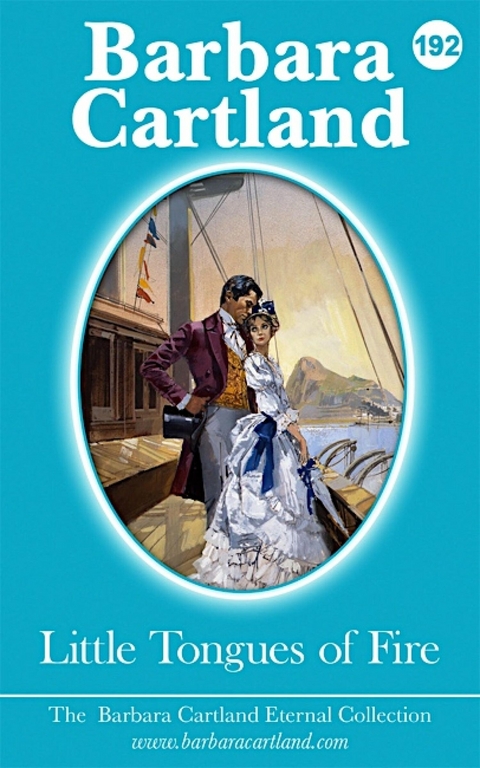
Little Tongues of Fire (eBook)
298 Seiten
Barbara Cartland eBooks Ltd (Verlag)
978-1-78867-055-5 (ISBN)
Barbara Cartland was the world's most prolific novelist who wrote an amazing 723 books in her lifetime, of which no less than 644 were romantic novels with worldwide sales of over 1 billion copies and her books were translated into 36 different languages. As well as romantic novels, she wrote historical biographies, 6 autobiographies, theatrical plays and books of advice on life, love, vitamins and cookery. She wrote her first book at the age of 21 and it was called Jigsaw. It became an immediate bestseller and sold 100,000 copies in hardback in England and all over Europe in translation. Between the ages of 77 and 97 she increased her output and wrote an incredible 400 romances as the demand for her romances was so strong all over the world. She wrote her last book at the age of 97 and it was entitled perhaps prophetically The Way to Heaven. Her books have always been immensely popular in the United States where in 1976 her current books were at numbers 1 & 2 in the B. Dalton bestsellers list, a feat never achieved before or since by any author. Barbara Cartland became a legend in her own lifetime and will be best remembered for her wonderful romantic novels so loved by her millions of readers throughout the world, who have always collected her books to read again and again, especially when they feel miserable or depressed. Her books will always be treasured for their moral message, her pure and innocent heroines, her handsome and dashing heroes, her blissful happy endings and above all for her belief that the power of love is more important than anything else in everyone's life.
Still in mourning after the death of her father, Colonel Wallace, in a battle in India, the beautiful young Vina Wallace is astonished to receive news that not only had her heroic father saved the Maharajah of Kulhapur's life, but also that the Maharajah has died and left jewels worth a small fortune to her dead father. And now, as her father's only child, the jewels are hers.Vina is being looked after by her uncle and aunt and her aunt has grand ideas of shining in higher Society and being invited to parties at ancestral homes and by Queen Victoria to Windsor Castle.Unknown to Vina the news of her newly acquired fortune reaches the ears of the Duke of Quarington and his penniless brother Lord Edgar, who is desperate to find a way to repay his vast debts as the Duke is refusing to bail him out yet again.Fearing Vina will fall victim to fortune-hunters, her aunt and uncle plan to offer her hand in marriage to the dissolute Lord Edgar - an admirable solution to both families' problems.The trouble is that Vina has vowed never to marry unless for love. Worse still she overhears the cynical Lord Edgar planning to marry Vina for her money and then to resume his life of debauchery and womanising! Is there no escape for Vina from a life without love?
Chapter Two
The Duke had chosen his house party with much care.
He thought it would be a great mistake for it to be too small and even worse for it to be too big.
He also wanted to invite people who would not be particularly interested in what Edgar was doing so that he would have a chance to get to know Miss Wallace.
As he was thinking of his own amusement too, he included Lady Irene Halford, whom he knew would be only too eager to accept his invitation.
He had realised for some time that Lady Irene was stalking him, as he described it privately to himself, and he was as yet not certain whether or not he would succumb to her blandishments, which were becoming increasingly obvious.
At the same time she was one of the most beautiful women in London.
Her classical features and perfectly proportioned body had attracted his attention the first time he had seen her.
Her husband, Lord Halford, was at least twenty years older than his wife. He was, therefore, more concerned with his duties at Court than with escorting her to all the balls and Receptions that they were invited to.
The Duke was therefore well aware that if he accepted her attentions, in Lady Irene’s eyes he would be hurting no one and there would certainly be no scandal.
He would not be the first lover she had taken, but she behaved in so circumspect a manner that even the gossips found it difficult to say anything unpleasant about her.
As he expected, Lady Irene answered his invitation by return and the Duke also included a few of his own particular men friends, who always made a success of any party he gave.
He thought he would invite some neighbours to dinner on the Saturday evening and then see how the party progressed before he planned what they would do on Sunday.
The Duke discussed it all with John Simpson, as he always did.
He arranged everything in the household, the servants, chefs and the bedroom plans, leaving the Duke to cope with his brother.
“I suppose,” Lord Edgar said sourly at breakfast on Friday morning, “that you expect me to make myself pleasant to this title-seeking country bumpkin you have chosen as my future wife?”
The Duke did not reply and Lord Edgar, pushing his plate away from him disdainfully as if he was not hungry, said,
“The more I think of it, the more I am inclined to go abroad. I seem to remember that was the alternative.”
“There is nothing to stop you,” the Duke answered, “but I think you would miss your horses, your friends, your Clubs and the fact that, being English, wherever you live you would always be a foreigner.”
“I would find that an advantage!” Lord Edgar retorted truculently.
“Then, of course, it is quite easy for you not to propose to Miss Wallace over the weekend and so let me know which foreign Bank I am to send your allowance to.”
“Dammit all, Alveric,” Lord Edgar shouted. “I am your brother and, as it happens, I am also your heir apparent, as you have no son.”
For a moment the Duke was still.
Then he said, almost as if he was speaking to himself,
“I had forgotten that.”
“Well, it is true,” Lord Edgar said, “and if you want to know, I have already approached the usurers to see what they will advance me on the chance of my succeeding on your death.”
“You have done what?” the Duke asked angrily.
“You heard what I said,” Lord Edgar snapped, “but actually the old skinflints were not interested. They said you are too young for there to be any reason for your dying normally.”
He accentuated the word ‘normally’ and the Duke remarked,
“Perhaps you are thinking of some clever way of disposing of me without being brought to justice?”
“I am not such a fool as to risk being hanged,” Lord Edgar retorted, “but if you did happen to break your neck out riding or drown in the lake, it would certainly solve my problems!”
The idea of Lord Edgar taking his place was so unpleasant that the Duke returned to reading the newspaper that was propped up in front of him on a silver stand.
“Supposing that this girl,” Edgar carried on in a low voice, “is as plain as a pikestaff and speaks to me as her father did to the raw recruits he had under his command?”
He sounded so depressed that the Duke could not help smiling as he replied,
“In which case you can always look for another heiress, but those as rich as Miss Wallace are few and far between.”
“Perhaps the stories of her fortune are exaggerated,” Lord Edgar suggested. “What do we do then?”
“I cannot think that the General, who is quite obviously a straightforward and honest man, would lie.”
Lord Edgar rose from the table, pushing back his chair violently.
“Well, I might as well enjoy my last hours of freedom,” he said. “I suppose it’s too late for me to slip up to London and see Connie before these title-seekers arrive?”
The Duke thought it beneath his dignity to answer him.
He continued reading the newspaper as his brother gave an exasperated sound that was half an oath and went out of the room slamming the door behind him.
The Duke sighed and, sitting back in his chair, wondered for the thousandth time how he had managed to fail with Edgar.
He had been such an attractive little boy and yet, looking back, the Duke knew that even when they were very small, Edgar had resented him because he was more important than himself as the elder son.
From the moment he was grown up Edgar had done everything he could, not only to disparage his elder brother, but also to draw attention to himself.
The Duke supposed that psychologically the reason that Edgar behaved in such an outrageous manner, and had done so ever since he had been at Eton, was because he wanted to inherit the Dukedom.
As the Duke had gradually come to realise this, he had gone out of his way to do more for Edgar than anyone else would have done in similar circumstances.
Even the family Solicitors and the Trustees of the estate had remonstrated with him and told him that he was giving his brother far too much money and in consequence denying others who were more worthy of his help.
Lord Edgar had showed no gratitude but seemed determined to provoke not only the Duke but his whole family and it made the Duke more cynical than ever.
When he was young, he had been very badly treated by the first woman he had fallen in love with.
His father had been alive and in good health and there had seemed then little chance of Alveric inheriting the title for at least twenty years.
While the young woman concerned had encouraged the Duke’s advances, she had not really considered him seriously.
Because she was very beautiful and in many ways sophisticated, he had been head over heels in love with her. It had therefore been a cruel shock when he learned that she was laughing at him behind his back.
She even read aloud to her intimate friends, who considered the Duke a joke, the letters that he wrote to her.
Because he was extremely sensitive, the hurt she inflicted on him took a long time to heal.
But, although he appeared to have recovered, the scars remained.
What was more, when the fifth Duke died unexpectedly from appendicitis and Alveric inherited the Dukedom, the girl he had loved realised what a mistake she had made.
Throwing over the man she had become engaged to, she tried to revive the love she had so cruelly turned away.
It was perhaps this more than anything else that had made the Duke decide that all women were treacherous and that he had no wish to marry.
But he would not have been human if he had not accepted the favours he was offered.
Yet he was convinced that when women expressed their love for him, they were thinking of his coronet and not of him as a man.
The lines of cynicism on his face deepened as he told himself that never again would he look at or be interested in a young unmarried woman.
He was involved only with the sophisticated beauties who deceived their husbands cleverly enough to avoid any scandal. They hid their fiery desires in public, but privately most men found them irresistible.
The Duke could pick and choose and every year he became more fastidious and it became a feather in a woman’s cap when it was whispered that the Duke was her lover.
Even so the women he chose never knew from one meeting to the next if the Duke was, as she longed for, as infatuated with her as she was with him.
The Duke thought as he now left the breakfast room that there was nothing more he could do for his brother.
The sooner Lady Irene arrived and his thoughts could be elsewhere the better.
It was John Simpson who understood more than anybody else what his Master was feeling and he reminded himself that what he wanted was the Duke’s happiness.
It seemed extraordinary with all his great possessions and surrounded by those who served and admired him, that he could not be happy.
And yet John Simpson was aware that in fact the Duke was a lonely man and there was a great deal missing in his life that could not be purchased with money.
It was a feeling that he would not put into words.
Looking over his guest list, he found himself hoping that, when Lord Edgar married Miss Wallace, he would improve the Duke’s way of life.
Perhaps in that way the Duke would have one burden less on his shoulders.
*
Vina was feeling somewhat bewildered as she drove with her uncle and aunt towards Quarington.
Even with the knowledge that apparently her aunt Marjory’s idea of Paradise was to be...
| Erscheint lt. Verlag | 1.4.2018 |
|---|---|
| Sprache | englisch |
| Themenwelt | Literatur ► Historische Romane |
| ISBN-10 | 1-78867-055-8 / 1788670558 |
| ISBN-13 | 978-1-78867-055-5 / 9781788670555 |
| Informationen gemäß Produktsicherheitsverordnung (GPSR) | |
| Haben Sie eine Frage zum Produkt? |
 EPUB (Adobe DRM)
Kopierschutz: Adobe-DRM
Adobe-DRM ist ein Kopierschutz, der das eBook vor Mißbrauch schützen soll. Dabei wird das eBook bereits beim Download auf Ihre persönliche Adobe-ID autorisiert. Lesen können Sie das eBook dann nur auf den Geräten, welche ebenfalls auf Ihre Adobe-ID registriert sind.
Details zum Adobe-DRM
Dateiformat: EPUB (Electronic Publication)
EPUB ist ein offener Standard für eBooks und eignet sich besonders zur Darstellung von Belletristik und Sachbüchern. Der Fließtext wird dynamisch an die Display- und Schriftgröße angepasst. Auch für mobile Lesegeräte ist EPUB daher gut geeignet.
Systemvoraussetzungen:
PC/Mac: Mit einem PC oder Mac können Sie dieses eBook lesen. Sie benötigen eine
eReader: Dieses eBook kann mit (fast) allen eBook-Readern gelesen werden. Mit dem amazon-Kindle ist es aber nicht kompatibel.
Smartphone/Tablet: Egal ob Apple oder Android, dieses eBook können Sie lesen. Sie benötigen eine
Geräteliste und zusätzliche Hinweise
Buying eBooks from abroad
For tax law reasons we can sell eBooks just within Germany and Switzerland. Regrettably we cannot fulfill eBook-orders from other countries.
aus dem Bereich