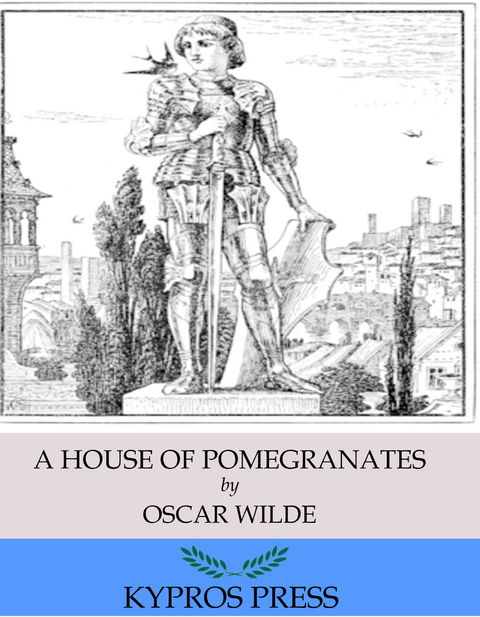
House of Pomegranates (eBook)
133 Seiten
Charles River Editors (Verlag)
978-1-5312-4982-3 (ISBN)
Oscar Wilde was a prominent Irish playwright and novelist in the late 19th century. With classics such as The Importance of Being Earnest and The Picture of Dorian Gray, Wilde remains one of the most widely read authors today. This edition of A House of Pomegranates includes a table of contents.
THE YOUNG KING
To Margaret Lady Brooke — The Ranee of Sarawak
It was the night before the day fixed for his coronation, and the young King was sitting alone in his beautiful chamber. His courtiers had all taken their leave of him, bowing their heads to the ground, according to the ceremonious usage of the day, and had retired to the Great Hall of the Palace, to receive a few last lessons from the Professor of Etiquette; there being some of them who had still quite natural manners, which in a courtier is, I need hardly say, a very grave offence.
The lad — for he was only a lad, being but sixteen years of age — was not sorry at their departure, and had flung himself back with a deep sigh of relief on the soft cushions of his embroidered couch, lying there, wild-eyed and open-mouthed, like a brown woodland Faun, or some young animal of the forest newly snared by the hunters.
And, indeed, it was the hunters who had found him, coming upon him almost by chance as, bare-limbed and pipe in hand, he was following the flock of the poor goatherd who had brought him up, and whose son he had always fancied himself to be. The child of the old King’s only daughter by a secret marriage with one much beneath her in station — a stranger, some said, who, by the wonderful magic of his lute-playing, had made the young Princess love him; while others spoke of an artist from Rimini, to whom the Princess had shown much, perhaps too much honour, and who had suddenly disappeared from the city, leaving his work in the Cathedral unfinished — he had been, when but a week old, stolen away from his mother’s side, as she slept, and given into the charge of a common peasant and his wife, who were without children of their own, and lived in a remote part of the forest, more than a day’s ride from the town. Grief, or the plague, as the court physician stated, or, as some suggested, a swift Italian poison administered in a cup of spiced wine, slew, within an hour of her wakening, the white girl who had given him birth, and as the trusty messenger who bare the child across his saddle-bow stooped from his weary horse and knocked at the rude door of the goatherd’s hut, the body of the Princess was being lowered into an open grave that had been dug in a deserted churchyard, beyond the city gates, a grave where it was said that another body was also lying, that of a young man of marvellous and foreign beauty, whose hands were tied behind him with a knotted cord, and whose breast was stabbed with many red wounds.
Such, at least, was the story that men whispered to each other. Certain it was that the old King, when on his deathbed, whether moved by remorse for his great sin, or merely desiring that the kingdom should not pass away from his line, had had the lad sent for, and, in the presence of the Council, had acknowledged him as his heir.
And it seems that from the very first moment of his recognition he had shown signs of that strange passion for beauty that was destined to have so great an influence over his life. Those who accompanied him to the suite of rooms set apart for his service, often spoke of the cry of pleasure that broke from his lips when he saw the delicate raiment and rich jewels that had been prepared for him, and of the almost fierce joy with which he flung aside his rough leathern tunic and coarse sheepskin cloak. He missed, indeed, at times the fine freedom of his forest life, and was always apt to chafe at the tedious Court ceremonies that occupied so much of each day, but the wonderful palace - Joyeuse, as they called it — of which he now found himself lord, seemed to him to be a new world fresh-fashioned for his delight; and as soon as he could escape from the council-board or audience-chamber, he would run down the great staircase, with its lions of gilt bronze and its steps of bright porphyry, and wander from room to room, and from corridor to corridor, like one who was seeking to find in beauty an anodyne from pain, a sort of restoration from sickness.
Upon these journeys of discovery, as he would call them — and, indeed, they were to him real voyages through a marvellous land, he would sometimes be accompanied by the slim, fair-haired Court pages, with their floating mantles, and gay fluttering ribands; but more often he would be alone, feeling through a certain quick instinct, which was almost a divination, that the secrets of art are best learned in secret, and that Beauty, like Wisdom, loves the lonely worshipper.
Many curious stories were related about him at this period. It was said that a stout Burgo-master, who had come to deliver a florid oratorical address on behalf of the citizens of the town, had caught sight of him kneeling in real adoration before a great picture that had just been brought from Venice, and that seemed to herald the worship of some new gods. On another occasion he had been missed for several hours, and after a lengthened search had been discovered in a little chamber in one of the northern turrets of the palace gazing, as one in a trance, at a Greek gem carved with the figure of Adonis. He had been seen, so the tale ran, pressing his warm lips to the marble brow of an antique statue that had been discovered in the bed of the river on the occasion of the building of the stone bridge, and was inscribed with the name of the Bithynian slave of Hadrian. He had passed a whole night in noting the effect of the moonlight on a silver image of Endymion.
All rare and costly materials had certainly a great fascination for him, and in his eagerness to procure them he had sent away many merchants, some to traffic for amber with the rough fisher-folk of the north seas, some to Egypt to look for that curious green turquoise which is found only in the tombs of kings, and is said to possess magical properties, some to Persia for silken carpets and painted pottery, and others to India to buy gauze and stained ivory, moonstones and bracelets of jade, sandal-wood and blue enamel and shawls of fine wool.
But what had occupied him most was the robe he was to wear at his coronation, the robe of tissued gold, and the ruby-studded crown, and the sceptre with its rows and rings of pearls. Indeed, it was of this that he was thinking to-night, as he lay back on his luxurious couch, watching the great pinewood log that was burning itself out on the open hearth. The designs, which were from the hands of the most famous artists of the time, had been submitted to him many months before, and he had given orders that the artificers were to toil night and day to carry them out, and that the whole world was to be searched for jewels that would be worthy of their work. He saw himself in fancy standing at the high altar of the cathedral in the fair raiment of a King, and a smile played and lingered about his boyish lips, and lit up with a bright lustre his dark woodland eyes.
After some time he rose from his seat, and leaning against the carved penthouse of the chimney, looked round at the dimly-lit room. The walls were hung with rich tapestries representing the Triumph of Beauty. A large press, inlaid with agate and lapis-lazuli, filled one corner, and facing the window stood a curiously wrought cabinet with lacquer panels of powdered and mosaiced gold, on which were placed some delicate goblets of Venetian glass, and a cup of dark-veined onyx. Pale poppies were broidered on the silk coverlet of the bed, as though they had fallen from the tired hands of sleep, and tall reeds of fluted ivory bare up the velvet canopy, from which great tufts of ostrich plumes sprang, like white foam, to the pallid silver of the fretted ceiling. A laughing Narcissus in green bronze held a polished mirror above its head. On the table stood a flat bowl of amethyst.
Outside he could see the huge dome of the cathedral, looming like a bubble over the shadowy houses, and the weary sentinels pacing up and down on the misty terrace by the river. Far away, in an orchard, a nightingale was singing. A faint perfume of jasmine came through the open window. He brushed his brown curls back from his forehead, and taking up a lute, let his fingers stray across the cords. His heavy eyelids drooped, and a strange languor came over him. Never before had he felt so keenly, or with such exquisite joy, the magic and the mystery of beautiful things.
When midnight sounded from the clock-tower he touched a bell, and his pages entered and disrobed him with much ceremony, pouring rose-water over his hands, and strewing flowers on his pillow. A few moments after that they had left the room, he fell asleep.
And as he slept he dreamed a dream, and this was his dream.
He thought that he was standing in a long, low attic, amidst the whir and clatter of many looms. The meagre daylight peered in through the grated windows, and showed him the gaunt figures of the weavers bending over their cases. Pale, sickly-looking children were crouched on the huge crossbeams. As the shuttles dashed through the warp they lifted up the heavy battens, and when the shuttles stopped they let the battens fall and pressed the threads together. Their faces were pinched with famine, and their thin hands shook and trembled. Some haggard women were seated at a table sewing. A horrible odour filled the place. The air was foul and heavy, and the walls dripped and streamed with damp.
The young King went over to one of the weavers, and stood by him and watched him.
And the weaver looked at him angrily, and said, ‘Why art thou watching me? Art thou a spy set on us by our master?’
‘Who is thy master?’ asked the young King.
‘Our...
| Erscheint lt. Verlag | 22.3.2018 |
|---|---|
| Sprache | englisch |
| Themenwelt | Literatur ► Anthologien |
| Literatur ► Klassiker / Moderne Klassiker | |
| Literatur ► Romane / Erzählungen | |
| Schlagworte | An Ideal Husband • Classic • EPIC • European • Humor • importance of being earnest • Irish • The Picture of Dorian Gray • Victorian • witty |
| ISBN-10 | 1-5312-4982-5 / 1531249825 |
| ISBN-13 | 978-1-5312-4982-3 / 9781531249823 |
| Informationen gemäß Produktsicherheitsverordnung (GPSR) | |
| Haben Sie eine Frage zum Produkt? |
 EPUB (Adobe DRM)
Größe: 659 KB
Kopierschutz: Adobe-DRM
Adobe-DRM ist ein Kopierschutz, der das eBook vor Mißbrauch schützen soll. Dabei wird das eBook bereits beim Download auf Ihre persönliche Adobe-ID autorisiert. Lesen können Sie das eBook dann nur auf den Geräten, welche ebenfalls auf Ihre Adobe-ID registriert sind.
Details zum Adobe-DRM
Dateiformat: EPUB (Electronic Publication)
EPUB ist ein offener Standard für eBooks und eignet sich besonders zur Darstellung von Belletristik und Sachbüchern. Der Fließtext wird dynamisch an die Display- und Schriftgröße angepasst. Auch für mobile Lesegeräte ist EPUB daher gut geeignet.
Systemvoraussetzungen:
PC/Mac: Mit einem PC oder Mac können Sie dieses eBook lesen. Sie benötigen eine
eReader: Dieses eBook kann mit (fast) allen eBook-Readern gelesen werden. Mit dem amazon-Kindle ist es aber nicht kompatibel.
Smartphone/Tablet: Egal ob Apple oder Android, dieses eBook können Sie lesen. Sie benötigen eine
Geräteliste und zusätzliche Hinweise
Buying eBooks from abroad
For tax law reasons we can sell eBooks just within Germany and Switzerland. Regrettably we cannot fulfill eBook-orders from other countries.
EPUB (Ohne DRM)Digital Rights Management: ohne DRM
Dieses eBook enthält kein DRM oder Kopierschutz. Eine Weitergabe an Dritte ist jedoch rechtlich nicht zulässig, weil Sie beim Kauf nur die Rechte an der persönlichen Nutzung erwerben.
Dateiformat: EPUB (Electronic Publication)
EPUB ist ein offener Standard für eBooks und eignet sich besonders zur Darstellung von Belletristik und Sachbüchern. Der Fließtext wird dynamisch an die Display- und Schriftgröße angepasst. Auch für mobile Lesegeräte ist EPUB daher gut geeignet.
Systemvoraussetzungen:
PC/Mac: Mit einem PC oder Mac können Sie dieses eBook lesen. Sie benötigen dafür die kostenlose Software Adobe Digital Editions.
eReader: Dieses eBook kann mit (fast) allen eBook-Readern gelesen werden. Mit dem amazon-Kindle ist es aber nicht kompatibel.
Smartphone/Tablet: Egal ob Apple oder Android, dieses eBook können Sie lesen. Sie benötigen dafür eine kostenlose App.
Geräteliste und zusätzliche Hinweise
Buying eBooks from abroad
For tax law reasons we can sell eBooks just within Germany and Switzerland. Regrettably we cannot fulfill eBook-orders from other countries.
aus dem Bereich