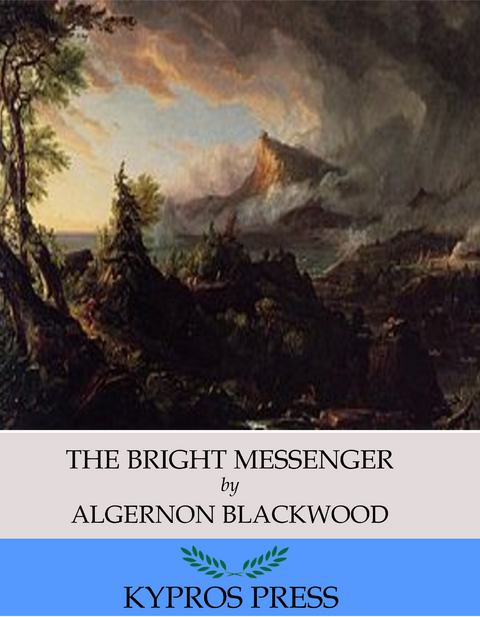
Bright Messenger (eBook)
483 Seiten
Charles River Editors (Verlag)
978-1-5183-9697-7 (ISBN)
Algernon Blackwood was a prolific British author best known for his ghost stories. Blackwood's most famous work includes The Willows and The Wendigo. This edition of The Bright Messenger includes a table of contents.
CHAPTER 1
EDWARD FILLERY, SO FAR AS may be possible to a man of normal passions and emotions, took a detached view of life and human nature. At the age of thirty-eight he still remained a spectator, a searching, critical, analytical, yet chiefly, perhaps, a sympathetic spectator, before the great performance whose stage is the planet and whose performers and auditorium are humanity.
Knowing himself outcast, an unwelcome deadhead at the play, he had yet felt no bitterness against the parents whose fierce illicit passion had deprived him of an honourable seat. The first shock of resentment over, he had faced the situation with a tolerance which showed an unusual charity, an exceptional understanding, in one so young.
He was twenty when he learned the truth about himself. And it was his wondering analysis as to why two loving humans could be so careless of their offspring’s welfare, when the rest of Nature took such pains in the matter, that first betrayed, perhaps, his natural aptitude. He had the innate gift of seeing things as they were, undisturbed by personal emotion, while yet asking himself with scientific accuracy why and how they came to be so. These were invaluable qualities in the line of knowledge and research he chose for himself as psychologist and doctor. The terms are somewhat loose. His longing was to probe the motives of conduct in the first place, and, in the second, to correct the results of wrong conduct by removing faulty motives. Psychiatrist and healer, therefore, were his more accurate titles; psychiatrist and healer, in due course, he became.
His father, an engineer of ability and enterprise, prospecting in the remoter parts of the Caucasus for copper, and making a comfortable fortune in so doing, was carried off his feet suddenly by the beauty of a Khaketian peasant girl, daughter of a shepherd in these lonely and majestic mountains, whose intolerable grandeur may well intoxicate a man to madness. A dangerous and disgraceful episode it seems to have been between John Fillery, hitherto of steady moral fibre, and this strange, lovely pagan girl, whose savage father hunted the pair of them high and low for weeks before they finally eluded him in the azalea valleys beyond Artvine.
Great passion, possibly great love, born of this enchanted land whose peaks touch heaven, while their lower turfy slopes are carpeted with lilies, azaleas, rhododendrons, contributed to the birth of Edward, who first saw the light in a secret chamber of a dirty Tiflis house, above the Koura torrent. That same night, when the sun dipped beneath the Black Sea waters two hundred miles to the westward, his mother had looked for the last time upon her northern lover and her wild Caucasian mountains.
Edward, however, persisted, visible emblem of a few weeks’ primal passion in a primal land. Intense desire, born in this remote wilderness of amazing loveliness, lent him, perhaps, a strain of illicit, almost unearthly yearning, a secret nostalgia for some lost vale of beauty that held fiercer sunshine, mightier winds and fairer flowers than those he knew in this world.
At the age of four he was brought to England; his Russian memories faded, though not the birthright of his primitive blood. Settling in London, his father increased his fortune as consulting engineer, but did not marry. To the short vehement episode he had given of his very best; he remained true to his gorgeous memory and his sin; the cream of his life, its essence and its perfume, had been spent in those wild wind-swept azalea valleys beyond Artvine. The azalea honey was in his blood, the scent of the lilies in his brain; he still heard the Koura and Rion foaming down towards ancient Colchis. Edward embodied for him the spirit of these sweet, passionate memories. He loved the boy, he cherished and he spoilt him.
But Edward had stuff in him that rendered spoiling harmless. A vigorous, independent youngster, he showed firmness and character as a lad. To the delight of his father he knew his own mind early, reading and studying on his own account, possessed at the same time by a vehement love of nature and outdoor life that was far more than the average English boy’s inclination to open air and sport. There lay some primal quality in his blood that was of ancient origin and leaned towards wildness. There seemed almost, at the same time, a faunish strain that turned away from life.
As a tiny little fellow he had that strange touch of creative imagination other children have also known an invisible playmate. It had no name, as it, apparently, had no sex. The boy’s father could trace it directly to no fairy tale read or heard; its origin in the child’s mind remained a mystery. But its characteristics were unusual, even for such fanciful imaginings: too full-fledged to have been created gradually by the boy’s loneliness, it seemed half goblin and half Nature-spirit; it replaced, at any rate, the little brothers and sisters who were not there, and the father, led by his conscience, possibly, to divine or half divine its origin, met the pretence with sympathetic encouragement.
It came usually with the wind, moreover, and went with the wind, and wind accordingly excited the child. “Listen! Father!” he would exclaim when no air was moving anywhere and the day was still as death. Then: “Plop! So there you are!” as though it had dropped through empty space and landed at his feet. “It came from a tremenjus height,” the child explained. “The wind’s up there, you see, today.” Which struck the parent’s mind as odd, because it proved later true. An upper wind, far in the higher strata of air, came down an hour or so afterwards and blew into a storm.
Fire and flowers, too, were connected with this invisible playmate. “He’ll make it burn, father,” the child said convincingly, when the chimney smoked and the coals refused to catch, and then became very busy with his friend in the grate and about the hearth, just as though he helped and superintended what was being invisibly accomplished. “It’s burning better, anyhow,” agreed the father, astonished in spite of himself as the coals began to glow and spurt their gassy flames. “Well done; I am very much obliged to you and your little friend.”
“But it’s the only thing he can do. He likes it. It’s his work really, don’t you see keeping up the heat in things.”
“Oh, it’s his natural job, is it? I see, yes. But my thanks to him, all the same.”
“Thank you very much,” said grave Edward, aged five, addressing his tiny friend among the fire-irons. “I’m much mobliged to you.”
Edward was a bit older when the flower incident took place with the geranium that no amount of care and coaxing seemed able to keep alive. It had been dying slowly for some days, when Edward announced that he saw its “inside” flitting about the plant, but unable to get back into it. “It’s got out, you see, and can’t get back into its body again, so it’s dying.”
“Well, what in the world are we to do about it?” asked his father.
“I’ll ask,” was the solemn reply. “Now I know!” he cried, delighted, after asking his question of the empty air and listening for the answer. “Of course. Now I see. Look, father, there it is its spirit!” He stood beside the flower and pointed to the earth in the pot.
“Dear me, yes! Where d’you see it? I don’t see it quite.”
“He says I can pick it up and put it back and then the flower will live.” The child put out a hand as though picking up something that moved quickly about the stem.
“What’s it look like?” asked his father quickly.
“Oh, sort of trinangles and things with lines and corners,” was the reply, making a gesture as though he caught it and popped it back into the red drooping blossoms. “There you are! Now you’re alive again. Thank you very much, please” this last remark to the invisible playmate who was superintending.
“A sort of geometrical figure, was it?” inquired the father next day, when, to his surprise, he found the geranium blooming in full health and beauty once again. “That’s what you saw, eh?”
“It was its spirit, and it was shiny red, like fire,” the child replied. “It’s heat. Without these things there’d be no flowers at all.”
“Who makes everything grow?” he asked suddenly, a moment later.
“You mean what makes them grow.”
“Who,” he repeated with emphasis. “Who builds the bodies up and looks after them?”
“Ah! the structure, you mean, the form?”
Edward nodded. His father had the feeling he was not being asked for information, but was being cross-examined. A faint pressure, as of uneasiness, touched him.
“They develop automatically that means naturally, under the laws of nature,” he replied.
“And the laws who keeps them working properly?”
The father, with a mental gulp, replied that God did.
“A beetle’s body, for instance, or a daisy’s or an elephant’s?” persisted the child undeceived by the theological evasion. “Or mine, or a...
| Erscheint lt. Verlag | 22.3.2018 |
|---|---|
| Sprache | englisch |
| Themenwelt | Literatur ► Anthologien |
| Literatur ► Klassiker / Moderne Klassiker | |
| Literatur ► Romane / Erzählungen | |
| Schlagworte | bizarre • British • Classic • ghost • Horror • The Damned • the empty house • The Wendigo • The Willows • Weird |
| ISBN-10 | 1-5183-9697-6 / 1518396976 |
| ISBN-13 | 978-1-5183-9697-7 / 9781518396977 |
| Informationen gemäß Produktsicherheitsverordnung (GPSR) | |
| Haben Sie eine Frage zum Produkt? |
 EPUB (Adobe DRM)
Größe: 836 KB
Kopierschutz: Adobe-DRM
Adobe-DRM ist ein Kopierschutz, der das eBook vor Mißbrauch schützen soll. Dabei wird das eBook bereits beim Download auf Ihre persönliche Adobe-ID autorisiert. Lesen können Sie das eBook dann nur auf den Geräten, welche ebenfalls auf Ihre Adobe-ID registriert sind.
Details zum Adobe-DRM
Dateiformat: EPUB (Electronic Publication)
EPUB ist ein offener Standard für eBooks und eignet sich besonders zur Darstellung von Belletristik und Sachbüchern. Der Fließtext wird dynamisch an die Display- und Schriftgröße angepasst. Auch für mobile Lesegeräte ist EPUB daher gut geeignet.
Systemvoraussetzungen:
PC/Mac: Mit einem PC oder Mac können Sie dieses eBook lesen. Sie benötigen eine
eReader: Dieses eBook kann mit (fast) allen eBook-Readern gelesen werden. Mit dem amazon-Kindle ist es aber nicht kompatibel.
Smartphone/Tablet: Egal ob Apple oder Android, dieses eBook können Sie lesen. Sie benötigen eine
Geräteliste und zusätzliche Hinweise
Buying eBooks from abroad
For tax law reasons we can sell eBooks just within Germany and Switzerland. Regrettably we cannot fulfill eBook-orders from other countries.
EPUB (Ohne DRM)Digital Rights Management: ohne DRM
Dieses eBook enthält kein DRM oder Kopierschutz. Eine Weitergabe an Dritte ist jedoch rechtlich nicht zulässig, weil Sie beim Kauf nur die Rechte an der persönlichen Nutzung erwerben.
Dateiformat: EPUB (Electronic Publication)
EPUB ist ein offener Standard für eBooks und eignet sich besonders zur Darstellung von Belletristik und Sachbüchern. Der Fließtext wird dynamisch an die Display- und Schriftgröße angepasst. Auch für mobile Lesegeräte ist EPUB daher gut geeignet.
Systemvoraussetzungen:
PC/Mac: Mit einem PC oder Mac können Sie dieses eBook lesen. Sie benötigen dafür die kostenlose Software Adobe Digital Editions.
eReader: Dieses eBook kann mit (fast) allen eBook-Readern gelesen werden. Mit dem amazon-Kindle ist es aber nicht kompatibel.
Smartphone/Tablet: Egal ob Apple oder Android, dieses eBook können Sie lesen. Sie benötigen dafür eine kostenlose App.
Geräteliste und zusätzliche Hinweise
Buying eBooks from abroad
For tax law reasons we can sell eBooks just within Germany and Switzerland. Regrettably we cannot fulfill eBook-orders from other countries.
aus dem Bereich