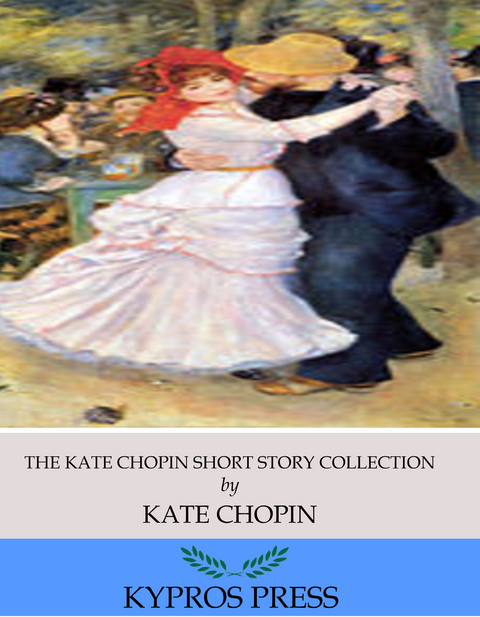
Kate Chopin Short Story Collection (eBook)
774 Seiten
Charles River Editors (Verlag)
978-1-5183-9229-0 (ISBN)
Kate Chopin was an American author and one of the most famous feminists of the 19th century. Chopin's most famous works include The Awakening and At Fault. This edition of The Kate Chopin Short Story Collection includes a table of contents and the following:Beyond the BayouMa'Anne PelagieDesiree's BabyA Respectable WomanThe kissA Pair of Silk StockingsThe LocketA ReflectionAt the 'Cadian BallThe StormThe Story of an HourAthenaiseLilacsRipe FigsA Night in AcadieAfter the WinterPolydoreRegretA Matter of PrejudiceCalineA Dresden Lady in DixieNeg CreolThe LiliesAzelieA Sentimental SoulDead Men's ShoesAt Cheniere CaminadaOdalie Misses MassCavanelleTante Cat'rinetteOzeme's HolidayA Point at Issue!The UnexpectedThe Night Came SlowlyThe RecoveryThe Return of AlcibiadeThe Benitous' SlaveThe Blind ManOld Aunt PeggyA December Day in DixieA Family AffairA Gentlemen of Bayou TecheA HarbingerA Horse StoryA Lady of Bayou St. JohnA Little Country GirlA Little Free-MulattoA Mental SuggestionA Morning WalkAn Egyptian CigaretteAn Idle FellowA No-Account CreoleA Rude AwakeningA Shameful AffairA Turkey HuntA Very Fine FiddleA Visit to AvoyellesA Wizard from GettysburgBoulot and BoulotteDoctor Chevalier's LieEmancipation. A Life FableFor Marse ChouchouteHer LettersIn and Out of NatchitochesIn SabineJuanitaLa Belle ZoraideLokaLove on the Bon-DieuMadame Celestin's DivorceMiss McEnders
MA’AME PELAGIE
I
When the war began, there stood on Cote Joyeuse an imposing mansion of red brick, shaped like the Pantheon. A grove of majestic live-oaks surrounded it.
Thirty years later, only the thick walls were standing, with the dull red brick showing here and there through a matted growth of clinging vines. The huge round pillars were intact; so to some extent was the stone flagging of hall and portico. There had been no home so stately along the whole stretch of Cote Joyeuse. Every one knew that, as they knew it had cost Philippe Valmet sixty thousand dollars to build, away back in 1840. No one was in danger of forgetting that fact, so long as his daughter Pelagie survived. She was a queenly, white-haired woman of fifty. “Ma’ame Pelagie,” they called her, though she was unmarried, as was her sister Pauline, a child in Ma’ame Pelagie’s eyes; a child of thirty-five.
The two lived alone in a three-roomed cabin, almost within the shadow of the ruin. They lived for a dream, for Ma’ame Pelagie’s dream, which was to rebuild the old home.
It would be pitiful to tell how their days were spent to accomplish this end; how the dollars had been saved for thirty years and the picayunes hoarded; and yet, not half enough gathered! But Ma’ame Pelagie felt sure of twenty years of life before her, and counted upon as many more for her sister. And what could not come to pass in twenty—in forty—years?
Often, of pleasant afternoons, the two would drink their black coffee, seated upon the stone-flagged portico whose canopy was the blue sky of Louisiana. They loved to sit there in the silence, with only each other and the sheeny, prying lizards for company, talking of the old times and planning for the new; while light breezes stirred the tattered vines high up among the columns, where owls nested.
“We can never hope to have all just as it was, Pauline,” Ma’ame Pelagie would say; “perhaps the marble pillars of the salon will have to be replaced by wooden ones, and the crystal candelabra left out. Should you be willing, Pauline?”
“Oh, yes Sesoeur, I shall be willing.” It was always, “Yes, Sesoeur,” or “No, Sesoeur,” “Just as you please, Sesoeur,” with poor little Mam’selle Pauline. For what did she remember of that old life and that old spendor? Only a faint gleam here and there; the half-consciousness of a young, uneventful existence; and then a great crash. That meant the nearness of war; the revolt of slaves; confusion ending in fire and flame through which she was borne safely in the strong arms of Pelagie, and carried to the log cabin which was still their home. Their brother, Leandre, had known more of it all than Pauline, and not so much as Pelagie. He had left the management of the big plantation with all its memories and traditions to his older sister, and had gone away to dwell in cities. That was many years ago. Now, Leandre’s business called him frequently and upon long journeys from home, and his motherless daughter was coming to stay with her aunts at Cote Joyeuse.
They talked about it, sipping their coffee on the ruined portico. Mam’selle Pauline was terribly excited; the flush that throbbed into her pale, nervous face showed it; and she locked her thin fingers in and out incessantly.
“But what shall we do with La Petite, Sesoeur? Where shall we put her? How shall we amuse her? Ah, Seigneur!”
“She will sleep upon a cot in the room next to ours,” responded Ma’ame Pelagie, “and live as we do. She knows how we live, and why we live; her father has told her. She knows we have money and could squander it if we chose. Do not fret, Pauline; let us hope La Petite is a true Valmet.”
Then Ma’ame Pelagie rose with stately deliberation and went to saddle her horse, for she had yet to make her last daily round through the fields; and Mam’selle Pauline threaded her way slowly among the tangled grasses toward the cabin.
The coming of La Petite, bringing with her as she did the pungent atmosphere of an outside and dimly known world, was a shock to these two, living their dream-life. The girl was quite as tall as her aunt Pelagie, with dark eyes that reflected joy as a still pool reflects the light of stars; and her rounded cheek was tinged like the pink crepe myrtle. Mam’selle Pauline kissed her and trembled. Ma’ame Pelagie looked into her eyes with a searching gaze, which seemed to seek a likeness of the past in the living present.
And they made room between them for this young life.
II
La Petite had determined upon trying to fit herself to the strange, narrow existence which she knew awaited her at Cote Joyeuse. It went well enough at first. Sometimes she followed Ma’ame Pelagie into the fields to note how the cotton was opening, ripe and white; or to count the ears of corn upon the hardy stalks. But oftener she was with her aunt Pauline, assisting in household offices, chattering of her brief past, or walking with the older woman arm-in-arm under the trailing moss of the giant oaks.
Mam’selle Pauline’s steps grew very buoyant that summer, and her eyes were sometimes as bright as a bird’s, unless La Petite were away from her side, when they would lose all other light but one of uneasy expectancy. The girl seemed to love her well in return, and called her endearingly Tan’tante. But as the time went by, La Petite became very quiet,—not listless, but thoughtful, and slow in her movements. Then her cheeks began to pale, till they were tinged like the creamy plumes of the white crepe myrtle that grew in the ruin.
One day when she sat within its shadow, between her aunts, holding a hand of each, she said: “Tante Pelagie, I must tell you something, you and Tan’tante.” She spoke low, but clearly and firmly. “I love you both,—please remember that I love you both. But I must go away from you. I can’t live any longer here at Cote Joyeuse.”
A spasm passed through Mam’selle Pauline’s delicate frame. La Petite could feel the twitch of it in the wiry fingers that were intertwined with her own. Ma’ame Pelagie remained unchanged and motionless. No human eye could penetrate so deep as to see the satisfaction which her soul felt. She said: “What do you mean, Petite? Your father has sent you to us, and I am sure it is his wish that you remain.”
“My father loves me, tante Pelagie, and such will not be his wish when he knows. Oh!” she continued with a restless, movement, “it is as though a weight were pressing me backward here. I must live another life; the life I lived before. I want to know things that are happening from day to day over the world, and hear them talked about. I want my music, my books, my companions. If I had known no other life but this one of privation, I suppose it would be different. If I had to live this life, I should make the best of it. But I do not have to; and you know, tante Pelagie, you do not need to. It seems to me,” she added in a whisper, “that it is a sin against myself. Ah, Tan’tante!—what is the matter with Tan’tante?”
It was nothing; only a slight feeling of faintness, that would soon pass. She entreated them to take no notice; but they brought her some water and fanned her with a palmetto leaf.
But that night, in the stillness of the room, Mam’selle Pauline sobbed and would not be comforted. Ma’ame Pelagie took her in her arms.
“Pauline, my little sister Pauline,” she entreated, “I never have seen you like this before. Do you no longer love me? Have we not been happy together, you and I?”
“Oh, yes, Sesoeur.”
“Is it because La Petite is going away?”
“Yes, Sesoeur.”
“Then she is dearer to you than I!” spoke Ma’ame Pelagie with sharp resentment. “Than I, who held you and warmed you in my arms the day you were born; than I, your mother, father, sister, everything that could cherish you. Pauline, don’t tell me that.”
Mam’selle Pauline tried to talk through her sobs.
“I can’t explain it to you, Sesoeur. I don’t understand it myself. I love you as I have always loved you; next to God. But if La Petite goes away I shall die. I can’t understand,—help me, Sesoeur. She seems—she seems like a saviour; like one who had come and taken me by the hand and was leading me somewhere-somewhere I want to go.”
Ma’ame Pelagie had been sitting beside the bed in her peignoir and slippers. She held the hand of her sister who lay there, and smoothed down the woman’s soft brown hair. She said not a word, and the silence was broken only by Mam’selle Pauline’s continued sobs. Once Ma’ame Pelagie arose to mix a drink of orange-flower water, which she gave to her sister, as she would have offered it to a nervous, fretful child. Almost an hour passed before Ma’ame Pelagie spoke again. Then she said:—
“Pauline, you must cease that sobbing, now, and sleep. You will make yourself ill. La Petite will not go away. Do you hear me? Do you understand? She will stay, I promise you.”
Mam’selle Pauline could not...
| Erscheint lt. Verlag | 22.3.2018 |
|---|---|
| Sprache | englisch |
| Themenwelt | Literatur ► Anthologien |
| Literatur ► Klassiker / Moderne Klassiker | |
| Literatur ► Romane / Erzählungen | |
| Schlagworte | American • At Fault • Classic • EPIC • feminist • Historical • Poetry • Short Stories • The Awakening |
| ISBN-10 | 1-5183-9229-6 / 1518392296 |
| ISBN-13 | 978-1-5183-9229-0 / 9781518392290 |
| Informationen gemäß Produktsicherheitsverordnung (GPSR) | |
| Haben Sie eine Frage zum Produkt? |
 EPUB (Adobe DRM)
Größe: 1,0 MB
Kopierschutz: Adobe-DRM
Adobe-DRM ist ein Kopierschutz, der das eBook vor Mißbrauch schützen soll. Dabei wird das eBook bereits beim Download auf Ihre persönliche Adobe-ID autorisiert. Lesen können Sie das eBook dann nur auf den Geräten, welche ebenfalls auf Ihre Adobe-ID registriert sind.
Details zum Adobe-DRM
Dateiformat: EPUB (Electronic Publication)
EPUB ist ein offener Standard für eBooks und eignet sich besonders zur Darstellung von Belletristik und Sachbüchern. Der Fließtext wird dynamisch an die Display- und Schriftgröße angepasst. Auch für mobile Lesegeräte ist EPUB daher gut geeignet.
Systemvoraussetzungen:
PC/Mac: Mit einem PC oder Mac können Sie dieses eBook lesen. Sie benötigen eine
eReader: Dieses eBook kann mit (fast) allen eBook-Readern gelesen werden. Mit dem amazon-Kindle ist es aber nicht kompatibel.
Smartphone/Tablet: Egal ob Apple oder Android, dieses eBook können Sie lesen. Sie benötigen eine
Geräteliste und zusätzliche Hinweise
Buying eBooks from abroad
For tax law reasons we can sell eBooks just within Germany and Switzerland. Regrettably we cannot fulfill eBook-orders from other countries.
EPUB (Ohne DRM)Digital Rights Management: ohne DRM
Dieses eBook enthält kein DRM oder Kopierschutz. Eine Weitergabe an Dritte ist jedoch rechtlich nicht zulässig, weil Sie beim Kauf nur die Rechte an der persönlichen Nutzung erwerben.
Dateiformat: EPUB (Electronic Publication)
EPUB ist ein offener Standard für eBooks und eignet sich besonders zur Darstellung von Belletristik und Sachbüchern. Der Fließtext wird dynamisch an die Display- und Schriftgröße angepasst. Auch für mobile Lesegeräte ist EPUB daher gut geeignet.
Systemvoraussetzungen:
PC/Mac: Mit einem PC oder Mac können Sie dieses eBook lesen. Sie benötigen dafür die kostenlose Software Adobe Digital Editions.
eReader: Dieses eBook kann mit (fast) allen eBook-Readern gelesen werden. Mit dem amazon-Kindle ist es aber nicht kompatibel.
Smartphone/Tablet: Egal ob Apple oder Android, dieses eBook können Sie lesen. Sie benötigen dafür eine kostenlose App.
Geräteliste und zusätzliche Hinweise
Buying eBooks from abroad
For tax law reasons we can sell eBooks just within Germany and Switzerland. Regrettably we cannot fulfill eBook-orders from other countries.
aus dem Bereich