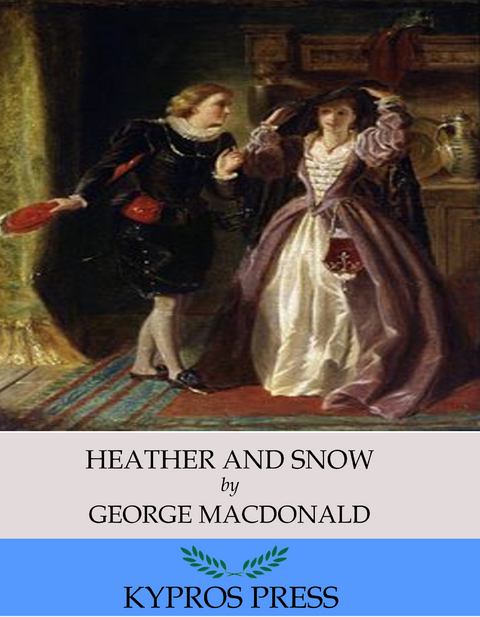
Heather and Snow (eBook)
314 Seiten
Charles River Editors (Verlag)
978-1-5183-7965-9 (ISBN)

George MacDonald was a Scottish author and Christian minister. MacDonald was an early writer of the fantasy novel and his works influenced authors such as C.S. Lewis and J.R.R. Tolkien. This edition of Heather and Snow includes a table of contents.
CHAPTER III. AT THE FOOT OF THE HORN
THE REGION WAS LIKE A waste place in the troubled land of dreams—a spot so waste that the dreamer struggles to rouse himself from his dream, finding it too dreary to dream on. I have heard it likened to ‘the ill place, wi’ the fire oot;’ but it did not so impress me when first, after long desire, I saw it. There was nothing to suggest the silence of once roaring flame, no half-molten rocks, no huge, honey-combed scoriae, no depths within depths glooming mystery and ancient horror. It was the more desolate that it moved no active sense of dismay. What I saw was a wide stretch of damp-looking level, mostly of undetermined or of low-toned colour, with here and there a black spot, or, on the margin, the brighter green of a patch of some growing crop. Flat and wide, the eye found it difficult to rest upon it and not sweep hurriedly from border to border for lack of self-asserted object on which to alight. It looked low, but indeed lay high; the bases of the hills surrounding it were far above the sea. These hills, at this season a ring of dull-brown high-heaved hummocks, appeared to make of it a huge circular basin, miles in diameter, over the rim of which peered the tops and peaks of mountains more distant. Up the side of the Horn, which was the loftiest in the ring, ran a stone wall, in the language of the country a dry-stane-dyke, of considerable size, climbing to the very top—an ugly thing which the eye could not avoid. There was nothing but the grouse to have rendered it worth the proprietor’s while to erect such a boundary to his neighbour’s property, plentiful as were the stones ready for that poorest use of stones—division.
The farms that border the hollow, running each a little way up the side of the basin, are, some of them at least, as well cultivated as any in Scotland, but Winter claims there the paramountcy, and yields to Summer so few of his rights that the place must look forbidding, if not repulsive, to such as do not live in it. To love it, I think one must have been born there. In the summer, it is true, it has the character of bracing, but can be such, I imagine, only to those who are pretty well braced already; the delicate of certain sorts, I think it must soon brace with the bands of death.
The region is in constant danger of famine. If the snow come but a little earlier than usual, the crops lie green under it, and no store of meal can be laid up in the cottages. Then, if the snow lie deep, the difficulty in conveying supplies of the poor fare which their hardihood counts sufficient, will cause the dwellers there no little suffering. Of course they are but few. A white cottage may be seen here and there on the southerly slopes of the basin, but hardly one in its bottom.
It was now summer, and in a month or two the landscape would look more cheerful; the heather that covered the hills would no longer be dry and brown and in places black with fire, but a blaze of red purple, a rich mantle of bloom. Even now, early in July, the sun had a little power. I cannot say it would have been warm had there been the least motion in the air, for seldom indeed could one there from the south grant that the wind had no keen edge to it; but on this morning there was absolute stillness, and although it was not easy for Kirsty to imagine any summer air other than warm, yet the wind’s absence had not a little to do with the sense of luxurious life that now filled her heart. She sat on her favourite grassy slope near the foot of the cone-shaped Horn, looking over the level miles before her, and knitting away at a ribbed stocking of dark blue whose toe she had nearly finished, glad in the thought, not of rest from her labour, but of beginning the yet more important fellow-stocking. She had no need to look close at her work to keep the loops right; but she was so careful and precise that, if she lived to be old and blind, she would knit better then than now. It was to her the perfect glory of a summer day; and I imagine her delight in the divine luxury greater than that of many a poet dwelling in softer climes.
The spot where she sat was close by the turf-hut which I have already described. At every shifting of a needle she would send a new glance all over her world, a glance to remind one somehow of the sweep of a broad ray of sunlight across earth and sea, when, on a morning of upper wind, the broken clouds take endless liberties with shadow and shine. What she saw I cannot tell; I know she saw far more than a stranger would have seen, for she knew her home. His eyes would, I believe, have been drawn chiefly to those intense spots of live white, opaque yet brilliant, the heads of the cotton-grass here and there in thin patches on the dark ground. For nearly the whole of the level was a peat-moss. Miles and miles of peat, differing in quality and varying in depth, lay between those hills, the only fuel almost of the region. In some spots it was very wet, water lying beneath and all through its substance; in others, dark spots, the sides of holes whence it had been dug, showed where it was drier. His eyes would rest for a moment also on those black spaces on the hills where the old heather had been burned that its roots might shoot afresh, and feed the grouse with soft young sprouts, their chief support: they looked now like neglected spots where men cast stones and shards, but by and by would be covered with a tenderer green than the rest of the hill-side. He would not see the moorland birds that Kirsty saw; he would only hear their cries, with now and then perhaps the bark of a sheep-dog.
My reader will probably conclude the prospect altogether uninteresting, even ugly; but certainly Christina Barclay did not think it such. The girl was more than well satisfied with the world-shell in which she found herself; she was at the moment basking, both bodily and spiritually, in a full sense of the world’s bliss. Her soul was bathed in its own content, calling none of its feelings to account. The sun, the air, the wide expanse; the hill-tops’ nearness to the heavens which yet they could not invade; the little breaths which every now and then awoke to assert their existence by immediately ceasing; doubtless also the knowledge that her stocking was nearly done, that her father and mother were but a mile or so away, that she knew where Steenie was, and that a cry would bring him to her feet;—all these things bore each a part in making Kirsty quiet with satisfaction. That there was, all the time, a deeper cause of her peace, Kirsty knew well-the same that is the root of life itself; and if it was not, at this moment or at that, filled with conscious gratitude, her heart was yet like a bird ever on the point of springing up to soar, and often soaring high indeed. Whether it came of something special in her constitution that happiness always made her quiet, as nothing but sorrow will make some, I do not presume to say. I only know that, had her bliss changed suddenly to sadness, Kirsty would have been quiet still. Whatever came to Kirsty seemed right, for there it was!
She was now a girl of sixteen. The only sign she showed of interest in her person, appeared in her hair and the covering of her neck. Of one of the many middle shades of brown, with a rippling tendency to curl in it, her hair was parted with nicety, and drawn back from her face into a net of its own colour, while her neckerchief was of blue silk, covering a very little white skin, but leaving bare a brown throat. She wore a blue print wrapper, nowise differing from that of a peasant woman, and a blue winsey petticoat, beyond which appeared her bare feet, lovely in shape, and brown of hue. Her dress was nowise trim, and suggested neither tidiness nor disorder. The hem of the petticoat was in truth a little rent, but not more than might seem admissible where the rough wear was considered to which the garment was necessarily exposed: when a little worse it would receive the proper attention, and be brought back to respectability! Kirsty grudged the time spent on her garments. She looked down on them as the moon might on the clouds around her. She made or mended them to wear them, not think about them.
Her forehead was wide and rather low, with straight eyebrows. Her eyes were of a gentle hazel, not the hazel that looks black at night. Her nose was strong, a little irregular, with plenty of substance, and sensitive nostrils. A decided and well-shaped chin dominated a neck by no means slender, and seemed to assert the superiority of the face over the whole beautiful body. Its chief expression was of a strong repose, a sweet, powerful peace, requiring but occasion to pass into determination. The sensitiveness of the nostrils with the firmness in the meeting of the closed lips, suggested a faculty of indignation unsparing toward injustice; while the clearness of the heaven of the forehead gave confidence that such indignation would never show itself save for another.
I wish, presumptuous wish! that I could see the mind of a woman grow as she sits spinning or weaving: it would reveal the process next highest to creation. But the only hope of ever understanding such things lies in growing oneself. There is the still growth of the moonlit night of reverie; cloudy, with wind, and a little rain, comes the morning of thought, when the mind grows faster and the heart more slowly; then wakes the storm in the forest of human relation, tempest and lightning abroad, the soul enlarging by great bursts of vision and leaps of understanding and resolve; then floats up the mystic twilight eagerness, not unmingled with the dismay of compelled progress, when, bidding...
| Erscheint lt. Verlag | 22.3.2018 |
|---|---|
| Sprache | englisch |
| Themenwelt | Literatur ► Anthologien |
| Literatur ► Klassiker / Moderne Klassiker | |
| Literatur ► Romane / Erzählungen | |
| Schlagworte | At the Back of the North Wind • Fantasy • Lilith • Phantastes • Scottish • the princess and the goblin • the wise woman |
| ISBN-10 | 1-5183-7965-6 / 1518379656 |
| ISBN-13 | 978-1-5183-7965-9 / 9781518379659 |
| Informationen gemäß Produktsicherheitsverordnung (GPSR) | |
| Haben Sie eine Frage zum Produkt? |
 EPUB (Adobe DRM)
Größe: 747 KB
Kopierschutz: Adobe-DRM
Adobe-DRM ist ein Kopierschutz, der das eBook vor Mißbrauch schützen soll. Dabei wird das eBook bereits beim Download auf Ihre persönliche Adobe-ID autorisiert. Lesen können Sie das eBook dann nur auf den Geräten, welche ebenfalls auf Ihre Adobe-ID registriert sind.
Details zum Adobe-DRM
Dateiformat: EPUB (Electronic Publication)
EPUB ist ein offener Standard für eBooks und eignet sich besonders zur Darstellung von Belletristik und Sachbüchern. Der Fließtext wird dynamisch an die Display- und Schriftgröße angepasst. Auch für mobile Lesegeräte ist EPUB daher gut geeignet.
Systemvoraussetzungen:
PC/Mac: Mit einem PC oder Mac können Sie dieses eBook lesen. Sie benötigen eine
eReader: Dieses eBook kann mit (fast) allen eBook-Readern gelesen werden. Mit dem amazon-Kindle ist es aber nicht kompatibel.
Smartphone/Tablet: Egal ob Apple oder Android, dieses eBook können Sie lesen. Sie benötigen eine
Geräteliste und zusätzliche Hinweise
Buying eBooks from abroad
For tax law reasons we can sell eBooks just within Germany and Switzerland. Regrettably we cannot fulfill eBook-orders from other countries.
EPUB (Ohne DRM)Digital Rights Management: ohne DRM
Dieses eBook enthält kein DRM oder Kopierschutz. Eine Weitergabe an Dritte ist jedoch rechtlich nicht zulässig, weil Sie beim Kauf nur die Rechte an der persönlichen Nutzung erwerben.
Dateiformat: EPUB (Electronic Publication)
EPUB ist ein offener Standard für eBooks und eignet sich besonders zur Darstellung von Belletristik und Sachbüchern. Der Fließtext wird dynamisch an die Display- und Schriftgröße angepasst. Auch für mobile Lesegeräte ist EPUB daher gut geeignet.
Systemvoraussetzungen:
PC/Mac: Mit einem PC oder Mac können Sie dieses eBook lesen. Sie benötigen dafür die kostenlose Software Adobe Digital Editions.
eReader: Dieses eBook kann mit (fast) allen eBook-Readern gelesen werden. Mit dem amazon-Kindle ist es aber nicht kompatibel.
Smartphone/Tablet: Egal ob Apple oder Android, dieses eBook können Sie lesen. Sie benötigen dafür eine kostenlose App.
Geräteliste und zusätzliche Hinweise
Buying eBooks from abroad
For tax law reasons we can sell eBooks just within Germany and Switzerland. Regrettably we cannot fulfill eBook-orders from other countries.
aus dem Bereich