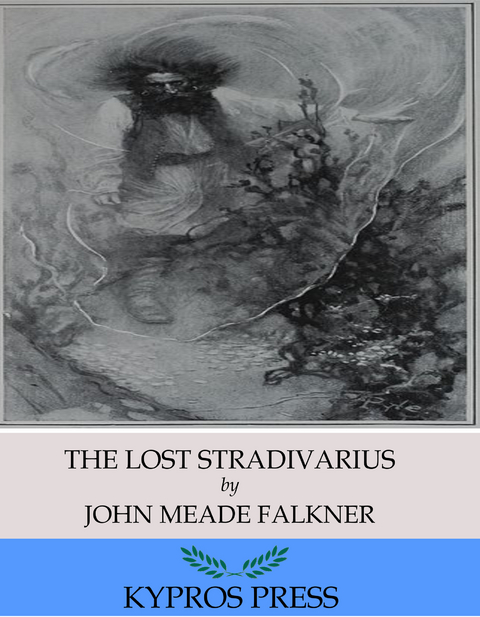
Lost Stradivarius (eBook)
202 Seiten
Charles River Editors (Verlag)
978-1-5183-7877-5 (ISBN)

John Meade Falkner was a British writer and chairman of Armstrong Whitworth during World War I. Falkner's most famous works are his three novels, Moonfleet, The Lost Stradivarius and The Nebuly Coat. This edition of The Lost Stradivarius includes a table of contents.
CHAPTER I
YOUR FATHER, JOHN MALTRAVERS, WAS born in 1820 at Worth, and succeeded his father and mine, who died when we were still young children. John was sent to Eton in due course, and in 1839, when he was nineteen years of age, it was determined that he should go to Oxford. It was intended at first to enter him at Christ Church; but Dr. Sarsdell, who visited us at Worth in the summer of 1839, persuaded Mr. Thoresby, our guardian, to send him instead to Magdalen Hall. Dr. Sarsdell was himself Principal of that institution, and represented that John, who then exhibited some symptoms of delicacy, would meet with more personal attention under his care than he could hope to do in so large a college as Christ Church. Mr. Thoresby, ever solicitous for his ward’s welfare, readily waived other considerations in favour of an arrangement which he considered conducive to John’s health, and he was accordingly matriculated at Magdalen Hall in the autumn of 1839.
Dr. Sarsdell had not been unmindful of his promise to look after my brother, and had secured him an excellent first-floor sitting-room, with a bedroom adjoining, having an aspect towards New College Lane.
I shall pass over the first two years of my brother’s residence at Oxford, because they have nothing to do with the present story. They were spent, no doubt, in the ordinary routine of work and recreation common in Oxford at that period.
From his earliest boyhood he had been passionately devoted to music, and had attained a considerable proficiency on the violin. In the autumn term of 1841 he made the acquaintance of Mr. William Gaskell, a very talented student at New College, and also a more than tolerable musician. The practice of music was then very much less common at Oxford than it has since become, and there were none of those societies existing which now do so much to promote its study among undergraduates. It was therefore a cause of much gratification to the two young men, and it afterwards became a strong bond of friendship, to discover that one was as devoted to the pianoforte as was the other to the violin. Mr. Gaskell, though in easy circumstances, had not a pianoforte in his rooms, and was pleased to use a fine instrument by D’Almaine that John had that term received as a birthday present from his guardian.
From that time the two students were thrown much together, and in the autumn term of 1841 and Easter term of 1842 practised a variety of music in John’s rooms, he taking the violin part and Mr. Gaskell that for the pianoforte.
It was, I think, in March 1842 that John purchased for his rooms a piece of furniture which was destined afterwards to play no unimportant part in the story I am narrating. This was a very large and low wicker chair of a form then coming into fashion in Oxford, and since, I am told, become a familiar object of most college rooms. It was cushioned with a gaudy pattern of chintz, and bought for new of an upholsterer at the bottom of the High Street.
Mr. Gaskell was taken by his uncle to spend Easter in Rome, and obtaining special leave from his college to prolong his travels; did not return to Oxford till three weeks of the summer term were passed and May was well advanced. So impatient was he to see his friend that he would not let even the first evening of his return pass without coming round to John’s rooms. The two young men sat without lights until the night was late; and Mr. Gaskell had much to narrate of his travels, and spoke specially of the beautiful music which he had heard at Easter in the Roman churches. He had also had lessons on the piano from a celebrated professor of the Italian style, but seemed to have been particularly delighted with the music of the seventeenth-century composers, of whose works he had brought back some specimens set for piano and violin.
It was past eleven o’clock when Mr. Gaskell left to return to New College; but the night was unusually warm, with a moon near the full, and John sat for some time in a cushioned window-seat before the open sash thinking over what he had heard about the music of Italy. Feeling still disinclined for sleep, he lit a single candle and began to turn over some of the musical works which Mr. Gaskell had left on the table. His attention was especially attracted to an oblong book, bound in soiled vellum, with a coat of arms stamped in gilt upon the side. It was a manuscript copy of some early suites by Graziani for violin and harpsichord, and was apparently written at Naples in the year 1744, many years after the death of that composer. Though the ink was yellow and faded, the transcript had been accurately made, and could be read with tolerable comfort by an advanced musician in spite of the antiquated notation.
Perhaps by accident, or perhaps by some mysterious direction which our minds are incapable of appreciating, his eye was arrested by a suite of four movements with a basso continuo, or figured bass, for the harpsichord. The other suites in the book were only distinguished by numbers, but this one the composer had dignified with the name of “l’Areopagita.” Almost mechanically John put the book on his music-stand, took his violin from its case, and after a moment’s tuning stood up and played the first movement, a lively Coranto. The light of the single candle burning on the table was scarcely sufficient to illumine the page; the shadows hung in the creases of the leaves, which had grown into those wavy folds sometimes observable in books made of thick paper and remaining long shut; and it was with difficulty that he could read what he was playing. But he felt the strange impulse of the old-world music urging him forward, and did not even pause to light the candles which stood ready in their sconces on either side of the desk. The Coranto was followed by a Sarabanda, and the Sarabanda by a Gagliarda. My brother stood playing, with his face turned to the window, with the room and the large wicker chair of which I have spoken behind him. The Gagliarda began with a bold and lively air, and as he played the opening bars, he heard behind him a creaking of the wicker chair. The sound was a perfectly familiar one—as of some person placing a hand on either arm of the chair preparatory to lowering himself into it, followed by another as of the same person being leisurely seated. But for the tones of the violin, all was silent, and the creaking of the chair was strangely distinct. The illusion was so complete that my brother stopped playing suddenly, and turned round expecting that some late friend of his had slipped in unawares, being attracted by the sound of the violin, or that Mr. Gaskell himself had returned. With the cessation of the music an absolute stillness fell upon all; the light of the single candle scarcely reached the darker corners of the room, but fell directly on the wicker chair and showed it to be perfectly empty. Half amused, half vexed with himself at having without reason interrupted his music, my brother returned to the Gagliarda; but some impulse induced him to light the candles in the sconces, which gave an illumination more adequate to the occasion. The Gagliarda and the last movement, a Minuetto, were finished, and John closed the book, intending, as it was now late, to seek his bed. As he shut the pages a creaking of the wicker chair again attracted his attention, and he heard distinctly sounds such as would be made by a person raising himself from a sitting posture. This time, being less surprised, he could more aptly consider the probable causes of such a circumstance, and easily arrived at the conclusion that there must be in the wicker chair osiers responsive to certain notes of the violin, as panes of glass in church windows are observed to vibrate in sympathy with certain tones of the organ. But while this argument approved itself to his reason, his imagination was but half convinced; and he could not but be impressed with the fact that the second creaking of the chair had been coincident with his shutting the music-book; and, unconsciously, pictured to himself some strange visitor waiting until the termination of the music, and then taking his departure.
His conjectures did not, however, either rob him of sleep or even disturb it with dreams, and he woke the next morning with a cooler mind and one less inclined to fantastic imagination. If the strange episode of the previous evening had not entirely vanished from his mind, it seemed at least fully accounted for by the acoustic explanation to which I have alluded above. Although he saw Mr. Gaskell in the course of the morning, he did not think it necessary to mention to him so trivial a circumstance, but made with him an appointment to sup together in his own rooms that evening, and to amuse themselves afterwards by essaying some of the Italian music.
It was shortly after nine that night when, supper being finished, Mr. Gaskell seated himself at the piano and John tuned his violin. The evening was closing in; there had been heavy thunder-rain in the afternoon, and the moist air hung now heavy and steaming, while across it there throbbed the distant vibrations of the tenor bell at Christ Church. It was tolling the customary 101 strokes, which are rung every night in term-time as a signal for closing the college gates. The two young men enjoyed themselves for some while, playing first a suite by Cesti, and then two early sonatas by Buononcini. Both of them were sufficiently expert musicians to make reading at sight a pleasure rather than an effort; and Mr. Gaskell especially was well versed in the theory of music, and in the correct rendering of the basso continuo. After the...
| Erscheint lt. Verlag | 22.3.2018 |
|---|---|
| Sprache | englisch |
| Themenwelt | Literatur ► Anthologien |
| Literatur ► Klassiker / Moderne Klassiker | |
| Literatur ► Romane / Erzählungen | |
| Schlagworte | Architect • British • ghost story • Historical • moonfleet • nebuly coat • smugglers • the lost stradivarius |
| ISBN-10 | 1-5183-7877-3 / 1518378773 |
| ISBN-13 | 978-1-5183-7877-5 / 9781518378775 |
| Informationen gemäß Produktsicherheitsverordnung (GPSR) | |
| Haben Sie eine Frage zum Produkt? |
 EPUB (Adobe DRM)
Größe: 721 KB
Kopierschutz: Adobe-DRM
Adobe-DRM ist ein Kopierschutz, der das eBook vor Mißbrauch schützen soll. Dabei wird das eBook bereits beim Download auf Ihre persönliche Adobe-ID autorisiert. Lesen können Sie das eBook dann nur auf den Geräten, welche ebenfalls auf Ihre Adobe-ID registriert sind.
Details zum Adobe-DRM
Dateiformat: EPUB (Electronic Publication)
EPUB ist ein offener Standard für eBooks und eignet sich besonders zur Darstellung von Belletristik und Sachbüchern. Der Fließtext wird dynamisch an die Display- und Schriftgröße angepasst. Auch für mobile Lesegeräte ist EPUB daher gut geeignet.
Systemvoraussetzungen:
PC/Mac: Mit einem PC oder Mac können Sie dieses eBook lesen. Sie benötigen eine
eReader: Dieses eBook kann mit (fast) allen eBook-Readern gelesen werden. Mit dem amazon-Kindle ist es aber nicht kompatibel.
Smartphone/Tablet: Egal ob Apple oder Android, dieses eBook können Sie lesen. Sie benötigen eine
Geräteliste und zusätzliche Hinweise
Buying eBooks from abroad
For tax law reasons we can sell eBooks just within Germany and Switzerland. Regrettably we cannot fulfill eBook-orders from other countries.
EPUB (Ohne DRM)Digital Rights Management: ohne DRM
Dieses eBook enthält kein DRM oder Kopierschutz. Eine Weitergabe an Dritte ist jedoch rechtlich nicht zulässig, weil Sie beim Kauf nur die Rechte an der persönlichen Nutzung erwerben.
Dateiformat: EPUB (Electronic Publication)
EPUB ist ein offener Standard für eBooks und eignet sich besonders zur Darstellung von Belletristik und Sachbüchern. Der Fließtext wird dynamisch an die Display- und Schriftgröße angepasst. Auch für mobile Lesegeräte ist EPUB daher gut geeignet.
Systemvoraussetzungen:
PC/Mac: Mit einem PC oder Mac können Sie dieses eBook lesen. Sie benötigen dafür die kostenlose Software Adobe Digital Editions.
eReader: Dieses eBook kann mit (fast) allen eBook-Readern gelesen werden. Mit dem amazon-Kindle ist es aber nicht kompatibel.
Smartphone/Tablet: Egal ob Apple oder Android, dieses eBook können Sie lesen. Sie benötigen dafür eine kostenlose App.
Geräteliste und zusätzliche Hinweise
Buying eBooks from abroad
For tax law reasons we can sell eBooks just within Germany and Switzerland. Regrettably we cannot fulfill eBook-orders from other countries.
aus dem Bereich