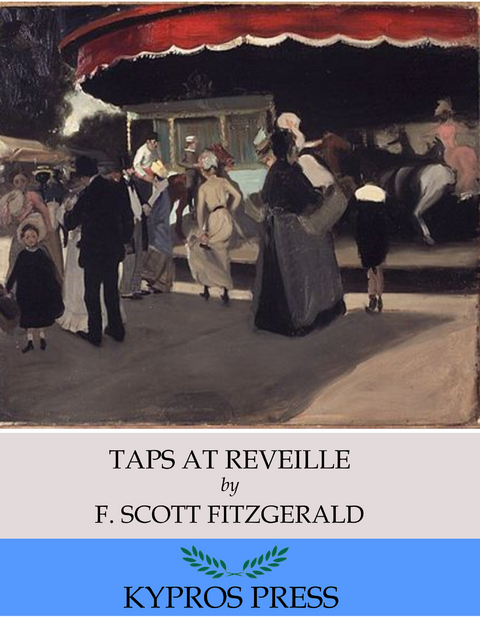
Taps at Reveille (eBook)
479 Seiten
Charles River Editors (Verlag)
978-1-5183-7741-9 (ISBN)
F. Scott Fitzgerald was an American writer best known for his classic works highlighting the Jazz Age in the early 20th century. Fitzgerald only finished 4 novels yet is considered to be one of the most influential writers in American history. This edition of Taps at Reveille includes a table of contents.
BASIL: THE FRESHEST BOY
The Saturday Evening Post (28 July 1928)
It was a hidden Broadway restaurant in the dead of the night, and a brilliant and mysterious group of society people, diplomats and members of the underworld were there. A few minutes ago the sparkling wine had been flowing and a girl had been dancing gaily upon a table, but now the whole crowd were hushed and breathless. All eyes were fixed upon the masked but well-groomed man in the dress suit and opera hat who stood nonchalantly in the door.
‘Don’t move, please,’ he said, in a well-bred, cultivated voice that had, nevertheless, a ring of steel in it. ‘This thing in my hand might — go off.’
His glance roved from table to table — fell upon the malignant man higher up with his pale saturnine face, upon Heatherly, the suave secret agent from a foreign power, then rested a little longer, a little more softly perhaps, upon the table where the girl with dark hair and dark tragic eyes sat alone.
‘Now that my purpose is accomplished, it might interest you to know who I am.’ There was a gleam of expectation in every eye. The breast of the dark-eyed girl heaved faintly and a tiny burst of subtle French perfume rose into the air. ‘I am none other than that elusive gentleman, Basil Lee, better known as the Shadow.’
Taking off his well-fitting opera hat, he bowed ironically from the waist. Then, like a flash, he turned and was gone into the night.
‘You get up to New York only once a month,’ Lewis Crum was saying, ‘and then you have to take a master along.’
Slowly, Basil Lee’s glazed eyes turned from the barns and billboards of the Indiana countryside to the interior of the Broadway Limited. The hypnosis of the swift telegraph poles faded and Lewis Crum’s stolid face took shape against the white slipcover of the opposite bench.
‘I’d just duck the master when I got to New York,’ said Basil.
‘Yes, you would!’
‘I bet I would.’
‘You try it and you’ll see.’
‘What do you mean saying I’ll see, all the time, Lewis? What’ll I see?’
His very bright dark-blue eyes were at this moment fixed upon his companion with boredom and impatience. The two had nothing in common except their age, which was fifteen, and the lifelong friendship of their fathers — which is less than nothing. Also they were bound from the same Middle-Western city for Basil’s first and Lewis’s second year at the same Eastern school.
But, contrary to all the best traditions, Lewis the veteran was miserable and Basil the neophyte was happy. Lewis hated school. He had grown entirely dependent on the stimulus of a hearty vital mother, and as he felt her slipping farther and farther away from him, he plunged deeper into misery and homesickness. Basil, on the other hand, had lived with such intensity on so many stories of boarding-school life that, far from being homesick, he had a glad feeling of recognition and familiarity. Indeed, it was with some sense of doing the appropriate thing, having the traditional rough-house, that he had thrown Lewis’s comb off the train at Milwaukee last night for no reason at all.
To Lewis, Basil’s ignorant enthusiasm was distasteful — his instinctive attempt to dampen it had contributed to the mutual irritation.
‘I’ll tell you what you’ll see,’ he said ominously. ‘They’ll catch you smoking and put you on bounds.’
‘No, they won’t, because I won’t be smoking. I’ll be in training for football.’
‘Football! Yeah! Football!’
‘Honestly, Lewis, you don’t like anything, do you?’
‘I don’t like football. I don’t like to go out and get a crack in the eye.’ Lewis spoke aggressively, for his mother had canonized all his timidities as common sense. Basil’s answer, made with what he considered kindly intent, was the sort of remark that creates lifelong enmities.
‘You’d probably be a lot more popular in school if you played football,’ — he suggested patronizingly.
Lewis did not consider himself unpopular. He did not think of it in that way at all. He was astounded.
‘You wait!’ he cried furiously. ‘They’ll take all that freshness out of you.’
‘Clam yourself,’ said Basil, coolly plucking at the creases of his first long trousers. ‘Just clam yourself.’
‘I guess everybody knows you were the freshest boy at the Country Day!’
‘Clam yourself,’ repeated Basil, but with less assurance. ‘Kindly clam yourself.’
‘I guess I know what they had in the school paper about you —’
Basil’s own coolness was no longer perceptible.
‘If you don’t clam yourself,’ he said darkly, ‘I’m going to throw your brushes off the train too.’
The enormity of this threat was effective. Lewis sank back in his seat, snorting and muttering, but undoubtedly calmer. His reference had been to one of the most shameful passages in his companion’s life. In a periodical issued by the boys of Basil’s late school there had appeared under the heading Personals:
If someone will please poison young Basil, or find some other means to stop his mouth, the school at large and myself will be much obliged.
The two boys sat there fuming wordlessly at each other. Then, resolutely, Basil tried to re-inter this unfortunate souvenir of the past. All that was behind him now. Perhaps he had been a little fresh, but he was making a new start. After a moment, the memory passed and with it the train and Lewis’s dismal presence — the breath of the East came sweeping over him again with a vast nostalgia. A voice called him out of the fabled world; a man stood beside him with a hand on his sweater-clad shoulder.
‘Lee!’
‘Yes, sir.’
‘It all depends on you now. Understand?’
‘Yes, sir.’
‘All right,’ the coach said, ‘go in and win.’
Basil tore the sweater from his stripling form and dashed out on the field. There were two minutes to play and the score was 3 to 0 for the enemy, but at the sight of young Lee, kept out of the game all year by a malicious plan of Dan Haskins, the school bully, and Weasel Weems, his toady, a thrill of hope went over the St Regis stand.
‘33-12-16-22!’ barked Midget Brown, the diminutive little quarterback.
It was his signal —
‘Oh, gosh!’ Basil spoke aloud, forgetting the late unpleasantness. ‘I wish we’d get there before tomorrow.’
II
St Regis School, Eastchester,
November 18, 19 —
Dear Mother:
There is not much to say today, but I thought I would write you about my allowance. All the boys have a bigger allowance than me, because there are a lot of little things I have to get, such as shoe laces, etc. School is still very nice and am having a fine time, but football is over and there is not much to do. I am going to New York this week to see a show. I do not know yet what it will be, but probably the Quacker Girl or little boy Blue as they are both very good. Dr Bacon is very nice and there’s a good phycission in the village. No more now as I have to study Algebra.
Your Affectionate Son,
Basil D. Lee.
As he put the letter in its envelope, a wizened little boy came into the deserted study hall where he sat and stood staring at him.
‘Hello,’ said Basil, frowning.
‘I been looking for you,’ said the little boy, slowly and judicially. ‘I looked all over — up in your room and out in the gym, and they said you probably might of sneaked off in here.’
‘What do you want?’ Basil demanded.
‘Hold your horses, Bossy.’
Basil jumped to his feet. The little boy retreated a step.
‘Go on, hit me!’ he chirped nervously. ‘Go on, hit me, cause I’m just half your size — Bossy.’
Basil winced. ‘You call me that again and I’ll spank you.’
‘No, you won’t spank me. Brick Wales said if you ever touched any of us —’
‘But I never did touch any of you.’
‘Didn’t you chase a lot of us one day and didn’t Brick Wales —’
‘Oh, what do you want?’ Basil cried in desperation.
‘Doctor Bacon wants you. They sent me after you and somebody said maybe you sneaked in here.’
Basil dropped his letter in his pocket and walked out — the little boy and his invective following him through the door. He traversed a long corridor, muggy with that odour best described as the smell of stale caramels that is so peculiar to boys’ schools, ascended a stairs and knocked at an unexceptional but formidable door.
Doctor Bacon was at his desk. He was a handsome, redheaded Episcopal clergyman of fifty whose original real...
| Erscheint lt. Verlag | 22.3.2018 |
|---|---|
| Sprache | englisch |
| Themenwelt | Literatur ► Anthologien |
| Literatur ► Klassiker / Moderne Klassiker | |
| Literatur ► Romane / Erzählungen | |
| Schlagworte | American dream • Benjamin Button • Classic • Jazz Age • last tycoon • Roaring Twenties • Tender is the night • The Great Gatsby |
| ISBN-10 | 1-5183-7741-6 / 1518377416 |
| ISBN-13 | 978-1-5183-7741-9 / 9781518377419 |
| Informationen gemäß Produktsicherheitsverordnung (GPSR) | |
| Haben Sie eine Frage zum Produkt? |
 EPUB (Adobe DRM)
Größe: 839 KB
Kopierschutz: Adobe-DRM
Adobe-DRM ist ein Kopierschutz, der das eBook vor Mißbrauch schützen soll. Dabei wird das eBook bereits beim Download auf Ihre persönliche Adobe-ID autorisiert. Lesen können Sie das eBook dann nur auf den Geräten, welche ebenfalls auf Ihre Adobe-ID registriert sind.
Details zum Adobe-DRM
Dateiformat: EPUB (Electronic Publication)
EPUB ist ein offener Standard für eBooks und eignet sich besonders zur Darstellung von Belletristik und Sachbüchern. Der Fließtext wird dynamisch an die Display- und Schriftgröße angepasst. Auch für mobile Lesegeräte ist EPUB daher gut geeignet.
Systemvoraussetzungen:
PC/Mac: Mit einem PC oder Mac können Sie dieses eBook lesen. Sie benötigen eine
eReader: Dieses eBook kann mit (fast) allen eBook-Readern gelesen werden. Mit dem amazon-Kindle ist es aber nicht kompatibel.
Smartphone/Tablet: Egal ob Apple oder Android, dieses eBook können Sie lesen. Sie benötigen eine
Geräteliste und zusätzliche Hinweise
Buying eBooks from abroad
For tax law reasons we can sell eBooks just within Germany and Switzerland. Regrettably we cannot fulfill eBook-orders from other countries.
EPUB (Ohne DRM)Digital Rights Management: ohne DRM
Dieses eBook enthält kein DRM oder Kopierschutz. Eine Weitergabe an Dritte ist jedoch rechtlich nicht zulässig, weil Sie beim Kauf nur die Rechte an der persönlichen Nutzung erwerben.
Dateiformat: EPUB (Electronic Publication)
EPUB ist ein offener Standard für eBooks und eignet sich besonders zur Darstellung von Belletristik und Sachbüchern. Der Fließtext wird dynamisch an die Display- und Schriftgröße angepasst. Auch für mobile Lesegeräte ist EPUB daher gut geeignet.
Systemvoraussetzungen:
PC/Mac: Mit einem PC oder Mac können Sie dieses eBook lesen. Sie benötigen dafür die kostenlose Software Adobe Digital Editions.
eReader: Dieses eBook kann mit (fast) allen eBook-Readern gelesen werden. Mit dem amazon-Kindle ist es aber nicht kompatibel.
Smartphone/Tablet: Egal ob Apple oder Android, dieses eBook können Sie lesen. Sie benötigen dafür eine kostenlose App.
Geräteliste und zusätzliche Hinweise
Buying eBooks from abroad
For tax law reasons we can sell eBooks just within Germany and Switzerland. Regrettably we cannot fulfill eBook-orders from other countries.
aus dem Bereich