


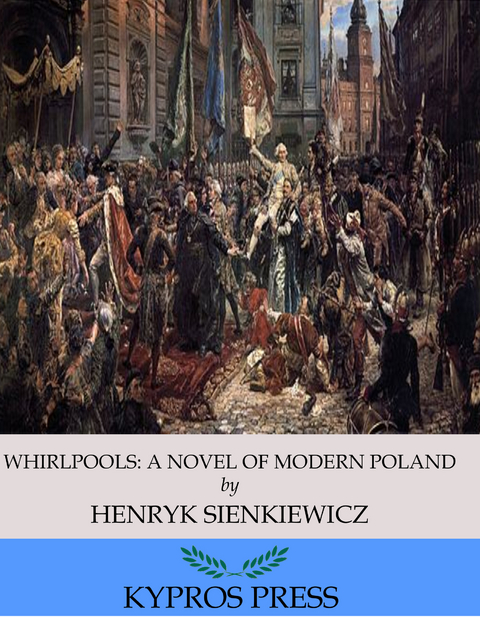
Whirlpools: A Novel of Modern Poland (eBook)
484 Seiten
Charles River Editors (Verlag)
978-1-5183-6880-6 (ISBN)
Henryk Sienkiewicz was the most famous Polish author near the turn of the 20th century. Sienkiewicz won the Nobel Prize in Literature in 1905 and his historical novels are still popular today. This edition of Whirlpools: A Novel of Modern Poland includes a table of contents.
I
GRONSKI ARRIVED AT THE JASTRZEB manor-house about midnight. In the house all were asleep excepting an old servant and the young heir, Ladislaus Krzycki, who awaited his guest with supper and greeted him with great cordiality, for notwithstanding the disparity in their ages they were bound by ties of an old intimacy. It continued from those days when Gronski, as a university student, surrounded with a tutelary friendship the youthful Krzycki, who was attending the gymnasium. Later they met frequently and the closer friendly relations between Gronski and the Krzycki family did not undergo any interruption.
Therefore when, after the first greetings, they repaired to the dining-room the young heir of Jastrzeb again began to embrace Gronski. After a while, having seated him at the table, he shook from his eyes the remnants of drowsiness which had oppressed him, became thoroughly animated, and said with sincere happiness:
“How immensely fortunate I am that at last we have you at Jastrzeb; and Mother, how she has been expecting you! I, whenever I am in Warsaw, always begin with you, but a year has passed since your last visit here.”
Gronski inquired about Pani Krzycki’s health and that of the younger members of the household, after which he said:
“It is, indeed, strange that I have not been out in the country, not only with you but elsewhere. In summer time they dispatch me every year to Carlsbad, and after Carlsbad one strays somewhere in the west. Besides, in Warsaw matters are now seething as in a caldron, and it is difficult to tear one’s self from all this.”
The conversation, which started with a lengthy discussion of public affairs, was afterwards turned by Ladislaus towards private matters:
“Did you,” he said, “besides the notification of the death of Uncle Zarnowski, receive a letter from Mother? I ask for this reason: I mailed first the notification, and later in the day Mother decided to write the letter.”
“I received both and for that reason I am here. I tell you candidly I would not come merely to attend your uncle’s funeral. It is true that a year ago, when he was in Warsaw for medical treatment, we dined together for several months at the same club, but that was all; though people were astonished that such a misanthrope, who avoided everybody, did not somehow run away from me. How were your relations? Were they cool to the end?”
“Rather, there were none. He would not receive anybody and did not wish to see any one, not even his parish-priest. Extreme unction was administered by the Canon of Olchowa. When he became seriously ill, we visited him in Rzeslewo, but he received us with blunt discourtesy. Mother did not mind it and repeated her visits, though at times he was disagreeable towards her. As for myself, I confess that I did not call there again until he was in a very critical state.”
“Did he leave a large estate?”
“Rzeslewo is a huge patch of that kind of soil in which you can anywhere plant at least onions. There is not one copper coin of indebtedness. At one time Uncle had a house in Warsaw, to which he removed the entire equipment from Rzeslewo, which was not, by any means, despicable. We thought that he would reside permanently in the city, but he later sold everything; from which I infer he must have left funds. Some, as is customary with people who are fond of exaggeration, say hundreds of thousands. The Lord only knows. But this much is certain: he inherited a great deal from his brothers. I do not know whether you have ever heard that there were three of them. One perished, while yet a student, in a duel at Dorpat; the other died, also young, from typhoid fever, and Uncle Adam got everything they left.”
“It is said that he lived very poorly.”
“He stayed a great deal in Warsaw and abroad for his health. How he lived there I do not know, but, after his return to Rzeslewo, very wretchedly. I think, however, that this was more due to whimsicality than to greed, for he was not greedy. You would not believe how that manor appeared; how everything was denuded and abandoned. In every room the roof was leaky, and if some unexpected guests or unknown relatives arrive for the funeral, I will have to invite them to Jastrzeb, for there I would not know where to house them.”
“Do you know of any other relatives?”
“Yes, there are Pani Otocka and her sister; also Dolhanski, who undoubtedly will come, and ourselves. I have not heard of others, though in all probability they will be found, as in Poland everybody is related. Mother insists that we are the nearest, but, to tell the truth, we are not very close; as the deceased was a distant cousin of Mother’s.”
“And Pani Otocka and Panna Marynia?”
“Better ask Mother about that; yesterday for an hour she was expounding to me as to who was born to whom; what he was to whom; whom did who’s sister marry, and what was who’s relation to the deceased. I could not grasp it all. Those ladies will be here to-morrow at one o’clock, and with them an English lady, their friend.”
“I know; they told me about that in Warsaw, not knowing that they would chance upon the funeral. But that English lady speaks Polish almost as well as we do.”
“What? How is that?”
“Her father owned a factory in which he employed many Polish workmen. The young lady, while a child, had a Polish nurse, and later some emigrant taught her Polish.”
“And that she should care for it!”
“Among the English people you will find many odd characters, and this Mr. Anney was an odd character in this respect, that he could, like Lord Dudley, select for his heraldic device: ‘Causas non fata sequor,’ because, like him, he also loved Poland, Polish history, and the Poles. The workmen were sometimes turbulent and caused him much annoyance, but this did not dishearten him. He established schools for them, procured priests, took charge of the orphans, etc.”
“That was a righteous man. But Miss Anney, is she pretty?—young?”
“About Pani Otocka’s age—a year younger or older—and they are very fond of each other. How long is it since you have seen Pani Otocka and Marynia?”
“It is six years. Pani Otocka was not yet married and Panna Marynia Zbyltowska was a girl, perhaps ten years old, in short dresses. I well remember her because even then she played the violin and was regarded as a child-wonder. My mother drew nearer to them last summer in Krynica and has become extraordinarily captivated with them. She insisted that this winter I should renew their acquaintance, but they left Warsaw for the winter. Even then she commanded me to invite them in my own name to Jastrzeb, and a few days before the death of Uncle, she wrote to them to come for a lengthy visit. Day before yesterday we received a dispatch that they will come. You are on intimate terms with them?”
“Yes, on intimate and very sincere terms,” answered Gronski.
“Because I wanted to speak with you a little about them, but the hour is late and you are after a journey. Perhaps it would be better to defer it until to-morrow.”
“I slept on the train and it is not far from the station to your place. Besides, I have the bad habit of not retiring to sleep before two o’clock.”
Ladislaus’ countenance bore slight traces of perplexity. He poured out for himself a glass of wine, drank it, and then said:
“The matter is somewhat delicate. I am certain that Mother has concocted some scheme. Perhaps she may have written to you about this and, if not, she will speak about it, because she is much concerned about your opinion, and in a certain contingency will ask your assistance. Several times she incidentally spoke about your influence with Pani Otocka. I believe that you have influence with everybody, not excluding my mother. For that reason I would like to ask a favor of you.”
Gronski glanced at the young nobleman and afterwards at the servant, as if he wanted to say: “Why is this witness here?” Ladislaus understood and said:
“He is very deaf, so we can speak quite freely. He wheezes because he has the asthma.”
Afterwards he continued:
“Mother for the past two years has been bent upon my getting married, so she bustles about, writes voluminous letters, and sends me every winter to Warsaw, and I am certain that last summer she was in Krynica not so much for her own health, which, God be praised, she preserves so well, but to look over the young ladies and make a selection. And there these cousins of mine have so bewitched her that she returned, as I surmise, with a prepared project.”
“I must give you warning,” interrupted Gronski, “that so far as Panna Marynia is concerned you are building an edifice upon ice, as in the first place she is but sixteen; and again she will, at the end of autumn, return to the conservatory in Brussels; and thirdly her whole soul is wrapped up in her violin and in all probability will always remain there.”
...| Erscheint lt. Verlag | 22.3.2018 |
|---|---|
| Übersetzer | Henryk Sienkiewicz |
| Sprache | englisch |
| Themenwelt | Literatur ► Historische Romane |
| Literatur ► Klassiker / Moderne Klassiker | |
| Schlagworte | action • Classic • Historical • Nobel prize • pan michael • Polish • Quo vadis • the deluge • with fire and sword |
| ISBN-10 | 1-5183-6880-8 / 1518368808 |
| ISBN-13 | 978-1-5183-6880-6 / 9781518368806 |
| Informationen gemäß Produktsicherheitsverordnung (GPSR) | |
| Haben Sie eine Frage zum Produkt? |
 EPUB (Adobe DRM)
Größe: 1,0 MB
Kopierschutz: Adobe-DRM
Adobe-DRM ist ein Kopierschutz, der das eBook vor Mißbrauch schützen soll. Dabei wird das eBook bereits beim Download auf Ihre persönliche Adobe-ID autorisiert. Lesen können Sie das eBook dann nur auf den Geräten, welche ebenfalls auf Ihre Adobe-ID registriert sind.
Details zum Adobe-DRM
Dateiformat: EPUB (Electronic Publication)
EPUB ist ein offener Standard für eBooks und eignet sich besonders zur Darstellung von Belletristik und Sachbüchern. Der Fließtext wird dynamisch an die Display- und Schriftgröße angepasst. Auch für mobile Lesegeräte ist EPUB daher gut geeignet.
Systemvoraussetzungen:
PC/Mac: Mit einem PC oder Mac können Sie dieses eBook lesen. Sie benötigen eine
eReader: Dieses eBook kann mit (fast) allen eBook-Readern gelesen werden. Mit dem amazon-Kindle ist es aber nicht kompatibel.
Smartphone/Tablet: Egal ob Apple oder Android, dieses eBook können Sie lesen. Sie benötigen eine
Geräteliste und zusätzliche Hinweise
Buying eBooks from abroad
For tax law reasons we can sell eBooks just within Germany and Switzerland. Regrettably we cannot fulfill eBook-orders from other countries.
EPUB (Ohne DRM)Digital Rights Management: ohne DRM
Dieses eBook enthält kein DRM oder Kopierschutz. Eine Weitergabe an Dritte ist jedoch rechtlich nicht zulässig, weil Sie beim Kauf nur die Rechte an der persönlichen Nutzung erwerben.
Dateiformat: EPUB (Electronic Publication)
EPUB ist ein offener Standard für eBooks und eignet sich besonders zur Darstellung von Belletristik und Sachbüchern. Der Fließtext wird dynamisch an die Display- und Schriftgröße angepasst. Auch für mobile Lesegeräte ist EPUB daher gut geeignet.
Systemvoraussetzungen:
PC/Mac: Mit einem PC oder Mac können Sie dieses eBook lesen. Sie benötigen dafür die kostenlose Software Adobe Digital Editions.
eReader: Dieses eBook kann mit (fast) allen eBook-Readern gelesen werden. Mit dem amazon-Kindle ist es aber nicht kompatibel.
Smartphone/Tablet: Egal ob Apple oder Android, dieses eBook können Sie lesen. Sie benötigen dafür eine kostenlose App.
Geräteliste und zusätzliche Hinweise
Buying eBooks from abroad
For tax law reasons we can sell eBooks just within Germany and Switzerland. Regrettably we cannot fulfill eBook-orders from other countries.
aus dem Bereich


