Rescue (eBook)
546 Seiten
Charles River Editors (Verlag)
978-1-5183-6474-7 (ISBN)
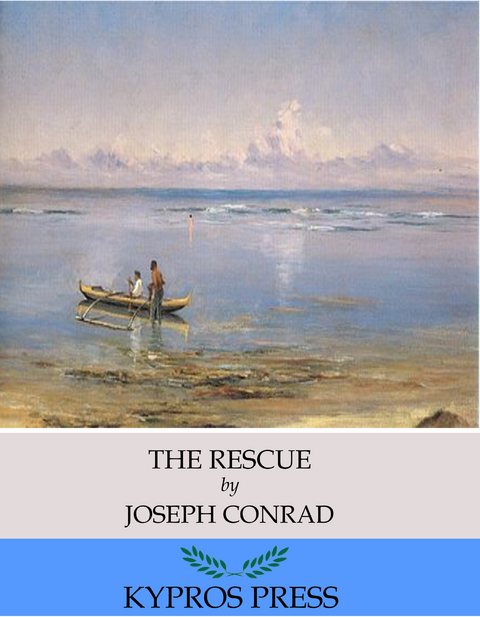
Joseph Conrad was a British author who is generally regarded as one of the greatest writers in English literature. Conrad's style influenced many of the great authors that followed him. This edition of The Rescue includes a table of contents.
CHAPTER I
OUT OF THE LEVEL BLUE of a shallow sea Carimata raises a lofty barrenness of grey and yellow tints, the drab eminence of its arid heights. Separated by a narrow strip of water, Suroeton, to the west, shows a curved and ridged outline resembling the backbone of a stooping giant. And to the eastward a troop of insignificant islets stand effaced, indistinct, with vague features that seem to melt into the gathering shadows. The night following from the eastward the retreat of the setting sun advanced slowly, swallowing the land and the sea; the land broken, tormented and abrupt; the sea smooth and inviting with its easy polish of continuous surface to wanderings facile and endless.
There was no wind, and a small brig that had lain all the afternoon a few miles to the northward and westward of Carimata had hardly altered its position half a mile during all these hours. The calm was absolute, a dead, flat calm, the stillness of a dead sea and of a dead atmosphere. As far as the eye could reach there was nothing but an impressive immobility. Nothing moved on earth, on the waters, and above them in the unbroken lustre of the sky. On the unruffled surface of the straits the brig floated tranquil and upright as if bolted solidly, keel to keel, with its own image reflected in the unframed and immense mirror of the sea. To the south and east the double islands watched silently the double ship that seemed fixed amongst them forever, a hopeless captive of the calm, a helpless prisoner of the shallow sea.
Since midday, when the light and capricious airs of these seas had abandoned the little brig to its lingering fate, her head had swung slowly to the westward and the end of her slender and polished jib-boom, projecting boldly beyond the graceful curve of the bow, pointed at the setting sun, like a spear poised high in the hand of an enemy. Right aft by the wheel the Malay quartermaster stood with his bare, brown feet firmly planted on the wheel-grating, and holding the spokes at right angles, in a solid grasp, as though the ship had been running before a gale. He stood there perfectly motionless, as if petrified but ready to tend the helm as soon as fate would permit the brig to gather way through the oily sea.
The only other human being then visible on the brig’s deck was the person in charge: a white man of low stature, thick-set, with shaven cheeks, a grizzled moustache, and a face tinted a scarlet hue by the burning suns and by the sharp salt breezes of the seas. He had thrown off his light jacket, and clad only in white trousers and a thin cotton singlet, with his stout arms crossed on his breast—upon which they showed like two thick lumps of raw flesh—he prowled about from side to side of the half-poop. On his bare feet he wore a pair of straw sandals, and his head was protected by an enormous pith hat—once white but now very dirty—which gave to the whole man the aspect of a phenomenal and animated mushroom. At times he would interrupt his uneasy shuffle athwart the break of the poop, and stand motionless with a vague gaze fixed on the image of the brig in the calm water. He could also see down there his own head and shoulders leaning out over the rail and he would stand long, as if interested by his own features, and mutter vague curses on the calm which lay upon the ship like an immovable burden, immense and burning.
At last, he sighed profoundly, nerved himself for a great effort, and making a start away from the rail managed to drag his slippers as far as the binnacle. There he stopped again, exhausted and bored. From under the lifted glass panes of the cabin skylight near by came the feeble chirp of a canary, which appeared to give him some satisfaction. He listened, smiled faintly muttered “Dicky, poor Dick—” and fell back into the immense silence of the world. His eyes closed, his head hung low over the hot brass of the binnacle top. Suddenly he stood up with a jerk and said sharply in a hoarse voice:
“You’ve been sleeping—you. Shift the helm. She has got stern way on her.”
The Malay, without the least flinch of feature or pose, as if he had been an inanimate object called suddenly into life by some hidden magic of the words, spun the wheel rapidly, letting the spokes pass through his hands; and when the motion had stopped with a grinding noise, caught hold again and held on grimly. After a while, however, he turned his head slowly over his shoulder, glanced at the sea, and said in an obstinate tone:
“No catch wind—no get way.”
“No catch—no catch—that’s all you know about it,” growled the red-faced seaman. “By and by catch Ali—” he went on with sudden condescension. “By and by catch, and then the helm will be the right way. See?”
The stolid seacannie appeared to see, and for that matter to hear, nothing. The white man looked at the impassive Malay with disgust, then glanced around the horizon—then again at the helmsman and ordered curtly:
“Shift the helm back again. Don’t you feel the air from aft? You are like a dummy standing there.”
The Malay revolved the spokes again with disdainful obedience, and the red-faced man was moving forward grunting to himself, when through the open skylight the hail “On deck there!” arrested him short, attentive, and with a sudden change to amiability in the expression of his face.
“Yes, sir,” he said, bending his ear toward the opening. “What’s the matter up there?” asked a deep voice from below.
The red-faced man in a tone of surprise said:
“Sir?”
“I hear that rudder grinding hard up and hard down. What are you up to, Shaw? Any wind?”
“Ye-es,” drawled Shaw, putting his head down the skylight and speaking into the gloom of the cabin. “I thought there was a light air, and—but it’s gone now. Not a breath anywhere under the heavens.”
He withdrew his head and waited a while by the skylight, but heard only the chirping of the indefatigable canary, a feeble twittering that seemed to ooze through the drooping red blossoms of geraniums growing in flower-pots under the glass panes. He strolled away a step or two before the voice from down below called hurriedly:
“Hey, Shaw? Are you there?”
“Yes, Captain Lingard,” he answered, stepping back. “Have we drifted anything this afternoon?”
“Not an inch, sir, not an inch. We might as well have been at anchor.”
“It’s always so,” said the invisible Lingard. His voice changed its tone as he moved in the cabin, and directly afterward burst out with a clear intonation while his head appeared above the slide of the cabin entrance:
“Always so! The currents don’t begin till it’s dark, when a man can’t see against what confounded thing he is being drifted, and then the breeze will come. Dead on end, too, I don’t doubt.”
Shaw moved his shoulders slightly. The Malay at the wheel, after making a dive to see the time by the cabin clock through the skylight, rang a double stroke on the small bell aft. Directly forward, on the main deck, a shrill whistle arose long drawn, modulated, dying away softly. The master of the brig stepped out of the companion upon the deck of his vessel, glanced aloft at the yards laid dead square; then, from the door-step, took a long, lingering look round the horizon.
He was about thirty-five, erect and supple. He moved freely, more like a man accustomed to stride over plains and hills, than like one who from his earliest youth had been used to counteract by sudden swayings of his body the rise and roll of cramped decks of small craft, tossed by the caprice of angry or playful seas.
He wore a grey flannel shirt, and his white trousers were held by a blue silk scarf wound tightly round his narrow waist. He had come up only for a moment, but finding the poop shaded by the main-topsail he remained on deck bareheaded. The light chestnut hair curled close about his well-shaped head, and the clipped beard glinted vividly when he passed across a narrow strip of sunlight, as if every hair in it had been a wavy and attenuated gold wire. His mouth was lost in the heavy moustache; his nose was straight, short, slightly blunted at the end; a broad band of deeper red stretched under the eyes, clung to the cheek bones. The eyes gave the face its remarkable expression. The eyebrows, darker than the hair, pencilled a straight line below the wide and unwrinkled brow much whiter than the sunburnt face. The eyes, as if glowing with the light of a hidden fire, had a red glint in their greyness that gave a scrutinizing ardour to the steadiness of their gaze.
That man, once so well known, and now so completely forgotten amongst the charming and heartless shores of the shallow sea, had amongst his fellows the nickname of “Red-Eyed Tom.” He was proud of his luck but not of his good sense. He was proud of his brig, of the speed of his craft, which was reckoned the swiftest country vessel in those seas, and proud of what she represented.
She represented a run of luck on the Victorian goldfields; his sagacious moderation; long days of planning, of loving care in building; the great joy of his youth, the incomparable freedom of the seas; a perfect because a wandering home; his independence, his love—and his...
| Erscheint lt. Verlag | 22.3.2018 |
|---|---|
| Sprache | englisch |
| Themenwelt | Literatur ► Anthologien |
| Literatur ► Klassiker / Moderne Klassiker | |
| Literatur ► Romane / Erzählungen | |
| Schlagworte | British • Classic • Heart of Darkness • Historical • Lord Jim • Polish • Realism • sea tales • secret agent |
| ISBN-10 | 1-5183-6474-8 / 1518364748 |
| ISBN-13 | 978-1-5183-6474-7 / 9781518364747 |
| Informationen gemäß Produktsicherheitsverordnung (GPSR) | |
| Haben Sie eine Frage zum Produkt? |
 EPUB (Adobe DRM)
Größe: 861 KB
Kopierschutz: Adobe-DRM
Adobe-DRM ist ein Kopierschutz, der das eBook vor Mißbrauch schützen soll. Dabei wird das eBook bereits beim Download auf Ihre persönliche Adobe-ID autorisiert. Lesen können Sie das eBook dann nur auf den Geräten, welche ebenfalls auf Ihre Adobe-ID registriert sind.
Details zum Adobe-DRM
Dateiformat: EPUB (Electronic Publication)
EPUB ist ein offener Standard für eBooks und eignet sich besonders zur Darstellung von Belletristik und Sachbüchern. Der Fließtext wird dynamisch an die Display- und Schriftgröße angepasst. Auch für mobile Lesegeräte ist EPUB daher gut geeignet.
Systemvoraussetzungen:
PC/Mac: Mit einem PC oder Mac können Sie dieses eBook lesen. Sie benötigen eine
eReader: Dieses eBook kann mit (fast) allen eBook-Readern gelesen werden. Mit dem amazon-Kindle ist es aber nicht kompatibel.
Smartphone/Tablet: Egal ob Apple oder Android, dieses eBook können Sie lesen. Sie benötigen eine
Geräteliste und zusätzliche Hinweise
Buying eBooks from abroad
For tax law reasons we can sell eBooks just within Germany and Switzerland. Regrettably we cannot fulfill eBook-orders from other countries.
EPUB (Ohne DRM)Digital Rights Management: ohne DRM
Dieses eBook enthält kein DRM oder Kopierschutz. Eine Weitergabe an Dritte ist jedoch rechtlich nicht zulässig, weil Sie beim Kauf nur die Rechte an der persönlichen Nutzung erwerben.
Dateiformat: EPUB (Electronic Publication)
EPUB ist ein offener Standard für eBooks und eignet sich besonders zur Darstellung von Belletristik und Sachbüchern. Der Fließtext wird dynamisch an die Display- und Schriftgröße angepasst. Auch für mobile Lesegeräte ist EPUB daher gut geeignet.
Systemvoraussetzungen:
PC/Mac: Mit einem PC oder Mac können Sie dieses eBook lesen. Sie benötigen dafür die kostenlose Software Adobe Digital Editions.
eReader: Dieses eBook kann mit (fast) allen eBook-Readern gelesen werden. Mit dem amazon-Kindle ist es aber nicht kompatibel.
Smartphone/Tablet: Egal ob Apple oder Android, dieses eBook können Sie lesen. Sie benötigen dafür eine kostenlose App.
Geräteliste und zusätzliche Hinweise
Buying eBooks from abroad
For tax law reasons we can sell eBooks just within Germany and Switzerland. Regrettably we cannot fulfill eBook-orders from other countries.
aus dem Bereich