Uncle's Dream and the Permanent Husband (eBook)
421 Seiten
Seltzer Books (Verlag)
978-1-4554-2897-7 (ISBN)
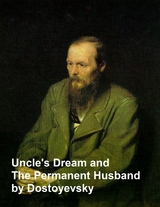
Two classic novellas. According to Wikipedia: 'Fyodor Mikhailovich Dostoyevsky (11 November 1821 - 9 February 1881)was a Russian writer of novels, short stories and essays. Dostoyevsky's literary works explore human psychology in the troubled political, social and spiritual context of 19th-century Russian society. A Slavophile, nationalist and monarchist, he criticised the bourgeois, pre-materialist West and nihilism in many of his works. Although Dostoyevsky wrote books in the mid-1850s which were influenced by realist and romanticist writers, most notably by Dickens, Gogol and Balzac, his best remembered work was done in his last years, including such masterpieces as Crime and Punishment, The Idiot and The Brothers Karamazov. Dostoyevsky overall wrote 11 complete novels, three novellas, seventeen short novels and three essays.'
Two classic novellas. According to Wikipedia: "e;Fyodor Mikhailovich Dostoyevsky (11 November 1821 - 9 February 1881) was a Russian writer of novels, short stories and essays. Dostoyevsky's literary works explore human psychology in the troubled political, social and spiritual context of 19th-century Russian society. A Slavophile, nationalist and monarchist, he criticised the bourgeois, pre-materialist West and nihilism in many of his works. Although Dostoyevsky wrote books in the mid-1850s which were influenced by realist and romanticist writers, most notably by Dickens, Gogol and Balzac, his best remembered work was done in his last years, including such masterpieces as Crime and Punishment, The Idiot and The Brothers Karamazov. Dostoyevsky overall wrote 11 complete novels, three novellas, seventeen short novels and three essays."e;
CHAPTER XI.
Mosgliakoff went out from Maria Alexandrovna’s house to all appearances quite pacified. She had fired his ardour completely. His imagination was kindled.
He did not go to his godfather’s, for he felt the need of solitude. A terrific rush of heroic and romantic thoughts surged over him, and gave him no rest.
He pictured to himself the solemn explanation he should have with Zina, then the generous throbs of his all-forgiving heart; his pallor and despair at the future ball in St. Petersburg; then Spain, the Guadalquiver, and love, and the old dying prince joining their hands with his last blessing. Then came thoughts of his beautiful wife, devoted to himself, and never ceasing to wonder at and admire her husband’s heroism and exalted refinement of taste and conduct. Then, among other things, the attention which he should attract among the ladies of the highest circles, into which he would of course enter, thanks to his marriage with Zina—widow of the Prince K.: then the inevitable appointments, first as a vice-governor, with the delightful accompaniment of salary: in a word, all, all that Maria Alexandrovna’s eloquence had pictured to his imagination, now marched in triumphant procession through his brain, soothing and attracting and flattering his self-love.
And yet—(I really cannot explain this phenomenon, however!)—and yet, no sooner did the first flush of this delightful sunrise of future delights pass off and fade away, than the annoying thought struck him: this is all very well, but it is in the future: and now, to-day, I shall look a dreadful fool. As he reflected thus, he looked up and found that he had wandered a long way, to some of the dirty back slums of the town. A wet snow was falling; now and again he met another belated pedestrian like himself. The outer circumstances began to anger Mosgliakoff, which was a bad sign; for when things are going well with us we are always inclined to see everything in a rose-coloured light.
Paul could not help remembering that up to now he had been in the habit of cutting a dash at Mordasoff. He had enjoyed being treated at all the houses he went to in the town, as Zina’s accepted lover, and to be congratulated, as he often was, upon the honour of that distinction. He was proud of being her future husband; and here he was now with notice to quit. He would be laughed at. He couldn’t tell everybody about the future scene in the ball-room at St. Petersburg, and the Guadalquiver, and all that! And then a thought came out into prominence, which had been uncomfortably fidgeting about in his brain for some time: “Was it all true? Would it really come about as Maria Alexandrovna had predicted?”
Here it struck him that Maria Alexandrovna was an amazingly cunning woman; that, however worthy she might be of universal esteem, still she was a known scandal-monger, and lied from morning to night! that, again, she probably had some good reason for wishing him out of the place to-night. He next bethought him of Zina, and of her parting look at him, which was very far from being expressive of passionate love; he remembered also, that, less than an hour ago she had called him a fool.
As he thought of the last fact Paul stopped in his tracks, as though shot; blushed, and almost cried for very shame! At this very moment he was unfortunate enough to lose his footing on the slippery pavement, and to go head-first into a snow-heap. As he stood shaking himself dry, a whole troop of dogs, which had long trotted barking at his heels, flew at him. One of them, a wretched little half-starved beast, went so far as to fix her teeth into his fur coat and hang therefrom. Swearing and striking out, Paul cleared his way out of the yelping pack at last, in a fury, and with rent clothes; and making his way as fast as he could to the corner of the street, discovered that he hadn’t the slightest idea where he was. He walked up lanes, and down streets, and round corners, and lost himself more and more hopelessly; also his temper. “The devil take all these confounded exalted ideas!” he growled, half aloud; “and the archfiend take every one of you, you and your Guadalquivers and humbug!”
Mosgliakoff was not in a pretty humour at this moment.
At last, tired and horribly angry, after two hours of walking, he reached the door of Maria Alexandrovna’s house.
Observing a host of carriages standing outside, he paused to consider.
“Surely she has not a party to-night!” he thought, “and if she has, why has she a party?”
He inquired of the servants, and found out that Maria Alexandrovna had been out of town, and had fetched up Afanassy Matveyevitch, gorgeous in his dress-suit and white tie. He learned, further, that the prince was awake, but had not as yet made his appearance in the “salon.”
On receiving this information, Paul Mosgliakoff said not a word, but quietly made his way upstairs to his uncle’s room.
He was in that frame of mind in which a man determines to commit some desperate act, out of revenge, aware at the time, and wide awake to the fact that he is about to do the deed, but forgetting entirely that he may very likely regret it all his life afterwards!
Entering the prince’s room, he found that worthy seated before the glass, with a perfectly bare head, but with whiskers and napoleon stuck on. His wig was in the hands of his old and grey valet, his favourite Ivan Pochomitch, and the latter was gravely and thoughtfully combing it out.
As for the prince, he was indeed a pitiable object! He was not half awake yet, for one thing; he sat as though he were still dazed with sleep; he kept opening and shutting his mouth, and stared at Mosgliakoff as though he did not know him!
“Well, how are you, uncle?” asked Mosgliakoff.
“What, it’s you, is it!” said the prince. “Ye—yes; I’ve been as—leep a little while! Oh, heavens!” he cried suddenly, with great animation, “why, I’ve got no wi—ig on!”
“Oh, never mind that, uncle; I’ll help you on with it, if you like!”
“Dear me; now you’ve found out my se—ecret! I told him to shut the door. Now, my friend, you must give me your word in—stantly, that you’ll never breathe a hint of this to anyone—I mean about my hair being ar—tificial!”
“Oh, uncle! As if I could be guilty of such meanness?” cried Paul, who was anxious to please the prince, for reasons of his own.
“Ye—yes, ye—yes. Well, as I see you are a good fe—ellow, I—I’ll just as—tonish you a little: I’ll tell you all my secrets! How do you like my mous—tache, my dear boy?”
“Wonderful, uncle, wonderful! It astonishes me that you should have been able to keep it so long!”
“Sp—are your wonder, my friend, it’s ar—tificial!”
“No!! That’s difficult to believe! Well, and your whiskers, uncle! admit—you black them, now don’t you?”
“Black them? Not—only I don’t black them, but they, too, are ar—tificial!” said the Prince, regarding Mosgliakoff with a look of triumph.
“What! Artificial? No, no, uncle! I can’t believe that! You’re laughing at me!”
“Parole d’honneur, mon ami!” cried the delighted old man; “and fancy, all—everybody is taken in by them just as you were! Even Stepanida Matveyevna cannot believe they are not real, sometimes, although she often sticks them on herself! But, I am sure, my dear friend, you will keep my se—cret. Give me your word!”
“I do give you my word, uncle! But surely you do not suppose I would be so mean as to divulge it?”
“Oh, my boy! I had such a fall to-day, without you. The coachman upset me out of the carriage again!”
“How? When?”
“Why, we were driving to the mo—nastery, when?——”
“I know, uncle: that was early this morning!”
“No, no! A couple of hours ago, not more! I was driving along with him, and he suddenly took and up—set me!”
“Why, my dear uncle, you were asleep,” began Paul, in amazement!
“Ye—yes, ye—yes. I did have a sleep; and then I drove away, at least I—at least I—dear me, how strange it all seems!”
“I assure you, uncle, you have been dreaming! You saw all this in a dream! You have been sleeping quietly here since just after dinner!”
“No!” And the prince reflected. “Ye—yes. Perhaps I did see it all in a dream! However, I can remember all I saw quite well. First, I saw a large bull with horns; and then I saw a pro—curor, and I think he had huge horns too. Then there was Napoleon Buonaparte. Did you ever hear, my boy, that people say I am so like Napoleon Buonaparte? But my profile is very like some old pope. What do you think about it, my...
| Erscheint lt. Verlag | 1.3.2018 |
|---|---|
| Sprache | englisch |
| Themenwelt | Literatur ► Anthologien |
| Literatur ► Klassiker / Moderne Klassiker | |
| Literatur ► Romane / Erzählungen | |
| ISBN-10 | 1-4554-2897-3 / 1455428973 |
| ISBN-13 | 978-1-4554-2897-7 / 9781455428977 |
| Informationen gemäß Produktsicherheitsverordnung (GPSR) | |
| Haben Sie eine Frage zum Produkt? |
 EPUB (Adobe DRM)
Größe: 842 KB
Kopierschutz: Adobe-DRM
Adobe-DRM ist ein Kopierschutz, der das eBook vor Mißbrauch schützen soll. Dabei wird das eBook bereits beim Download auf Ihre persönliche Adobe-ID autorisiert. Lesen können Sie das eBook dann nur auf den Geräten, welche ebenfalls auf Ihre Adobe-ID registriert sind.
Details zum Adobe-DRM
Dateiformat: EPUB (Electronic Publication)
EPUB ist ein offener Standard für eBooks und eignet sich besonders zur Darstellung von Belletristik und Sachbüchern. Der Fließtext wird dynamisch an die Display- und Schriftgröße angepasst. Auch für mobile Lesegeräte ist EPUB daher gut geeignet.
Systemvoraussetzungen:
PC/Mac: Mit einem PC oder Mac können Sie dieses eBook lesen. Sie benötigen eine
eReader: Dieses eBook kann mit (fast) allen eBook-Readern gelesen werden. Mit dem amazon-Kindle ist es aber nicht kompatibel.
Smartphone/Tablet: Egal ob Apple oder Android, dieses eBook können Sie lesen. Sie benötigen eine
Geräteliste und zusätzliche Hinweise
Buying eBooks from abroad
For tax law reasons we can sell eBooks just within Germany and Switzerland. Regrettably we cannot fulfill eBook-orders from other countries.
EPUB (Ohne DRM)Digital Rights Management: ohne DRM
Dieses eBook enthält kein DRM oder Kopierschutz. Eine Weitergabe an Dritte ist jedoch rechtlich nicht zulässig, weil Sie beim Kauf nur die Rechte an der persönlichen Nutzung erwerben.
Dateiformat: EPUB (Electronic Publication)
EPUB ist ein offener Standard für eBooks und eignet sich besonders zur Darstellung von Belletristik und Sachbüchern. Der Fließtext wird dynamisch an die Display- und Schriftgröße angepasst. Auch für mobile Lesegeräte ist EPUB daher gut geeignet.
Systemvoraussetzungen:
PC/Mac: Mit einem PC oder Mac können Sie dieses eBook lesen. Sie benötigen dafür die kostenlose Software Adobe Digital Editions.
eReader: Dieses eBook kann mit (fast) allen eBook-Readern gelesen werden. Mit dem amazon-Kindle ist es aber nicht kompatibel.
Smartphone/Tablet: Egal ob Apple oder Android, dieses eBook können Sie lesen. Sie benötigen dafür eine kostenlose App.
Geräteliste und zusätzliche Hinweise
Buying eBooks from abroad
For tax law reasons we can sell eBooks just within Germany and Switzerland. Regrettably we cannot fulfill eBook-orders from other countries.
aus dem Bereich