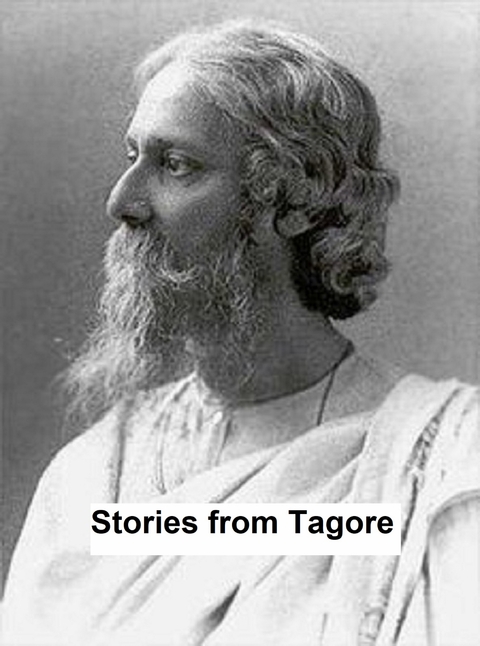
Stories from Tagore (eBook)
230 Seiten
Seltzer Books (Verlag)
978-1-4554-2871-7 (ISBN)
Classic novel.According to Wikipedia: 'Rabindranath Tagore (May 1861 - 7 August 1941)was a Bengali polymath who reshaped his region's literature and music. Author of Gitanjali and its 'profoundly sensitive, fresh and beautiful verse', he became the first non-European to win the Nobel Prize in Literature in 1913. In translation his poetry was viewed as spiritual and mercurial; his seemingly mesmeric personality, flowing hair, and other-worldly dress earned him a prophet-like reputation in the West. His 'elegant prose and magical poetry' remain largely unknown outside Bengal.'
Classic novel. According to Wikipedia: "e;Rabindranath Tagore (May 1861 - 7 August 1941)was a Bengali polymath who reshaped his region's literature and music. Author of Gitanjali and its "e;profoundly sensitive, fresh and beautiful verse"e;, he became the first non-European to win the Nobel Prize in Literature in 1913. In translation his poetry was viewed as spiritual and mercurial; his seemingly mesmeric personality, flowing hair, and other-worldly dress earned him a prophet-like reputation in the West. His "e;elegant prose and magical poetry"e; remain largely unknown outside Bengal."e;
IX. THE SON OF RASHMANI
I
Kalipada's mother was Rashmani, but she had to do the duty of the father as well, because when both of the parents are "mother" then it is bad for the child. Bhavani, her husband, was wholly incapable of keeping his children under discipline. To know why he was bent on spoiling his son, you must hear something of the former history of the family.
Bhavani was born in the famous house of Saniari. His father, Abhaya Charan, had a son, Shyama Charan, by his first wife. When he married again after her death he had himself passed the marriageable age, and his new father-in-law took advantage of the weakness of his position to have a special portion of his estate settled on his daughter. In this way he was satisfied that proper provision had been made, if his daughter should become a widow early in life. She would be independent of the charity of Shyama Charan.
The first part of his anticipation came true. For very soon after the birth of a son, whom she called Bhavani, Abhaya Charan died. It gave the father-in-law great peace and consolation, as he looked forward to his own death, to know that his daughter was properly looked after.
Shyama Charan was quite grown up. In fact his own eldest boy was a year older than Bhavani. He brought up the latter with his own son. In doing this he never took a farthing from the property allotted to his step-mother, and every year he got a receipt from her after submitting detailed accounts. His honesty in this affair surprised the neighbourhood. In fact they thought that such honesty was another name for foolishness. They did not like the idea of a division being made in the undivided ancestral property. If Shyama Charan in some underhand manner had been able to annul the dowry, his neighbours would have admired his sagacity; and there were good advisers ready to hand who could have rendered him material aid in the attainment of such an object. But Shyama Charan, in spite of the risk of crippling his patrimony, strictly set aside the dowry which came to the share of his step-mother; and the widow, Vraja Sundari, being naturally affectionate and trustful, had every confidence in Shyama Charan whom she trusted as her own son. More than once she had chided him for being so particular about her portion of the property. She would tell him that, as she was not going to take her property with her when she died, and as it would in any case revert to the family, it was not necessary to be so very strict about rendering accounts. But he never listened to her.
Shyama Charan was a severe disciplinarian by habit and his children were perfectly aware of the fact. But Bhavani had every possible freedom, and this gave rise to the impression that he was more partial to his step-brother than to his own sons. But Bhavani's education was sadly neglected and he completely relied on Shyama Charan for the management of his share of the property. He merely had to sign documents occasionally without ever spending a thought on their contents. On the other hand, Tarapada, the eldest son of Shyama Charan, was quite an expert in the management of the estate, having to act as an assistant to his father.
After the death of Shyama Charan, Tarapada said to Bhavani, "Uncle, we must not live together as we have done for so long, because some trifling misunderstanding may come at any moment and cause utter disruption."
Bhavani never imagined, even in his dream, that a day might come when he would have to manage his own affairs. The world in which he had been born and bred ever appeared to him complete and entire in itself. It was an incomprehensible calamity to him that there could be a dividing line somewhere and that this world of his could be split into two. When he found that Tarapada was immovable and indifferent to the grief and dishonour that such a step would bring to the family, he began to rack his brain to find out how the property could be divided with the least possible strain.
Tarapada showed surprise at his uncle's anxiety and said that there was no need to trouble about this, because the division had already been made in the life-time of his grandfather. Bhavani said in amazement, "But I know nothing of this!" Tarapada said in answer, "Then you must be the only one in the whole neighbourhood who does not. For, lest there should be ruinous litigation after he had gone, my grandfather had already given a portion of the property to your mother." Bhavani thought this not unlikely and asked, "What about the house?" Tarapada said, "If you wish, you can keep this house to yourself and we shall be contented with the other house in the district town."
As Bhavani had never been to this town-house, he had neither knowledge of it, nor affection for it. He was astounded at the magnanimity of Tarapada for so easily relinquishing his right to the house in the village where they had been brought up. But when Bhavani told everything to his mother, she struck her forehead with her hand and said: "This is preposterous! What I got from my husband was my own dowry and its income is very small. I do not see why you should be deprived of your share in your father's property."
Bhavani said, "Tarapada is quite positive that his grandfather never gave us any thing except this land."
Vraja Sundari was astonished and informed her son that her husband had made two copies of his will, one of which was still lying in her own box. The box was opened and it was found that there was only the deed of gift for the property belonging to the mother and nothing else. The copy of the will had been taken out.
The help of advisers was sought. The man who came to their rescue was Bagala, the son of their family guru. It was the profession of the father to look after the spiritual needs of the village; the material side was left to the son. The two of them had divided between themselves the other world and this. Whatever might be the result for others, they themselves had nothing to suffer from this division. Bagala said that, even if the will was missing, the shares in the ancestral property must be equal, as between the brothers.
Just at this time, a copy of a will made its appearance supporting the claims of the other side. In this document there was no mention of Bhavani and the whole property was given to the grandsons at the time when no son was born to Bhavani. With Bagala as his captain Bhavani set out on his voyage across the perilous sea of litigation. When his vessel at last reached harbour his funds were nearly exhausted and the ancestral property was in the hands of the other party. The land which was given to his mother had dwindled to such an extent, that it could barely give them shelter, or keep up the family dignity. Then Tarapada went away to the district town and they never met again.
II
Shyama Charan's treachery pierced the heart of the widow like an assassin's knife. To the end of her life, almost every day she would heave a sigh and say that God would never suffer such an injustice to be done. She was quite firm in her faith when she said to Bhavani, "I do not know your law or your law courts, but I am certain that my husband's true will and testament will someday be recovered. You will find it again."
Because Bhavani was helpless in worldly matters such assurances as these gave him great consolation. He settled down in his inactivity, certain in his own mind that his pious mother's prophecy could never remain unfulfilled. After his mother's death his faith became all the stronger, since the memory of her piety acquired greater radiance through death's mystery. He felt quite unconcerned about the stress of their poverty which became more and more formidable as the years went by. The necessities of life and the maintenance of family traditions,--these seemed to him like play acting on a temporary stage, not real things. When his former expensive clothing was outworn and he had to buy cheap materials in the shop, this amused him almost like a joke. He smiled and said to himself,--"These people do not know that this is only a passing phase of my fortune. Their surprise will be all the greater, when some day I shall celebrate the Puja Festival with unwonted magnificence."
This certainty of future prodigality was so clear to his mind's eye that present penury escaped his attention. His servant, Noto, was the principal companion with whom he had discussions about these things. They used to have animated conversations, in which sometimes his opinion differed from his master's, as to the propriety of bringing down a theatrical troupe from Calcutta for these future occasions. Noto used to get reprimands from Bhavani for his natural miserliness in these items of future expenditure.
While Bhavani's one anxiety was about the absence of an heir, who could inherit his vast possible wealth, a son was born to him. The horoscope plainly indicated that the lost property would come back to this boy.
From the time of the birth of his son, Bhavani's attitude was changed. It became cruelly difficult for him now to bear his poverty with his old amused equanimity, because he felt that he had a duty towards this new representative of the illustrious house of Saniari, who had such a glorious future before him. That the traditional extravagance could not be maintained on the occasion of the birth of his child gave him the keenest sorrow. He felt as if he were cheating his own son....
| Erscheint lt. Verlag | 1.3.2018 |
|---|---|
| Sprache | englisch |
| Themenwelt | Literatur ► Anthologien |
| Literatur ► Klassiker / Moderne Klassiker | |
| Literatur ► Romane / Erzählungen | |
| ISBN-10 | 1-4554-2871-X / 145542871X |
| ISBN-13 | 978-1-4554-2871-7 / 9781455428717 |
| Informationen gemäß Produktsicherheitsverordnung (GPSR) | |
| Haben Sie eine Frage zum Produkt? |
 EPUB (Adobe DRM)
Größe: 459 KB
Kopierschutz: Adobe-DRM
Adobe-DRM ist ein Kopierschutz, der das eBook vor Mißbrauch schützen soll. Dabei wird das eBook bereits beim Download auf Ihre persönliche Adobe-ID autorisiert. Lesen können Sie das eBook dann nur auf den Geräten, welche ebenfalls auf Ihre Adobe-ID registriert sind.
Details zum Adobe-DRM
Dateiformat: EPUB (Electronic Publication)
EPUB ist ein offener Standard für eBooks und eignet sich besonders zur Darstellung von Belletristik und Sachbüchern. Der Fließtext wird dynamisch an die Display- und Schriftgröße angepasst. Auch für mobile Lesegeräte ist EPUB daher gut geeignet.
Systemvoraussetzungen:
PC/Mac: Mit einem PC oder Mac können Sie dieses eBook lesen. Sie benötigen eine
eReader: Dieses eBook kann mit (fast) allen eBook-Readern gelesen werden. Mit dem amazon-Kindle ist es aber nicht kompatibel.
Smartphone/Tablet: Egal ob Apple oder Android, dieses eBook können Sie lesen. Sie benötigen eine
Geräteliste und zusätzliche Hinweise
Buying eBooks from abroad
For tax law reasons we can sell eBooks just within Germany and Switzerland. Regrettably we cannot fulfill eBook-orders from other countries.
EPUB (Ohne DRM)Digital Rights Management: ohne DRM
Dieses eBook enthält kein DRM oder Kopierschutz. Eine Weitergabe an Dritte ist jedoch rechtlich nicht zulässig, weil Sie beim Kauf nur die Rechte an der persönlichen Nutzung erwerben.
Dateiformat: EPUB (Electronic Publication)
EPUB ist ein offener Standard für eBooks und eignet sich besonders zur Darstellung von Belletristik und Sachbüchern. Der Fließtext wird dynamisch an die Display- und Schriftgröße angepasst. Auch für mobile Lesegeräte ist EPUB daher gut geeignet.
Systemvoraussetzungen:
PC/Mac: Mit einem PC oder Mac können Sie dieses eBook lesen. Sie benötigen dafür die kostenlose Software Adobe Digital Editions.
eReader: Dieses eBook kann mit (fast) allen eBook-Readern gelesen werden. Mit dem amazon-Kindle ist es aber nicht kompatibel.
Smartphone/Tablet: Egal ob Apple oder Android, dieses eBook können Sie lesen. Sie benötigen dafür eine kostenlose App.
Geräteliste und zusätzliche Hinweise
Buying eBooks from abroad
For tax law reasons we can sell eBooks just within Germany and Switzerland. Regrettably we cannot fulfill eBook-orders from other countries.
aus dem Bereich