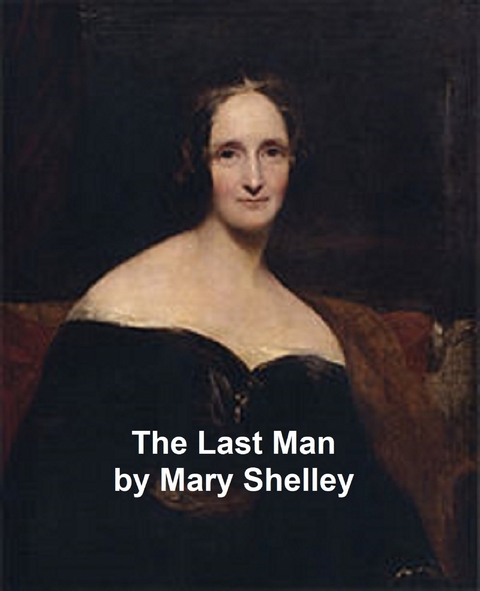
Last Man (eBook)
635 Seiten
Seltzer Books (Verlag)
978-1-4553-3240-3 (ISBN)
According to Wikipedia: 'The Last Man is an apocalyptic science fiction novel by Mary Shelley, which was first published in 1826. The book tells of a future world that has been ravaged by a plague. The novel was harshly reviewed at the time, and was virtually unknown until a scholarly revival beginning in the 1960s. It is notable in part for its semi-biographical portraits of Romantic figures in Shelley's circle, particularly Shelley's late husband Percy Bysshe Shelley and Lord Byron.'
According to Wikipedia: "e;The Last Man is an apocalyptic science fiction novel by Mary Shelley, which was first published in 1826. The book tells of a future world that has been ravaged by a plague. The novel was harshly reviewed at the time, and was virtually unknown until a scholarly revival beginning in the 1960s. It is notable in part for its semi-biographical portraits of Romantic figures in Shelley's circle, particularly Shelley's late husband Percy Bysshe Shelley and Lord Byron."e;
CHAPTER VII.
HAVING seen our friend properly installed in his new office, we turned our eyes towards Windsor. The nearness of this place to London was such, as to take away the idea of painful separation, when we quitted Raymond and Perdita. We took leave of them in the Protectoral Palace. It was pretty enough to see my sister enter as it were into the spirit of the drama, and endeavour to fill her station with becoming dignity. Her internal pride and humility of manner were now more than ever at war. Her timidity was not artificial, but arose from that fear of not being properly appreciated, that slight estimation of the neglect of the world, which also characterized Raymond. But then Perdita thought more constantly of others than he; and part of her bashfulness arose from a wish to take from those around her a sense of inferiority; a feeling which never crossed her mind. From the circumstances of her birth and education, Idris would have been better fitted for the formulae of ceremony; but the very ease which accompanied such actions with her, arising from habit, rendered them tedious; while, with every drawback, Perdita evidently enjoyed her situation. She was too full of new ideas to feel much pain when we departed; she took an affectionate leave of us, and promised to visit us soon; but she did not regret the circumstances that caused our separation. The spirits of Raymond were unbounded; he did not know what to do with his new got power; his head was full of plans; he had as yet decided on none-- but he promised himself, his friends, and the world, that the aera of his Protectorship should be signalized by some act of surpassing glory. Thus, we talked of them, and moralized, as with diminished numbers we returned to Windsor Castle. We felt extreme delight at our escape from political turmoil, and sought our solitude with redoubled zest. We did not want for occupation; but my eager disposition was now turned to the field of intellectual exertion only; and hard study I found to be an excellent medicine to allay a fever of spirit with which in indolence, I should doubtless have been assailed. Perdita had permitted us to take Clara back with us to Windsor; and she and my two lovely infants were perpetual sources of interest and amusement.
The only circumstance that disturbed our peace, was the health of Adrian. It evidently declined, without any symptom which could lead us to suspect his disease, unless indeed his brightened eyes, animated look, and flustering cheeks, made us dread consumption; but he was without pain or fear. He betook himself to books with ardour, and reposed from study in the society he best loved, that of his sister and myself. Sometimes he went up to London to visit Raymond, and watch the progress of events. Clara often accompanied him in these excursions; partly that she might see her parents, partly because Adrian delighted in the prattle, and intelligent looks of this lovely child.
Meanwhile all went on well in London. The new elections were finished; parliament met, and Raymond was occupied in a thousand beneficial schemes. Canals, aqueducts, bridges, stately buildings, and various edifices for public utility, were entered upon; he was continually surrounded by projectors and projects, which were to render England one scene of fertility and magnificence; the state of poverty was to be abolished; men were to be transported from place to place almost with the same facility as the Princes Houssain, Ali, and Ahmed, in the Arabian Nights. The physical state of man would soon not yield to the beatitude of angels; disease was to be banished; labour lightened of its heaviest burden. Nor did this seem extravagant. The arts of life, and the discoveries of science had augmented in a ratio which left all calculation behind; food sprung up, so to say, spontaneously--machines existed to supply with facility every want of the population. An evil direction still survived; and men were not happy, not because they could not, but because they would not rouse themselves to vanquish self-raised obstacles. Raymond was to inspire them with his beneficial will, and the mechanism of society, once systematised according to faultless rules, would never again swerve into disorder. For these hopes he abandoned his long-cherished ambition of being enregistered in the annals of nations as a successful warrior; laying aside his sword, peace and its enduring glories became his aim--the title he coveted was that of the benefactor of his country.
Among other works of art in which he was engaged, he had projected the erection of a national gallery for statues and pictures. He possessed many himself, which he designed to present to the Republic; and, as the edifice was to be the great ornament of his Protectorship, he was very fastidious in his choice of the plan on which it would be built. Hundreds were brought to him and rejected. He sent even to Italy and Greece for drawings; but, as the design was to be characterized by originality as well as by perfect beauty, his endeavours were for a time without avail. At length a drawing came, with an address where communications might be sent, and no artist's name affixed. The design was new and elegant, but faulty; so faulty, that although drawn with the hand and eye of taste, it was evidently the work of one who was not an architect. Raymond contemplated it with delight; the more he gazed, the more pleased he was; and yet the errors multiplied under inspection. He wrote to the address given, desiring to see the draughtsman, that such alterations might be made, as should be suggested in a consultation between him and the original conceiver.
A Greek came. A middle-aged man, with some intelligence of manner, but with so common-place a physiognomy, that Raymond could scarcely believe that he was the designer. He acknowledged that he was not an architect; but the idea of the building had struck him, though he had sent it without the smallest hope of its being accepted. He was a man of few words. Raymond questioned him; but his reserved answers soon made him turn from the man to the drawing. He pointed out the errors, and the alterations that he wished to be made; he offered the Greek a pencil that he might correct the sketch on the spot; this was refused by his visitor, who said that he perfectly understood, and would work at it at home. At length Raymond suffered him to depart.
The next day he returned. The design had been re-drawn; but many defects still remained, and several of the instructions given had been misunderstood. "Come," said Raymond, "I yielded to you yesterday, now comply with my request--take the pencil."
The Greek took it, but he handled it in no artist-like way; at length he said: "I must confess to you, my Lord, that I did not make this drawing. It is impossible for you to see the real designer; your instructions must pass through me. Condescend therefore to have patience with my ignorance, and to explain your wishes to me; in time I am certain that you will be satisfied."
Raymond questioned vainly; the mysterious Greek would say no more. Would an architect be permitted to see the artist? This also was refused. Raymond repeated his instructions, and the visitor retired. Our friend resolved however not to be foiled in his wish. He suspected, that unaccustomed poverty was the cause of the mystery, and that the artist was unwilling to be seen in the garb and abode of want. Raymond was only the more excited by this consideration to discover him; impelled by the interest he took in obscure talent, he therefore ordered a person skilled in such matters, to follow the Greek the next time he came, and observe the house in which he should enter. His emissary obeyed, and brought the desired intelligence. He had traced the man to one of the most penurious streets in the metropolis. Raymond did not wonder, that, thus situated, the artist had shrunk from notice, but he did not for this alter his resolve.
On the same evening, he went alone to the house named to him. Poverty, dirt, and squalid misery characterized its appearance. Alas! thought Raymond, I have much to do before England becomes a Paradise. He knocked; the door was opened by a string from above--the broken, wretched staircase was immediately before him, but no person appeared; he knocked again, vainly--and then, impatient of further delay, he ascended the dark, creaking stairs. His main wish, more particularly now that he witnessed the abject dwelling of the artist, was to relieve one, possessed of talent, but depressed by want. He pictured to himself a youth, whose eyes sparkled with genius, whose person was attenuated by famine. He half feared to displease him; but he trusted that his generous kindness would be administered so delicately, as not to excite repulse. What human heart is shut to kindness? and though poverty, in its excess, might render the sufferer unapt to submit to the supposed degradation of a benefit, the zeal of the benefactor must at last relax him into thankfulness. These thoughts encouraged Raymond, as he stood at the door of the highest room of the house. After trying vainly to enter the other apartments, he perceived just within the threshold of this one, a pair of small Turkish slippers; the door was ajar, but all was silent within. It was probable that the inmate was absent, but secure that he had found the right person, our adventurous Protector was tempted to enter, to leave a purse on the table, and silently depart. In pursuance of this idea, he pushed open the door gently--but the room was inhabited.
Raymond had never visited the dwellings of want, and the scene that now presented itself struck him to the heart....
| Erscheint lt. Verlag | 1.3.2018 |
|---|---|
| Sprache | englisch |
| Themenwelt | Literatur ► Anthologien |
| Literatur ► Klassiker / Moderne Klassiker | |
| Literatur ► Romane / Erzählungen | |
| ISBN-10 | 1-4553-3240-2 / 1455332402 |
| ISBN-13 | 978-1-4553-3240-3 / 9781455332403 |
| Informationen gemäß Produktsicherheitsverordnung (GPSR) | |
| Haben Sie eine Frage zum Produkt? |
 EPUB (Adobe DRM)
Größe: 634 KB
Kopierschutz: Adobe-DRM
Adobe-DRM ist ein Kopierschutz, der das eBook vor Mißbrauch schützen soll. Dabei wird das eBook bereits beim Download auf Ihre persönliche Adobe-ID autorisiert. Lesen können Sie das eBook dann nur auf den Geräten, welche ebenfalls auf Ihre Adobe-ID registriert sind.
Details zum Adobe-DRM
Dateiformat: EPUB (Electronic Publication)
EPUB ist ein offener Standard für eBooks und eignet sich besonders zur Darstellung von Belletristik und Sachbüchern. Der Fließtext wird dynamisch an die Display- und Schriftgröße angepasst. Auch für mobile Lesegeräte ist EPUB daher gut geeignet.
Systemvoraussetzungen:
PC/Mac: Mit einem PC oder Mac können Sie dieses eBook lesen. Sie benötigen eine
eReader: Dieses eBook kann mit (fast) allen eBook-Readern gelesen werden. Mit dem amazon-Kindle ist es aber nicht kompatibel.
Smartphone/Tablet: Egal ob Apple oder Android, dieses eBook können Sie lesen. Sie benötigen eine
Geräteliste und zusätzliche Hinweise
Buying eBooks from abroad
For tax law reasons we can sell eBooks just within Germany and Switzerland. Regrettably we cannot fulfill eBook-orders from other countries.
EPUB (Ohne DRM)Digital Rights Management: ohne DRM
Dieses eBook enthält kein DRM oder Kopierschutz. Eine Weitergabe an Dritte ist jedoch rechtlich nicht zulässig, weil Sie beim Kauf nur die Rechte an der persönlichen Nutzung erwerben.
Dateiformat: EPUB (Electronic Publication)
EPUB ist ein offener Standard für eBooks und eignet sich besonders zur Darstellung von Belletristik und Sachbüchern. Der Fließtext wird dynamisch an die Display- und Schriftgröße angepasst. Auch für mobile Lesegeräte ist EPUB daher gut geeignet.
Systemvoraussetzungen:
PC/Mac: Mit einem PC oder Mac können Sie dieses eBook lesen. Sie benötigen dafür die kostenlose Software Adobe Digital Editions.
eReader: Dieses eBook kann mit (fast) allen eBook-Readern gelesen werden. Mit dem amazon-Kindle ist es aber nicht kompatibel.
Smartphone/Tablet: Egal ob Apple oder Android, dieses eBook können Sie lesen. Sie benötigen dafür eine kostenlose App.
Geräteliste und zusätzliche Hinweise
Buying eBooks from abroad
For tax law reasons we can sell eBooks just within Germany and Switzerland. Regrettably we cannot fulfill eBook-orders from other countries.
aus dem Bereich