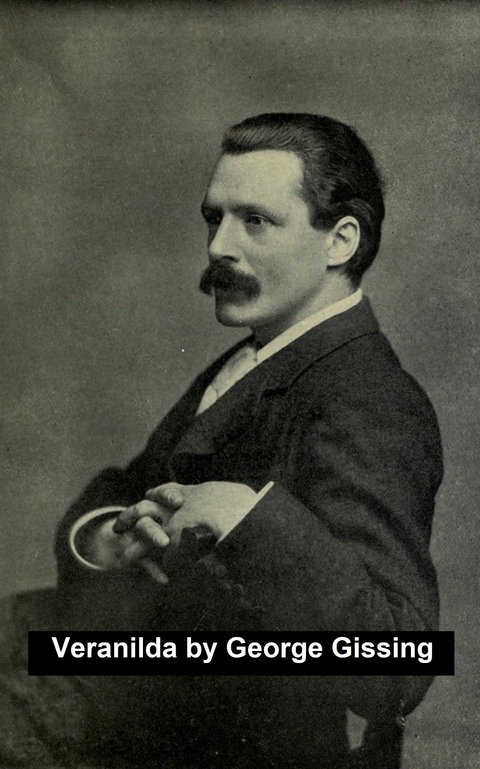
Veranilda (eBook)
578 Seiten
Seltzer Books (Verlag)
978-1-4553-5572-3 (ISBN)
Classic novel.According to Wikipedia: 'George Robert Gissing (November 22, 1857 - December 28, 1903) was an English novelist who wrote twenty-three novels between 1880 and 1903. From his early naturalistic works, he developed into one of the most accomplished realists of the late-Victorian era. ... In 1880 when his first novel, Workers in the Dawn, proved to be an abject failure, he became a private tutor to keep poverty from the door. In 1883, he separated from his wife, now an alcoholic, but gave her a weekly income on what little money he had until her death in 1888. In 1884 his second novel, The Unclassed, which saw a marked improvement in style and characterisation, met with moderate critical acclaim. After this Gissing published novels almost on a yearly basis, but so little money did they bring him, that for several more years he had to continue working as a tutor. Although notoriously exploited by his publishers, he was able to visit Italy in 1889 from the sale of the copyright of The Nether World, his most pessimistic book. Between 1891 and 1897 (his so-called middle period) Gissing produced his best works, which include New Grub Street, Born in Exile, The Odd Women, In the Year of Jubilee, and The Whirlpool. In advance of their time, they variously deal with the growing commercialism of the literary market, religious charlatanism, the situation of emancipated women in a male-dominated society, the poverty of the working classes, and marriage in a decadent world. During this period, having belatedly become aware of the financial rewards of writing short stories for the press, he produced almost seventy stories. As a result he was able to give up teaching. ... The middle years of the decade saw Gissing's reputation reach new heights: by some critics he is counted alongside George Meredith and Thomas Hardy as one of the best three novelists of his day. He also enjoyed new friendships with fellow writers such as Henry James, and H.G. Wells, and came into contact with many other up and coming writers such as Joseph Conrad and Stephen Crane. ... In 1903 Gissing published The Private Papers of Henry Ryecroft, which brought him much acclaim. This is his most autobiographical work. It is the memoir of the last happy years of a writer who had struggled much like Gissing, but thanks to a late legacy had been able to give up writing to retire to the countryside.'
Classic novel. According to Wikipedia: "e;George Robert Gissing (November 22, 1857 - December 28, 1903) was an English novelist who wrote twenty-three novels between 1880 and 1903. From his early naturalistic works, he developed into one of the most accomplished realists of the late-Victorian era. ... In 1880 when his first novel, Workers in the Dawn, proved to be an abject failure, he became a private tutor to keep poverty from the door. In 1883, he separated from his wife, now an alcoholic, but gave her a weekly income on what little money he had until her death in 1888. In 1884 his second novel, The Unclassed, which saw a marked improvement in style and characterisation, met with moderate critical acclaim. After this Gissing published novels almost on a yearly basis, but so little money did they bring him, that for several more years he had to continue working as a tutor. Although notoriously exploited by his publishers, he was able to visit Italy in 1889 from the sale of the copyright of The Nether World, his most pessimistic book. Between 1891 and 1897 (his so-called middle period) Gissing produced his best works, which include New Grub Street, Born in Exile, The Odd Women, In the Year of Jubilee, and The Whirlpool. In advance of their time, they variously deal with the growing commercialism of the literary market, religious charlatanism, the situation of emancipated women in a male-dominated society, the poverty of the working classes, and marriage in a decadent world. During this period, having belatedly become aware of the financial rewards of writing short stories for the press, he produced almost seventy stories. As a result he was able to give up teaching. ... The middle years of the decade saw Gissing's reputation reach new heights: by some critics he is counted alongside George Meredith and Thomas Hardy as one of the best three novelists of his day. He also enjoyed new friendships with fellow writers such as Henry James, and H.G. Wells, and came into contact with many other up and coming writers such as Joseph Conrad and Stephen Crane. ... In 1903 Gissing published The Private Papers of Henry Ryecroft, which brought him much acclaim. This is his most autobiographical work. It is the memoir of the last happy years of a writer who had struggled much like Gissing, but thanks to a late legacy had been able to give up writing to retire to the countryside."e;
CHAPTER XI - SEEKING
They passed beneath the walls of the amphitheatre and by Constantine's triumphal arch. Like all the innumerable fountains of the city, the Meta Sudans stood dry; around the base of the rayed colossus of Apollo, goats were browsing. Thence they went along by the Temple of Venus and Rome, its giant columns yet unshaken, its roof gleaming with gilded bronze; and so under the Arch of Titus, when, with a sharp turn to the left, they began the ascent of the Palatine.
The vast buildings which covered the Imperial hill, though discoloured by the lapse of ages and hung with ivy, had suffered little diminution of their external majesty; time had made them venerable, but had not shattered their walls. For two centuries and a half, they had stood all but desolate, and within that time had thrice been sacked by barbarians, yet something of the riches and art which made their ancient glory was still discoverable in the countless halls and chambers; statues, busts, mural paintings, triumphs of mosaic, pictured hangings, had in many parts escaped the spoiler and survived ruin; whilst everywhere appeared the magnificence of rare stones, the splendours of royal architecture, the beauty of unsurpassed carving. Though owls nested where empresses were wont to sleep, and nettles pierced where the lord of the world feasted his courtiers, this was still the Palace of those who styled themselves Ever August; each echo seemed to repeat an immortal name, and in every gallery seemed to move the shadows of a majestic presence.
Belisarius had not resided here, preferring for his abode the palace of the Pincian. His successor in the military government of Rome chose a habitation on the deserted hill, in that portion of its complex structures which had been raised by Vespasian and his sons. Thither the two visitors were now directing their steps. Having passed a gateway, where Marcian answered with a watchword the challenge of the guard, they ascended a broad flight of stairs, and stood before an entrance flanked with two great pillars of Numidian marble, toned by time to a hue of richest orange. Here stood soldiers, to whom again the password was given. Entering, they beheld a great hall, surrounded by a colonnade of the Corinthian order, whereon had been lavished exquisite carving; in niches behind the columns stood statues in basalt, thrice the size of life, representing Roman emperors, and at the far end was a tribune with a marble throne. This, once the hall of audience, at present served as a sort of antechamber; here and there loitered a little group of citizens, some of whom had been waiting since early morning for speech with the commander; in one corner, soldiers played at dice, in another a notary was writing at a table before which stood two ecclesiastics. Voices and footsteps made a faint, confused reverberation under the immense vault.
Anxiously glancing about him, Basil followed his conductor across the hall and out into a peristyle, its pavement richly tesselated, and the portico, still elaborately adorned with work in metal and in marble, giving proof of still greater magnificence in bygone time; pedestals had lost their statues, and blank spaces on the wall told of precious panelling torn off. Beyond, they came to a curtained doorway, where they were detained for some moments by the sentry; then the curtain was drawn aside, and Basil found himself in the triclinium of the Flavian palace, now used by the Greek general as his public reception room. Its size was not much less than that of the hall of audience; its decoration in the same grandiose style. Enormous pillars of granite supported the roof; statues stood, or had stood, all around; the pavement, composed of serpentine, porphyry, and Numidian marble in many hues, was a superb work of art. But Basil saw only the human figures before him. In a chair covered with furs sat a man of middle age, robust, fair-complexioned, with a keen look in his pale blue eyes and something of the wolfish about his mouth. Bessas had long ago given proof of valour, and enjoyed repute as a general, but since his holding command in Rome, his vices, chief of which was avarice, showed much more prominently than the virtues which had advanced him; he used the Imperial authority chiefly to enrich himself, in this respect, it is true, merely acting in harmony with the Emperor's representative at Ravenna, and with: the other Greek generals scattered about Italy, but exhibiting in his methods a shrewdness and an inhumanity not easily rivalled. Behind his chair stood several subordinates, and on a stool before him sat a noble recently arrived as envoy from Byzantium.
Having been previously instructed as to his behaviour in this redoubtable presence, Basil followed the example of Marcian in approaching with bent head to within a distance of three paces, then dropping to his knees, and bowing so as almost to touch the ground with his forehead. He heard a gruff voice command him to rise.
'So this is the heir of the Senator Maximus,' said Bessas, much as he might have spoken of viewing a horse that interested him. 'What is his name?'
'Basilius, my lord,' replied Marcian, with grave respect.
'And what is he doing? Why does not a limber lad like that serve the Emperor?'
'Your Magnanimity will recollect that the lord Basil had permission to attend Maximus into Campania, whence he is but now returned.'
'Can't he speak for himself?' growled Bessas, turning sharply upon Marcian. 'You have a tongue, lord Basil? Do you only use it among the wenches?'
A subdued laugh sounded behind the commander's chair. The envoy from Byzantium showed more discreet appreciation of the jest. And Basil, his head bowed, would fain have concealed a face burning with angry shame.
'I will do my best,' he replied in a steady voice, 'to answer any question your excellence may put to me.'
'Come, that's better,' said the general, with that affectation of bluff good-nature which always veiled his designs. 'I like the look of you, my good Basil; who knows but we may be friends? By the bye, was there not some special reason for your coming to see me?'
'Your excellence summoned me.'
'Yes, yes, I remember. That affair of the Gothic wench.' Bessas checked himself, glanced at the envoy, and corrected his phrase. 'The Gothic lady, I would say, who has somehow been spirited out of sight. What can you tell us of her, lord Basil? It has been whispered to me that if you cannot lead us to this beauty's hiding-place, nobody can.'
Basil answered in the only way consistent with prudence: he not only denied all knowledge of where Veranilda was to be found, but spoke as though her fate had little or no interest for him, whereas he professed himself greatly troubled by the disappearance of his cousin Aurelia. It seemed that Petronilla did not purpose delivering Veranilda to the Greeks. Perhaps she did not yet understand the import of their inquiry. That it was she who held Veranilda prisoner he had less doubt than ever, and boldly he declared his conviction. But even, whilst speaking, he thought with dread of the possibility of Veranilda's being delivered to Bessas; for who could assure him that this sinister-looking Thracian would respect the mandate received from Byzantium? On the other hand, who could say to what sufferings and perils his beloved was exposed whilst Petronilla's captive? He preferred the risks to follow upon her surrender. Did he but know where she was there would at least be a hope of rescuing her.
'By Christ!' exclaimed Bessas, when he had listened intently to all Basil's replies, 'this is a strange business. I begin to think, excellent lord Basil, that you are as much deceived in your suspicions of the lady Petronilla as she is in her suspicions of you. These two wenches--ladies, I would say--may have reasons of their own for hiding; or somebody of whom you know nothing may have carried them off. How is this Aurelia to look upon? Young and comely, I warrant.'
Basil briefly described his cousin; whereupon the listener gave a shrug.
'We will talk of it again, to-morrow or the day after. Hold yourself in readiness, lord Basil--you hear?--to come when bidden. And, hark you, bring the senator's will, that I may look it over myself. Trust me, I will see that this lady Aurelia suffers no wrong; if necessary, I will myself hold her property in trust. They tell me she is a heretic--that must be inquired into. But take no thought for the matter, my good Basil; trust me, you shall be relieved from all responsibilities. Go in peace!'
Bessas rose, impatient to have done with business. In the little hippodrome, hard by, an entertainment had been prepared for this afternoon: female equestrians were to perform perilous feats; there was to be a fight between a man and a boar; with other trifles, such as served to pass the time till dinner. In the entrance hall waited messengers from Ravenna, who for hours had urgently requested audience; but, partly because he knew that their despatches would be disagreeable, in part because he liked playing at royalty, the commander put them off till to-morrow. Even so did he postpone an inspection of a certain part of the city wall, repeatedly suggested to him by one of his subordinates. Leisure and accumulation of wealth were obscuring the man's soldierly qualities. He gave little heed to the progress of the war, and scoffed at the fear that Totila might ere long march against Rome.
Basil walked in gloomy silence. The interview had...
| Erscheint lt. Verlag | 1.3.2018 |
|---|---|
| Sprache | englisch |
| Themenwelt | Literatur ► Anthologien |
| Literatur ► Klassiker / Moderne Klassiker | |
| Literatur ► Romane / Erzählungen | |
| ISBN-10 | 1-4553-5572-0 / 1455355720 |
| ISBN-13 | 978-1-4553-5572-3 / 9781455355723 |
| Informationen gemäß Produktsicherheitsverordnung (GPSR) | |
| Haben Sie eine Frage zum Produkt? |
 EPUB (Adobe DRM)
Größe: 578 KB
Kopierschutz: Adobe-DRM
Adobe-DRM ist ein Kopierschutz, der das eBook vor Mißbrauch schützen soll. Dabei wird das eBook bereits beim Download auf Ihre persönliche Adobe-ID autorisiert. Lesen können Sie das eBook dann nur auf den Geräten, welche ebenfalls auf Ihre Adobe-ID registriert sind.
Details zum Adobe-DRM
Dateiformat: EPUB (Electronic Publication)
EPUB ist ein offener Standard für eBooks und eignet sich besonders zur Darstellung von Belletristik und Sachbüchern. Der Fließtext wird dynamisch an die Display- und Schriftgröße angepasst. Auch für mobile Lesegeräte ist EPUB daher gut geeignet.
Systemvoraussetzungen:
PC/Mac: Mit einem PC oder Mac können Sie dieses eBook lesen. Sie benötigen eine
eReader: Dieses eBook kann mit (fast) allen eBook-Readern gelesen werden. Mit dem amazon-Kindle ist es aber nicht kompatibel.
Smartphone/Tablet: Egal ob Apple oder Android, dieses eBook können Sie lesen. Sie benötigen eine
Geräteliste und zusätzliche Hinweise
Buying eBooks from abroad
For tax law reasons we can sell eBooks just within Germany and Switzerland. Regrettably we cannot fulfill eBook-orders from other countries.
EPUB (Ohne DRM)Digital Rights Management: ohne DRM
Dieses eBook enthält kein DRM oder Kopierschutz. Eine Weitergabe an Dritte ist jedoch rechtlich nicht zulässig, weil Sie beim Kauf nur die Rechte an der persönlichen Nutzung erwerben.
Dateiformat: EPUB (Electronic Publication)
EPUB ist ein offener Standard für eBooks und eignet sich besonders zur Darstellung von Belletristik und Sachbüchern. Der Fließtext wird dynamisch an die Display- und Schriftgröße angepasst. Auch für mobile Lesegeräte ist EPUB daher gut geeignet.
Systemvoraussetzungen:
PC/Mac: Mit einem PC oder Mac können Sie dieses eBook lesen. Sie benötigen dafür die kostenlose Software Adobe Digital Editions.
eReader: Dieses eBook kann mit (fast) allen eBook-Readern gelesen werden. Mit dem amazon-Kindle ist es aber nicht kompatibel.
Smartphone/Tablet: Egal ob Apple oder Android, dieses eBook können Sie lesen. Sie benötigen dafür eine kostenlose App.
Geräteliste und zusätzliche Hinweise
Buying eBooks from abroad
For tax law reasons we can sell eBooks just within Germany and Switzerland. Regrettably we cannot fulfill eBook-orders from other countries.
aus dem Bereich