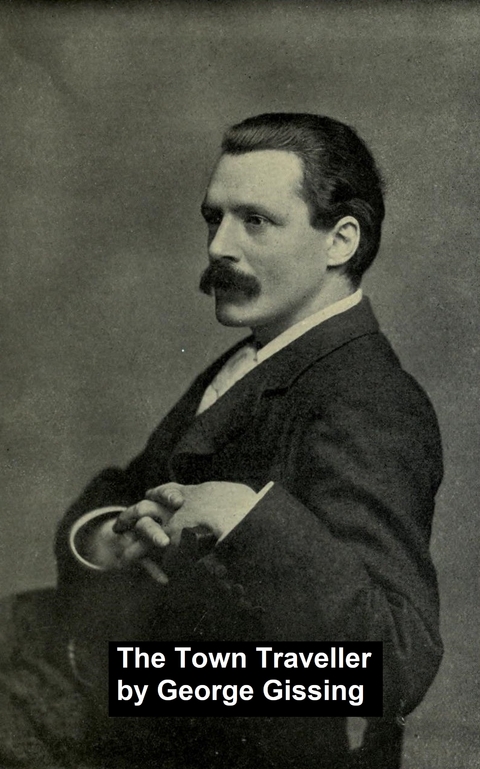
Town Traveller (eBook)
474 Seiten
Seltzer Books (Verlag)
978-1-4553-5570-9 (ISBN)
Classic novel.According to Wikipedia: 'George Robert Gissing (November 22, 1857 - December 28, 1903) was an English novelist who wrote twenty-three novels between 1880 and 1903. From his early naturalistic works, he developed into one of the most accomplished realists of the late-Victorian era. ... In 1880 when his first novel, Workers in the Dawn, proved to be an abject failure, he became a private tutor to keep poverty from the door. In 1883, he separated from his wife, now an alcoholic, but gave her a weekly income on what little money he had until her death in 1888. In 1884 his second novel, The Unclassed, which saw a marked improvement in style and characterisation, met with moderate critical acclaim. After this Gissing published novels almost on a yearly basis, but so little money did they bring him, that for several more years he had to continue working as a tutor. Although notoriously exploited by his publishers, he was able to visit Italy in 1889 from the sale of the copyright of The Nether World, his most pessimistic book. Between 1891 and 1897 (his so-called middle period) Gissing produced his best works, which include New Grub Street, Born in Exile, The Odd Women, In the Year of Jubilee, and The Whirlpool. In advance of their time, they variously deal with the growing commercialism of the literary market, religious charlatanism, the situation of emancipated women in a male-dominated society, the poverty of the working classes, and marriage in a decadent world. During this period, having belatedly become aware of the financial rewards of writing short stories for the press, he produced almost seventy stories. As a result he was able to give up teaching. ... The middle years of the decade saw Gissing's reputation reach new heights: by some critics he is counted alongside George Meredith and Thomas Hardy as one of the best three novelists of his day. He also enjoyed new friendships with fellow writers such as Henry James, and H.G. Wells, and came into contact with many other up and coming writers such as Joseph Conrad and Stephen Crane. ... In 1903 Gissing published The Private Papers of Henry Ryecroft, which brought him much acclaim. This is his most autobiographical work. It is the memoir of the last happy years of a writer who had struggled much like Gissing, but thanks to a late legacy had been able to give up writing to retire to the countryside.'
Classic novel. According to Wikipedia: "e;George Robert Gissing (November 22, 1857 - December 28, 1903) was an English novelist who wrote twenty-three novels between 1880 and 1903. From his early naturalistic works, he developed into one of the most accomplished realists of the late-Victorian era. ... In 1880 when his first novel, Workers in the Dawn, proved to be an abject failure, he became a private tutor to keep poverty from the door. In 1883, he separated from his wife, now an alcoholic, but gave her a weekly income on what little money he had until her death in 1888. In 1884 his second novel, The Unclassed, which saw a marked improvement in style and characterisation, met with moderate critical acclaim. After this Gissing published novels almost on a yearly basis, but so little money did they bring him, that for several more years he had to continue working as a tutor. Although notoriously exploited by his publishers, he was able to visit Italy in 1889 from the sale of the copyright of The Nether World, his most pessimistic book. Between 1891 and 1897 (his so-called middle period) Gissing produced his best works, which include New Grub Street, Born in Exile, The Odd Women, In the Year of Jubilee, and The Whirlpool. In advance of their time, they variously deal with the growing commercialism of the literary market, religious charlatanism, the situation of emancipated women in a male-dominated society, the poverty of the working classes, and marriage in a decadent world. During this period, having belatedly become aware of the financial rewards of writing short stories for the press, he produced almost seventy stories. As a result he was able to give up teaching. ... The middle years of the decade saw Gissing's reputation reach new heights: by some critics he is counted alongside George Meredith and Thomas Hardy as one of the best three novelists of his day. He also enjoyed new friendships with fellow writers such as Henry James, and H.G. Wells, and came into contact with many other up and coming writers such as Joseph Conrad and Stephen Crane. ... In 1903 Gissing published The Private Papers of Henry Ryecroft, which brought him much acclaim. This is his most autobiographical work. It is the memoir of the last happy years of a writer who had struggled much like Gissing, but thanks to a late legacy had been able to give up writing to retire to the countryside."e;
CHAPTER XVI - AN ALLY IN THE QUEST
Commercially he was doing well. Quodling and Son were more than satisfied with him. Excellent prospects lay ahead, and this time it would assuredly be his own fault if he had not secured the permanency so much desired for him by Mrs. Clover.
By the by, would this make any difference? What if he let Mrs. Clover know of his greatly improved position? She might reconsider things. And yet, as often as he thought of Minnie, he felt that her mother's objection corresponded too well with the disposition of the girl. Minnie was not for him. Well and good, he would find somebody else.
Polly Sparkes? Polly be hanged. Why did her eyes and her teeth and her rosy cheeks keep plaguing him? He had told himself times innumerable that he cared not a snap of the fingers for Polly and all her highly-coloured attractions. If only he had not been such a fool as to treat her shabbily last Sunday morning! He felt sorry, and couldn't get rid of the vexation.
It worried him this afternoon as he left Quodlings in Norton Folgate and walked towards the Bank. He was thinking, too, of a poor fellow with a large family for whom he had tried these last few days to find employment, without the usual success. In Threadneedle Street a hand arrested him.
"Just the man I wanted," said the voice of Mr. Greenacre. He was in an elegant overcoat, with a silk hat of the newest fashion. You remember your promise?
"What promise?"
"Nonsense! But we can't talk about it here. Come to the Bilboes. Don't know the Bilboes? What a mood you're in to-day."
Mr. Gammon flattered himself that he knew the City tolerably well, but with the place of refreshment to which his friend now led him he was totally unacquainted. It stood or lurked in a very obscure by-way between the Bank and St. Paul's, and looked externally by no means inviting; within, but for the absence of daylight at all times, it was comfortable enough, and peculiarly quiet--something between an old inn and a modern public-house, with several small rooms for eating, drinking, smoking, or any other legitimate occupation. The few men who were about had a prosperous appearance, and Gammon saw that they did not belong to his special world.
"What does the name mean?" he inquired, as they seated themselves under a gas-jet in a corner made cosy with a deep divan.
"Bilboes? Oh, I originated it in the days gone by. The proprietor was a man called William Bowes--you perceive? Poor little Jimmy Todd used to roar about it. The best-natured fellow that ever lived. You've heard me speak of him--second son of Sir Luke Todd. Died, poor boy, out in India."
"What promise of mine were you talking about?" asked Gammon, when an order for drinks had been given.
"Promise--promise? Nonsense! You're wool-gathering to-day, my dear boy. By the by, I called at your place on Sunday. I was driving a very fresh pony, new to harness; promised to trot her round a little for a friend of mine. Thought you might have liked a little turn on the Surrey roads."
Greenacre chatted with his usual fluency, and seemed at ease in the world.
"You're doing well just now, eh?" said Gammon presently.
"Thanks; feel remarkably well. A touch of liver now and then, but nothing serious. By the by, anything I can do for you? Any genealogy?"
Gammon had drained his tumbler of hot whisky, and felt better for it. With the second he became more communicative. He asked himself why, after all, he should not hang on to the clue he had obtained from Polly, and why Greenacre should not be made use of.
"Know anything about a Gildersleeve?" he asked with a laugh.
His companion smiled cheerfully, looking at once more interested.
"Gildersleeve! Why, yes, there was a boy of that name--no, no; it was Gildersleeves, I remember. Any connexion with Quodling?"
"Can't say. The people I mean live in Stanhope Gardens. I don't know anything about them."
"Like to?"
Gammon admitted that the name had a significance for him. A matter of curiosity.
"No harm in a bit of genealogy," said Greenacre. "Always interesting. Stanhope Gardens? What number?"
He urged no further question and gave no promise, but Gammon felt sure this time that information would speedily be forthcoming. Scarcely a week passed before Greenacre wrote to him with a request for a meeting at the Bilboes. As usual, the man of mystery approached his subject by indirect routes. Beginning with praise of London as the richest ground of romance discoverable in the world, he proceeded to tell the story of a cats'-meat woman who, after purveying for the cats at a West End mansion for many years, discovered one day that the master of the house was her own son.
"He behaved to her very handsomely. At this moment she is living in a pleasant little villa out Leatherhead way. You see her driving herself in a little donkey-carriage, and throwing bits of meat to pussy-cats at the cottage doors. Touch of nature that, isn't it? By the by, you were speaking of a family named Gildersleeve."
He added this, absently looking about the little room, which just now they had to themselves.
"Know anything about them?" asked Gammon, eyeing him curiously.
"I was just going to say--ah, yes, to be sure, the Gildersleeves. Now I wonder, Gammon--forgive me, I can't help wondering--why this family interests you."
"Oh, nothing. I came across the name."
"Evidently." Greenacre's tone became a little more positive. "I'm sure you have no objection to telling me how and where you came across it."
Gammon had an uncomfortable sense of something unfamiliar in his friend. Greenacre had never spoken in this way to him; it sounded rather too imperative, too much the tone of a superior.
"I don't think I can tell you that," he said awkwardly.
"No? Really? I'm sorry. In that case I can't tell you anything that I have learnt. Yet I fancy it might be worth your while to exchange."
"Exchange?"
"Your information for mine, you know. What I have is substantial, reliable. I think you can trust me in matters of genealogy. Come now. Am I right in supposing this curiosity of yours is not altogether unconnected with Your interest in Francis Quodling the silk broker? Nothing to me, Gammon; nothing, I assure you. Pure love of genealogical inquiry. Never made a penny out of such things in my life. But I have taken a little trouble, etc. As a matter of friendship--no? Then we'll drop the subject. By the by have you a black-and-tan to dispose of?"
He passed into a vein so chatty and so amiable that Gammon began to repent of distrusting him. Besides, his information might be really valuable and could not easily be obtained in any other way.
"Look here, Greenacre, I don't see why I shouldn't tell you. The fact is, a man I used to know has disappeared, and I want to find him. He was seen at the theatre with a lady who lives at that house; that's the long and the short of it."
"Good! Now we're getting on in the old way. Age of the man about fifty, eh? And if I remember you said he was like Quodling in the face, Francis Quodling? Just so. H'm. I can assure you, then, that no such individual lives at the house we're speaking of."
"No, but perhaps--"
"One moment. The Gildersleeves are a young married couple. With them lives an older lady--"
Greenacre paused, meditating.
"The name of the missing man?" he added gently.
"Fellow called Clover."
"Clover--clover? Clo--"
Greenacre's first repetition of the name was mechanical, the next sounded a note of confused surprise, the third broke short in a very singular way, just as if his eyes had suddenly fallen on something which startled him into silence. Yet no one had entered the room, no face had appeared at the door.
"What's up?" asked Gammon.
The other regained his self-possession, as though he had for a moment wandered mentally from the subject they were discussing.
"Forgive me. What name did you say? Yes, yes, Clover. Odd name. Tell me something about him. Where did you know him? What was he?"
Having gone so far, Gammon saw no reason for refusing the details of the story. With the pleasure that every man feels in narrating circumstances known only to a few, he told all he could about the career of Mrs. Clover's husband. Greenacre listened with a placidly smiling attention.
"Just the kind of thing I am always coming across," he remarked. "Everyday story in London. We must find this man. Do you know his Christian name?"
Mrs. Clover called him Mark.
"Mark? May or may not be his own, of course. And now, if you permit the question, who saw this man and...
| Erscheint lt. Verlag | 1.3.2018 |
|---|---|
| Sprache | englisch |
| Themenwelt | Literatur ► Anthologien |
| Literatur ► Klassiker / Moderne Klassiker | |
| Literatur ► Romane / Erzählungen | |
| ISBN-10 | 1-4553-5570-4 / 1455355704 |
| ISBN-13 | 978-1-4553-5570-9 / 9781455355709 |
| Informationen gemäß Produktsicherheitsverordnung (GPSR) | |
| Haben Sie eine Frage zum Produkt? |
 EPUB (Adobe DRM)
Größe: 474 KB
Kopierschutz: Adobe-DRM
Adobe-DRM ist ein Kopierschutz, der das eBook vor Mißbrauch schützen soll. Dabei wird das eBook bereits beim Download auf Ihre persönliche Adobe-ID autorisiert. Lesen können Sie das eBook dann nur auf den Geräten, welche ebenfalls auf Ihre Adobe-ID registriert sind.
Details zum Adobe-DRM
Dateiformat: EPUB (Electronic Publication)
EPUB ist ein offener Standard für eBooks und eignet sich besonders zur Darstellung von Belletristik und Sachbüchern. Der Fließtext wird dynamisch an die Display- und Schriftgröße angepasst. Auch für mobile Lesegeräte ist EPUB daher gut geeignet.
Systemvoraussetzungen:
PC/Mac: Mit einem PC oder Mac können Sie dieses eBook lesen. Sie benötigen eine
eReader: Dieses eBook kann mit (fast) allen eBook-Readern gelesen werden. Mit dem amazon-Kindle ist es aber nicht kompatibel.
Smartphone/Tablet: Egal ob Apple oder Android, dieses eBook können Sie lesen. Sie benötigen eine
Geräteliste und zusätzliche Hinweise
Buying eBooks from abroad
For tax law reasons we can sell eBooks just within Germany and Switzerland. Regrettably we cannot fulfill eBook-orders from other countries.
EPUB (Ohne DRM)Digital Rights Management: ohne DRM
Dieses eBook enthält kein DRM oder Kopierschutz. Eine Weitergabe an Dritte ist jedoch rechtlich nicht zulässig, weil Sie beim Kauf nur die Rechte an der persönlichen Nutzung erwerben.
Dateiformat: EPUB (Electronic Publication)
EPUB ist ein offener Standard für eBooks und eignet sich besonders zur Darstellung von Belletristik und Sachbüchern. Der Fließtext wird dynamisch an die Display- und Schriftgröße angepasst. Auch für mobile Lesegeräte ist EPUB daher gut geeignet.
Systemvoraussetzungen:
PC/Mac: Mit einem PC oder Mac können Sie dieses eBook lesen. Sie benötigen dafür die kostenlose Software Adobe Digital Editions.
eReader: Dieses eBook kann mit (fast) allen eBook-Readern gelesen werden. Mit dem amazon-Kindle ist es aber nicht kompatibel.
Smartphone/Tablet: Egal ob Apple oder Android, dieses eBook können Sie lesen. Sie benötigen dafür eine kostenlose App.
Geräteliste und zusätzliche Hinweise
Buying eBooks from abroad
For tax law reasons we can sell eBooks just within Germany and Switzerland. Regrettably we cannot fulfill eBook-orders from other countries.
aus dem Bereich