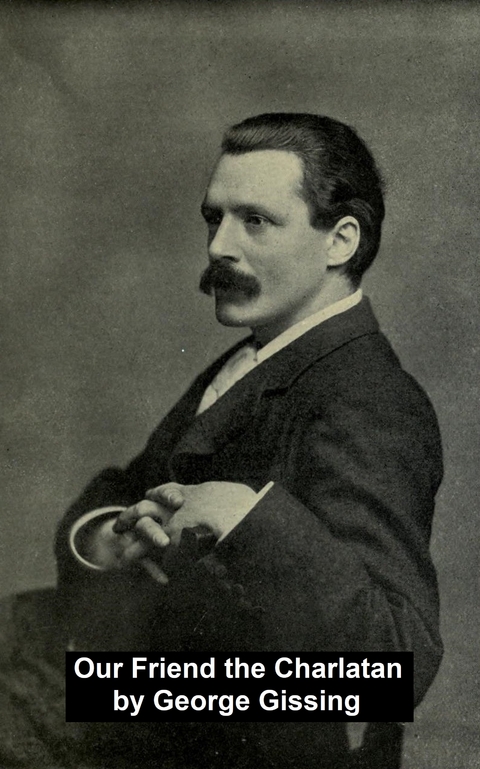
Our Friend the Charlatan (eBook)
631 Seiten
Seltzer Books (Verlag)
978-1-4553-5566-2 (ISBN)

Classic novel.According to Wikipedia: 'George Robert Gissing (November 22, 1857 - December 28, 1903) was an English novelist who wrote twenty-three novels between 1880 and 1903. From his early naturalistic works, he developed into one of the most accomplished realists of the late-Victorian era. ... In 1880 when his first novel, Workers in the Dawn, proved to be an abject failure, he became a private tutor to keep poverty from the door. In 1883, he separated from his wife, now an alcoholic, but gave her a weekly income on what little money he had until her death in 1888. In 1884 his second novel, The Unclassed, which saw a marked improvement in style and characterisation, met with moderate critical acclaim. After this Gissing published novels almost on a yearly basis, but so little money did they bring him, that for several more years he had to continue working as a tutor. Although notoriously exploited by his publishers, he was able to visit Italy in 1889 from the sale of the copyright of The Nether World, his most pessimistic book. Between 1891 and 1897 (his so-called middle period) Gissing produced his best works, which include New Grub Street, Born in Exile, The Odd Women, In the Year of Jubilee, and The Whirlpool. In advance of their time, they variously deal with the growing commercialism of the literary market, religious charlatanism, the situation of emancipated women in a male-dominated society, the poverty of the working classes, and marriage in a decadent world. During this period, having belatedly become aware of the financial rewards of writing short stories for the press, he produced almost seventy stories. As a result he was able to give up teaching. ... The middle years of the decade saw Gissing's reputation reach new heights: by some critics he is counted alongside George Meredith and Thomas Hardy as one of the best three novelists of his day. He also enjoyed new friendships with fellow writers such as Henry James, and H.G. Wells, and came into contact with many other up and coming writers such as Joseph Conrad and Stephen Crane. ... In 1903 Gissing published The Private Papers of Henry Ryecroft, which brought him much acclaim. This is his most autobiographical work. It is the memoir of the last happy years of a writer who had struggled much like Gissing, but thanks to a late legacy had been able to give up writing to retire to the countryside.'
Classic novel. According to Wikipedia: "e;George Robert Gissing (November 22, 1857 - December 28, 1903) was an English novelist who wrote twenty-three novels between 1880 and 1903. From his early naturalistic works, he developed into one of the most accomplished realists of the late-Victorian era. ... In 1880 when his first novel, Workers in the Dawn, proved to be an abject failure, he became a private tutor to keep poverty from the door. In 1883, he separated from his wife, now an alcoholic, but gave her a weekly income on what little money he had until her death in 1888. In 1884 his second novel, The Unclassed, which saw a marked improvement in style and characterisation, met with moderate critical acclaim. After this Gissing published novels almost on a yearly basis, but so little money did they bring him, that for several more years he had to continue working as a tutor. Although notoriously exploited by his publishers, he was able to visit Italy in 1889 from the sale of the copyright of The Nether World, his most pessimistic book. Between 1891 and 1897 (his so-called middle period) Gissing produced his best works, which include New Grub Street, Born in Exile, The Odd Women, In the Year of Jubilee, and The Whirlpool. In advance of their time, they variously deal with the growing commercialism of the literary market, religious charlatanism, the situation of emancipated women in a male-dominated society, the poverty of the working classes, and marriage in a decadent world. During this period, having belatedly become aware of the financial rewards of writing short stories for the press, he produced almost seventy stories. As a result he was able to give up teaching. ... The middle years of the decade saw Gissing's reputation reach new heights: by some critics he is counted alongside George Meredith and Thomas Hardy as one of the best three novelists of his day. He also enjoyed new friendships with fellow writers such as Henry James, and H.G. Wells, and came into contact with many other up and coming writers such as Joseph Conrad and Stephen Crane. ... In 1903 Gissing published The Private Papers of Henry Ryecroft, which brought him much acclaim. This is his most autobiographical work. It is the memoir of the last happy years of a writer who had struggled much like Gissing, but thanks to a late legacy had been able to give up writing to retire to the countryside."e;
CHAPTER VIII
Under the roof at Rivenoak was an attic which no one ever entered. The last person who had done so was Sir Quentin Ogram; on a certain day in eighteen hundred and--something, the baronet locked the door and put key into his pocket, and during the more than forty years since elapsed the room had remained shut. It guarded neither treasure nor dire secret; the hidden contents were merely certain essays in the art of sculpture, sundry shapes in clay and in marble, the work of Sir Quentin himself when a very young man. Only one of these efforts had an abiding interest; it was a marble bust representing a girl, or young woman, of remarkable beauty, the head proudly poised, the eyes disdainfully direct, on the lips a smile which seemed to challenge the world's opinion. Not a refined or nobly suggestive face, but stamped with character, alive with vehement self-consciousness; a face to admire at a distance, not without misgiving as one pictured the flesh and blood original. Young Quentin had made a fine portrait. The model was his mistress, and, soon after the bust was finished, she became his wife.
Naturally, Sir Spencer and Lady Ogram were not bidden to the wedding; in fact, they knew nothing about it until a couple of years after, when, on the birth to him of a son and heir, Quentin took his courage in both hands and went down to Rivenoak to make the confession. He avowed somewhat less than the truth, finding it quite task enough to mitigate the circumstances of Mrs. Ogram's birth and breeding. The exhibition of a portrait paved his way. This superbly handsome creature, adorned as became her present and prospective station, assuredly gave no shock at the first glance. By some freak of fate she had for parents a plumber and a washerwoman--"poor but very honest people," was Quentin's periphrase; their poverty of late considerably relieved by the thoughtful son-in-law, and their honesty perhaps fortified at the same time. Arabella (the beauty's baptismal name) unfortunately had two brothers; sisters, most happily, none. The brothers, however, were of a roaming disposition, and probably would tend to a colonial life; Quentin had counselled it, with persuasions which touched their sense of the fitting. So here was the case stated; Sir Spencer and his lady had but to reflect upon it, with what private conjectures might chance to enter their minds. Quentin was an only child; he had provided already for the continuance of the house; being of mild disposition, the baronet bowed his head to destiny, and, after a moderate interval, Arabella crossed the threshold of Rivenoak.
Of course there were one or two friends of Quentin's who knew all the facts of the case; these comrades he saw no more, having promised his wife never again to acknowledge or hold any intercourse with them. With his bachelor life had ended the artistic aspirations to which he had been wont to declare that he should for ever devote himself; Mrs. Ogram (she had been for a year or two a professional model) objected to that ungentlemanly pursuit with much more vigour and efficacy than the young man's parents, who had merely regretted that Quentin should waste his time and associate with a class of persons not regarded as worthy of much respect. Whether the dismissed cronies would talk or keep silence, who could say? Sir Spencer affected to believe that Arabella, when his son came to know her, was leading the life of a harmless, necessary sempstress, and that only by long entreaty, and under every condition of decorum, had she been induced to sit for her bust to the enthusiastic sculptor. Very touching was the story of how, when the artist became adorer and offered marriage, dear Arabella would not hear of such a thing; how, when her heart began to soften, she one day burst into tears and implored Mr. Ogram to prove his love, not by wildly impossible sacrifice, but simply by sending her to school, so that she might make herself less unworthy to think of him with pathetic devotion, and from a great distance, to the end of her days. To school, in very deed, she had been sent; that is to say, she had all manner of teachers, first in England and then abroad, during the couple of years before the birth of her child; and by this instruction Arabella profited so notably that her language made no glaring contrast with that of the civilised world, and her mind seemed if anything more acute, more circumspective, than women's generally in the sphere to which she was now admitted. Sir Spencer and Lady Ogram did not love her; they made no pretence of doing so; and it may be feared that the lives of both were shortened by chagrin and humiliation. At the age of thirty or so, Quentin succeeded to the baronetcy. In the same year his son died. No other offspring had blessed, or was to bless, the romantic union.
Behold Arabella, erst of Camden Town, installed as mistress of a house in Mayfair and reigning over Rivenoak. Inevitably, legends were rife about her; where the exact truth was not known, people believed worse. Her circle of society was but a narrow one; but for two classes of well-dressed people, the unscrupulous snobs and the cheerily indifferent, her drawing-room would have been painfully bare. Some families knew her because Sir Quentin was one of the richest men in his county; certain persons accepted her invitations because she was not exactly like other hostesses, and could talk in rather an amusing way. The years went on; scandal lost its verdure; Lady Ogram was accepted as a queer woman with a queer history, a rather vulgar eccentric, whose caprices and enterprises afforded agreeable matter for gossip. No one had ever ventured to assail her post-matrimonial reputation; she was fiercely virtuous, and would hold no terms with any woman not wholly above reproach. It had to be admitted that she bore herself with increasing dignity; moreover, that she showed a disposition to use her means and influence for what are called good ends. Towards the year 1870 the name of Lady Ogram began to be mentioned with respect.
Then her husband died. Sir Quentin had doubtless fallen short of entire happiness; before middle-age he was a taciturn, washed-out sort of man, with a look of timid anxiety. Perchance he regretted the visions of his youth, the dreams of glory in marble. When he became master of Rivenoak, and gave up his London house, Arabella wished him to destroy all his sculpture, that no evidence might remain of the relations which had at first existed between them, no visible relic of the time which she refused to remember. Sir Quentin pleaded against this condemnation, and obtained a compromise. The fine bust, and a few other of his best things, were to be transferred to Rivenoak, and there kept under lock and key. Often had the baronet felt that he would like to look at the achievements of his hopeful time, but he never summoned courage to mount to the attic. His years went by in a mouldering inactivity. Once or twice he escaped alone to the Continent, and wandered for weeks about the Italian sculpture-galleries, living in the sunny, ardent past; he came back nerve-shaken and low in health. His death was sudden-- 'failure of the heart's action,' said doctors, in their indisputable phrase--and Lady Ogram shut herself up for a time that she might not have the trouble of grieving before witnesses.
The baronet had behaved very generously to her in his last will and testament. Certain sums went to kinsfolk, to charities, to servants; his land and the bulk of his personal estate became Lady Ogram's own. She was a most capable and energetic woman of affairs; by her counsel, Sir Quentin had increased his wealth, and doubtless it seemed to him that no one had so good a right as she to enjoy its possession. The sacrifice he had made for her, though he knew it a blight upon his life, did but increase the power exercised over him by his arbitrary spouse; he never ceased to feel a certain pride in her, pride in the beauty of her face and form, pride in the mental and moral vigour which made her so striking an exception to the rule that low-born English girls cannot rise above their native condition. Arabella's family had given him no trouble; holding it a duty to abandon them, she never saw parents or brothers after her marriage, and never spoke of them. Though violent of temper, she had never made her husband suffer from this characteristic; to be sure, Sir Quentin was from the first, submissive, and rarely gave her occasion for displeasure. Over the baronet's grave in the little churchyard of Shawe she raised a costly monument. Its sole inscription was the name of the deceased, with the dates of his birth and death; Lady Ogram knew not, indeed, what else to add.
Fully another ten years elapsed before the widow's health showed any sign of failing. It was whilst passing a winter in Cornwall, that she suffered a slight paralytic attack, speedily, in appearance, overcome, but the beginning of steady decline. Her intellectual activity had seemed to increase as time went on. Outgrowing various phases of orthodox religious zeal, outgrowing an unreasoned conservatism in political and social views, she took up all manner of novel causes, and made Rivenoak a place of pilgrimage for the apostles of revolution. Yet the few persons who enjoyed close acquaintance with her knew that, at heart, she still nourished the pride of her Tank, and that she had little if any genuine sympathy with democratic principles. Only a moral restlessness, a perhaps half-conscious lack of adaptation to her circumstances, accounted for the antinomianism which took hold upon her. Local politics found her commonly on the Conservative side, and, as certain indiscreet inquirers found to their cost, it was perilous to seek Lady...
| Erscheint lt. Verlag | 1.3.2018 |
|---|---|
| Sprache | englisch |
| Themenwelt | Literatur ► Anthologien |
| Literatur ► Klassiker / Moderne Klassiker | |
| Literatur ► Romane / Erzählungen | |
| ISBN-10 | 1-4553-5566-6 / 1455355666 |
| ISBN-13 | 978-1-4553-5566-2 / 9781455355662 |
| Informationen gemäß Produktsicherheitsverordnung (GPSR) | |
| Haben Sie eine Frage zum Produkt? |
 EPUB (Adobe DRM)
Größe: 631 KB
Kopierschutz: Adobe-DRM
Adobe-DRM ist ein Kopierschutz, der das eBook vor Mißbrauch schützen soll. Dabei wird das eBook bereits beim Download auf Ihre persönliche Adobe-ID autorisiert. Lesen können Sie das eBook dann nur auf den Geräten, welche ebenfalls auf Ihre Adobe-ID registriert sind.
Details zum Adobe-DRM
Dateiformat: EPUB (Electronic Publication)
EPUB ist ein offener Standard für eBooks und eignet sich besonders zur Darstellung von Belletristik und Sachbüchern. Der Fließtext wird dynamisch an die Display- und Schriftgröße angepasst. Auch für mobile Lesegeräte ist EPUB daher gut geeignet.
Systemvoraussetzungen:
PC/Mac: Mit einem PC oder Mac können Sie dieses eBook lesen. Sie benötigen eine
eReader: Dieses eBook kann mit (fast) allen eBook-Readern gelesen werden. Mit dem amazon-Kindle ist es aber nicht kompatibel.
Smartphone/Tablet: Egal ob Apple oder Android, dieses eBook können Sie lesen. Sie benötigen eine
Geräteliste und zusätzliche Hinweise
Buying eBooks from abroad
For tax law reasons we can sell eBooks just within Germany and Switzerland. Regrettably we cannot fulfill eBook-orders from other countries.
EPUB (Ohne DRM)Digital Rights Management: ohne DRM
Dieses eBook enthält kein DRM oder Kopierschutz. Eine Weitergabe an Dritte ist jedoch rechtlich nicht zulässig, weil Sie beim Kauf nur die Rechte an der persönlichen Nutzung erwerben.
Dateiformat: EPUB (Electronic Publication)
EPUB ist ein offener Standard für eBooks und eignet sich besonders zur Darstellung von Belletristik und Sachbüchern. Der Fließtext wird dynamisch an die Display- und Schriftgröße angepasst. Auch für mobile Lesegeräte ist EPUB daher gut geeignet.
Systemvoraussetzungen:
PC/Mac: Mit einem PC oder Mac können Sie dieses eBook lesen. Sie benötigen dafür die kostenlose Software Adobe Digital Editions.
eReader: Dieses eBook kann mit (fast) allen eBook-Readern gelesen werden. Mit dem amazon-Kindle ist es aber nicht kompatibel.
Smartphone/Tablet: Egal ob Apple oder Android, dieses eBook können Sie lesen. Sie benötigen dafür eine kostenlose App.
Geräteliste und zusätzliche Hinweise
Buying eBooks from abroad
For tax law reasons we can sell eBooks just within Germany and Switzerland. Regrettably we cannot fulfill eBook-orders from other countries.
aus dem Bereich