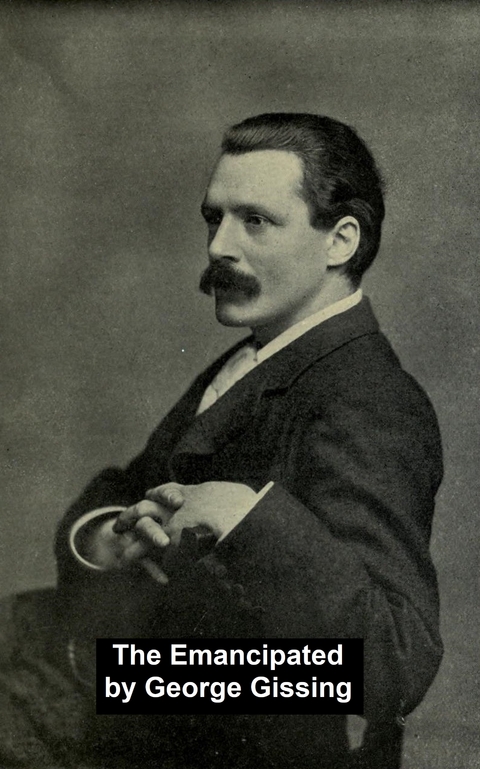
Emancipated (eBook)
646 Seiten
Seltzer Books (Verlag)
978-1-4553-5558-7 (ISBN)
Classic novel.According to Wikipedia: 'George Robert Gissing (November 22, 1857 - December 28, 1903) was an English novelist who wrote twenty-three novels between 1880 and 1903. From his early naturalistic works, he developed into one of the most accomplished realists of the late-Victorian era. ... In 1880 when his first novel, Workers in the Dawn, proved to be an abject failure, he became a private tutor to keep poverty from the door. In 1883, he separated from his wife, now an alcoholic, but gave her a weekly income on what little money he had until her death in 1888. In 1884 his second novel, The Unclassed, which saw a marked improvement in style and characterisation, met with moderate critical acclaim. After this Gissing published novels almost on a yearly basis, but so little money did they bring him, that for several more years he had to continue working as a tutor. Although notoriously exploited by his publishers, he was able to visit Italy in 1889 from the sale of the copyright of The Nether World, his most pessimistic book. Between 1891 and 1897 (his so-called middle period) Gissing produced his best works, which include New Grub Street, Born in Exile, The Odd Women, In the Year of Jubilee, and The Whirlpool. In advance of their time, they variously deal with the growing commercialism of the literary market, religious charlatanism, the situation of emancipated women in a male-dominated society, the poverty of the working classes, and marriage in a decadent world. During this period, having belatedly become aware of the financial rewards of writing short stories for the press, he produced almost seventy stories. As a result he was able to give up teaching. ... The middle years of the decade saw Gissing's reputation reach new heights: by some critics he is counted alongside George Meredith and Thomas Hardy as one of the best three novelists of his day. He also enjoyed new friendships with fellow writers such as Henry James, and H.G. Wells, and came into contact with many other up and coming writers such as Joseph Conrad and Stephen Crane. ... In 1903 Gissing published The Private Papers of Henry Ryecroft, which brought him much acclaim. This is his most autobiographical work. It is the memoir of the last happy years of a writer who had struggled much like Gissing, but thanks to a late legacy had been able to give up writing to retire to the countryside.'
Classic novel. According to Wikipedia: "e;George Robert Gissing (November 22, 1857 - December 28, 1903) was an English novelist who wrote twenty-three novels between 1880 and 1903. From his early naturalistic works, he developed into one of the most accomplished realists of the late-Victorian era. ... In 1880 when his first novel, Workers in the Dawn, proved to be an abject failure, he became a private tutor to keep poverty from the door. In 1883, he separated from his wife, now an alcoholic, but gave her a weekly income on what little money he had until her death in 1888. In 1884 his second novel, The Unclassed, which saw a marked improvement in style and characterisation, met with moderate critical acclaim. After this Gissing published novels almost on a yearly basis, but so little money did they bring him, that for several more years he had to continue working as a tutor. Although notoriously exploited by his publishers, he was able to visit Italy in 1889 from the sale of the copyright of The Nether World, his most pessimistic book. Between 1891 and 1897 (his so-called middle period) Gissing produced his best works, which include New Grub Street, Born in Exile, The Odd Women, In the Year of Jubilee, and The Whirlpool. In advance of their time, they variously deal with the growing commercialism of the literary market, religious charlatanism, the situation of emancipated women in a male-dominated society, the poverty of the working classes, and marriage in a decadent world. During this period, having belatedly become aware of the financial rewards of writing short stories for the press, he produced almost seventy stories. As a result he was able to give up teaching. ... The middle years of the decade saw Gissing's reputation reach new heights: by some critics he is counted alongside George Meredith and Thomas Hardy as one of the best three novelists of his day. He also enjoyed new friendships with fellow writers such as Henry James, and H.G. Wells, and came into contact with many other up and coming writers such as Joseph Conrad and Stephen Crane. ... In 1903 Gissing published The Private Papers of Henry Ryecroft, which brought him much acclaim. This is his most autobiographical work. It is the memoir of the last happy years of a writer who had struggled much like Gissing, but thanks to a late legacy had been able to give up writing to retire to the countryside."e;
CHAPTER VI - CAPTIVE TRAVELLERS
He had taken leave of the Spences and Mrs. Baske, yet was not sure that he should go. He had said good-bye to Mrs. Lessingham and to Cecily herself, yet made no haste to depart. It drew on to evening, and he sat idly in his room in Casa Rolandi, looking at his traps half packed. Then of a sudden up he started. "Imbecile! Insensate! I give you fifteen minutes to be on your way to the station. Miss the next train--and sink to the level of common men!" Shirts, socks-- straps, locks; adieux, tips--horses, whips! Clatter through the Piazzetta Mondragone; down at breakneck speed to the Toledo; across the Piazza del Municipio; a good-bye to the public scriveners sitting at their little tables by the San Carlo; sharp round the corner, and along by the Porto Grande with its throng of vessels. All the time he sings a tune to himself, caught up in the streets of the tuneful city; an air lilting to the refrain--
"Io ti voglio bene assaje E tu non pienz' a me!"
Just after nightfall he alighted from the train at Pompeii. Having stowed away certain impedimenta at the station, he took his travelling-bag in his hand, broke with small ceremony through porters and hotel-touts, came forth upon the high-road, and stepped forward like one to whom the locality is familiar. In a minute or two he was overtaken by a little lad, who looked up at him and said in an insinuating voice, "Albergo del Sole, signore?"
"Prendi, bambino," was Mallard's reply, as he handed the bag to him. "Avanti!"
A divine evening, softly warm, dim-glimmering. The dusty road ran on between white trunks of plane-trees; when the station and the houses near it were left behind, no other building came in view. To the left of the road, hidden behind its long earth-rampart, lay the dead city; far beyond rose the dark shape of Vesuvius, crested with beacon-glow, a small red fire, now angry, now murky, now for a time extinguished. The long rumble of the train died away, and there followed silence absolute, scarcely broken for a few minutes by a peasant singing in the distance, the wailing song so often heard in the south of Italy. Silence that was something more than the wonted soundlessness of night; the haunting oblivion of a time long past, a melancholy brooding voiceless upon the desolate home of forgotten generations.
A walk of ten minutes, and there shone light from windows. The lad ran forward and turned in at the gate of a garden; Mallard followed, and approached some persons who were standing at an open door. He speedily made arrangements for his night's lodging, saw his room, and went to the quarter of the inn where dinner was already in progress. This was a building to itself, at one side of the garden. Through the doorway he stepped immediately into a low-roofed hall, where a number of persons sat at table. Pillars supported the ceiling in the middle, and the walls were in several places painted with heads or landscapes, the work of artists who had made their abode here; one or two cases with glass doors showed relics of Pompeii.
Elgar was one of the company. When he became aware of Mallard's arrival, he stood up with a cry of "All hail!" and pointed to a seat near him.
"I began to be afraid you wouldn't come this evening. Try the risotto; it's excellent. Ye gods! what an appetite I had when I sat down! To-day have I ascended Vesuvius. How many bottles of wine I drank between starting and returning I cannot compute; I never knew before what it was to be athirst. Why, their vino di Vesuvio is for all the world like cider; I thought at first I was being swindled-- not an impossible thing in these regions. I must tell you a story about a party of Americans I encountered at Bosco Reale."
The guests numbered seven or eight; with one exception besides Elgar, they were Germans, all artists of one kind or another, fellows of genial appearance, loud in vivacious talk. The exception was a young Englishman, somewhat oddly dressed, and with a great quantity of auburn hair that rolled forward upon his distinguished brow. At a certain pension on the Mergellina he was well known. He sat opposite Elgar, and had been in conversation with him.
Mallard cared little what he ate, and ate little of any thing. Neither was he in the mood for talk; but Elgar, who had finished his solid meal, and now amused himself with grapes (in two forms), spared him the necessity of anything but an occasional monosyllable. The young man was elated, and grew more so as he proceeded with his dessert; his cheeks were deeply flushed; his eyes gleamed magnificently.
In the meantime Clifford Marsh had joined in conversation with the Germans; his use of their tongue was far from idiomatic, but by sheer determination to force a way through linguistic obstacles, he talked with a haphazard fluency which was amusing enough. No false modesty imposed a check upon his eloquence. It was to the general table that he addressed himself on the topic that had arisen; in an English dress his speech ran somewhat as follows:--
"Gentlemen, allow me to say that I have absolutely no faith in the future of which you speak! It is my opinion that democracy is the fatal enemy of art. How can you speak of ancient and mediaeval states? Neither in Greece nor in Italy was there ever what we understand by a democracy."
"Factisch! Der Herr hat Recht!" cried some one, and several other voices strove to make themselves heard; but the orator raised his note and overbore interruption.
"You must excuse me, gentlemen, if I say that--however it may be from other points of view--from the standpoint of art, democracy is simply the triumph of ignorance and brutality." ("Gewisz!"-- "Nimmermehr!"--"Vortrefflich!") "I don't care to draw distinctions between forms of the thing. Socialism, communism, collectivism, parliamentarism,--all these have one and the same end: to put men on an equality; and in proportion as that end is approached, so will art in every shape languish. Art, gentlemen, is nourished upon inequalities and injustices!" ("Ach!"--"Wie kann man so etwas sagen!"--"Hoch! verissime!") "I am not representing this as either good or bad. It may be well that justice should be established, even though art perish. I simply state a fact!" ("Doch!"--"Erlauben Sie!") "Supremacy of the vulgar interest means supremacy of ignoble judgment in all matters of mind. See what plutocracy already makes of art!"
Here one of the Germans insisted on a hearing; a fine fellow, with Samsonic locks and a ringing voice.
"Sir! sir! who talks of a genuine democracy with mankind in its present state? Before it comes about, the multitude will be instructed, exalted, emancipated, humanized!"
"Sir!" shouted Marsh, "who talks of the Millennium? I speak of things possible within a few hundred years. The multitude will never be humanized. Civilization is attainable only by the few; nature so ordains it."
"Pardon me for saying that is a lie! I use the word controversially." "It is a manifest truth!" cried the other. "Who ever doubted it but a Dummkopf? I use the word with reference to this argument only."
So it went on for a long time. Mallard and Elgar knew no German, so could derive neither pleasure nor profit from the high debate.
"Are you as glum here as in London?" Reuben asked of his companion, in a bantering voice. "I should have pictured you grandly jovial, wreathed perhaps with ruddy vine-leaves, the light of inspiration in your eye, and in your hand a mantling goblet! Drink, man, drink! you need a stimulant, an exhilarant, an anti-phlegmatic, a counter-irritant against English spleen. You are still on the other side of the Alps, of the Channel; the fogs yet cling about you. Clear your brow, O painter of Ossianic wildernesses! Taste the foam of life! We are in the land of Horace, and nunc est bibendum!-- Seriously, do you never relax?"
"Oh yes. You should see me over the fifth tumbler of whiskey at Stornoway."
"Bah! you might as well say the fifth draught of fish-oil North Cape. How innocent this wine is! A gallon of it would give one no more than a pleasant glow, the faculty of genial speech. Take a glass with me to the health of your enchanting ward."
"Please to command your tongue," growled Mallard, with a look that was not to be mistaken.
"I beg your pardon. It shall be to the health of that superb girl we saw in the Mercato. But, as far as I can judge yet, the Neapolitan type doesn't appeal to me very strongly. It is finely animal, and of course that has its value; but I prefer the suggestion of a soul, don't you? I remember a model old Langton had in Rome, a girl fresh from the mountains; by Juno! a glorious creature! I dare say you have seen her portrait in his studio; he likes to show it. But it does her nothing like justice; she might have sat for the genius of the Republic. Utterly untaught, and intensely stupid; but there were marvellous things to be read in her face. Ah, but give me the girls of Venice! You know them, how they walk about the piazza; their tall, lithe forms, the counterpart of the gondolier; their splendid black hair, elaborately braided and pierced with...
| Erscheint lt. Verlag | 1.3.2018 |
|---|---|
| Sprache | englisch |
| Themenwelt | Literatur ► Anthologien |
| Literatur ► Klassiker / Moderne Klassiker | |
| Literatur ► Romane / Erzählungen | |
| ISBN-10 | 1-4553-5558-5 / 1455355585 |
| ISBN-13 | 978-1-4553-5558-7 / 9781455355587 |
| Informationen gemäß Produktsicherheitsverordnung (GPSR) | |
| Haben Sie eine Frage zum Produkt? |
 EPUB (Adobe DRM)
Größe: 646 KB
Kopierschutz: Adobe-DRM
Adobe-DRM ist ein Kopierschutz, der das eBook vor Mißbrauch schützen soll. Dabei wird das eBook bereits beim Download auf Ihre persönliche Adobe-ID autorisiert. Lesen können Sie das eBook dann nur auf den Geräten, welche ebenfalls auf Ihre Adobe-ID registriert sind.
Details zum Adobe-DRM
Dateiformat: EPUB (Electronic Publication)
EPUB ist ein offener Standard für eBooks und eignet sich besonders zur Darstellung von Belletristik und Sachbüchern. Der Fließtext wird dynamisch an die Display- und Schriftgröße angepasst. Auch für mobile Lesegeräte ist EPUB daher gut geeignet.
Systemvoraussetzungen:
PC/Mac: Mit einem PC oder Mac können Sie dieses eBook lesen. Sie benötigen eine
eReader: Dieses eBook kann mit (fast) allen eBook-Readern gelesen werden. Mit dem amazon-Kindle ist es aber nicht kompatibel.
Smartphone/Tablet: Egal ob Apple oder Android, dieses eBook können Sie lesen. Sie benötigen eine
Geräteliste und zusätzliche Hinweise
Buying eBooks from abroad
For tax law reasons we can sell eBooks just within Germany and Switzerland. Regrettably we cannot fulfill eBook-orders from other countries.
EPUB (Ohne DRM)Digital Rights Management: ohne DRM
Dieses eBook enthält kein DRM oder Kopierschutz. Eine Weitergabe an Dritte ist jedoch rechtlich nicht zulässig, weil Sie beim Kauf nur die Rechte an der persönlichen Nutzung erwerben.
Dateiformat: EPUB (Electronic Publication)
EPUB ist ein offener Standard für eBooks und eignet sich besonders zur Darstellung von Belletristik und Sachbüchern. Der Fließtext wird dynamisch an die Display- und Schriftgröße angepasst. Auch für mobile Lesegeräte ist EPUB daher gut geeignet.
Systemvoraussetzungen:
PC/Mac: Mit einem PC oder Mac können Sie dieses eBook lesen. Sie benötigen dafür die kostenlose Software Adobe Digital Editions.
eReader: Dieses eBook kann mit (fast) allen eBook-Readern gelesen werden. Mit dem amazon-Kindle ist es aber nicht kompatibel.
Smartphone/Tablet: Egal ob Apple oder Android, dieses eBook können Sie lesen. Sie benötigen dafür eine kostenlose App.
Geräteliste und zusätzliche Hinweise
Buying eBooks from abroad
For tax law reasons we can sell eBooks just within Germany and Switzerland. Regrettably we cannot fulfill eBook-orders from other countries.
aus dem Bereich