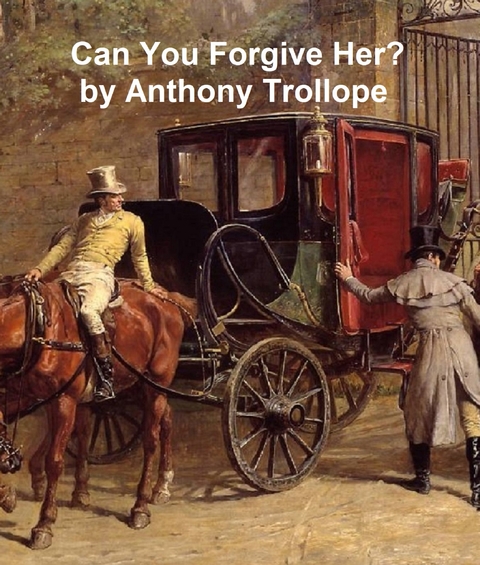
Can You Forgive Her? (eBook)
1201 Seiten
Seltzer Books (Verlag)
978-1-4553-6620-0 (ISBN)
First published serially in 1864-1865 and in book form in 1864 (Volume I) and 1865.
The Palliser series consists of:Can You Forgive Her? Phineas Finn, The Eustace Diamonds, Phineas Redux, The Prime Minister, and The Duke's Children. According to Wikipedia: 'Anthony Trollope ( 1815 - 1882 ) became one of the most successful, prolific and respected English novelists of the Victorian era. Some of Trollope's best-loved works, known as the Chronicles of Barsetshire, revolve around the imaginary county of Barsetshire; he also wrote penetrating novels on political, social, and gender issues and conflicts of his day. Trollope has always been a popular novelist. Noted fans have included Sir Alec Guinness (who never travelled without a Trollope novel), former British Prime Ministers Harold Macmillan and Sir John Major, economist John Kenneth Galbraith, American novelists Sue Grafton and Dominick Dunne and soap opera writer Harding Lemay. Trollope's literary reputation dipped somewhat during the last years of his life, but he regained the esteem of critics by the mid-twentieth century. 'Of all novelists in any country, Trollope best understands the role of money. Compared with him even Balzac is a romantic.' - W. H. Auden'
First published serially in 1864-1865 and in book form in 1864 (Volume I) and 1865. The Palliser series consists of: Can You Forgive Her? Phineas Finn, The Eustace Diamonds, Phineas Redux, The Prime Minister, and The Duke's Children. According to Wikipedia: "e;Anthony Trollope ( 1815 1882 ) became one of the most successful, prolific and respected English novelists of the Victorian era. Some of Trollope's best-loved works, known as the Chronicles of Barsetshire, revolve around the imaginary county of Barsetshire; he also wrote penetrating novels on political, social, and gender issues and conflicts of his day. Trollope has always been a popular novelist. Noted fans have included Sir Alec Guinness (who never travelled without a Trollope novel), former British Prime Ministers Harold Macmillan and Sir John Major, economist John Kenneth Galbraith, American novelists Sue Grafton and Dominick Dunne and soap opera writer Harding Lemay. Trollope's literary reputation dipped somewhat during the last years of his life, but he regained the esteem of critics by the mid-twentieth century. "e;Of all novelists in any country, Trollope best understands the role of money. Compared with him even Balzac is a romantic."e; W. H. Auden"e;
CHAPTER X Nethercoats
We will leave Mrs Greenow with her niece and two sisters at Yarmouth, and returning by stages to London, will call upon Mr Grey at his place in Cambridgeshire as we pass by. I believe it is conceded by all the other counties, that Cambridgeshire possesses fewer rural beauties than any other county in England. It is very flat; it is not well timbered; the rivers are merely dikes; and in a very large portion of the county the farms and fields are divided simply by ditches--not by hedgerows. Such arrangements are, no doubt, well adapted for agricultural purposes, but are not conducive to rural beauty. Mr Grey's residence was situated in a part of Cambridgeshire in which the above-named characteristics are very much marked. It was in the Isle of Ely, some few miles distant from the Cathedral town, on the side of a long straight road, which ran through the fields for miles without even a bush to cheer it. The name of his place was Nethercoats, and here he lived generally throughout the year, and here he intended to live throughout his life.
His father had held a prebendal stall at Ely in times when prebendal stalls were worth more than they are at present, and having also been possessed of a living in the neighbourhood, had amassed a considerable sum of money. With this he had during his life purchased the property of Nethercoats, and had built on it the house in which his son now lived. He had married late in life, and had lost his wife soon after the birth of an only child. The house had been built in his own parish, and his wife had lived there for a few months and had died there. But after that event the old clergyman had gone back to his residence in the Close at Ely, and there John Grey had had the home of his youth. He had been brought up under his father's eye, having been sent to no public school. But he had gone to Cambridge, had taken college honours, and had then, his father dying exactly at this time, declined to accept a fellowship. His father had left to him an income of some fifteen hundred a year, and with this he sat himself down, near to his college friends, near also to the old cathedral which he loved, in the house which his father had built.
But though Nethercoats possessed no beauty of scenery, though the country around it was in truth as uninteresting as any country could be, it had many delights of its own. The house itself was as excellent a residence for a country gentleman of small means as taste and skill together could construct. I doubt whether prettier rooms were ever seen than the drawing-room, the library, and the dining-room at Nethercoats. They were all on the ground-floor, and all opened out on to the garden and lawn. The library, which was the largest of the three, was a handsome chamber, and so filled as to make it well known in the University as one of the best private collections in that part of England. But perhaps the gardens of Nethercoats constituted its greatest glory. They were spacious and excellently kept up, and had been originally laid out with that knowledge of gardening without which no garden, merely as a garden, can be effective. And such, of necessity, was the garden of Nethercoats. Fine single forest trees there were none there, nor was it possible that there should have been any such. Nor could there be a clear rippling stream with steep green banks, and broken rocks lying about its bed. Such beauties are beauties of landscape, and do not of their nature belong to a garden. But the shrubs of Nethercoats were of the rarest kind, and had been long enough in their present places to have reached the period of their beauty. Nothing had been spared that a garden could want. The fruit-trees were perfect in their kind, and the glass-houses were so good and so extensive that John Grey in his prudence was some times tempted to think that he had too much of them.
It must be understood that there were no grounds, according to the meaning usually given to that word, belonging to the house at Nethercoats. Between the garden and the public road there was a paddock belonging to the house, along the side of which, but divided from it by a hedge and shrubbery, ran the private carriageway up to the house. This swept through the small front flower-garden, dividing it equally; but the lawns and indeed the whole of that which made the beauty of the place lay on the back of the house, on which side opened the windows from the three sitting-rooms. Down on the public road there stood a lodge at which lived one of the gardeners. There was another field of some six or seven acres, to which there was a gate from the corner of the front paddock, and which went round two sides of the garden. This was Nethercoats, and the whole estate covered about twelve acres.
It was not a place for much bachelor enjoyment of that sort generally popular with bachelors; nevertheless Mr Grey had been constant in his residence there for the seven years which had now elapsed since he had left his college. His easy access to Cambridge had probably done much to mitigate what might otherwise have been the too great tedium of his life; and he had, prompted thereto by early associations, found most of his society in the Close of Ely Cathedral. But, with all the delight he could derive from these two sources, there had still been many solitary hours in his life, and he had gradually learned to feel that he of all men wanted a companion in his home.
His visits to London had generally been short and far between, occasioned probably by some need in the library, or by the necessity of some slight literary transaction with the editor or publisher of a periodical. In one of these visits he had met Alice Vavasor, and had remained in Town,--I will not say till Alice had promised to share his home in Cambridgeshire, but so long that he had resolved before he went that he would ask her to do so. He had asked her, and we know that he had been successful. He had obtained her promise, and from that moment all his life had been changed for him. Hitherto at Nethercoats his little smoking-room, his books, and his plants had been everything to him. Now he began to surround himself with an infinity of feminine belongings, and to promise himself an infinity of feminine blessings, wondering much that he should have been content to pass so long a portion of his life in the dull seclusion which he had endured. He was not by nature an impatient man; but now he became impatient, longing for the fruition of his new idea of happiness,--longing to have that as his own which he certainly loved beyond all else in the world, and which, perhaps, was all he had ever loved with the perfect love of equality. But though impatient, and fully aware of his own impatience, he acknowledged to himself that Alice could not be expected to share it. He could plan nothing now,--could have no pleasure in life that she was not expected to share. But as yet it could not be so with her. She had her house in London, her town society, and her father. And, inasmuch as the change for her would be much greater than it would be for him, it was natural that she should require some small delay. He had not pressed her. At least he had not pressed her with that eager pressure which a girl must resist with something of the opposition of a contest, if she resist it at all. But in truth his impatience was now waxing strong, and during the absence in Switzerland of which we have spoken, he resolved that a marriage very late in the autumn,--that a marriage even in winter, would be better than a marriage postponed till the following year. It was not yet late in August when the party returned from their tour. Would not a further delay of two months suffice for his bride?
Alice had written to him occasionally from Switzerland, and her first two letters had been very charming. They had referred almost exclusively to the tour, and had been made pleasant with some slightly coloured account of George Vavasor's idleness, and of Kate's obedience to her brother's behests. Alice had never written much of love in her love-letters, and Grey was well enough contented with her style, though it was not impassioned. As for doubting her love, it was not in the heart of the man to do so after it had been once assured to him by her word. He could not so slightly respect himself or her as to leave room for such a doubt in his bosom. He was a man who could never have suggested to himself that a woman loved him till the fact was there before him; but who having ascertained, as he might think, the fact, could never suggest to himself that her love would fail him. Her first two letters from Switzerland had been very pleasant; but after that there had seemed to have crept over her a melancholy which she unconsciously transferred to her words, and which he could not but taste in them,--at first unconsciously, also, but soon with so plain a flavour that he recognised it, and made it a matter of mental inquiry. During the three or four last days of the journey, while they were at Basle and on their way home, she had not written. But she did write on the day after her arrival, having then received from Mr Grey a letter, in which he told her how very much she would add to his happiness if she would now agree that their marriage should not be postponed beyond the end of October. This letter she found in her room on her return, and this she answered at once. And she answered it in such words that Mr Grey resolved that he would at once go to her in London. I will give her letter at length, as I shall then be best able to proceed with my story quickly.
Queen Anne Street, -- August, 186--.
DEAREST JOHN,--
We reached home yesterday...
| Erscheint lt. Verlag | 1.3.2018 |
|---|---|
| Sprache | englisch |
| Themenwelt | Literatur ► Anthologien |
| Literatur ► Klassiker / Moderne Klassiker | |
| Literatur ► Romane / Erzählungen | |
| ISBN-10 | 1-4553-6620-X / 145536620X |
| ISBN-13 | 978-1-4553-6620-0 / 9781455366200 |
| Informationen gemäß Produktsicherheitsverordnung (GPSR) | |
| Haben Sie eine Frage zum Produkt? |
 EPUB (Adobe DRM)
Größe: 1,2 MB
Kopierschutz: Adobe-DRM
Adobe-DRM ist ein Kopierschutz, der das eBook vor Mißbrauch schützen soll. Dabei wird das eBook bereits beim Download auf Ihre persönliche Adobe-ID autorisiert. Lesen können Sie das eBook dann nur auf den Geräten, welche ebenfalls auf Ihre Adobe-ID registriert sind.
Details zum Adobe-DRM
Dateiformat: EPUB (Electronic Publication)
EPUB ist ein offener Standard für eBooks und eignet sich besonders zur Darstellung von Belletristik und Sachbüchern. Der Fließtext wird dynamisch an die Display- und Schriftgröße angepasst. Auch für mobile Lesegeräte ist EPUB daher gut geeignet.
Systemvoraussetzungen:
PC/Mac: Mit einem PC oder Mac können Sie dieses eBook lesen. Sie benötigen eine
eReader: Dieses eBook kann mit (fast) allen eBook-Readern gelesen werden. Mit dem amazon-Kindle ist es aber nicht kompatibel.
Smartphone/Tablet: Egal ob Apple oder Android, dieses eBook können Sie lesen. Sie benötigen eine
Geräteliste und zusätzliche Hinweise
Buying eBooks from abroad
For tax law reasons we can sell eBooks just within Germany and Switzerland. Regrettably we cannot fulfill eBook-orders from other countries.
EPUB (Ohne DRM)Digital Rights Management: ohne DRM
Dieses eBook enthält kein DRM oder Kopierschutz. Eine Weitergabe an Dritte ist jedoch rechtlich nicht zulässig, weil Sie beim Kauf nur die Rechte an der persönlichen Nutzung erwerben.
Dateiformat: EPUB (Electronic Publication)
EPUB ist ein offener Standard für eBooks und eignet sich besonders zur Darstellung von Belletristik und Sachbüchern. Der Fließtext wird dynamisch an die Display- und Schriftgröße angepasst. Auch für mobile Lesegeräte ist EPUB daher gut geeignet.
Systemvoraussetzungen:
PC/Mac: Mit einem PC oder Mac können Sie dieses eBook lesen. Sie benötigen dafür die kostenlose Software Adobe Digital Editions.
eReader: Dieses eBook kann mit (fast) allen eBook-Readern gelesen werden. Mit dem amazon-Kindle ist es aber nicht kompatibel.
Smartphone/Tablet: Egal ob Apple oder Android, dieses eBook können Sie lesen. Sie benötigen dafür eine kostenlose App.
Geräteliste und zusätzliche Hinweise
Buying eBooks from abroad
For tax law reasons we can sell eBooks just within Germany and Switzerland. Regrettably we cannot fulfill eBook-orders from other countries.
aus dem Bereich