Smoke (eBook)
276 Seiten
Charles River Editors (Verlag)
978-1-5312-8158-8 (ISBN)
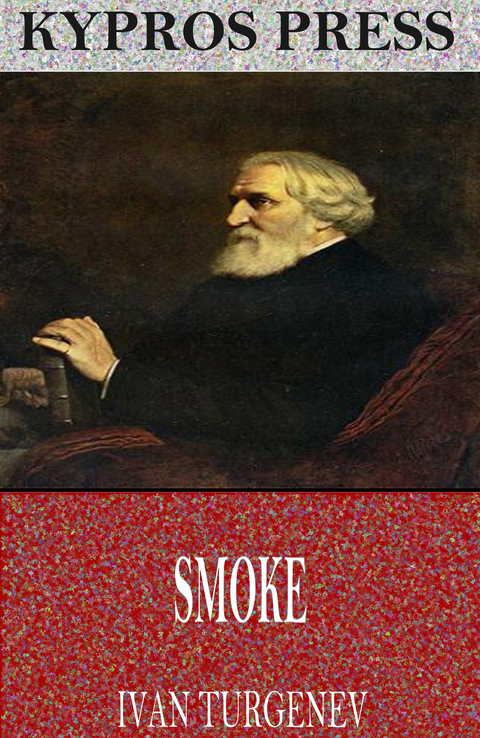
Ivan Turgenev was a Russian writer and playwright in the 19th century. Turgenev's novel Fathers and Sons as well as his short stories were key contributions to Russian Realism. This edition of Smoke includes a table of contents.
INTRODUCTION
WHEN Litvinov was torn loose from his “far from gay or complicated” life, caught up in a lurid passion in which he was never at home, and then abandoned, he fled upon the train. At first he was exhausted by the prodigious effort of will he had made; then a kind of composure came upon him. He “was hardened.” The train, the minutes, were carrying him away from the wreck of his life.
“He took to gazing out of the window. The day was gray and damp; there was no rain, but the fog held on, and low-lying clouds veiled the sky. The wind was blowing in the contrary direction to the course of the train; whitish clouds of steam, now alone, now mingled with other, darker clouds, of smoke, swept, in an endless series, past the window beside which Litvinov sat. He began to watch the steam, the smoke. Incessantly whirling, rising and falling, twisting and catching at the grass, at the bushes, playing pranks, as it were, lengthening and melting, puff followed puff, . . . they were constantly changing and yet remained the same . . . a monotonous, hurried, tiresome game! Sometimes the wind changed, the road made a turn — the whole mass suddenly disappeared, and immediately became visible through the opposite window; then, once more, the hugh train flung itself over, and once more veiled from Litvinov the wide view of the Rhine Valley. He gazed and gazed, and a strange reflection occurred to him. . . . He was alone in the carriage; there was no one to interfere with him. ‘Smoke, smoke’— he repeated several times in succession; and suddenly everything appeared to him to be smoke — everything, his own life, everything pertaining to men, especially everything Russian. Every thing is smoke and steam, he thought; — everything seems to be constantly undergoing change; every where there are new forms, phenomenon follows phenomenon, but in reality everything is exactly alike; everything is hurrying, hastening somewhither — and everything vanishes without leaving a trace, without having attained to any end whatever; another breeze has begun to blow — and everything has been flung to the other side, and there, again, is the same incessant, agitated — and useless game. He recalled many things which had taken place, with much sound and clatter, before his eyes the last few years . . ‘smoke,’ he murmured — ‘smoke.’”
“Smoke.” This is not only Litvinov’s reaction from experiences too terrible for his mind and heart to stand — and also his consolation — but it is Turgenev’s own reaction to life. The profound disillusion following the failure of the Revolutionary movement of ‘48, which swept over the intellectuals of Europe, had also its characteristic repercussion among the intellectual youth of Russia, and made a generation like the later generation so well portrayed by Tchekov — the men of the ‘80s, and also like the Intelligentsia after the failure of the Revolution of 1905.
The restless futility, self-searching, flabbiness of will so native to this type are incarnate in one of Turgenev’s greatest characters, Rudin. They persist in numerous characters in Smoke, and are not absent from the make-up of Litvinov himself — nor of Turgenev, for that matter. The conception of the futility of effort, of revolution, of political ideas in general, the tranquillity attained only by seeing life from the standpoint of eternity, Turgenev had already enunciated in Fathers and Children. He wished to see life with Olympian calm; the irony of Basarov’s death is a key-note of his profound pessimism. But in Smoke there is bitter satire, showing that life to him was still a battle, an exasperation.
The claims so often made by critics that Turgenev, the natural aristocrat, was always consciously, above all, an artist, are disproved by his own autobiographical note prefaced to the complete edition of his works published in Moscow in 1880:
“I took a header into the German Ocean,” he says, speaking of his going to Berlin, to study in the University — where, by the way, he was a fellow-student with Bakunin. “ . . . It was absolutely necessary for me to get clear of my enemy, the better to strike from a distance. To my eyes this enemy had a formidable appearance, and an ordinary name. My enemy was the ‘lawfulness’ of Serfdom.” This “enemy” Turgenev swore to conquer. “It was my ‘Hannibal oath,’ and in those days I was not the only one who took it. . . . I went to Germany to enable me to fulfill it. . .”
How well he kept this oath is evident in the effect of “Sportsmen’s Sketches,” his first important book, published about 1852, which, in the guise of mere description, depicted the wretchedness of the peasants in a way that roused Russian public opinion, more than any other one influence, to demand the Emancipation of the Serfs. This book is often called the Russian “Uncle Tom’s Cabin,” and appeared contemporaneously with it. The motive of Emancipation runs through almost all Turgenev’s work, and appears in Smoke, which was published after the freeing of the Serfs. (By the way, there is a humorous reference to Mrs. Stowe in Chapter IV.) For instance, when, bruised and broken, Litvinov returns to his estate in Russia, he was at first unable to change the old system:
“New ideas won their way badly, old ones had lost their force; the ignorant clashed with the dishonest; his whole deranged existence was in constant motion, like a quaking bog, and only the great word ‘Liberty’ moved, like the spirit of God, over the waters . . . .
“But a year passed, then a second, the third was beginning. The grand thought was gradually being realized, was being transformed into flesh and blood; a sprout was putting forth from the seed that had been sown; and its enemies, either open or secret, could no longer trample it under foot.”
The tremendous interest aroused by Turgenev’s books in Russia was partly due to the fact that they were all concerned with politics — that, beside their delicate and restrained literary art, through them all ran a strain of propaganda — that they dealt with the actual burning questions of the times. Smoke, in particular, was Turgenev’s contribution to the great controversy between the Slavophils and those who championed western ideals for Russia. There is no doubt that Turgenev’s own ideals are expressed by the ruined nobleman Potugin; and Litvinov himself, a rather quiet, ordinary young man, who has traveled over Europe studying technology and scientific farming, is the kind of man that Turgenev passionately believes Russia to need.
But at the same time the author has concentrated his most bitter attack upon those Russian young men who have come to Europe and absorbed, with all their Slavic facility, a mass of undigested European ideas and theories. There is nothing in literature more stinging than the satire of the first six chapters of Smoke, which has a quality of Dickens about it. This is not hatred, however. While laughing bitterly at his young “intellectual” countrymen, Turgenev understands them; they, like himself, are creatures of environment and heredity. But he pours his contempt upon the “aristocrats” of St. Petersburg, who are only cruel and corrupt.
The life of Litvinov is, in its fundamentals, the life of Turgenev himself. Like Litvinov, the author was the “son of a retired petty official,” living on a country estate, with a mother who tried to live as a noble, on an insufficient income, ruining the estate in the process. As with Litvinov, nothing but French was spoken in Turgenev’s family. Turgenev himself had to learn Russian from the house servants — the language of which he was afterwards to be the great master.
Like Litvinov, Turgenev also lived in Baden. Smoke was written there, and the episodes and characters are undoubtedly from life. He came to Baden to be near Madame Viardot, the opera singer, his most intimate, life-long friend . . . No doubt, also, Irina came from his own experience, at some time. She is one of a trio, passionate and beautiful, wreckers of men: Varvara Pavlovna, in A Nobleman’s Nest; Maria Nikolævna, in Torrents of Spring; and Irina. But she is by far the clearest and most human of the three. Many men have known such women — women who live like panthers, taking what they want and moving through the world all baleful fire, fit mates only for the strong. And Litvinov was not strong — nor was Turgenev.
Turgenev was the next of the great Russian novelists in line after Gogol, the predecessor and finally minor contemporary of the giants Tolstoy and Dostoyevsky. The Russian realistic novel, developing in its own way a technique distinct from that of Western literature, can be partially explained by the political conditions in Russia.
Politics were forbidden, and yet the Russian people were passionately concerned with politics and the Russian novelists are above all political propagandists. Yet how could politics be written about so as to be printed openly and read in Russia? Only by describing Russian life and institutions in the form of a story, only by painting a picture of people and permitting the reader to draw his own conclusions. In this Turgenev excelled . . . .
Smoke, outside of the one tremendous episode of Litvinov and Irina in Baden, is chiefly interesting to us as a description of Russian society, not...
| Erscheint lt. Verlag | 22.3.2018 |
|---|---|
| Sprache | englisch |
| Themenwelt | Literatur ► Anthologien |
| Literatur ► Klassiker / Moderne Klassiker | |
| Literatur ► Romane / Erzählungen | |
| Schlagworte | Classic • Dostoyevsky • EPIC • fathers and sons • Realism • Russian • sportsman’s sketches • Tolstoy |
| ISBN-10 | 1-5312-8158-3 / 1531281583 |
| ISBN-13 | 978-1-5312-8158-8 / 9781531281588 |
| Informationen gemäß Produktsicherheitsverordnung (GPSR) | |
| Haben Sie eine Frage zum Produkt? |
 EPUB (Adobe DRM)
Größe: 1,1 MB
Kopierschutz: Adobe-DRM
Adobe-DRM ist ein Kopierschutz, der das eBook vor Mißbrauch schützen soll. Dabei wird das eBook bereits beim Download auf Ihre persönliche Adobe-ID autorisiert. Lesen können Sie das eBook dann nur auf den Geräten, welche ebenfalls auf Ihre Adobe-ID registriert sind.
Details zum Adobe-DRM
Dateiformat: EPUB (Electronic Publication)
EPUB ist ein offener Standard für eBooks und eignet sich besonders zur Darstellung von Belletristik und Sachbüchern. Der Fließtext wird dynamisch an die Display- und Schriftgröße angepasst. Auch für mobile Lesegeräte ist EPUB daher gut geeignet.
Systemvoraussetzungen:
PC/Mac: Mit einem PC oder Mac können Sie dieses eBook lesen. Sie benötigen eine
eReader: Dieses eBook kann mit (fast) allen eBook-Readern gelesen werden. Mit dem amazon-Kindle ist es aber nicht kompatibel.
Smartphone/Tablet: Egal ob Apple oder Android, dieses eBook können Sie lesen. Sie benötigen eine
Geräteliste und zusätzliche Hinweise
Buying eBooks from abroad
For tax law reasons we can sell eBooks just within Germany and Switzerland. Regrettably we cannot fulfill eBook-orders from other countries.
EPUB (Ohne DRM)Digital Rights Management: ohne DRM
Dieses eBook enthält kein DRM oder Kopierschutz. Eine Weitergabe an Dritte ist jedoch rechtlich nicht zulässig, weil Sie beim Kauf nur die Rechte an der persönlichen Nutzung erwerben.
Dateiformat: EPUB (Electronic Publication)
EPUB ist ein offener Standard für eBooks und eignet sich besonders zur Darstellung von Belletristik und Sachbüchern. Der Fließtext wird dynamisch an die Display- und Schriftgröße angepasst. Auch für mobile Lesegeräte ist EPUB daher gut geeignet.
Systemvoraussetzungen:
PC/Mac: Mit einem PC oder Mac können Sie dieses eBook lesen. Sie benötigen dafür die kostenlose Software Adobe Digital Editions.
eReader: Dieses eBook kann mit (fast) allen eBook-Readern gelesen werden. Mit dem amazon-Kindle ist es aber nicht kompatibel.
Smartphone/Tablet: Egal ob Apple oder Android, dieses eBook können Sie lesen. Sie benötigen dafür eine kostenlose App.
Geräteliste und zusätzliche Hinweise
Buying eBooks from abroad
For tax law reasons we can sell eBooks just within Germany and Switzerland. Regrettably we cannot fulfill eBook-orders from other countries.
aus dem Bereich