


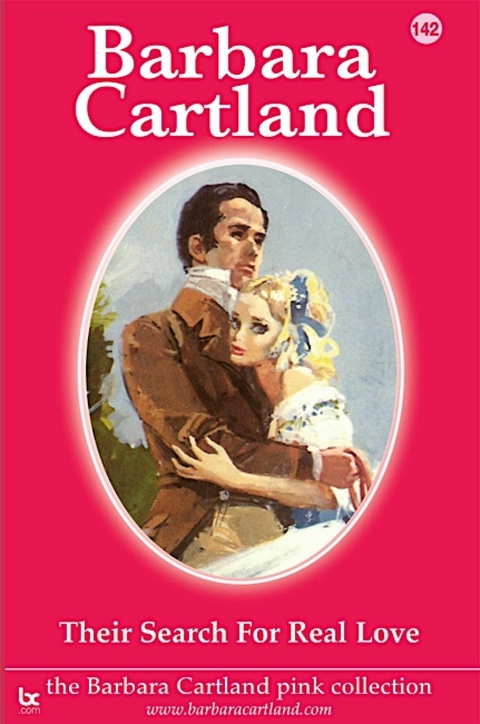
Their Search for Real Love (eBook)
245 Seiten
Barbara Cartland.com (Verlag)
978-1-78213-886-0 (ISBN)
Barbara Cartland was the world's most prolific novelist who wrote an amazing 723 books in her lifetime, of which no less than 644 were romantic novels with worldwide sales of over 1 billion copies and her books were translated into 36 different languages. As well as romantic novels, she wrote historical biographies, 6 autobiographies, theatrical plays and books of advice on life, love, vitamins and cookery. She wrote her first book at the age of 21 and it was called Jigsaw. It became an immediate bestseller and sold 100,000 copies in hardback in England and all over Europe in translation. Between the ages of 77 and 97 she increased her output and wrote an incredible 400 romances as the demand for her romances was so strong all over the world. She wrote her last book at the age of 97 and it was entitled perhaps prophetically The Way to Heaven. Her books have always been immensely popular in the United States where in 1976 her current books were at numbers 1 & 2 in the B. Dalton bestsellers list, a feat never achieved before or since by any author. Barbara Cartland became a legend in her own lifetime and will be best remembered for her wonderful romantic novels so loved by her millions of readers throughout the world, who have always collected her books to read again and again, especially when they feel miserable or depressed. Her books will always be treasured for their moral message, her pure and innocent heroines, her handsome and dashing heroes, her blissful happy endings and above all for her belief that the power of love is more important than anything else in everyone's life.
Sir John Gilmour has received a letter from his old friend Gavron Murillo, who lives in Paris to say that he only has a very short time to live and wants to see him urgently before he dies. Gavron, who was of Oriental appearance and a very rich man, had helped Sir John and his father with their finances when they had been almost on the point of bankruptcy and he had made them very wealthy. When Sir John arrives at Gavron's bedside, the old man tells him that his dying wish is that he should marry his daughter, the beautiful Melita. Sir John feels that he cannot refuse the old man after all he had done for him and his father, although he is extremely surprised as he had no idea that Gavron had ever married. Melita, who had been living in a Convent in Thailand after her mother had died giving birth to her, is notified to travel to Paris immediately. When Sir John meets her and tells her what he had promised her father, Melita says that she only wants to marry for love. It is then agreed that they will pretend to their families that they have been married quietly and secretly in Paris while they attempt to find real love with someone else. When they finally return to England and go to live in Sir John's enchanting house in the country, Melita is very happy. Then it is reported in the newspapers that she and Sir John have inherited all Gavron's vast amount of money and estates. How Melita is kidnapped. How Sir John is blackmailed by the kidnappers and suffers the agony of trying to find and rescue her. And how in the end they both find real love, which is not very far away from them, is all told in this romantic and exciting story by BARBARA CARTLAND.
CHAPTER ONE ~ 1891
Sir John Gilmour glanced at the clock and realised that it was nearly one o’clock in the morning.
It was time, he thought, for him to leave.
He turned to the pretty woman who was holding his arm and said,
“I am afraid that I have to go home. I have many things I need to do tomorrow and I must have some sleep before I start work.”
She laughed.
“Work to you is very different from what it is to other people. But you have not forgotten, John dear, that you are dining with me tomorrow night?”
“Of course I have not forgotten,” Sir John replied, “and I will be counting the hours until I see you again.”
She looked up at him.
As their eyes met, she said in a whisper,
“We shall be alone! As you know Arthur is going to the races and will not be back until Saturday.”
Sir John smiled.
“We will talk about it tomorrow,” he murmured.
Releasing himself from her arm he went across the room to where his hostess was saying goodbye to several people who, like himself, realised that it was now late.
As the guests were moving away, he held out his hand saying,
“How can I ever thank you for a most amusing and delicious dinner and an even more delightful band?”
“I am so glad that you enjoyed yourself, John,” she answered, “and I will look forward to seeing you again next week.”
“If I am in London, I will be knocking on the door even sooner than you expect,” Sir John promised.
She pressed her hand closer into his and said,
“You know I want to see you.”
“And I want to see you,” he replied.
He raised her hand and touched it with his lips.
Without saying anymore he walked quickly through the dancers to the door that led from the ballroom into the passage.
Even as he did so, there was a patter of feet behind him.
He turned round to see a very pretty woman who had been often acclaimed as one of the most influential and attractive hostesses in London.
“John!” she exclaimed a little breathlessly.
As she reached him, she said,
“You have not forgotten that you are dining with us on Tuesday night. I have a special surprise for you, but I am so afraid that you will disappear into the country and forget you promised to be my guest for dinner.”
“Of course I have not forgotten your party,” Sir John answered. “How could I forget you?”
She looked up at him and her eyes said more than her lips.
Sir John kissed her hand and said,
“I will be with you at eight o’clock. Don’t worry, it is a date which is impossible to forget.”
“Just as I could never forget you,” she said in a low voice.
Because he could see several people coming from the room he had just left, Sir John released her hand and moved quickly down the passage to the front door.
It was always the same, he reflected.
Wherever he went it was difficult to get away.
There were always attractive women wishing to delay him when he wanted to be free.
As he expected, his carriage was waiting for him outside the front door and, as he stepped into it, he said to the footman holding the door,
“Tell Cochran to take me back home as quickly as possible. I am sorry to keep him waiting, but I wanted to leave at least an hour ago.”
“We thinks as ’ow you’d be ever so late, sir,” the man answered with a smile.
He shut the door, as Sir John sank down on the seat inside.
The horses moved off and were going at a very fast pace and Sir John lay back comfortably in the carriage.
He thought, with a sigh, that it was far later than he had intended to leave. But it was always the same at those parties.
The most attractive woman always seemed to come last on his list of dances.
It was impossible for him to leave without being unnecessarily rude.
All the same it had been an amusing evening.
He had had two of the most famous beauties in London Society at his side at dinner.
They had vied with each other in flattering him and made him feel embarrassed by whispering things he had no wish to be overheard or suspected by their husbands or, far more dangerous, older women who desired his attention.
It would have been impossible for Sir John not to be aware that he was the most sought after young man in the whole of London Society.
He had a reputation for being a roué, which was entirely justified.
It was inevitable that a great many men were not only jealous of his success but angry because their wives were infatuated by him.
“If it was not forbidden by the law and the Prince of Wales, I would call him out for a duel,” more than one member at his Club had said to a friend.
“You are not the only one saying that,” the friend had replied. “But while I suspect what Gilmour is after, he is too clever for them to be certain.”
Although the men were suspicious of him, they had to admit he was an excellent sportsman both in the hunting field and as a gunshot at fashionable shoots.
His racehorses which were kept at Newmarket were outstanding and he had, they were obliged to admit, one of the finest and most impressive houses in the country.
“The trouble with young Gilmour,” an older man at the Club had said, “is that he is determined never to marry and as you all know he avoids the ambitious mothers who want their debutante daughters to share his ancient title.”
“If you ask me, he is too damned clever for all of us,” another member asserted.
While those to whom he was speaking laughed, he added,
“You mark my words he will come a cropper one day and will find himself walking up the aisle when he least expects it!”
There was laughter at this suggestion.
At the same time a twinkle in one or two of his friends’ eyes told the speaker, and it made him very angry, that they were all well aware that the girl he was about to marry had fallen madly in love with Sir John Gilmour.
So she had broken off the engagement one week before the Wedding was due to take place.
It was no compensation at all to know that he had no intention of marrying the young girl concerned.
Sir John had avowed openly that he would never marry until he was very much older and obliged to have an heir to whom he could leave everything he possessed.
“If you ask me,” one man at the Club said bitterly, “he’ll fall on his face when he least expects it. Then we will all be able to cheer his downfall instead of praising him as you do at the moment.”
As he walked away, one of his friends laughed.
“Poor old geezer,” another said. “But the real truth is that Gilmour always gets the better of us and it appears that we are all too silly and feeble and there is nothing we can do about it.”
There was an audible groan from everyone, but no one contradicted him.
*
Driving home Sir John was admitting to himself that he felt tired.
It was not only the parties he was obliged to attend every daym but he was having a somewhat wild love affair with an extremely pretty woman whose husband had been unexpectedly called to the North of England when he least expected it.
“His sister is very ill,” the beauty told Sir John, “and, as William will not be back for at least a week, it gives us a chance to see each other.”
It meant, naturally, that Sir John went to their house in Belgrave Square for dinner.
He was driving back home in the early hours of the morning when, as he told himself, all sensible men were asleep so they would feel fresh and lively in the morning.
Now, as the carriage stopped outside his house in Grosvenor Square, he thought to himself that he was a fool to let himself do so much, pleasant and amusing though it was.
“Goodnight,” he called to his coachman. “I am very sorry to have kept you up late. I will come home tomorrow at a more reasonable hour.”
The coachman grinned and touched his cap.
“We likes you to ’ave a good time, Sir John,” he said, “and if your ’orse wins on Thursday at Newmarket, we’ll all be celebratin’ the victory!”
“I hope you will not be disappointed,” Sir John said as he walked into the house.
His valet was dutifully waiting for him, although he had obviously dozed off until his Master appeared.
It did not take him long to undress.
When he then sank down in his large and extremely comfortable bed, it was with a sigh of relief that he would go straight to sleep and not think about anything that might demand his attention until tomorrow morning.
It was only as his valet left the room and Sir John was blowing out the candles by his bedside that he saw that there was a telegram waiting for him.
For a moment he just stared at it wondering why it was there.
Then he was at once aware that his secretary would not have put it there if it had not been urgent. He would undoubtedly have kept it downstairs until the morning.
With a sigh he reached for the telegram wondering why it should need his attention at this very late hour of the night.
Yet he recognised that it was quite obviously of extreme importance.
He sat up against his pillows and almost reluctantly opened the envelope.
At a glance the telegram appeared to be a long one and then, as he began to read the first lines, his whole body stiffened.
Holding the telegram high up so that he could see the words more clearly, he read,
“Please come and see me immediately.
I have only a short time to live and...
| Erscheint lt. Verlag | 14.9.2017 |
|---|---|
| Sprache | englisch |
| Themenwelt | Literatur ► Historische Romane |
| Literatur ► Romane / Erzählungen | |
| ISBN-10 | 1-78213-886-2 / 1782138862 |
| ISBN-13 | 978-1-78213-886-0 / 9781782138860 |
| Informationen gemäß Produktsicherheitsverordnung (GPSR) | |
| Haben Sie eine Frage zum Produkt? |
 EPUB (Adobe DRM)
Kopierschutz: Adobe-DRM
Adobe-DRM ist ein Kopierschutz, der das eBook vor Mißbrauch schützen soll. Dabei wird das eBook bereits beim Download auf Ihre persönliche Adobe-ID autorisiert. Lesen können Sie das eBook dann nur auf den Geräten, welche ebenfalls auf Ihre Adobe-ID registriert sind.
Details zum Adobe-DRM
Dateiformat: EPUB (Electronic Publication)
EPUB ist ein offener Standard für eBooks und eignet sich besonders zur Darstellung von Belletristik und Sachbüchern. Der Fließtext wird dynamisch an die Display- und Schriftgröße angepasst. Auch für mobile Lesegeräte ist EPUB daher gut geeignet.
Systemvoraussetzungen:
PC/Mac: Mit einem PC oder Mac können Sie dieses eBook lesen. Sie benötigen eine
eReader: Dieses eBook kann mit (fast) allen eBook-Readern gelesen werden. Mit dem amazon-Kindle ist es aber nicht kompatibel.
Smartphone/Tablet: Egal ob Apple oder Android, dieses eBook können Sie lesen. Sie benötigen eine
Geräteliste und zusätzliche Hinweise
Buying eBooks from abroad
For tax law reasons we can sell eBooks just within Germany and Switzerland. Regrettably we cannot fulfill eBook-orders from other countries.
aus dem Bereich


