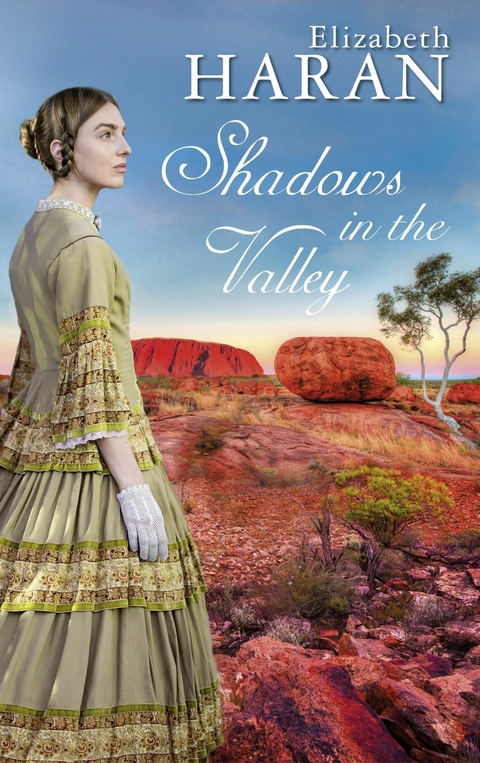
Shadows in the Valley (eBook)
529 Seiten
Bastei Entertainment (Verlag)
9783732546152 (ISBN)

South Australia, 1866. Beautiful but destitute Abigail is forced to marry an old landowner who desperately needs heirs. But on their wedding night something terrible happens ...
Abbey flees Martindale Hall. She has no memory of the previous night, but no one believes her. With no one to trust, she seeks refuge in the neighbouring town of Clare. There, her luck seems to change. She meets Jack Hawker, who is looking for someone to tend to his mother on the remote farm Bungaree Station. Jack hires Abbey for the job. But Abbey's respite is short-lived. Days later, a visitor from Martindale Hall turns up on the farm, accusing Abbey of a horrible crime ... Will Jack believe her? Or is she doomed to a life of penance?
With an eye for detail, Elizabeth Haran is the author of numerous other romantic adventures including Island of Whispering Winds, Under a Flaming Sky, Dreams beneath a Red Sun, and River of Fortune, Staircase to the Moon, and Beyond the Red Horizon, all available as eBooks.
For fans of sagas set against a backdrop of beautiful landscapes, like Sarah Lark's, Island of a Thousand Springs or Kate Morton's, The Forgotten Garden.
About the author
Elizabeth Haran was born in Bulawayo, Rhodesia and migrated to Australia as a child. She lives with her family in Adelaide and has written fourteen novels set in Australia. Her heart-warming and carefully crafted books have been published in ten countries and are bestsellers in Germany.
CHAPTER 1
Burra – South Australia
November – 1866
From Blyth Street, the three miles of parched earth that snaked through Burra township looked like any other dried up creek bed, cracking to pieces under severe drought. But upon closer inspection, smoke could be seen drifting from holes in the tops of the banks. The holes served as chimneys for hundreds of “dugouts,” carved into the sides of the creek bed. Nearly two thousand people lived in the dusty dwellings. Brought here to work in the Monster Mine, families had hoped to make their fortunes in Burra, one hundred miles from Adelaide in South Australia’s Gilbert Valley.
The sun was setting on a hot November day. For months the creek—now called Creek Street—had been nothing more than a basin for dust and scraggly weeds. Unfortunately, without the whisper of a breeze, the lingering stench of human waste and garbage was suffocating.
As evening approached, the women in the dugouts began preparing their simple dinners, but in the back of their minds, they held a sense of apprehension that had settled with the dust over Creek Street. Suddenly, an eerie, heart-rending cry of anguish broke the tense silence, and everyone became still for a moment. Then the wailing began.
Two tears slid down Abbey Scottsdale’s sun-kissed cheeks as she got up from the dirt floor of the two-roomed dugout she shared with her father. She stepped outside. Many others nearby had emerged from their dugouts. In the fading light her neighbours resembled a forest of trees in a narrow valleysentinels, silent and still.
They knew what the cries of anguish meant, because they weren’t unexpected. Little Ely Dugan had lost his battle with typhoid. A small and frail four-year-old, he’d had almost no hope of surviving, despite the hundreds of prayers said for him. His mother’s agonised cries wrenched at the hearts of those gathered outside the family dugout.
Abbey was eighteen, and not yet a wife or mother, but she felt for Evelyn Dugan, who had already lost a son the past year. In that time, almost thirty children had died of typhus, smallpox, and typhoid fever on Creek Street. And every time a child died on Creek Street, it reminded Abbey of what she had lost personally. She’d been born in Ireland in 1848. Little more than a year later, her brother Liam had arrived, and then her sister Eileen was born eighteen months later. When Abbey was five, Liam had died from smallpox. A year later, Eileen was dead after a severe bout of whooping cough. And, in 1860, her mother Mary, at only twenty-nine years of age, had died from diphtheria.
Disease was rampant in the unsanitary conditions of the creek. But with nowhere else to go, the miners were forced to live in mud dugouts shored up with timber beams. The cave-like dwellings were cool in the summer, but were damp, muddy, and bitterly cold in the winter when the inhabitants were often driven out by the rising creek water.
Brushing her tears from her cheeks, Abbey went back into her dugout. She tied up her long black hair and went to stir the pot of smoked bacon bone soup she’d made for the evening meal. She didn’t know why she’d been spared typhoid and other diseases, and she also didn’t know why someone as young and innocent as Ely had not.
Abbey was waiting for her father to come home from the Miner’s Arms Hotel. He always went to the pub on Thursday evenings, as it was payday, and he also went there most Saturday afternoons, drinking with his friends, men who had also left Ireland to find work. She resented him for not coming straight home from work on Saturdays, but on Thursdays, it gave her an hour alone with Neal Tavis. She couldn’t see Neal on Saturdays because he spent the day working on a local farm for extra money.
Neal was the young man Abbey had fallen in love with. He was eighteen-years old and worked alongside her father, 180 yards below ground in the copper mine. After work on Thursdays, Neal hurried home to wash before coming to see Abbey, so as to avoid her dad. Finlay Scottsdale could be volatile and unpredictable when drunk, and he had made his opinion about Neal very clear. He didn’t want his daughter to marry someone without prospects, and he considered a miner who lived in a dugout to be unsuitable. He wanted better for Abbey than what he himself had been able to give her. Neal hoped Finlay would change his mind if he could buy a piece of land and prove he was worthy. He saved every penny he could, but it was hard because he was a young man burdened with responsibilities, something Finlay was very aware of. Neal supported his mother, Meg, and two school-age sisters, twins Emily and Amy. They lived nearly a mile down Creek Street from the Scottsdales, on the opposite side.
An hour passed, and then a familiar whistle broke the sombre quiet that had befallen the camp as Finlay approached the dugout, inebriated and unaware of what had happened. Abbey listened intently to her father’s whistling, as it was often an indication of just how much he’d had to drink, and, consequently, the mood he would be in. After two or three pints, Finlay was optimistic about bettering their lives, but it was rare that he stopped at just two or three pints. After four or five pints, he could become melancholy or patriotic. When he’d had even more more to drink, he became pessimistic and morose. Abbey hated to see her father that way, but she’d come to realise there was no changing him. Instead, she tried to accept her father for who he was, but also looked forward to her future with Neal.
Finlay was in a good mood for a change, Abbey noted. He was whistling “Brian Boru’s March.” When he was really drunk, he whistled “The Lamentation of Deirdre.” It had been a favourite of her mother’s before she died. Abbey dreaded hearing it because it meant her father’s depression was soon to follow.
“Abigail, my angel,” Finlay said cheerfully, as he ducked his head to enter the dugout. “What fine feast have you prepared for us this night?”
Abbey barely glanced up from the floor, where she was sitting. “Little Ely just passed away, Father, could you please keep your voice down?” she said.
Finlay looked momentarily emotional. “That’s terrible news,” he muttered. “He was a fine little lad.”
“Yes, he was,” Abbey said sadly, remembering his impish grin and curly red hair. She’d always called him a little leprechaun. It upset her that her memories of her own brother and sister had faded, but she would never forget her mother’s endless tears over their loss.
Abbey sniffed, fighting her own unstable emotions. “Did you not hear Evelyn Dugan’s cries as you went by her dugout?”
“No, I didn’t,” Finlay said. He bent to sit down, stumbled, and fell heavily to the ground. Sitting up, he groaned, and then chuckled as he kicked ashes from the fire.
Abbey had seen him in this state numerous times, so she wasn’t alarmed. She clicked her tongue, a habit her mother had employed whenever she was cross with Finlay. For that, Finlay forgave her, as Abbey often admonished him like a wife, which he found strangely comforting.
“Abbey, we’ve something to celebrate,” Finlay said, smiling delightedly.
“What’s that, Father?” she asked flatly as she ladled soup into a bowl for him and tore off a piece of the bread she’d cooked. Some good news would make for a very welcome change.
“You and I have been invited to dine at Martindale Hall this Saturday evening,” Finlay replied excitedly.
Abbey looked across the fire at her father, a frown marring her pretty features. “Why have we been invited to the Hall?” She was perfectly aware of the mine owner’s contemptuous regard for his workers, so she was puzzled why he would invite her and her father to his home in Mintaro. It was described by those few who had seen it as palatial and ostentatious. She was even more puzzled about why her father would accept such an invitation, as Ebenezer Mason was a man with a reputation for looking down on the lower classes and exploiting them whenever he could.
Finlay didn’t answer immediately as he thought carefully about his next words. “I told you, we’ve been invited to dine,” he said. “And it’ll be on sumptuous fare, I’ll wager, maybe a roast leg of lamb with all the trimmings. That would be a real treat, hey, Abbey?” He licked his lips in anticipation. “I hope Ebenezer Mason has plenty of ale to go with it. I’m not one for fancy wines.”
“I’m confused, Father. I thought you had a low opinion of Mr. Mason,” Abbey said suspiciously. Her father had often grumbled about him because he was known for putting profit ahead of the miners’ safety.
“That I did, Abbey,” Finlay said thoughtfully.
“And now?” Abbey asked, confused.
“I’ve gotten to know the man in the last few weeks, Abbey, and I’m ashamed of how I’ve judged him.”
“I thought you had good reason to dislike him.”
“I thought I did,” Finlay said, sounding tired. He began spooning soup into his mouth noisily.
Abbey winced at the image of him doing that in the elegant dining room of Martindale Hall.
“We have to start thinking about your...
| Erscheint lt. Verlag | 12.6.2018 |
|---|---|
| Verlagsort | Köln |
| Sprache | englisch |
| Original-Titel | Dance of the Fiery Blue Gums |
| Themenwelt | Literatur ► Historische Romane |
| Literatur ► Romane / Erzählungen | |
| Schlagworte | Australia • Australien • call of the kiwi • Clare • Cornwall • Cumbria • Eden District • Elizabeth Haran • Ferne Länder • Fernweh • Frauenroman • Haran • Historical Romance • Historische Liebesromane • Kauri • land of the long white cloud • Landschaftsbild • landschaftsroman • Liebesroman • Liebesromane • Maori • martindale • Natur • Neuseeland • Outback • outback romance • red mangroves • romance books • romance novels • Sarah Lark • sea of freedom • song of the spirits • staircase to the moon • State of South Australia • St. Edmundsbury District • Suffolk • thousand springs |
| ISBN-13 | 9783732546152 / 9783732546152 |
| Informationen gemäß Produktsicherheitsverordnung (GPSR) | |
| Haben Sie eine Frage zum Produkt? |
 EPUB (Ohne DRM)
Digital Rights Management: ohne DRM
Dieses eBook enthält kein DRM oder Kopierschutz. Eine Weitergabe an Dritte ist jedoch rechtlich nicht zulässig, weil Sie beim Kauf nur die Rechte an der persönlichen Nutzung erwerben.
Dateiformat: EPUB (Electronic Publication)
EPUB ist ein offener Standard für eBooks und eignet sich besonders zur Darstellung von Belletristik und Sachbüchern. Der Fließtext wird dynamisch an die Display- und Schriftgröße angepasst. Auch für mobile Lesegeräte ist EPUB daher gut geeignet.
Systemvoraussetzungen:
PC/Mac: Mit einem PC oder Mac können Sie dieses eBook lesen. Sie benötigen dafür die kostenlose Software Adobe Digital Editions.
eReader: Dieses eBook kann mit (fast) allen eBook-Readern gelesen werden. Mit dem amazon-Kindle ist es aber nicht kompatibel.
Smartphone/Tablet: Egal ob Apple oder Android, dieses eBook können Sie lesen. Sie benötigen dafür eine kostenlose App.
Geräteliste und zusätzliche Hinweise
Buying eBooks from abroad
For tax law reasons we can sell eBooks just within Germany and Switzerland. Regrettably we cannot fulfill eBook-orders from other countries.
aus dem Bereich