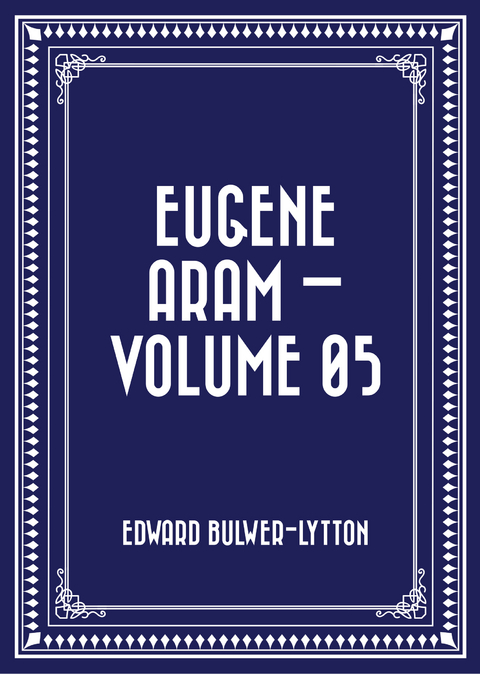
Eugene Aram - Volume 05 (eBook)
134 Seiten
Krill Press (Verlag)
978-1-5183-9328-0 (ISBN)
Edward Bulwer-Lytton was a well known English novelist in the 19th century, and he's been immortalized for coining famous phrases like "e;pursuit of the almighty dollar"e; and "e;the pen is mightier than the sword"e;. In addition to being a politician, he wrote across all genres, from horror stories to historical fiction and action titles.
CHAPTER I.
IT WAS NOW THE MORNING in which Eugene Aram was to be married to Madeline Lester. The student’s house had been set in order for the arrival of the bride; and though it was yet early morn, two old women, whom his domestic (now not the only one, for a buxom lass of eighteen had been transplanted from Lester’s household to meet the additional cares that the change of circumstances brought to Aram’s) had invited to assist her in arranging what was already arranged, were bustling about the lower apartments and making matters, as they call it, “tidy.”
“Them flowers look but poor things, after all,” muttered an old crone, whom our readers will recognize as Dame Darkmans, placing a bowl of exotics on the table. “They does not look nigh so cheerful as them as grows in the open air.”
“Tush! Goody Darkmans,” said the second gossip. “They be much prettier and finer, to my mind; and so said Miss Nelly when she plucked them last night and sent me down with them. They says there is not a blade o’ grass that the master does not know. He must be a good man to love the things of the field so.”
“Ho!” said Dame Darkmans, “ho! When Joe Wrench was hanged for shooting the lord’s keeper, and he mounted the scaffold wid a nosegay in his hand, he said, in a peevish voice, says he: ‘Why does not they give me a tarnation? I always loved them sort o’ flowers,—I wore them when I went a courting Bess Lucas,—an’ I would like to die with one in my hand!’ So a man may like flowers, and be but a hempen dog after all!”
“Now don’t you, Goody; be still, can’t you? What a tale for a marriage day!”
“Tally vally!” returned the grim hag, “many a blessing carries a curse in its arms, as the new moon carries the old. This won’t be one of your happy weddings, I tell ye.”
“And why d’ ye say that?”
“Did you ever see a man with a look like that make a happy husband? No, no! Can ye fancy the merry laugh o’ childer in this house, or a babe on the father’s knee, or the happy, still smile on the mother’s winsome face, some few years hence? No, Madge! the devil has set his black claw on the man’s brow.”
“Hush, hush, Goody Darkmans; he may hear o’ ye!” said the second gossip, who, having now done all that remained to do, had seated herself down by the window, while the more ominous crone, leaning over Aram’s oak chair, uttered from thence her sibyl bodings.
“No,” replied Mother Darkmans, “I seed him go out an hour agone, when the sun was just on the rise; and I said, when I seed him stroam into the wood yonder, and the ould leaves splashed in the damp under his feet, and his hat was aboon his brows, and his lips went so,—I said, says I, ‘t is not the man that will make a hearth bright that would walk thus on his marriage day. But I knows what I knows, and I minds what I seed last night.”
“Why, what did you see last night?” asked the listener, with a trembling voice; for Plother Darkmans was a great teller of ghost and witch tales, and a certain ineffable awe of her dark gypsy features and malignant words had circulated pretty largely throughout the village.
“Why, I sat up here with the ould deaf woman, and we were a drinking the health of the man and his wife that is to be, and it was nigh twelve o’ the clock ere I minded it was time to go home. Well, so I puts on my cloak, and the moon was up, an’ I goes along by the wood, and up by Fairlegh Field, an’ I was singing the ballad on Joe Wrench’s hanging, for the spirats had made me gamesome, when I sees somemut dark creep, creep, but iver so fast, arter me over the field, and making right ahead to the village. And I stands still, an’ I was not a bit afeared; but sure I thought it was no living cretur, at the first sight. And so it comes up faster and faster, and then I sees it was not one thing, but a many, many things, and they darkened the whole field afore me. And what d’ ye think they was? A whole body o’ gray rats, thousands and thousands on ‘em; and they were making away from the outbuildings here. For sure they knew, the witch things, that an ill luck sat on the spot. And so I stood aside by the tree, an’ I laughed to look on the ugsome creturs as they swept close by me, tramp, tramp! and they never heeded me a jot; but some on ‘em looked aslant at me with their glittering eyes, and showed their white teeth, as if they grinned, and were saying to me, ‘Ha, ha! Goody Darkmans, the house that we leave is a falling house, for the devil will have his own.’”
In some parts of the country, and especially in that where our scene is laid, no omen is more superstitiously believed evil than the departure of these loathsome animals from their accustomed habitation; the instinct which is supposed to make them desert an unsafe tenement is supposed also to make them predict, in desertion, ill fortune to the possessor. But while the ears of the listening gossip were still tingling with this narration, the dark figure of the student passed the window, and the old women, starting up, appeared in all the bustle of preparation, as Aram now entered the apartment.
“A happy day, your honor; a happy good morning,” said both the crones in a breath; but the blessing of the worse-natured was vented in so harsh a croak that Arum turned round as if struck by the sound, and still more disliking the well-remembered aspect of the person from whom it came, waved his hand impatiently, and bade them begone.
“A-whish, a-whish!” muttered Dame Darkmans,—"to spake so to the poor; but the rats never lie, the bonny things!”
Aram threw himself into his chair, and remained for some moments absorbed in a revery, which did not bear the aspect of gloom. Then, walking once or twice to and fro the apartment, he stopped opposite the chimney-piece, over which were slung the firearms, which he never omitted to keep charged and primed.
“Humph!” he said, half aloud, “ye have been but idle servants; and now ye are but little likely ever to requite the care I have bestowed upon you.”
With that a faint smile crossed his features; and turning away, he ascended the stairs that led to the lofty chamber in which he had been so often wont to outwatch the stars,—
Before we follow him to his high and lonely retreat we will bring the reader to the manor-house, where all was already gladness and quiet but deep joy.
It wanted about three hours to that fixed for the marriage; and Aram was not expected at the manor-house till an hour before the celebration of the event. Nevertheless, the bells were already ringing loudly and blithely; and the near vicinity of the church to the house brought that sound, so inexpressibly buoyant and cheering, to the ears of the bride with a noisy merriment that seemed like the hearty voice of an old- fashioned friend who seeks in his greeting rather cordiality than discretion. Before her glass stood the beautiful, the virgin, the glorious form of Madeline Lester; and Ellinor, with trembling hands (and a voice between a laugh and a cry), was braiding up her sister’s rich hair, and uttering her hopes, her wishes, her congratulations. The small lattice was open, and the air came rather chillingly to the bride’s bosom.
“It is a gloomy morning, dearest Nell,” said she, shivering; “the winter seems about to begin at last.”
“Stay, I will shut the window. The sun is struggling with the clouds at present, but I am sure it will clear up by and by. You don’t, you don’t leave us—the word must out—till evening.”
“Don’t cry!” said Madeline, half weeping herself, and sitting down, she drew Ellinor to her; and the two sisters, who had never been parted since birth, exchanged tears that were natural, though scarcely the unmixed tears of grief.
“And what pleasant evenings we shall have,” said Madeline, holding her sister’s hands, “in the Christmas time! You will be staying with us, you know; and that pretty old room in the north of the house Eugene has already ordered to be fitted up for you. Well, and my dear father, and dear Walter, who will be returned long ere then, will walk over to see us, and praise my housekeeping, and so forth. And then, after dinner, we will draw near the fire,—I next to Eugene, and my father, our guest, on the other side of me, with his long gray hair and his good fine face, with a tear of kind feeling in his eye,—you know that look he has whenever he is affected. And at a little distance on the other side of the hearth will be you—and Walter; I suppose we must make room for him. And Eugene, who will be then the liveliest of you all, shall read to us with his soft, clear voice, or tell us all about the birds and flowers and strange things in other countries. And then after supper we will walk half-way home across that beautiful valley—beautiful even in winter— with my father and Walter, and count the stars, and take new lessons in astronomy, and hear tales about the astrologers and the alchemists, with their fine old dreams. Ah! it will be such a happy Christmas! And...
| Erscheint lt. Verlag | 4.2.2016 |
|---|---|
| Sprache | englisch |
| Themenwelt | Literatur ► Anthologien |
| Literatur ► Klassiker / Moderne Klassiker | |
| Literatur ► Romane / Erzählungen | |
| Schlagworte | Austen • Bronte • classics • Dickens • Hawthorne • Prejudice • Sense |
| ISBN-10 | 1-5183-9328-4 / 1518393284 |
| ISBN-13 | 978-1-5183-9328-0 / 9781518393280 |
| Informationen gemäß Produktsicherheitsverordnung (GPSR) | |
| Haben Sie eine Frage zum Produkt? |
 EPUB (Adobe DRM)
Größe: 583 KB
Kopierschutz: Adobe-DRM
Adobe-DRM ist ein Kopierschutz, der das eBook vor Mißbrauch schützen soll. Dabei wird das eBook bereits beim Download auf Ihre persönliche Adobe-ID autorisiert. Lesen können Sie das eBook dann nur auf den Geräten, welche ebenfalls auf Ihre Adobe-ID registriert sind.
Details zum Adobe-DRM
Dateiformat: EPUB (Electronic Publication)
EPUB ist ein offener Standard für eBooks und eignet sich besonders zur Darstellung von Belletristik und Sachbüchern. Der Fließtext wird dynamisch an die Display- und Schriftgröße angepasst. Auch für mobile Lesegeräte ist EPUB daher gut geeignet.
Systemvoraussetzungen:
PC/Mac: Mit einem PC oder Mac können Sie dieses eBook lesen. Sie benötigen eine
eReader: Dieses eBook kann mit (fast) allen eBook-Readern gelesen werden. Mit dem amazon-Kindle ist es aber nicht kompatibel.
Smartphone/Tablet: Egal ob Apple oder Android, dieses eBook können Sie lesen. Sie benötigen eine
Geräteliste und zusätzliche Hinweise
Buying eBooks from abroad
For tax law reasons we can sell eBooks just within Germany and Switzerland. Regrettably we cannot fulfill eBook-orders from other countries.
aus dem Bereich