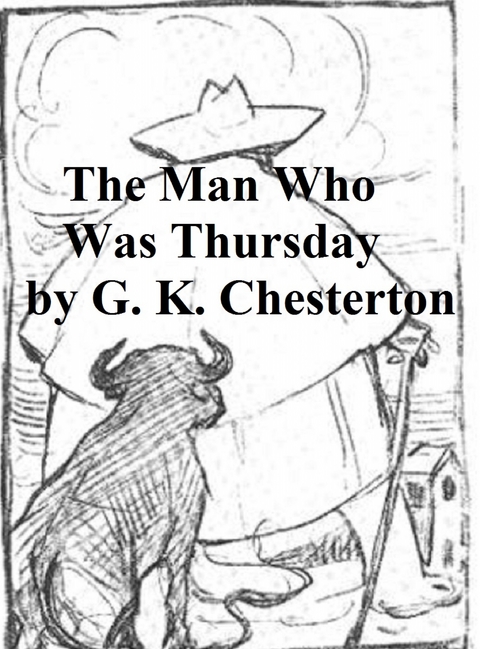
Man Who Was Thursday (eBook)
386 Seiten
Seltzer Books (Verlag)
978-1-4554-1565-6 (ISBN)
According to Wikipedia, 'The book has been referred to as a metaphysical thriller... Although it deals with anarchists, the novel is not an exploration or rebuttal of anarchist thought; Chesterton's ad hoc construction of 'Philosophical Anarchism' is distinguished from ordinary anarchism and is referred to several times not so much as a rebellion against government but as a rebellion against Good... Gilbert Keith Chesterton (29 May 1874 - 14 June 1936) was an English writer. His prolific and diverse output included philosophy, ontology, poetry, play writing, journalism, public lecturing and debating, literary and art criticism, biography, Christian apologetics, and fiction, including fantasy and detective fiction.'
According to Wikipedia, "e;The book has been referred to as a metaphysical thriller... Although it deals with anarchists, the novel is not an exploration or rebuttal of anarchist thought; Chesterton's ad hoc construction of "e;Philosophical Anarchism"e; is distinguished from ordinary anarchism and is referred to several times not so much as a rebellion against government but as a rebellion against Good... Gilbert Keith Chesterton (29 May 1874 - 14 June 1936) was an English writer. His prolific and diverse output included philosophy, ontology, poetry, play writing, journalism, public lecturing and debating, literary and art criticism, biography, Christian apologetics, and fiction, including fantasy and detective fiction."e;
CHAPTER X THE DUEL
SYME sat down at a cafe table with his companions, his blue eyes sparkling like the bright sea below, and ordered a bottle of Saumur with a pleased impatience. He was for some reason in a condition of curious hilarity. His spirits were already unnaturally high; they rose as the Saumur sank, and in half an hour his talk was a torrent of nonsense. He professed to be making out a plan of the conversation which was going to ensue between himself and the deadly Marquis. He jotted it down wildly with a pencil. It was arranged like a printed catechism, with questions and answers, and was delivered with an extraordinary rapidity of utterance.
"I shall approach. Before taking off his hat, I shall take off my own. I shall say, 'The Marquis de Saint Eustache, I believe.' He will say, 'The celebrated Mr. Syme, I presume.' He will say in the most exquisite French, 'How are you?' I shall reply in the most exquisite Cockney, 'Oh, just the Syme--' "
"Oh, shut it," said the man in spectacles. "Pull yourself together, and chuck away that bit of paper. What are you really going to do?"
"But it was a lovely catechism," said Syme pathetically. "Do let me read it you. It has only forty-three questions and answers, and some of the Marquis's answers are wonderfully witty. I like to be just to my enemy."
"But what's the good of it all?" asked Dr. Bull in exasperation.
"It leads up to my challenge, don't you see," said Syme, beaming. "When the Marquis has given the thirty-ninth reply, which runs--"
"Has it by any chance occurred to you," asked the Professor, with a ponderous simplicity, "that the Marquis may not say all the forty-three things you have put down for him? In that case, I understand, your own epigrams may appear somewhat more forced."
Syme struck the table with a radiant face.
"Why, how true that is," he said, "and I never thought of it. Sir, you have an intellect beyond the common. You will make a name."
"Oh, you're as drunk as an owl!" said the Doctor.
"It only remains," continued Syme quite unperturbed, "to adopt some other method of breaking the ice (if I may so express it) between myself and the man I wish to kill. And since the course of a dialogue cannot be predicted by one of its parties alone (as you have pointed out with such recondite acumen), the only thing to be done, I suppose, is for the one party, as far as possible, to do all the dialogue by himself. And so I will, by George!" And he stood up suddenly, his yellow hair blowing in the slight sea breeze.
A band was playing in a cafe chantant hidden somewhere among the trees, and a woman had just stopped singing. On Syme's heated head the bray of the brass band seemed like the jar and jingle of that barrel-organ in Leicester Square, to the tune of which he had once stood up to die. He looked across to the little table where the Marquis sat. The man had two companions now, solemn Frenchmen in frock-coats and silk hats, one of them with the red rosette of the Legion of Honour, evidently people of a solid social position. Besides these black, cylindrical costumes, the Marquis, in his loose straw hat and light spring clothes, looked Bohemian and even barbaric; but he looked the Marquis. Indeed, one might say that he looked the king, with his animal elegance, his scornful eyes, and his proud head lifted against the purple sea. But he was no Christian king, at any rate; he was, rather, some swarthy despot, half Greek, half Asiatic, who in the days when slavery seemed natural looked down on the Mediterranean, on his galley and his groaning slaves. Just so, Syme thought, would the brown-gold face of such a tyrant have shown against the dark green olives and the burning blue.
"Are you going to address the meeting?" asked the Professor peevishly, seeing that Syme still stood up without moving.
Syme drained his last glass of sparkling wine.
"I am," he said, pointing across to the Marquis and his companions, "that meeting. That meeting displeases me. I am going to pull that meeting's great ugly, mahogany-coloured nose."
He stepped across swiftly, if not quite steadily. The Marquis, seeing him, arched his black Assyrian eyebrows in surprise, but smiled politely.
"You are Mr. Syme, I think," he said.
Syme bowed.
"And you are the Marquis de Saint Eustache," he said gracefully. "Permit me to pull your nose."
He leant over to do so, but the Marquis started backwards, upsetting his chair, and the two men in top hats held Syme back by the shoulders.
"This man has insulted me!" said Syme, with gestures of explanation.
"Insulted you?" cried the gentleman with the red rosette, "when?"
"Oh, just now," said Syme recklessly. "He insulted my mother."
"Insulted your mother!" exclaimed the gentleman incredulously.
"Well, anyhow," said Syme, conceding a point, "my aunt."
"But how can the Marquis have insulted your aunt just now?" said the second gentleman with some legitimate wonder. "He has been sitting here all the time."
"Ah, it was what he said!" said Syme darkly.
"I said nothing at all," said the Marquis, "except something about the band. I only said that I liked Wagner played well."
"It was an allusion to my family," said Syme firmly. "My aunt played Wagner badly. It was a painful subject. We are always being insulted about it."
"This seems most extraordinary," said the gentleman who was decore, looking doubtfully at the Marquis.
"Oh, I assure you," said Syme earnestly, "the whole of your conversation was simply packed with sinister allusions to my aunt's weaknesses."
"This is nonsense!" said the second gentleman. "I for one have said nothing for half an hour except that I liked the singing of that girl with black hair."
"Well, there you are again!" said Syme indignantly. "My aunt's was red."
"It seems to me," said the other, "that you are simply seeking a pretext to insult the Marquis."
"By George!" said Syme, facing round and looking at him, "what a clever chap you are!"
The Marquis started up with eyes flaming like a tiger's.
"Seeking a quarrel with me!" he cried. "Seeking a fight with me! By God! there was never a man who had to seek long. These gentlemen will perhaps act for me. There are still four hours of daylight. Let us fight this evening."
Syme bowed with a quite beautiful graciousness.
"Marquis," he said, "your action is worthy of your fame and blood. Permit me to consult for a moment with the gentlemen in whose hands I shall place myself."
In three long strides he rejoined his companions, and they, who had seen his champagne-inspired attack and listened to his idiotic explanations, were quite startled at the look of him. For now that he came back to them he was quite sober, a little pale, and he spoke in a low voice of passionate practicality.
"I have done it," he said hoarsely. "I have fixed a fight on the beast. But look here, and listen carefully. There is no time for talk. You are my seconds, and everything must come from you. Now you must insist, and insist absolutely, on the duel coming off after seven tomorrow, so as to give me the chance of preventing him from catching the 7.45 for Paris. If he misses that he misses his crime. He can't refuse to meet you on such a small point of time and place. But this is what he will do. He will choose a field somewhere near a wayside station, where he can pick up the train. He is a very good swordsman, and he will trust to killing me in time to catch it. But I can fence well too, and I think I can keep him in play, at any rate, until the train is lost. Then perhaps he may kill me to console his feelings. You understand? Very well then, let me introduce you to some charming friends of mine," and leading them quickly across the parade, he presented them to the Marquis's seconds by two very aristocratic names of which they had not previously heard.
Syme was subject to spasms of singular common sense, not otherwise a part of his character. They were (as he said of his impulse about the spectacles) poetic intuitions, and they sometimes rose to the exaltation of prophecy.
He had correctly calculated in this case the policy of his opponent. When the Marquis was informed by his seconds that Syme could only fight in the morning, he must fully have realised that an obstacle had suddenly arisen between him and his bomb-throwing business in the capital. Naturally he could not explain this objection to his friends, so he chose the course which Syme had predicted. He induced his seconds to settle on a small meadow not far from the railway, and he trusted to the fatality of the first...
| Erscheint lt. Verlag | 1.3.2018 |
|---|---|
| Sprache | englisch |
| Themenwelt | Literatur ► Anthologien |
| Literatur ► Klassiker / Moderne Klassiker | |
| Literatur ► Romane / Erzählungen | |
| ISBN-10 | 1-4554-1565-0 / 1455415650 |
| ISBN-13 | 978-1-4554-1565-6 / 9781455415656 |
| Informationen gemäß Produktsicherheitsverordnung (GPSR) | |
| Haben Sie eine Frage zum Produkt? |
 EPUB (Adobe DRM)
Größe: 385 KB
Kopierschutz: Adobe-DRM
Adobe-DRM ist ein Kopierschutz, der das eBook vor Mißbrauch schützen soll. Dabei wird das eBook bereits beim Download auf Ihre persönliche Adobe-ID autorisiert. Lesen können Sie das eBook dann nur auf den Geräten, welche ebenfalls auf Ihre Adobe-ID registriert sind.
Details zum Adobe-DRM
Dateiformat: EPUB (Electronic Publication)
EPUB ist ein offener Standard für eBooks und eignet sich besonders zur Darstellung von Belletristik und Sachbüchern. Der Fließtext wird dynamisch an die Display- und Schriftgröße angepasst. Auch für mobile Lesegeräte ist EPUB daher gut geeignet.
Systemvoraussetzungen:
PC/Mac: Mit einem PC oder Mac können Sie dieses eBook lesen. Sie benötigen eine
eReader: Dieses eBook kann mit (fast) allen eBook-Readern gelesen werden. Mit dem amazon-Kindle ist es aber nicht kompatibel.
Smartphone/Tablet: Egal ob Apple oder Android, dieses eBook können Sie lesen. Sie benötigen eine
Geräteliste und zusätzliche Hinweise
Buying eBooks from abroad
For tax law reasons we can sell eBooks just within Germany and Switzerland. Regrettably we cannot fulfill eBook-orders from other countries.
EPUB (Ohne DRM)Digital Rights Management: ohne DRM
Dieses eBook enthält kein DRM oder Kopierschutz. Eine Weitergabe an Dritte ist jedoch rechtlich nicht zulässig, weil Sie beim Kauf nur die Rechte an der persönlichen Nutzung erwerben.
Dateiformat: EPUB (Electronic Publication)
EPUB ist ein offener Standard für eBooks und eignet sich besonders zur Darstellung von Belletristik und Sachbüchern. Der Fließtext wird dynamisch an die Display- und Schriftgröße angepasst. Auch für mobile Lesegeräte ist EPUB daher gut geeignet.
Systemvoraussetzungen:
PC/Mac: Mit einem PC oder Mac können Sie dieses eBook lesen. Sie benötigen dafür die kostenlose Software Adobe Digital Editions.
eReader: Dieses eBook kann mit (fast) allen eBook-Readern gelesen werden. Mit dem amazon-Kindle ist es aber nicht kompatibel.
Smartphone/Tablet: Egal ob Apple oder Android, dieses eBook können Sie lesen. Sie benötigen dafür eine kostenlose App.
Geräteliste und zusätzliche Hinweise
Buying eBooks from abroad
For tax law reasons we can sell eBooks just within Germany and Switzerland. Regrettably we cannot fulfill eBook-orders from other countries.
aus dem Bereich