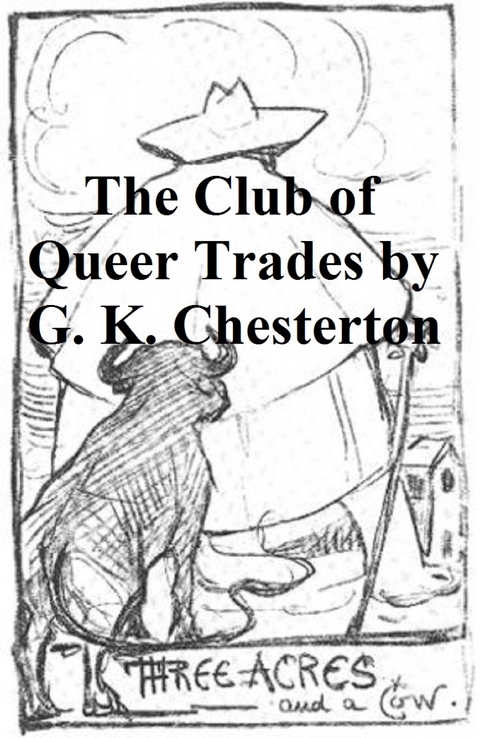
Club of Queer Trades (eBook)
350 Seiten
Seltzer Books (Verlag)
978-1-4553-5666-9 (ISBN)
Classic novel. According to Wikipedia: "e;Gilbert Keith Chesterton (1874 - 1936) was an influential English writer of the early 20th century. His prolific and diverse output included journalism, philosophy, poetry, biography, Christian apologetics, fantasy and detective fiction. Chesterton has been called the "e;prince of paradox."e;[1] He wrote in an off-hand, whimsical prose studded with startling formulations. For example: "e;Thieves respect property. They merely wish the property to become their property that they may more perfectly respect it."e;[2] He is one of the few Christian thinkers who are equally admired and quoted by both liberal and conservative Christians, and indeed by many non-Christians. Chesterton's own theological and political views were far too nuanced to fit comfortably under the "e;liberal"e; or "e;conservative"e; banner."e;
THE CLUB OF QUEER TRADES BY G. K.CHESTERTON
published by Samizdat Express, Orange, CT, USA
established in 1974, offering over 14,000 books
Ficiton by G. K. Chesterton available from us:
The Ball and the Cross
The Club of Queer Trades
The Innocence of Father Brown
The Man Who Knew Too Much
The Man Who Was Thursday
Manalive
The Napoleon of Notting Hill
The Trees of Pride
The Wisdom of Father Brown
feedback welcome: info@samizdat.com
visit us at samizdat.com
Access Ebook Press, Orange, CT USA
established in 1974, offering over 14,000 books
Other recommended works by G. K. Chesterton:
- The Ball and the Cross
- The Innocence of Father Brown
- The Man Who Knew Too Much
- The Man Who Was Thursday
- Manalive
- The Napoleon of Notting Hill
- The Trees of Pride
- The Wisdom of Father Brown
feedback welcome: mailto:info@accessebookpress.com
visit us at http://www.accessebookpress.com
Chapter 1 The Tremendous Adventures of Major Brown
Chapter 2 The Painful Fall of a Great Reputation
Chapter 3 The Awful Reason of the Vicar's Visit
Chapter 4 The Singular Speculation of the House-Agent
Chapter 5 The Noticeable Conduct of Professor Chadd
Chapter 6 The Eccentric Seclusion of the Old Lady
Chapter 1 The Tremendous Adventures of Major Brown
Rabelais, or his wild illustrator Gustave Dore, must have had something to do with the designing of the things called flats in England and America. There is something entirely Gargantuan in the idea of economising space by piling houses on top of each other, front doors and all. And in the chaos and complexity of those perpendicular streets anything may dwell or happen, and it is in one of them, I believe, that the inquirer may find the offices of the Club of Queer Trades. It may be thought at the first glance that the name would attract and startle the passer-by, but nothing attracts or startles in these dim immense hives. The passer-by is only looking for his own melancholy destination, the Montenegro Shipping Agency or the London office of the Rutland Sentinel, and passes through the twilight passages as one passes through the twilight corridors of a dream. If the Thugs set up a Strangers' Assassination Company in one of the great buildings in Norfolk Street, and sent in a mild man in spectacles to answer inquiries, no inquiries would be made. And the Club of Queer Trades reigns in a great edifice hidden like a fossil in a mighty cliff of fossils.
The nature of this society, such as we afterwards discovered it to be, is soon and simply told. It is an eccentric and Bohemian Club, of which the absolute condition of membership lies in this, that the candidate must have invented the method by which he earns his living. It must be an entirely new trade. The exact definition of this requirement is given in the two principal rules. First, it must not be a mere application or variation of an existing trade. Thus, for instance, the Club would not admit an insurance agent simply because instead of insuring men's furniture against being burnt in a fire, he insured, let us say, their trousers against being torn by a mad dog. The principle (as Sir Bradcock Burnaby-Bradcock, in the extraordinarily eloquent and soaring speech to the club on the occasion of the question being raised in the Stormby Smith affair, said wittily and keenly) is the same. Secondly, the trade must be a genuine commercial source of income, the support of its inventor. Thus the Club would not receive a man simply because he chose to pass his days collecting broken sardine tins, unless he could drive a roaring trade in them. Professor Chick made that quite clear. And when one remembers what Professor Chick's own new trade was, one doesn't know whether to laugh or cry.
The discovery of this strange society was a curiously refreshing thing; to realize that there were ten new trades in the world was like looking at the first ship or the first plough. It made a man feel what he should feel, that he was still in the childhood of the world. That I should have come at last upon so singular a body was, I may say without vanity, not altogether singular, for I have a mania for belonging to as many societies as possible: I may be said to collect clubs, and I have accumulated a vast and fantastic variety of specimens ever since, in my audacious youth, I collected the Athenaeum. At some future day, perhaps, I may tell tales of some of the other bodies to which I have belonged. I will recount the doings of the Dead Man's Shoes Society (that superficially immoral, but darkly justifiable communion); I will explain the curious origin of the Cat and Christian, the name of which has been so shamefully misinterpreted; and the world shall know at last why the Institute of Typewriters coalesced with the Red Tulip League. Of the Ten Teacups, of course I dare not say a word. The first of my revelations, at any rate, shall be concerned with the Club of Queer Trades, which, as I have said, was one of this class, one which I was almost bound to come across sooner or later, because of my singular hobby. The wild youth of the metropolis call me facetiously `The King of Clubs'. They also call me `The Cherub', in allusion to the roseate and youthful appearance I have presented in my declining years. I only hope the spirits in the better world have as good dinners as I have. But the finding of the Club of Queer Trades has one very curious thing about it. The most curious thing about it is that it was not discovered by me; it was discovered by my friend Basil Grant, a star-gazer, a mystic, and a man who scarcely stirred out of his attic.
Very few people knew anything of Basil; not because he was in the least unsociable, for if a man out of the street had walked into his rooms he would have kept him talking till morning. Few people knew him, because, like all poets, he could do without them; he welcomed a human face as he might welcome a sudden blend of colour in a sunset; but he no more felt the need of going out to parties than he felt the need of altering the sunset clouds. He lived in a queer and comfortable garret in the roofs of Lambeth. He was surrounded by a chaos of things that were in odd contrast to the slums around him; old fantastic books, swords, armour--the whole dust-hole of romanticism. But his face, amid all these quixotic relics, appeared curiously keen and modern--a powerful, legal face. And no one but I knew who he was.
Long ago as it is, everyone remembers the terrible and grotesque scene that occurred in--, when one of the most acute and forcible of the English judges suddenly went mad on the bench. I had my own view of that occurrence; but about the facts themselves there is no question at all. For some months, indeed for some years, people had detected something curious in the judge's conduct. He seemed to have lost interest in the law, in which he had been beyond expression brilliant and terrible as a K.C., and to be occupied in giving personal and moral advice to the people concerned. He talked more like a priest or a doctor, and a very outspoken one at that. The first thrill was probably given when he said to a man who had attempted a crime of passion: "I sentence you to three years imprisonment, under the firm, and solemn, and God-given conviction, that what you require is three months at the seaside." He accused criminals from the bench, not so much of their obvious legal crimes, but of things that had never been heard of in a court of justice, monstrous egoism, lack of humour, and morbidity deliberately encouraged. Things came to a head in that celebrated diamond case in which the Prime Minister himself, that brilliant patrician, had to come forward, gracefully and reluctantly, to give evidence against his valet. After the detailed life of the household had been thoroughly exhibited, the judge requested the Premier again to step forward, which he did with quiet dignity. The judge then said, in a sudden, grating voice: "Get a new soul. That thing's not fit for a dog. Get a new soul." All this, of course, in the eyes of the sagacious, was premonitory of that melancholy and farcical day when his wits actually deserted him in open court. It was a libel case between two very eminent and powerful financiers, against both of whom charges of considerable defalcation were brought. The case was long and complex; the advocates were long and eloquent; but at last, after weeks of work and rhetoric, the time came for the great judge to give a summing-up; and one of his celebrated masterpieces of lucidity and pulverizing logic was eagerly looked for. He had spoken very little during the prolonged affair, and he looked sad and lowering at the end of it. He was silent for a few moments, and then burst into a stentorian song. His remarks (as reported) were as follows:
"O Rowty-owty tiddly-owty Tiddly-owty tiddly-owty Highty-ighty tiddly-ighty Tiddly-ighty...
| Erscheint lt. Verlag | 1.3.2018 |
|---|---|
| Sprache | englisch |
| Themenwelt | Literatur ► Anthologien |
| Literatur ► Klassiker / Moderne Klassiker | |
| Literatur ► Romane / Erzählungen | |
| ISBN-10 | 1-4553-5666-2 / 1455356662 |
| ISBN-13 | 978-1-4553-5666-9 / 9781455356669 |
| Informationen gemäß Produktsicherheitsverordnung (GPSR) | |
| Haben Sie eine Frage zum Produkt? |
 EPUB (Adobe DRM)
Größe: 350 KB
Kopierschutz: Adobe-DRM
Adobe-DRM ist ein Kopierschutz, der das eBook vor Mißbrauch schützen soll. Dabei wird das eBook bereits beim Download auf Ihre persönliche Adobe-ID autorisiert. Lesen können Sie das eBook dann nur auf den Geräten, welche ebenfalls auf Ihre Adobe-ID registriert sind.
Details zum Adobe-DRM
Dateiformat: EPUB (Electronic Publication)
EPUB ist ein offener Standard für eBooks und eignet sich besonders zur Darstellung von Belletristik und Sachbüchern. Der Fließtext wird dynamisch an die Display- und Schriftgröße angepasst. Auch für mobile Lesegeräte ist EPUB daher gut geeignet.
Systemvoraussetzungen:
PC/Mac: Mit einem PC oder Mac können Sie dieses eBook lesen. Sie benötigen eine
eReader: Dieses eBook kann mit (fast) allen eBook-Readern gelesen werden. Mit dem amazon-Kindle ist es aber nicht kompatibel.
Smartphone/Tablet: Egal ob Apple oder Android, dieses eBook können Sie lesen. Sie benötigen eine
Geräteliste und zusätzliche Hinweise
Buying eBooks from abroad
For tax law reasons we can sell eBooks just within Germany and Switzerland. Regrettably we cannot fulfill eBook-orders from other countries.
EPUB (Ohne DRM)Digital Rights Management: ohne DRM
Dieses eBook enthält kein DRM oder Kopierschutz. Eine Weitergabe an Dritte ist jedoch rechtlich nicht zulässig, weil Sie beim Kauf nur die Rechte an der persönlichen Nutzung erwerben.
Dateiformat: EPUB (Electronic Publication)
EPUB ist ein offener Standard für eBooks und eignet sich besonders zur Darstellung von Belletristik und Sachbüchern. Der Fließtext wird dynamisch an die Display- und Schriftgröße angepasst. Auch für mobile Lesegeräte ist EPUB daher gut geeignet.
Systemvoraussetzungen:
PC/Mac: Mit einem PC oder Mac können Sie dieses eBook lesen. Sie benötigen dafür die kostenlose Software Adobe Digital Editions.
eReader: Dieses eBook kann mit (fast) allen eBook-Readern gelesen werden. Mit dem amazon-Kindle ist es aber nicht kompatibel.
Smartphone/Tablet: Egal ob Apple oder Android, dieses eBook können Sie lesen. Sie benötigen dafür eine kostenlose App.
Geräteliste und zusätzliche Hinweise
Buying eBooks from abroad
For tax law reasons we can sell eBooks just within Germany and Switzerland. Regrettably we cannot fulfill eBook-orders from other countries.
aus dem Bereich